





What if some UAP sightings had a terrestrial rather than extraterrestrial explanation? A 2024 academic paper by researchers Tim Lomas, Brendan Case, and Michael P. Masters explores exactly that question. Two of the three authors are researchers affiliated with Harvard’s Human Flourishing Program, and the third, Masters, is affiliated with Montana Technological University. The paper’s own opening note states plainly and directly that it is not associated with the Human Flourishing Program at Harvard, and does not represent an official position of that program or the university.
The source of these baffling objects and events, they suggest, might not be visitors from distant galaxies, but rather, an intelligent, non-human civilization that has been sharing Earth with us all along, what researchers have termed the “cryptoterrestrial hypothesis.”
This isn’t your typical sci-fi fodder. The hypothesis, while speculative, is rooted in a serious, multidisciplinary analysis of historical records, modern UAP data, and advances in evolutionary biology and archaeology. It challenges our deep-seated anthropocentrism, the idea that humans are the sole intelligent species on this planet. The authors don’t claim to have proof, but they do argue that it would be unscientific to dismiss these possibilities simply because they’re unfamiliar.
This needs an important, direct correction. The paper’s own name for this idea is the “cryptoterrestrial hypothesis,” a specific term with its own published history in UAP literature, not “Crypto-Earths.” The paper also includes a crucial self-assessment the piece originally omitted: the authors state they estimate the hypothesis at roughly 10 percent likelihood, revised upward from an original 1 percent estimate “in light of recent data,” and explicitly write that they “believe this hypothesis to be in all likelihood false,” while still arguing it merits serious scientific investigation. The paper outlines four key scenarios for how such a hidden population might have originated. Each one is a thought experiment the authors themselves regard as unlikely.
1. The Secret Heirs of an Ancient, Pre-Human Civilization
Imagine a world teeming with an advanced civilization thousands, or even millions, of years before our own. This isn’t the stuff of Atlantis legends, but a serious consideration. This hypothesis posits that a highly sophisticated society once thrived on Earth, only to be devastated by a global catastrophe, think a massive asteroid impact, a sudden Ice Age, or a cataclysmic geological event. Instead of perishing, a remnant of this civilization, possessing advanced technology, retreated.

Where could they have gone? The most plausible option, the paper suggests, is deep underground. By moving into subterranean strongholds, they could have survived the surface cataclysm. Over epochs, they may have developed camouflage technologies so sophisticated that they can intentionally hide among humanity or remain completely invisible, observing our development from the shadows. The UAPs we see could be their scouting craft, their advanced technologies occasionally malfunctioning or becoming visible to us by chance.
2. An Autochthonous Evolutionary Parallel
This is perhaps the most captivating and biologically grounded hypothesis. It suggests that human intelligence isn’t a singular evolutionary triumph. What if another intelligent branch evolved right alongside us, but in a different direction? The paper considers several fascinating possibilities:
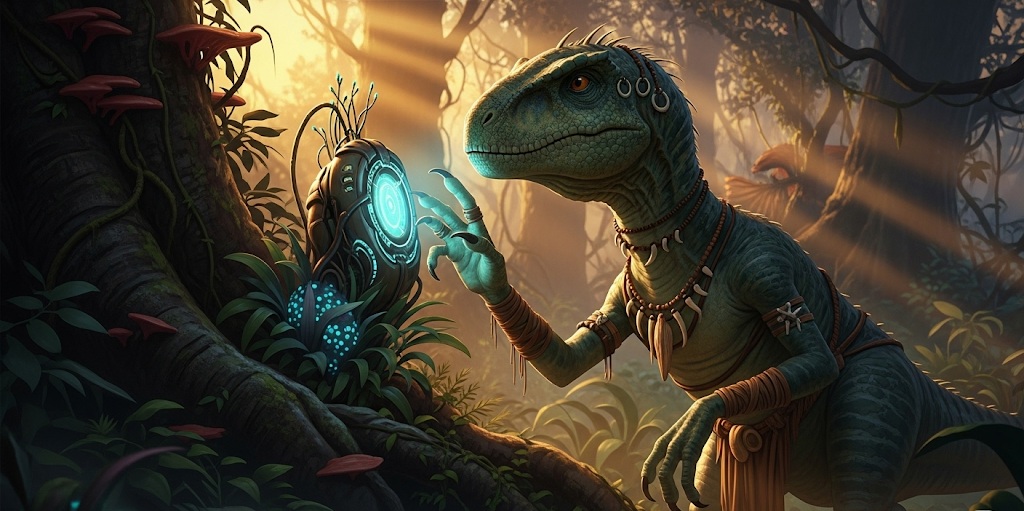
- Relict Hominids: Could relict populations of other early human species, like Neanderthals, have survived in isolated pockets, evolving differently? Or perhaps there’s an entirely unknown species of ancient human that managed to thrive in remote, inaccessible locations. Their intelligence could be non-technological, or their technology could be so fundamentally different from ours that we wouldn’t recognize it.
- The Descendants of Dinosaurs: This one sounds like pure fiction, but it has a history in scientific thought. The idea of “dinosauroids,” intelligent descendants of theropods that survived the K-Pg extinction, has been a long-standing sci-fi trope. What if it’s more? A species that evolved in parallel, perhaps with a different body plan and intellectual focus, could have found a way to avoid humans, perhaps inhabiting a niche we never bothered to explore.
- Other Terrestrial or Marine Species: The ocean remains the most unexplored frontier on our planet. The hypothesis muses on the possibility of highly intelligent creatures evolving from other animal groups, like cephalopods (e.g., octopuses and squid). These organisms are already known for their problem-solving abilities and complex communication. A species that developed higher intelligence in the deep oceans would have every reason to avoid surface-dwelling humans. Their UAPs might even be advanced submersibles, or craft that can operate in both environments.
3. The Temporal and Spacial Anomaly | Aliens Among Us
This hypothesis stretches the fabric of our reality, but it’s a necessary consideration when tackling the UAP phenomenon. What if the “aliens” are not from distant planets, but from a different point in time?

- Travelers from the Future: The authors propose, as one purely speculative scenario, that cryptoterrestrials could be our own descendants. In a future where humanity has mastered time travel, a group might have returned to our era for observation, research, or even intervention. Their presence would need to be carefully concealed to avoid paradoxes, and the UAPs we see could be their temporal or surveillance vehicles.
- Ancient Alien Colonists: The idea that extraterrestrial intelligence arrived on Earth long before humans is not new. However, this hypothesis suggests they didn’t just visit. They established hidden bases. These colonies could be in the deepest parts of our oceans, beneath the Earth’s crust, or even on the far side of the moon. This long-term, isolationist strategy would allow them to observe humanity without interference, and their UAPs would be their transportation and surveillance fleets.
4. “Magic” and Advanced Technology | The Stuff of Myth and Legend
This is the most speculative and yet, in some ways, the most culturally resonant hypothesis. It suggests that the myths, folklore, and legends we’ve been telling for millennia about magical creatures, fairies, elves, trolls, nature spirits, might have a basis in reality.

The paper suggests, again as speculation, that these beings could be cryptoterrestrials whose technology or biological abilities are so far beyond our understanding that they appear “magical.” The ability to appear and disappear, to influence matter or consciousness, to change their shape, all of these could be the result of a science we haven’t even conceived of yet. This could involve manipulating unknown laws of physics, or utilizing advanced biotechnology to an incredible degree. It re-frames folklore not as fantasy, but as our ancestors’ attempts to explain phenomena that were beyond their comprehension.
A Scientific Approach to the Fantastic
This careful hedging from the paper’s own authors deserves to be quoted directly and in full here, rather than summarized away entirely.
The authors are quick to clarify that they are not presenting these hypotheses as truth. “We do not claim that any of these hypotheses are true,” the scientists state. “But they are consistent scenarios that can explain a range of anomalous phenomena, from historical traditions to modern UAP observations, that cannot be satisfactorily explained by traditional models.”

The work’s value lies in its methodology. It’s an interdisciplinary synthesis, drawing on everything from folklore studies and archaeology to remote sensing and evolutionary biology. It proposes new avenues for research: the search for anomalous artifacts, rethinking biological anomalies, and analyzing satellite data for unusual activity in remote areas.
The Real “Ultraterrestrial” Category This Paper Belongs To
Understanding this broader taxonomy helps place the paper’s own modest claims in their proper, accurate context.
It’s worth explaining where this paper actually sits within the broader, landscape of UAP research, since it’s a minority position even within an already fringe field. The paper frames the cryptoterrestrial hypothesis as one subset of a broader category its authors call the “ultraterrestrial hypothesis,” an unconventional terrestrial explanation existing outside mainstream scientific consensus, distinct from both the conventional explanation, that UAP represent misidentified human technology or natural phenomena, and the more commonly discussed extraterrestrial hypothesis. Scholars of UAP-related claims, including historian Aaron John Gulyas, who has specifically studied the cryptoterrestrial concept in depth, have characterized it as “really more of a thought experiment designed to raise questions” than an actual, testable scientific theory, and contemporary reporting on the paper has directly noted that even researchers who are otherwise open to unconventional UAP explanations remain skeptical of this particular framework.
Where This Real Paper Was Actually Published
This detail is easy to overlook, but it changes how the entire paper should be read.
It’s worth being precise about the publication venue, since it affects how the paper should be understood. The paper appeared in Philosophy and Cosmology, a niche academic philosophy journal, volume 33, published in October 2024, distinct from mainstream physics, astronomy, or planetary science journals where an actually testable scientific claim would typically be submitted for rigorous empirical peer review. This publication context matters: the paper is serious philosophical and speculative scholarship exploring the logical space of possible explanations, explicitly framed by its own authors as unlikely to be true, rather than an empirical scientific study presenting new data, experiments, or discoveries. Academic norms distinguish clearly between a philosophy paper exploring a hypothesis’s logical coherence and a scientific paper testing that hypothesis against gathered evidence, an important distinction that popular retellings of this paper often blur by presenting the work as more authoritative and Harvard-endorsed than the authors themselves ever claimed.
The Real Government Context Behind Renewed UAP Interest
None of this government activity confirms the paper discussed above, but it does explain why such a paper found an audience at all.
It’s worth explaining the government context that has substantially fueled renewed academic and public interest in UAP research generally, since it’s separate from and doesn’t validate this specific paper’s speculative content. On-record congressional testimony, including statements from former intelligence official David Grusch in 2023, and legislative efforts including the Unidentified Anomalous Phenomena Disclosure Act introduced in Congress that same year, have measurably increased official government attention to UAP reporting and investigation. Government bodies, including the Pentagon’s own All-domain Anomaly Resolution Office, have publicly and repeatedly acknowledged hundreds of still-unexplained UAP cases in recent years. This measurable increase in official government engagement with the UAP topic is worth knowing accurately, since it’s the backdrop that made a speculative philosophy paper like this one newsworthy in the first place, though official government acknowledgment of still-unexplained cases remains a considerably different, more measured claim than confirmation of any specific explanation, cryptoterrestrial or otherwise.
The Road Ahead and the End of Anthropocentrism
Of course, this hypothesis will face significant criticism. The lack of direct, irrefutable evidence is the most obvious objection. The immense challenge of such a civilization remaining hidden for so long, and the biological and technological hurdles they would have to overcome, are also significant.
Yet, the very act of posing the question is what matters. This speculative academic work challenges us to consider our ingrained anthropocentrism. It dares to ask: if we are truly alone on this planet, why have people throughout history and in the modern era so persistently witnessed something else, lurking just out of sight? The answer, according to the paper’s own authors, is most likely still the more conventional explanations, misidentified aircraft, natural phenomena, and, in rarer cases, still-unexplained data awaiting better instruments and better science, rather than a hidden civilization actually sharing Earth with us. The value of this speculative philosophy paper lies not in having actually found that hidden civilization, but in demonstrating how rigorously even a self-acknowledged long-shot idea can be examined when approached with careful, transparent scholarly method.
It’s one of several such traditions this library has traced back to their actual sources.