
On a summer evening in 1908, a supervisor named Zacharias Eliakis walked up to archaeologist Luigi Pernier holding a disc of clay still caked in dirt. Pernier was in the middle of writing a letter home about a disappointing season. He stopped mid-sentence. Turning the disc over in his hands, he saw symbols spiraling from the rim to the center on both faces, dozens of tiny stamped pictures: a man in a feathered headdress, a ship, a bee, an axe, a woman. He added a postscript to his letter that night calling it one of the most important monuments of early Cretan writing ever found. He had no idea what it said. Nobody has figured it out since. Not in over a century of trying.
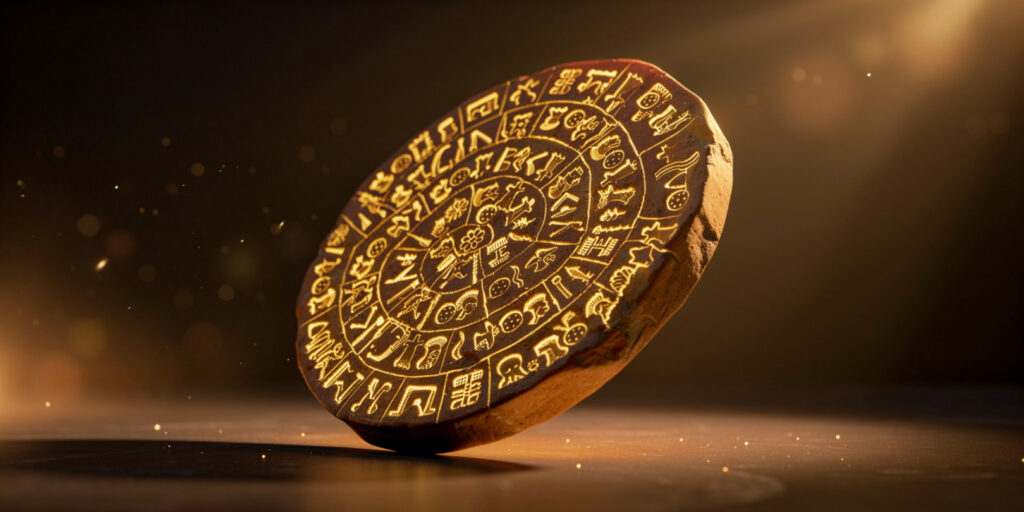
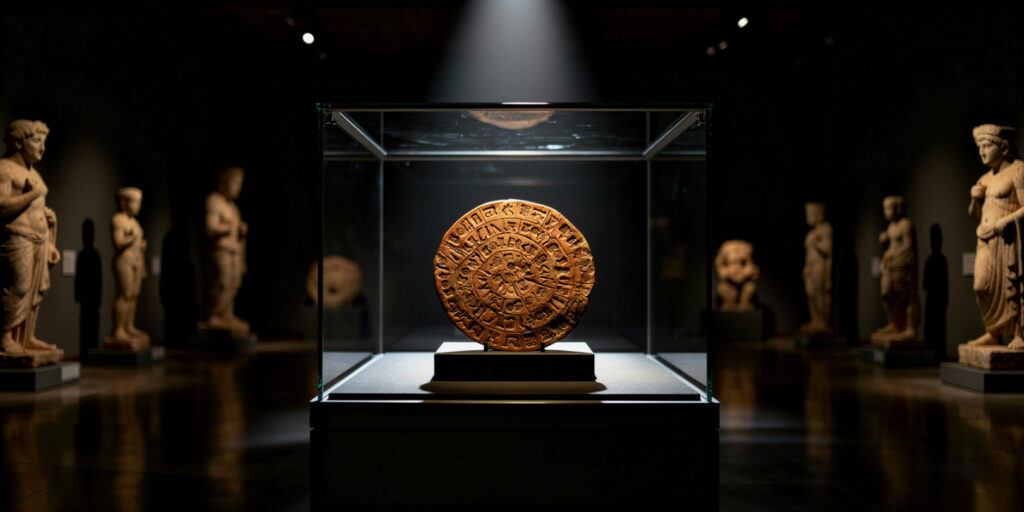
The object is called the Phaistos Disc. It sits in the Heraklion Archaeological Museum on Crete, fired clay, about 16 centimeters across, a little over a centimeter thick. It carries 241 symbol impressions built from just 45 distinct signs, arranged in a tight spiral on both sides, broken into groups by short incised lines that almost certainly mark word breaks. Every professional attempt to read it has failed. Every amateur attempt has failed. The failure itself is the story, and it says something uncomfortable about how fragile human knowledge actually is.
What Pernier Actually Found
The disc turned up on July 3, 1908, in the basement of the palace complex at Phaistos, on Crete’s southern coast, one of the largest Minoan palace sites ever excavated. It was buried in an underground storage cell, sealed and plastered over, alongside ash, burnt animal bones, and a separate clay tablet written in Linear A, the Minoan script that remains undeciphered to this day in its own right. The location suggests a shrine or an archive, somewhere important enough to seal off deliberately rather than simply abandon.
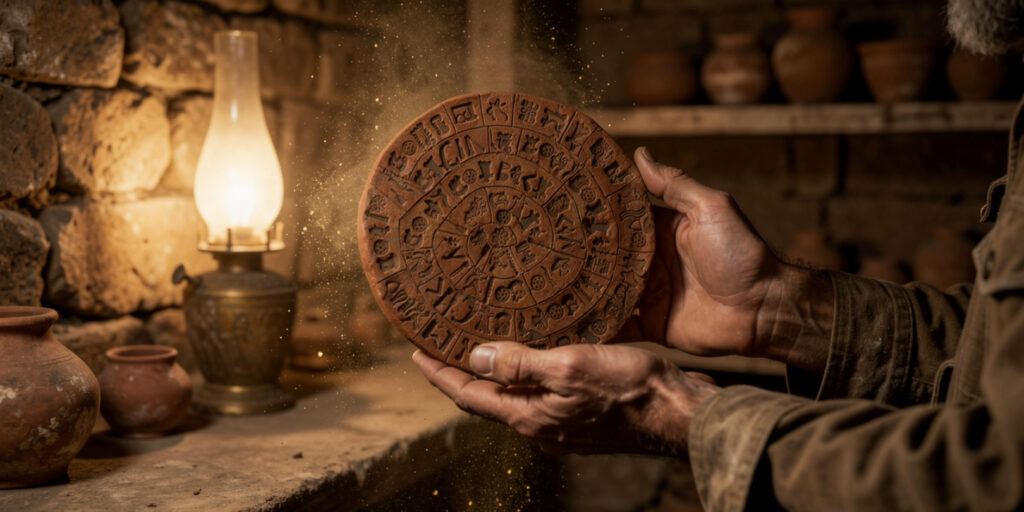
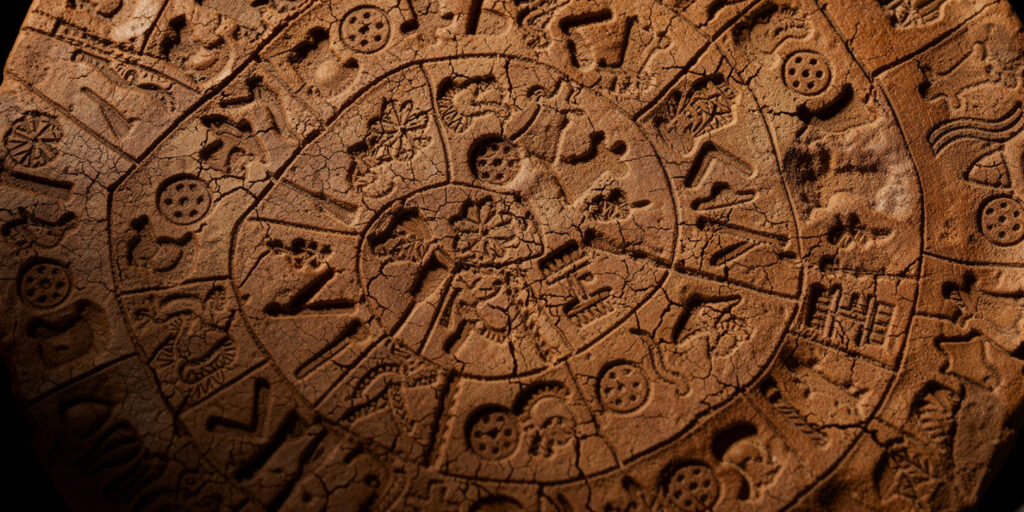
What made the object strange the moment anyone looked closely was not the symbols themselves. It was how they got there. Every other piece of writing recovered from Bronze Age Crete was scratched into wet clay by hand, stylus marks visible under magnification, each sign a little different from the last because a human hand drew it fresh every time. The Phaistos Disc symbols are identical to each other every time they repeat. That is only possible if they were not drawn at all. They were stamped, pressed into the soft clay with individually carved seals, one seal per sign, the same seal reused every time that sign appears. Someone on Bronze Age Crete built a set of movable type. Individual character stamps, reusable, interchangeable, more than three thousand years before Johannes Gutenberg is credited with inventing the same idea in Mainz.
The Forgery Accusation
An object this strange draws suspicion, and the Phaistos Disc has drawn it for over a century. Arthur Evans, the archaeologist who excavated the neighboring palace at Knossos and effectively invented the field of Minoan studies, noted early on that the human figures on the disc dress differently from every other Minoan figure ever depicted, and that the ship design does not match any known Cretan vessel. In 2008, antiquities dealer Jerome Eisenberg went further and accused Pernier directly of faking the object, pointing to its suspiciously pristine condition compared to the fragmentary, weathered state of nearly everything else pulled from the site, and to the fact that Pernier found it during an otherwise unproductive digging season, a convenient rescue for a disappointing year of fieldwork.
None of that has moved the field’s center of gravity. The disc is now generally accepted as authentic by working archaeologists, and the forgery theory remains a minority position pushed mainly by outsiders to the discipline rather than by excavators or epigraphers with direct access to the material and its context. The stratigraphic sealing, the presence of the genuine Linear A tablet in the same deposit, and the consistent firing and clay composition all argue for a real Bronze Age object. It is worth naming the suspicion honestly rather than pretending it never existed. It is also worth being honest that the suspicion has not held up against the people whose job it is to evaluate it.
How Ventris Actually Cracked Linear B
To understand why the Phaistos Disc has resisted every decipherment for a century, it helps to look at the one closely related Bronze Age Cretan script that someone actually did crack. Linear B, the script Arthur Evans found by the thousands of tablets at Knossos, sat unread for fifty years. Then, in 1952, a British architect named Michael Ventris solved it in his spare time. Ventris was not a professional linguist. He was self-taught, obsessed with the problem since hearing Evans lecture on it as a fourteen-year-old schoolboy, and he built his decipherment the way a cryptographer builds one: charting which signs clustered together, which signs never appeared at the start of a word, which patterns repeated across different tablets from different sites. Working alongside classicist Alice Kober’s earlier groundwork, he built a grid of sign relationships, made an inspired guess that a cluster of signs might be place names already known from later Greek geography, and within weeks realized the entire script was writing an archaic, abbreviated form of Greek five hundred years older than Homer.
The proof that he was right did not come from Ventris arguing louder than his skeptics. It came from a single clay tablet found at Pylos, on the Greek mainland, catalogued as PY Ta 641. The tablet listed vessels alongside pictorial ideograms showing exactly what kind of vessel each entry described, tripod cauldrons, cups with handles, jars. Ventris had proposed his sign values before anyone showed him this specific tablet. When his proposed readings were applied to it, the words matched the pictures. A three-legged vessel was labeled with a word that, decoded, meant three-legged. Scholar Sterling Dow, an early skeptic, changed his position specifically because of this tablet, and because Ventris had worked out the reading before ever seeing it. That is what a real decipherment looks like: a prediction made in advance, tested against evidence the decoder had not yet seen, and confirmed independently.
Ventris had one enormous advantage the Phaistos Disc does not offer anyone. Thousands of Linear B tablets survive, from multiple sites, recording mundane administrative transactions: grain shipments, land allocations, lists of vessels and livestock. That volume of repetitive, cross-referenced material is what let him test guesses against other guesses, catch himself when he was wrong, and eventually converge on an answer that matched, tablet after tablet, site after site. Decipherment is not really translation. It is statistics. It needs a large enough sample to separate real patterns from noise.
Why the Disc Cannot Be Cracked the Same Way
The Phaistos Disc offers none of that. It is a single object. Both sides together contain 241 sign impressions, which sounds substantial until you compare it to thousands of Linear B tablets recording the same limited vocabulary of grain and cattle and pottery over and over. No second Phaistos Disc has ever been found. No related inscription using the same 45 signs has ever turned up anywhere else on Crete, or anywhere else in the Mediterranean, in a century of digging. There is no Rosetta Stone parallel text sitting next to it in a known language. There is no larger corpus to check a guess against. In cryptographic terms, one short message in an unknown system, with an unknown language behind it, and nothing to cross-reference, is close to the theoretical limit of what cannot be solved. It isn’t that nobody has been clever enough. It’s that the problem, as it currently stands, may not contain enough information to have a verifiable answer at all.
The proposed solutions since 1908 make the point better than any abstract argument could. Researchers have read the disc as an early form of Greek, as Luwian, a language once spoken in Bronze Age Anatolia, as a Semitic language, as an otherwise unattested non-Indo-European tongue, and as everything from a religious hymn to a legal contract to an astronomical calendar. In a field that is converging on a real answer, independent attempts start to agree with each other as methods improve, the way Ventris’s work built on Kober’s and pointed the same direction other serious researchers were already leaning. Phaistos Disc attempts have done the opposite for over a century. They have diverged. Every new proposed methodology produces a new reading that shares almost nothing with the last one, and none of them can be tested against a second document the way Ventris tested his guesses against PY Ta 641. That pattern, divergence instead of convergence across a hundred and sixteen years of serious attempts, is not what a hard-but-solvable problem looks like. It’s closer to what a wrong question looks like, or an unanswerable one.
What the Disc Actually Shows, As Far As Anyone Can Tell
Strip away the question of what language it encodes, and the disc still tells you something concrete. The 45 signs depict recognizable things: human heads in different postures, a child, a woman, a bound captive, a plumed helmet, weapons including a bow and what looks like a mace, animals including a bee and what may be a fish, plants, boats, buildings or architectural elements, tools. This is not abstract geometric notation like most of Linear A and Linear B. It is closer to Egyptian hieroglyphics in spirit, small pictures standing in for sounds or words or both, deployed with enough internal consistency, repeated groupings, apparent word dividers, recurring sign clusters, that most researchers who have studied it accept it functions as genuine writing rather than decoration or a game board. Whoever made this intended it to be read by somebody. The tragedy, if that is the right word for it, is that whoever that somebody was, they took the key with them.
What the Silence Actually Means
It is worth sitting with what this object actually represents, separate from the question of translation. Someone on Bronze Age Crete, in the middle of the second millennium BCE, solved the problem of movable type. Not as a philosophical concept, as a working physical tool: a set of individually carved bronze or wood stamps, one per sign, reusable and interchangeable, a genuine printing technology built and used at least once, on at least one surviving object, more than three thousand years before Gutenberg is credited with the same insight in fifteenth-century Germany. And then, as far as the archaeological record can currently tell us, nobody used it again. No second stamped document has ever turned up. No successor technology. No evolution of the idea into anything resembling a printing tradition. A working solution to one of the most consequential problems in the history of information technology appears exactly once, on one disc, in one basement, and then vanishes from the record as completely as if it had never been thought of at all.
That is the real subject here, more than the specific untranslated symbols. Cultures do not just lose objects. They lose techniques, entire chains of specialized knowledge that exist only in the hands and memory of the small number of people who practice them, and when that chain breaks, whether through war, plague, economic collapse, or simply the death of the last person who knew how to cut the stamps correctly, the knowledge does not get rediscovered. It gets reinvented from scratch, centuries or millennia later, by someone with no idea it had already been done once before. The Phaistos Disc is not proof of a single genius. It is physical evidence that a specific, transferable technology existed, worked, and then disappeared so completely that the next time anyone on Earth had the same idea, they had absolutely no way of knowing they were the second person to have it.
The honest position on the Phaistos Disc’s language is that nobody knows, and the way the failures have accumulated over more than a century gives real reason to think nobody currently can know, not from this object alone. The honest position on what it represents technologically is different, and more solid: a working movable-type printing system, built and used in the Aegean Bronze Age, verified by physical examination of the stamped signs themselves, requiring no translation to confirm. The text may stay silent forever. What it was printed with should not be forgotten twice.
The Phaistos Disc raises the identical problem from a different island, a single Bronze Age object using real inscribed signs that has never been matched to a wider body of connected text.