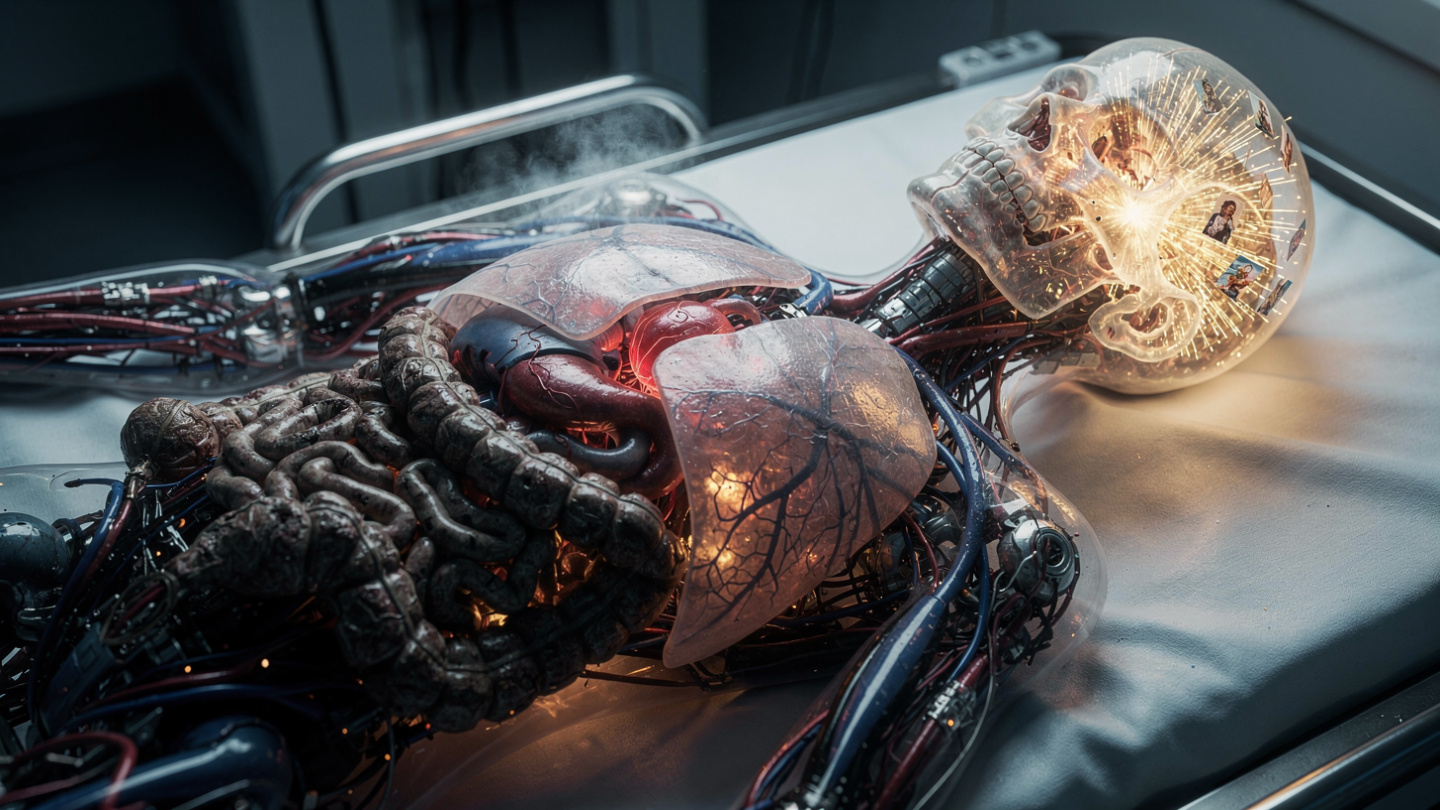
Jimo Borjigin wasn’t looking for evidence about near-death experiences when she found what would make her laboratory famous. She was studying hormone levels in the brains of rats after stroke when several of the animals died unexpectedly during the experiment, leaving her electrodes recording after their hearts had stopped. In the electrical activity that should have been winding down into silence, something appeared instead: a brief burst of unusually synchronized high-frequency activity, emerging during the final seconds of the animals’ lives and, in some respects, resembling patterns associated with an awake brain.
The finding was published in 2013. It led to further experiments in dying human patients, two additional papers, and a scientific argument that remains unresolved over a question far more difficult than the headlines suggest: when a brain is dying, is it merely producing the final electrical noise of failing tissue, or can organized neural activity persist briefly after the body has begun shutting down?
Dying Is Not a Single Moment
The first thing the research complicates is the ordinary language of death itself. The body does not simply cross an invisible line and switch off. Circulation changes, breathing becomes irregular, consciousness disappears, and different organs and cell types fail on different schedules. After the heart stops, oxygen deprivation begins a cascade whose timing varies across tissues: neurons are among the most vulnerable, while other cells can remain viable considerably longer. At the cellular level, death is therefore less like a light being switched off than a system losing functions in sequence, with different parts of the body reaching irreversibility at different times.

Three Studies, Not One Miracle
Borjigin’s accidental observation became a formal experiment published in the Proceedings of the National Academy of Sciences. Her team implanted electrodes at multiple locations in nine rats, induced cardiac arrest, and recorded the electrical activity of the brain through the interval between the final heartbeat and the disappearance of measurable signals. What appeared was a burst of low-gamma activity, roughly 25 to 55 hertz, accompanied by unusually strong synchronization across different regions of the brain. Gamma activity had already been associated with waking consciousness, perception, attention, meditation, and REM sleep, which made the finding intriguing. It did not, however, tell the researchers what the activity meant.
The paper immediately became part of a scientific argument rather than a final answer. Lakhmir Chawla and Michael Seneff published a challenge in the same journal, questioning whether the observed activity should be interpreted as evidence of meaningful brain function at the point of death. Borjigin and her colleagues responded. Psychiatrist Bruce Greyson, whose work helped establish the standardized methods used to study near-death experiences, also raised questions about the interpretation, prompting another response from the original researchers. The significance of that exchange is easy to miss in popular retellings: the central dispute was never simply whether electrical activity existed. The recordings showed that it did. The dispute was over what kind of activity it was, why it appeared, and whether anything about it could legitimately be connected to subjective experience.

Then came the human observations, which should be kept separate rather than blended into a single dramatic confirmation. In 2022, researchers reported a comparable surge of gamma activity in the brain of an 87-year-old patient during cardiac arrest, providing an unusual glimpse of a dying human brain under continuous recording. In 2023, Borjigin’s group published another study involving four hospital patients who died during cardiac arrest while already being monitored with EEG for unrelated medical reasons. Across the animal experiment and the two human studies, elevated and coordinated gamma activity appeared again. But the crucial limitation remained: none of the studies could tell the researchers what the activity felt like, whether it represented conscious experience, or whether it had anything to do with the experiences later described by people who survive cardiac arrest. A neural signal is not a memory, and a pattern of electrical activity is not by itself evidence of an experience occurring from the inside.
A Signal With Two Very Different Interpretations
This is where the story becomes genuinely interesting, because the disagreement is not between science and pseudoscience. It exists inside the scientific interpretation of the same observations. Borjigin’s reading is that the dying brain may briefly enter a highly organized state of activity resembling the neural patterns associated with conscious processing, potentially offering a biological clue toward the vivid experiences some cardiac-arrest survivors report. A competing interpretation is considerably less romantic: neurons under catastrophic physiological stress may fire chaotically as their normal regulatory systems fail, producing a burst of electrical activity that looks organized in a recording without representing organized thought or awareness at all. Both possibilities are compatible with the existence of the measured signal. Neither has been decisively demonstrated.
The distinction matters because the human stories that surround this research are much older than the EEG recordings. Physicians and researchers, including Elisabeth Kübler-Ross decades before Borjigin’s electrodes existed, have collected accounts of near-death experiences for decades: tunnels, lights, encounters, unusual perceptions, and memories that survivors sometimes describe as extraordinarily vivid. The existence of those reports is not in dispute. What remains unresolved is their relationship to the physiology of a dying brain. A burst of gamma activity cannot retroactively prove that a particular patient’s reported experience occurred during that burst, just as a compelling subjective account cannot establish what the patient’s neurons were doing at the precise moment it was experienced.
The Pam Reynolds Case Is Still Argued Over
Pam Reynolds Lowery’s case remains one of the most famous attempts to bridge that gap. On August 8, 1991, Reynolds underwent an extraordinary neurosurgical procedure at Barrow Neurological Institute to repair a cerebral aneurysm considered dangerously close to rupture. Neurosurgeon Robert Spetzler used a procedure involving profound hypothermia and induced cardiac arrest, cooling her body and draining blood from her head so the operation could be performed under conditions in which conventional brain activity was greatly suppressed. Years later, cardiologist Michael Sabom documented Reynolds’s account in Light and Death. She reported perceptions of the operation that she believed corresponded to details occurring while her physiological monitoring showed no ordinary brain activity.
The case became famous precisely because it appeared to create a problem for straightforward neurological explanations, but the details have never stopped being contested. In 2007, philosopher Keith Augustine published a series of peer-reviewed critiques in the Journal of Near-Death Studies, arguing that Reynolds’s most striking perceptions could have occurred before or after the period of complete physiological standstill rather than during it, and noting the substantial interval between the surgery and the detailed account later given to Sabom. Anesthesiologist Gerald Woerlee subsequently argued that ordinary mechanisms, including the transmission of sound through bone, could account for at least some of the apparently impossible perceptions.

Sabom rejected those explanations and offered specific reasons of his own, including the precautions taken to block auditory input during the operation and the assessment of Spetzler, the neurosurgeon who performed the procedure, that ordinary hearing during the relevant period was implausible. The result is not a neat scientific victory for either side. Reynolds’s case remains a disputed historical episode, interesting precisely because the proposed explanations have been examined in detail and because none has closed the argument to everyone’s satisfaction.
What the Research Actually Leaves Us With
The strongest conclusion is also the least sensational one. Dying brains can display organized electrical activity during the transition toward death, including bursts of gamma activity that have now been observed in animal experiments and in a small number of human cases. That activity is real. The disagreement concerns its meaning. It may represent a final period of highly organized neural processing. It may be a physiological consequence of catastrophic brain failure. It may contain elements of both. The available recordings cannot yet tell us which.
Nor does the research currently establish that a dying brain is generating the experiences reported by people who survive cardiac arrest. That connection remains a hypothesis, not a demonstrated chain of evidence. The same caution applies in the other direction: the existence of plausible neurological mechanisms does not automatically explain every detailed near-death account that has accumulated over decades. The most difficult cases remain difficult because the evidence comes in different forms, EEG recordings, physiological measurements, retrospective memories, clinical observations, and those forms of evidence do not line up neatly on a single timeline.
That is what makes Borjigin’s accidental discovery worth following. A researcher studying something else happened to keep recording when the heart stopped, and instead of finding silence she found a final burst of coordinated activity. Other researchers challenged the interpretation. Her team answered. Human cases appeared. New objections followed. More than a decade later, the argument remains open. The science has not demonstrated consciousness after death, and it has not demonstrated that near-death experiences are simply the last electrical flicker of a failing brain. What it has done is make the boundary between those two possibilities more interesting, and more difficult to draw, than it once appeared.
The dying brain study that started this line of research began, as so much good science does, as an accident nobody set out to find.
This piece touches on mortality and terminal illness as a scientific subject. If you’re navigating grief, a serious diagnosis, or thoughts about death that feel heavy right now, reaching out to a doctor, counselor, or someone you trust is a reasonable and worthwhile thing to do.