



Edgar Cayce (1877–1945) left behind one of the largest surviving records of twentieth-century trance-based spiritual practice: more than 14,000 documented readings, preserved by the organization he founded and still studied today. The scale of the archive is not in dispute. What is much harder to establish is what the archive means.
Cayce’s readings contain an elaborate cosmology of reincarnation, soul development, ancient civilizations, spiritual evolution, and a universal field of consciousness. They are extensively documented statements made by a real historical figure. They are not, by that fact alone, independently verified descriptions of reality.

Edgar Cayce | The Man Behind the Readings
Edgar Cayce was born in Kentucky in 1877 and spent more than four decades giving what became known as “readings” while in a self-induced, trance-like state. The sessions addressed an extraordinary range of subjects. Most concerned health and illness, but the surviving archive also contains material on reincarnation, dreams, spirituality, ancient civilizations, psychic phenomena, meditation, astrology, and what Cayce described as the Akashic Records.
The scale of the surviving record is remarkable. Cayce hired Gladys Davis as his secretary in 1923, and she faithfully documented his readings for the next two decades, the resulting archive eventually growing to more than 14,000 sessions. The Association for Research and Enlightenment, founded by Cayce and his supporters in 1931, preserved and organized the material, making the readings available for generations of researchers and spiritual seekers.
That distinction matters. We possess unusually extensive evidence of what Cayce said. We do not thereby possess equivalent evidence that the metaphysical realities he described objectively exist. The archive is real. The speaker was real. The experiences were reported and recorded. The larger question, whether the source of those experiences was genuinely clairvoyant, psychological, spiritual, or something else, remains a separate question.

The Biography That Became the Foundation
Much of the modern popular image of Cayce was shaped by Thomas Sugrue’s There Is a River, published in 1942. Sugrue was not a detached investigator who encountered Cayce from a distance. He was a journalist who met Cayce in the 1920s and eventually became deeply involved with the Cayce family and its work.
Sugrue’s personal connection became even more significant when he developed serious health problems and received treatment through Cayce’s readings. He spent extended periods with the family while working on the biography. The resulting book therefore possesses something historians value enormously, close access to its subject, but also something that demands caution: profound personal investment.
The publishing history makes the problem even more revealing. William Sloane, the editor associated with the book’s publication, later acknowledged that there was no conventional way to test a manuscript built around claims of clairvoyance. His decision to proceed was influenced, according to the account later reported by Nora Ephron, by a personal experience involving a Cayce reading and one of Sloane’s children.
None of this proves that Sugrue was dishonest, nor does it prove that Cayce’s readings were fraudulent. It establishes something subtler and more important: one of the foundational narratives through which Cayce entered the modern imagination was produced from inside a circle of people who already regarded his abilities as meaningful. There Is a River is therefore invaluable as a historical record of Cayce and his followers, but it should not be confused with an independent scientific investigation of his claims.
The Cosmology That Emerged From the Readings
What makes Cayce’s legacy extraordinary is not merely the number of readings. It is the coherence of the worldview that emerges from them.
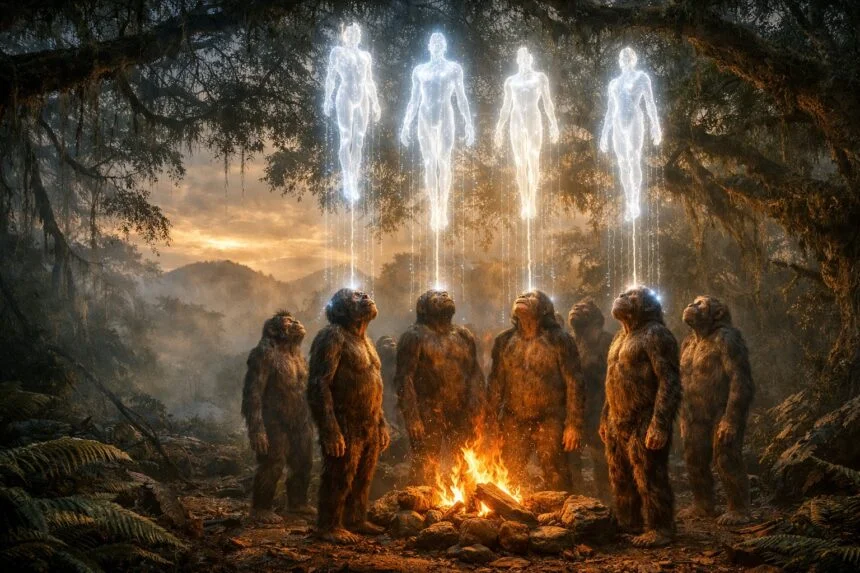
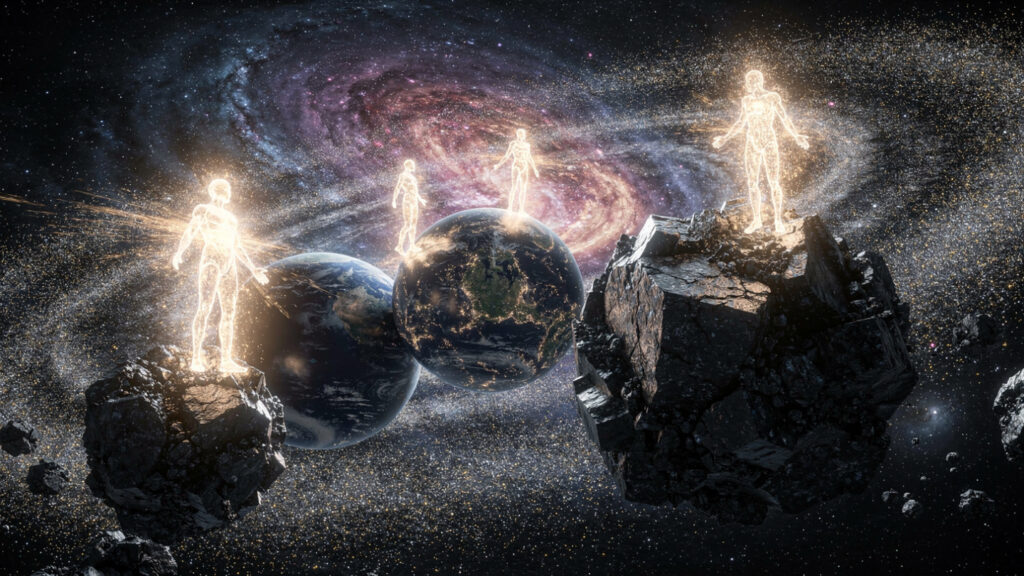
Across thousands of sessions, the readings describe human beings as souls undergoing a long process of spiritual development. Reincarnation becomes a mechanism through which experience, consequence, and moral growth unfold. Material existence is presented not simply as biological life but as part of a larger spiritual drama. Ancient civilizations, forgotten histories, psychic phenomena, dreams, and the relationship between consciousness and physical reality are repeatedly woven into that framework.
Many of these ideas have recognizable parallels with much older religious and metaphysical traditions, including strands of Gnostic thought, Theosophy, reincarnation philosophies, and other esoteric systems. That does not reduce Cayce’s work to plagiarism, nor does it prove its doctrines false. It places his ideas within a much longer history of human attempts to answer the same enormous questions: What is consciousness? Why are we here? Does the soul survive death? Is physical existence the whole of reality?
Cayce’s distinctive contribution was to present these questions through the peculiar mechanism of the reading: an American clairvoyant entering an altered state and apparently retrieving information from a deeper field of knowledge. Whether that field was supernatural, psychological, symbolic, or something science has not yet adequately described is precisely the question that cannot be settled merely by quoting the readings themselves.

Where the Evidence Ends and Interpretation Begins
This is the point at which extraordinary claims often become vulnerable. A recorded statement can establish that Cayce made a claim. It cannot, by itself, establish the external reality of whatever caused the claim.
Consider the difference between these two propositions:
Proposition one: Edgar Cayce repeatedly described a universal field of consciousness and spoke about souls existing before and beyond individual physical lives.
Proposition two: Modern science has independently demonstrated that consciousness is fundamental to the universe in precisely the way Cayce described it.
The first is historically demonstrable from the archive. The second does not follow from it.
What Modern Physics Actually Says About the Holographic Principle
The temptation to connect Cayce’s consciousness-centered worldview to modern physics is understandable. Contemporary theoretical physics has produced genuinely strange ideas about information, spacetime, quantum theory, and the fundamental structure of reality. The holographic principle is one of them: in certain physical frameworks, the information associated with a region can be related in a profound way to information encoded on a lower-dimensional boundary.
But “holographic” does not mean “the universe is a conscious simulation,” nor does the principle demonstrate that consciousness creates matter. The physics is concerned with deep relationships between information, geometry, gravity, and quantum descriptions. Extending those results into a metaphysical claim about consciousness requires additional philosophical assumptions that the physics itself does not supply.
That distinction actually makes the subject more interesting, not less. Science has not proved Cayce right. But science also has not finished answering the deepest questions Cayce was asking. What is consciousness? Why does subjective experience exist at all? How does information relate to physical reality? Is spacetime fundamental, or emergent from something deeper?
Those remain legitimate questions. What cannot legitimately be claimed is that unanswered questions constitute confirmation of a particular twentieth-century clairvoyant cosmology.
The Strongest Case for Cayce Is Not the One Usually Made
The most intellectually interesting defense of Cayce does not require pretending that every reading has been scientifically validated.
It begins with a simpler observation: Cayce generated an enormous, unusually well-preserved body of material that remained influential for generations. Thousands of people regarded the readings as personally transformative. An organization still preserves the original material. The philosophical system has recognizable continuity across decades of sessions. And the questions at its center, reincarnation, consciousness, purpose, spiritual development, the nature of reality, remain questions human beings continue to debate.
That does not make the cosmology true. It makes the phenomenon historically and philosophically significant.
The Strongest Skeptical Case Is Not the One Usually Made Either
The opposite mistake is to assume that because Cayce’s claims lack conventional scientific verification, the entire subject can be dismissed as meaningless.
That conclusion goes beyond the evidence in the other direction. A historical phenomenon can be genuine as a phenomenon without every interpretation of it being correct. Cayce really entered altered states. He really produced thousands of readings. Those readings really influenced patients, families, religious seekers, writers, and generations of metaphysical thinkers. The archive really exists.
The unresolved question is what, exactly, was happening inside those states.
What Edgar Cayce Actually Leaves Behind
Perhaps the most responsible way to approach Cayce is neither belief nor dismissal, but separation.
Separate the man from the mythology. Separate the archive from the interpretation. Separate a documented reading from the truth of the claim contained within it. Separate genuine discoveries in physics from metaphysical conclusions later attached to them.
When those distinctions are made, Cayce becomes more interesting, not less.
He was a twentieth-century American who spent decades entering a mysterious altered state and producing an enormous body of recorded material about health, consciousness, reincarnation, spirituality, dreams, ancient civilizations, and the nature of existence. His followers saw a clairvoyant accessing a deeper field of reality. Skeptics saw a remarkable but ultimately human phenomenon. Science has not established the metaphysical architecture Cayce described.
And yet the central questions remain.
What if consciousness is more fundamental than our current models can explain? What if Cayce was touching something real but describing it through the language available to his era? Or what if the entire phenomenon arose from the extraordinary capacities of the human mind itself?
Those possibilities are not equivalent. But neither should they be confused.
The enduring value of the Cayce archive may therefore lie less in proving a finished cosmology than in preserving an unfinished question: how much of reality remains invisible when we assume, before the investigation even begins, that consciousness is only what our current instruments can measure?