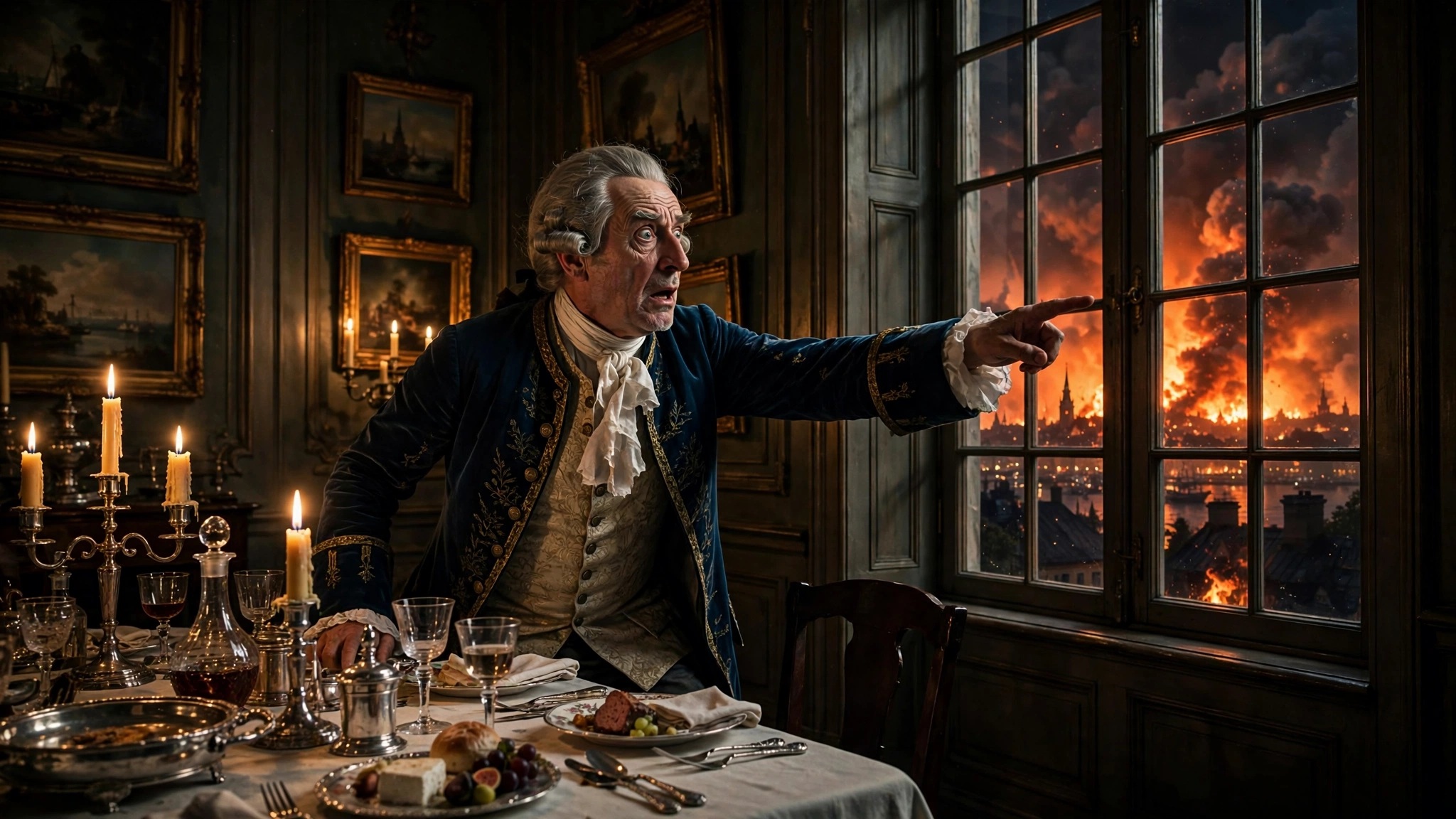
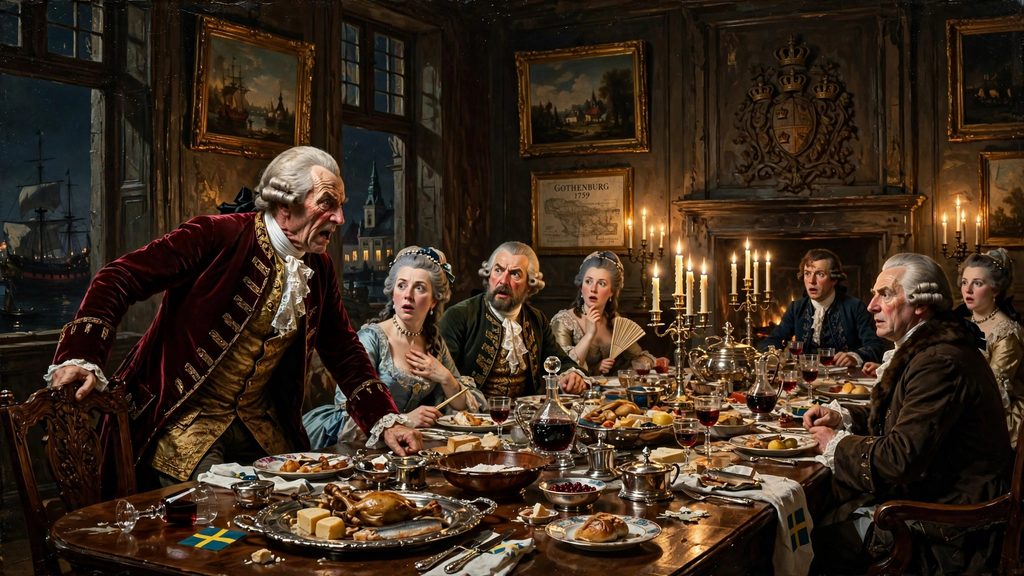
On 19 July 1759, Emanuel Swedenborg was at a dinner party in Gothenburg, roughly three hundred miles from Stockholm, when something happened that followed his name for the rest of his life. He was seventy-one years old, a retired royal assessor with a long, well-documented scientific career behind him, dining with around fifteen other guests at the home of a merchant named William Castel. Partway through the evening he grew agitated and told the table that a fire had broken out in Stockholm, near his own home in Södermalm, and that it was spreading fast. He kept returning to the subject as the evening went on. Then, around eight o’clock, he announced that the fire had been stopped three doors from his house.
News from Stockholm eventually reached Gothenburg and, according to the testimony collected afterward, matched the details Swedenborg had given at the dinner table. The story was not preserved as a supernatural anecdote invented generations later. It entered the record through witnesses who were alive at the time, an inquiry by the governor of Gothenburg, and eventually the attention of a philosopher who initially regarded the case as extraordinary enough to investigate for himself.
That philosopher was Immanuel Kant. And that is where the story gets more interesting than the usual version of it.
A Scientist Was Sitting at the Dinner Table
Swedenborg was not an obscure mystic who had suddenly appeared claiming supernatural powers. Born in Stockholm in 1688, he spent the first several decades of his life immersed in mathematics, engineering, natural philosophy and public administration. He studied at Uppsala, traveled through England and continental Europe, worked with the inventor Christopher Polhem, and in 1716 was appointed an extraordinary assessor to Sweden’s Royal Board of Mines. He became a member of the Swedish House of Nobility and one of the better-known scientific and technical figures in the country.
He was also an inventor and a prolific scientific writer, with interests ranging from metallurgy and mining to mathematics, astronomy, anatomy and theories of matter. The distinction matters because the later Swedenborg is often projected backward onto the earlier one. The man who would eventually describe conversations with angels had spent most of his adult life trying to understand the physical world through the intellectual tools available to him.

By the time of the Stockholm fire, Swedenborg was not a young scientist early in his career. His visionary period had begun more than a decade earlier, following a religious and psychological crisis recorded in his private writings in the 1740s. From around 1745 onward, he claimed conscious access to a spiritual world existing alongside the ordinary physical one, and he eventually abandoned his scientific career to devote himself almost entirely to biblical interpretation and theology.
The Fire Was Real
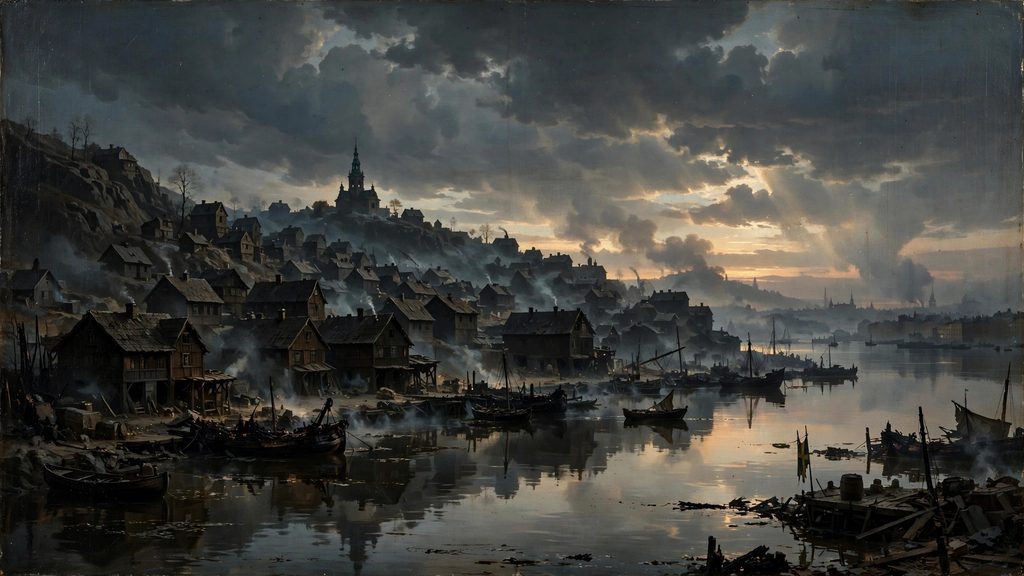
The first thing to establish is the least mysterious part. There really was a major fire in Stockholm that day. It began in Södermalm and became one of the city’s great eighteenth-century fires, independently documented outside anything to do with Swedenborg. What remains extraordinary is the claim that he described it while he was hundreds of miles away.
According to the account later preserved by Kant, Swedenborg became visibly distressed partway through the Castel dinner and said a dangerous fire had broken out in Stockholm. He reportedly identified the district, described it as spreading rapidly, mentioned that a friend’s house had already burned, and expressed concern for his own property before later announcing that the flames had been stopped near his home.
The account also says the governor of Gothenburg was informed and that Swedenborg was questioned about what he had said. That detail matters, because it means the story was not first constructed after news from Stockholm arrived. At least according to the surviving testimony, Swedenborg’s statements were already circulating locally before any confirmation reached Gothenburg.
Then the News Arrived From Stockholm
The traditional account says news from Stockholm arrived some days later and matched what Swedenborg had said, down to where the fire was stopped. Swedish biographical sources preserve the episode the same way, as the incident in which Swedenborg announced the fire had halted a few doors from his own home.
There is an important complication here. The surviving testimony is not a modern record made at the instant of the event. Much of what we know comes through accounts written or transmitted afterward, and even the chronology attached to Kant’s own retelling contains inconsistencies. Kant’s letter and his later book do not agree with each other on exactly when the fire happened, and later editors and Swedenborgian researchers argued over the discrepancy for years before settling on 19 July 1759, a Thursday, as the correct date.
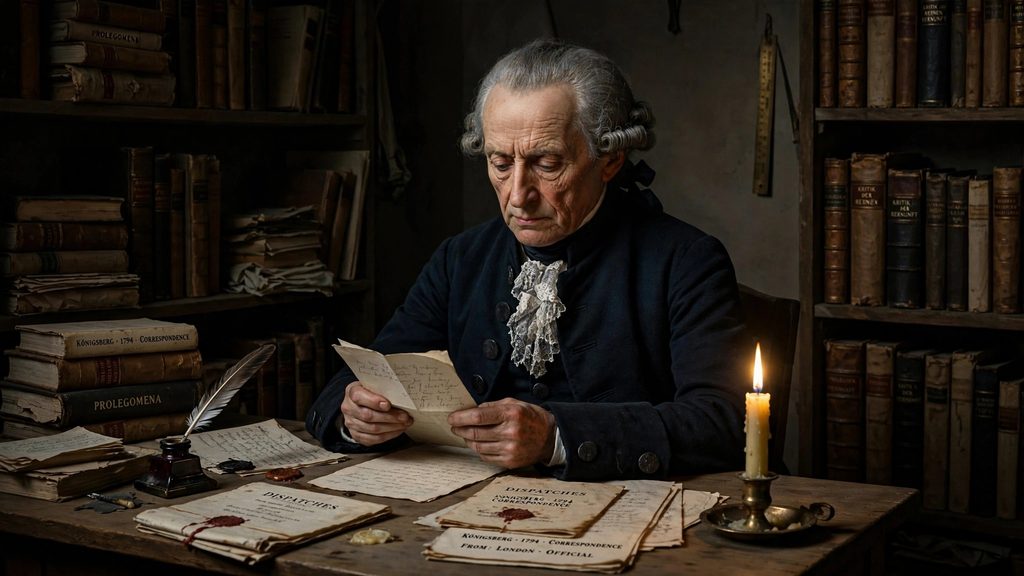
That does not erase the event. It changes what can responsibly be claimed about it. The defensible claim is narrower than the legend. A striking report of Swedenborg describing the Stockholm fire while in Gothenburg was preserved through multiple witnesses, and it became credible enough to contemporaries that it drew official attention and, four years later, serious philosophical investigation.
Then Immanuel Kant Started Asking Questions
Kant’s involvement is the reason this story survived as more than Swedenborgian folklore. He did not simply repeat what he had heard. In his letter on the subject, he explained that he had taken pains to investigate the reports rather than accept them on a predisposition toward the marvelous, describing an English acquaintance who had traveled to Sweden and examined the matter on the ground, questioning people in Stockholm and Gothenburg and checking the available records.
The tone of the letter is notable because Kant did not start as a believer. He said his general inclination ran toward skepticism, since extraordinary reports were usually insufficiently established. The Swedenborg material troubled that default position anyway. The Stockholm fire, specifically, was presented to him as the strongest case of its kind he had encountered.
This is the point where many modern retellings overreach. Kant did not scientifically prove that Swedenborg possessed clairvoyance. He investigated testimony about an extraordinary event and found the evidence difficult enough to dismiss that he took it seriously. Those are different claims.
The Kant Who Was Impressed Did Not Last
Three years after that letter, Kant published Dreams of a Spirit-Seer, Elucidated by Dreams of Metaphysics, in 1766. The change in tone is dramatic. The philosopher who had once treated the Swedenborg reports as unusually hard to dismiss now subjected Swedenborg’s spiritual writings to open ridicule, mocking his visions and arguing that claims which cannot be tested through ordinary sense experience should simply be set aside, however compelling the anecdotes attached to them.
The contradiction only looks total if the two documents are assumed to answer the same question. They do not. The earlier letter asked whether particular reports about Swedenborg appeared to have a factual basis. The later book asked what such reports could establish about the nature of reality. Even granting that Swedenborg accurately described the fire before ordinary news of it arrived, that alone would not demonstrate his explanation of how he knew.
Kant’s relationship with Swedenborg remains a subject of real scholarly debate. Some historians argue Swedenborg’s ideas mattered to Kant’s philosophical development. Others reject attempts to make Swedenborg a hidden cause of Kant’s critical philosophy. What can be established directly is simpler. Kant became fascinated enough by Swedenborg to investigate his claims, and dissatisfied enough with Swedenborg’s conclusions to later publish a book attacking them.
The Queen’s Secret Is a Different Kind of Evidence
A second Swedenborg story is told almost as often, and rests on considerably thinner documentation. Queen Louisa Ulrika of Sweden reportedly asked him whether he could contact her deceased brother, Prince Augustus William of Prussia. According to the story, Swedenborg returned the next day and privately told her something apparently known only to her and her brother, and she is said to have gone pale and remarked that she was not easily fooled.

The difference from the fire story is methodological. The fire has a named location, a real historical disaster, a group of dinner witnesses, a reported inquiry by the governor, and a philosopher who tried to investigate the case. The Queen story is preserved through a thinner chain of transmission, with far less contemporaneous documentation establishing exactly what was said and when.
That does not make the Queen’s story false. It simply places it in a different evidentiary category. A responsible account of Swedenborg should resist stacking every famous anecdote together and calling the pile evidence. Some stories have records behind them. Others have tradition behind them. Those are not the same thing.
Swedenborg’s Stranger Claim Was Not the Fire
The Stockholm episode is dramatic, but it is almost incidental to the larger system Swedenborg spent his final decades constructing. After his religious crisis in the 1740s, he produced a vast theological literature describing what he claimed to have learned through direct experience of heaven, hell and the spiritual world between them, most notably in Heaven and Hell, published in 1758. He did not present this as speculation. He wrote as someone reporting from a realm he believed he could actually perceive.
His afterlife is distinctive. Heaven and hell were not destinations assigned by an external judge. Souls moved toward communities corresponding to their deepest loves and habits, so that hell became the condition produced by an attachment to forms of love that could not coexist with heaven, and the afterlife worked something like a vast moral ecology in which people gravitated toward what they had already become.

That vision sets Swedenborg apart from the familiar medieval image of heaven as a fixed hierarchy of celestial ranks. Earlier Christian traditions, especially the hierarchy associated with Pseudo-Dionysius and later systematized by theologians such as Thomas Aquinas, imagined the heavenly world through ordered ranks of angels, a system covered in detail elsewhere in this library. Swedenborg instead described an enormous society structured around spiritual affinity rather than rank. The difference reflects two fundamentally different ideas about how an invisible world would be organized, and about how a human being could claim to know anything about it at all.
He Did Not Found the Church That Bears His Name
There is an irony in Swedenborg’s legacy. He did not organize a church around his writings. He regarded his theological work as a restoration of Christianity rather than the foundation of a new denomination. The New Church movement associated with his name developed only after his death in London in 1772, when English readers built institutions around his books. The man at the center of the most famous Swedenborg story never controlled the institution that eventually carried his theology forward.
So What Actually Happened in Gothenburg?
There are several ways to read the Stockholm fire story, and the record does not give enough to turn any one of them into a demonstrated conclusion. One possibility is that Swedenborg genuinely perceived the distant event through some unknown mechanism, the interpretation that made the story famous, though the record does not establish a mechanism. Another is that some ordinary source of information reached him earlier than later accounts recognized. News traveled through ships, merchants, letters and travelers, and eighteenth-century communication was slower than ours without being isolated. A third is that the surviving testimony sharpened with each retelling, since memory is not a recording device, especially once a coincidence has already acquired its meaning.
There are also questions that cannot be answered with confidence now. Exactly what did Swedenborg say before the news arrived, and how closely did each witness remember his words. Which details were written down immediately, and which entered the record later. An extraordinary conclusion requires more than an extraordinary story. It requires a chain of evidence strong enough to survive every ordinary explanation that can reasonably be tested.
That is precisely why Kant’s involvement matters. He did not turn Swedenborg into a scientific fact, and his later ridicule did not make the earlier investigation disappear. The episode instead captures something revealing about the eighteenth century, a period in which the boundaries between natural philosophy, theology and what we would now call paranormal investigation were still being negotiated. A respected scientist claimed access to another world. A major philosopher initially found one of the reports hard to dismiss. The same philosopher later turned against the larger system built on top of it.
The strange part is real. A fire burned in Stockholm. A seventy-one-year-old scientist hundreds of miles away grew agitated and reported what he said was happening there. Witnesses later repeated the story. Kant investigated it, and Kant later published a pointed attack on Swedenborg’s spiritual claims. What remains unresolved is the question the story has always wanted answered, which is how Swedenborg knew.

The record cannot take us the final step from an extraordinary report to clairvoyance. It can take us far enough to make the story worth treating as history rather than dismissing as folklore. The fire was real. The investigation was real. So is the uncertainty.
Swedenborg did not leave behind proof that he could see across three hundred miles. He left behind something harder to dispose of, an eighteenth-century case that was investigated before it became legend, survived skeptical scrutiny, and still has no universally accepted explanation. Sometimes the mystery is not that the evidence is weak. It is that the evidence is just strong enough to keep the question alive.