



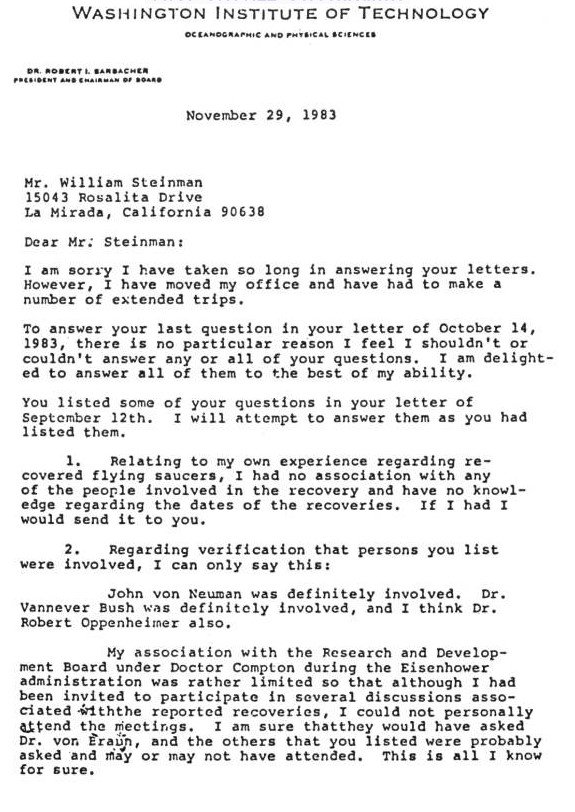
The letter was written in 1983 but the events it described had occurred thirty-five years earlier.
Dr. Robert Irving Sarbacher was a real physicist, president of the Washington Institute of Technology, and a consultant to the United States Defense Department’s Research and Development Board during the late 1940s and early 1950s. His institutional position gave him confirmed access to Pentagon research programs at the highest levels of the postwar American scientific establishment. His scientific contributions to electronics and physics remained in use at the time of his writing.
In 1983, UFO researcher William Steinman sent Sarbacher a letter asking what he knew about a 1948 New Mexico UFO crash and the individuals allegedly involved in its investigation. Sarbacher’s written response carries a weight that anonymous testimony does not: he named names.
John von Neumann was definitely involved. Dr. Vannevar Bush was definitely involved. Dr. Robert Oppenheimer was also involved.
These are not anonymous officials. Von Neumann is recognized as one of the most consequential mathematicians and physicists of the twentieth century, whose contributions include the mathematical foundations of quantum mechanics, the architecture of modern computers, and key theoretical work on the Manhattan Project. Bush is recorded as the director of the Office of Scientific Research and Development during World War II, the architect of the National Science Foundation, and the single most influential figure in the design of the postwar American scientific research establishment whose classified programs included everything that was considered sensitive enough to require the highest institutional management. Oppenheimer is recorded as the scientific director of the Los Alamos Laboratory and the Manhattan Project, whose security clearance and institutional access represented the apex of the American classified research infrastructure.
Whether these three men were involved in a crashed UFO retrieval and analysis program is the question that Sarbacher’s letter raises with an institutional weight that the anonymous testimony that constitutes most of the crash retrieval tradition does not.
What Sarbacher Said He Read
Sarbacher’s description of his access to the relevant materials is carefully worded in a way that reflects the institutional character of his position.
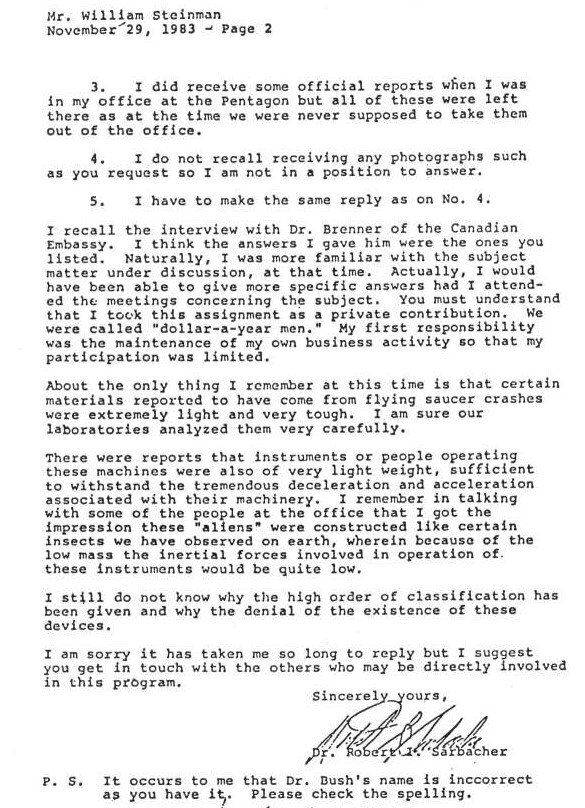
He received officially confirmed reports while working at his Pentagon office. The reports stayed in the office because they were not permitted to be removed. This is the institutional security protocol that classified Pentagon documents follow: certain materials are readable in a secured location but not removable from that location, a compartmentalization procedure that is standard for the most sensitive classified programs.

Whether the reports Sarbacher described are in any accessible archive, whether they were among the materials whose systematic removal from Navy archives was recorded by the Nimitz strike group witnesses in the library’s existing piece, or whether they remain in whatever classified storage the Pentagon’s most sensitive historical programs are maintained in, is the question that the security protocol he describes motivates examining.
His description of the materials recovered from the crashed vehicles is technical in its precision: extremely light and very powerful, analyzed by Pentagon laboratories for retro-engineering purposes. The phrase retro-engineering is the recorded term for the engineering analysis of recovered technology to understand and potentially replicate its functional principles, and its use by a credentialed physicist describing Pentagon laboratory work rather than by an anonymous conspiracy theorist is the detail whose institutional weight is significant.
The Insect Hypothesis
Sarbacher’s description of the beings as resembling insects in their physical parameters is the most technically element of his testimony and the one whose analytical development connects to the library’s existing Alien Robots piece most directly.
His reasoning is explicitly physical rather than simply descriptive: the beings’ light mass would allow them to withstand the deceleration and acceleration forces that recorded UAP flight profiles produce. This is a recorded physicist applying Newtonian mechanics to the question of what biology would be required to operate vehicles exhibiting the recorded performance parameters of UAP encounters.
The performance parameters the library’s Nimitz piece covers, altitude drops from 80,000 feet in under one second requiring acceleration exceeding 5,000 g-forces, are the figures whose biological implications Sarbacher’s insect analogy addresses: the exoskeletons of insects distribute structural load across the entire body surface rather than concentrating it at skeletal attachment points as vertebrate biology does, providing a biological mechanism for tolerating extreme acceleration that mammalian biology cannot match.
Whether Sarbacher’s insect analogy reflects a genuine biological assessment of what kind of life form could operate vehicles with recorded UAP performance parameters, or reflects an impression formed in informal Pentagon conversations rather than through systematic biological analysis, is the question that the statement raises.
The connection to the library’s existing Alien Robots piece is through the alternative framework: John Keel’s own observation that the beings described in close encounter accounts look more like robots or manufactured entities than like evolved biological organisms. Sarbacher’s insect hypothesis and Keel’s robot hypothesis are the two technical frameworks within which the non-human biology question has been most specifically examined by researchers whose institutional credentials are well established.
The Named Scientists and Their Institutional Positions
The institutional positions of the three named scientists during the relevant period are the established context that gives Sarbacher’s testimony its distinctive weight.
Vannevar Bush’s role is the most significant. As director of the Office of Scientific Research and Development during World War II, Bush administered the most extensive classified research program in American history, including the Manhattan Project, radar development, and the systematic application of American scientific talent to military problems at a scale and classification level that had no precedent in American institutional history. His 1945 report Science, The Endless Frontier defined the postwar American scientific research funding framework. Whether the man who designed, administered, and was trusted with the most extensive classified research program in American history would have been given responsibility for a recovered UAP materials analysis program, if such a program existed, is a question that his apparent institutional position makes the obvious answer yes.
John von Neumann’s wartime and postwar consulting work for the US government is extensive: his work on the Manhattan Project’s implosion design, his foundational contributions to computer architecture that were immediately applied to classified weapons calculations, and his membership on multiple high-level government advisory bodies, established him as one of the most trusted scientific consultants in the American classified research establishment. Whether his well established expertise in physics, mathematics, and early computer science would be relevant to the analysis of recovered UAP materials and potentially their propulsion or navigation technology is a question that his capabilities make straightforwardly answerable.
Oppenheimer’s security clearance was revoked in 1954 following his public opposition to the hydrogen bomb program and the subsequent hearing that found him a security risk. Whether his involvement in a crashed UAP program preceded or followed this clearance revocation, and whether his opposition to the H-bomb reflected any awareness of UAP technology that made the conventional weapons program seem less necessary, is the question that the timing of Sarbacher’s described involvement raises.
The Institutional Pattern
Sarbacher’s own statement that he does not understand why the government is hiding the information from the public is the element whose character is most revealing about his institutional position.
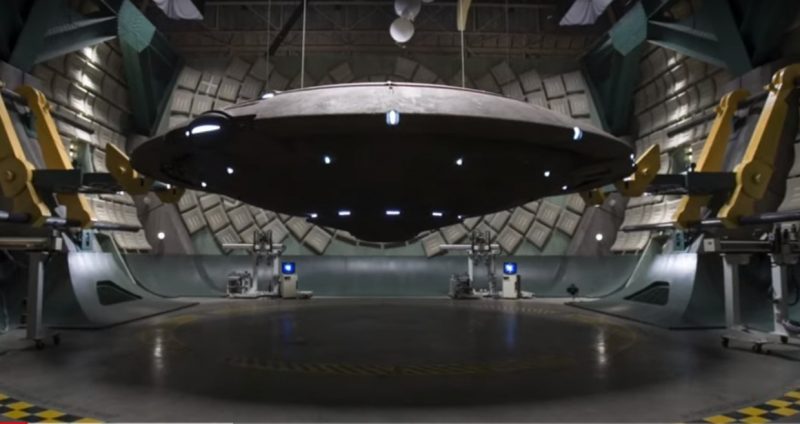
A credentialed Pentagon consultant who has read the relevant classified reports and finds the continued secrecy inexplicable is not the profile of someone whose testimony reflects either institutional loyalty to the secrecy program or deliberate disinformation designed to support it. It is the profile of someone who was given access to information at a sufficient level to understand what was being concealed, but who was not given the institutional rationale for the concealment and therefore cannot evaluate whether it is justified.
Whether the institutional rationale for concealing crashed UAP materials and non-human biological remains from the public is the recorded Robertson Panel framework, public panic management, the Zoo Hypothesis’s own logic about the value of non-contact, or something whose character the available declassified record does not establish, is the question that Sarbacher’s own puzzlement leaves specifically open.
The Robertson Panel’s 1953 recommendations are the most relevant institutional context: if the panel’s stated conclusion was that UAP evidence should be managed through ridicule and institutional denial to prevent public panic and maintain national security, then Sarbacher’s confirmed access to Pentagon reports he cannot remove and his own puzzlement at the secrecy reflect exactly the institutional architecture the Robertson Panel’s recommendations would produce: compartmentalized access without institutional explanation.

Whatever Sarbacher read in those Pentagon reports, he read them at his office and left them there. He remembered them thirty-five years later with sufficient clarity to name the three most consequential scientists in the American classified research establishment as the people responsible for analyzing them.