On November 14, 2004, Commander David Fravor of Strike Fighter Squadron 41 was flying an F/A-18F Super Hornet approximately 100 miles off the coast of San Diego when he was directed by the USS Princeton’s combat information center to investigate an unknown contact that had been appearing on the Princeton’s radar intermittently for approximately two weeks.
What Fravor found has not been explained.
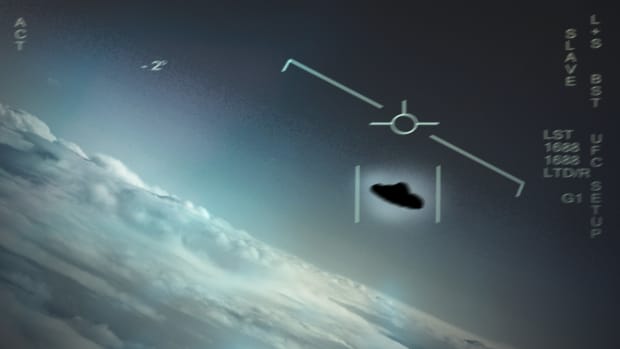
He described a white Tic-Tac shaped object approximately 15 meters in length, with no wings, no rotors, no visible propulsion system, and no exhaust plume, maneuvering over a disturbed patch of ocean at altitudes between sea level and approximately 20,000 feet. When he descended toward it, the object mirrored his maneuver, climbing to meet him. When he moved to cut off its flight path, it accelerated to a position approximately 60 miles away in less time than the engagement’s radar record could resolve.
He was a Navy commander with 16 years of flight experience. He had never seen anything he could not identify.
The object was subsequently captured on video by the ATFLIR targeting pod of a second F/A-18F whose pilot had been diverted to the area after Fravor’s engagement. The footage, 1 minute and 16 seconds of it in the version the Pentagon eventually released, shows a white oval object maneuvering against a background of ocean at approximately 25,000 feet, accelerating off the frame at the footage’s end.
What the Department of Defense released in 2017 was not the complete footage.
What Was Taken
Multiple witnesses from the Nimitz carrier strike group have stated, in accounts given to the SCU, to investigative journalists, and in public statements, that the materials covering the full scope of the November 14 encounter were removed from Navy archives in the hours and days following the incident.
The removal is established through witness convergence rather than through institutional records, which is precisely the evidentiary situation that the removal hypothesis predicts: if the materials were deliberately removed, the institutional records of their existence would also be removed or would never have been formally created.
Gary Voorhis, a radar operator aboard the USS Princeton, recorded in multiple public accounts that after the November 14 encounter his superior officers were approached by individuals he describes as non-uniformed, who downloaded data from the Princeton’s Cooperative Engagement Capability system, overwrote the hard drives, and removed the radar data chips. Voorhis has stated that the individuals identified themselves only as coming from higher up and that he was subsequently instructed not to discuss what he had observed.
P.J. Hughes, a petty officer aboard the Princeton, stated that he was instructed to collect all recordings and materials from the encounter and transfer them to unknown recipients who arrived by helicopter and left without providing identification or documentation of what they had taken.
Kevin Day, the Princeton’s senior chief petty officer and one of the radar operators who had been tracking the objects for approximately two weeks before the November 14 engagement, stated that the radar tracks showing the objects’ behavior during the full observation period, not just the FLIR footage day, were among the materials removed.
The ATFLIR footage that was eventually released in 2017 is described by multiple witnesses including the pilot who recorded it as being substantially shorter and lower resolution than the original footage. The original footage was reportedly approximately ten minutes in length and significantly sharper than the released version.
Whether these removals represent standard classified material handling by authorized personnel whose institutional authority was real but whose identification was withheld for operational security reasons, deliberate suppression of evidence by an institutional actor who understood the material’s significance, or accounts that have been enhanced through the psychology of significance that anomalous experiences can produce in witnesses reflecting on them over years, is the question that the convergence of multiple independent witnesses on the same removal narrative makes genuinely significant rather than easily dismissible.
Multiple witnesses, independent of each other, describing the same removal operation, with consistent details about the method and the anonymous character of the personnel involved, is not the normal pattern of confabulated or enhanced memory. It is the normal pattern of a real event recalled by multiple participants.
The SCU Analysis and What the Physics Shows
The Scientific Coalition for Ufology, whose membership includes retired military personnel, aerospace engineers, physicists, and intelligence analysts, published a 270-page technical analysis of the Nimitz encounter in 2019 that represents the most comprehensive independent technical assessment of the case in the public record.
The SCU’s methodology drew on the available FLIR footage, the witness accounts collected from multiple Nimitz strike group personnel, the email records obtained through FOIA requests confirming Navy officer awareness of the encounter, and the known technical parameters of the systems involved, including the ATFLIR targeting pod’s known performance characteristics and the Princeton’s SPY-1 radar system’s known capabilities.
The performance parameters the SCU derived from this analysis are the numbers that make the Nimitz object’s behavior most resistant to conventional explanation.
The altitude behavior described by multiple radar operators shows the object dropping from approximately 80,000 feet to approximately 20,000 feet in less than one second, and subsequently descending to sea level contact. The sustained acceleration required to produce this altitude change in the recorded time interval exceeds 5,000 g-forces by the SCU’s calculation. For context, the human body loses consciousness at approximately 5-9 g-forces sustained for more than a few seconds. The highest acceleration any known human aerospace vehicle has subjected its occupants to in operational conditions is approximately 12 g-forces for very brief durations. The known structural limits of the most advanced fighter aircraft in the current inventory are approximately 9 g-forces.
The speed parameters derived from the transition between Fravor’s engagement area and the object’s subsequent position at the combat air patrol point approximately 60 miles away, occurring in a timeframe that the witnesses described as effectively instantaneous, produce speed estimates of approximately 200,000 kilometers per hour by the SCU’s calculation. The fastest known airbreathing aircraft ever flown, the SR-71 Blackbird, reached approximately 3,500 kilometers per hour. The fastest known rocket-powered aircraft, the X-15, reached approximately 7,274 kilometers per hour. The Nimitz object’s transition speed exceeds both by a factor of approximately 28.
Kevin Knuth, a physicist at the State University of New York at Albany whose peer-reviewed paper on the Nimitz encounter performance parameters was published in the journal Entropy in 2019, independently derived similar performance estimates from the available data and calculated that the energy required to produce the recorded acceleration would be comparable to that released by a tactical nuclear weapon if achieved through conventional propulsion.
Whether the SCU’s and Knuth’s numbers are accurate depends on the precision of the witness testimony and the radar data from which the time intervals were derived. The radar data that would allow the most precise calculation of the object’s performance is among the materials described as removed from Navy archives. The performance estimates are therefore necessarily less precise than they would be with the complete radar record.
What is not uncertain is the order of magnitude: every performance parameter derived from every available data source places the Nimitz object’s behavior outside the known envelope of any known human aerospace technology by a margin that is not close.
Two Weeks Before Fravor
The November 14 engagement is the recorded event, but it was not the beginning of the anomalous activity.
Kevin Day stated that the Princeton’s radar had been tracking objects with anomalous performance characteristics in the same airspace for approximately two weeks before the FLIR footage was made. The objects were recorded as appearing at high altitude, approximately 80,000 feet, and descending to low altitude at velocities that the radar operators described as inconsistent with any known aircraft. They appeared daily, in the same general area, for approximately two weeks.
The decision to investigate one of the objects directly on November 14 was made because the objects had been present long enough that their pattern was established, and because the carrier strike group’s command structure determined that an intercept attempt was warranted.
Whether the two-week observation period, whose radar data is among the materials described as removed, would provide additional performance parameter data sufficient to constrain the explanation further, is the question that the removal makes unanswerable from the available record.
The Princeton’s radar operators, who spent two weeks watching the objects, described their behavior consistently: high-altitude appearance, rapid descent, low-altitude maneuvering, and departure at velocities inconsistent with any known aircraft. The objects appeared to show awareness of the naval exercise occurring in the same airspace, which was a standard training exercise involving nuclear aircraft carrier operations and surface ship maneuvering.
Whether this apparent awareness reflects genuine sensor capability on the part of the objects, the anthropomorphization of flight behavior that does not actually involve awareness of the exercise, or the pattern of behavior that any object maneuvering in the same airspace as a naval exercise would show regardless of awareness, is a question that the available evidence motivates without resolving.
The Institutional Response Pattern
The institutional response to the Nimitz encounter, traced through the FOIA request record and through the witness accounts of the removal operation, follows the pattern that the library’s Robertson Panel piece, CIA psychological warfare piece, and Condon Report chapter piece have recorded across the preceding sixty years of UAP institutional management.
The materials covering the full scope of the encounter were removed from the institutional record immediately after the event. The witnesses were instructed not to discuss what they had observed. The official release of the footage, when it finally occurred in 2017, was of a version that multiple witnesses described as shorter and lower resolution than the original. The FOIA requests for radar data, logbooks, and official reports related to the encounter were systematically denied.
The SCU’s analysis states that it began in 2015, two years before the New York Times disclosure, and that every request for official documentation was denied or resulted in the release of email records that established Navy officer awareness without providing technical data. The SCU had to reconstruct performance parameters from witness accounts and from what the FLIR footage itself contains rather than from the institutional record that the witnesses described as existing and as having been removed.
What the institutional response pattern shows is not, by itself, proof of what the object was. An institutional response involving removal of materials, instruction to witnesses to remain silent, and systematic denial of FOIA requests, is consistent with either the management of a genuine non-human aerospace vehicle encounter or the management of a sensitive classified program whose character the witnesses were not authorized to know.
Whether the objects were genuinely non-human or were a classified human technology program whose capabilities required maximum information security, the institutional response pattern is identical. Whether the witnesses’ descriptions of the objects’ behavior reflect genuine non-human performance or reflect the witness misperception of a human technology operating at the classified performance margins, is the question that the removed radar data would most directly address.
The data was removed. The question remains open.
What Fravor Said
Commander David Fravor has given consistent public accounts of the November 14 engagement in multiple recorded venues including congressional testimony, media interviews, and sworn statements to UAP investigators.
His recorded statement about what the object’s behavior implied is the most direct assessment from the most credentialed witness the case produced: he described the object as not like anything he had ever seen and stated that it was far beyond anything in our inventory.
Whether this assessment reflects Fravor’s accurate interpretation of what he observed or the framing that any anomalous experience tends to produce in its aftermath, is the question that his sixteen years of flight experience and his own track record as a reliable and precise observer makes difficult to dismiss through the standard cognitive bias explanation.
A Navy commander with sixteen years of experience, encountering an object that mirrors his descent and then accelerates to a position sixty miles away in an unresolved timeframe, is not the profile of a confused observer unfamiliar with the flight characteristics of advanced aerospace vehicles. He flew F/A-18s daily. He knew what they looked like from adjacent aircraft. He knew what their performance envelope was.
He said it was not that.
The SCU’s 270-page analysis confirmed it was not that.
Kevin Knuth’s peer-reviewed physics paper confirmed it was not that.
The radar operators who watched it for two weeks said it was not that.
What it was remains officially unknown, which in the context of sixty years of institutional management of the UAP question means something more than simply unresolved.