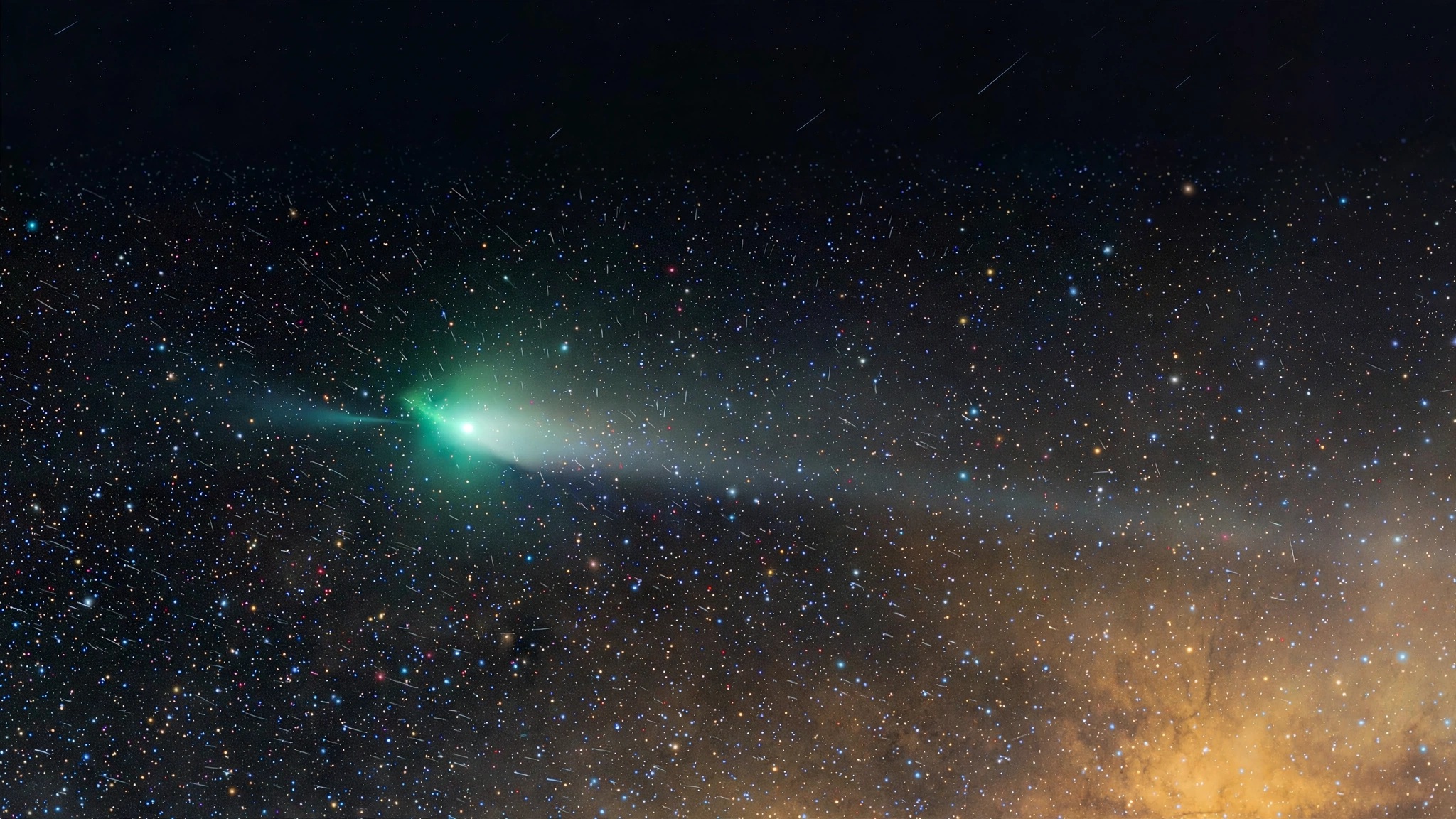
On the night of 1 July 2025, a survey telescope on a dry hillside at Río Hurtado in northern Chile caught a faint smudge drifting against the stars. The software flagged it. Astronomers checked it. Within a few nights the numbers had turned strange. The object was moving at about 61 kilometres a second, far too fast for anything the Sun could hold on to. It had not been born here. It had fallen in from the space between the stars, it was crossing the inner solar system once, and it would never come back.
It became 3I/ATLAS, the third interstellar object humanity has ever caught, after ’Oumuamua in 2017 and Borisov in 2019. It was also the first to arrive in an age that could point almost everything at it. Over the next nine months it was watched by Hubble and the James Webb Space Telescope, by the great observatories of Chile and Hawaii, by orbiters circling Mars, by probes on their way to Jupiter and the asteroids, by X-ray satellites, and by the largest radio dishes on Earth, listening for a voice.
- Case File | What Crossed Our Sky
- Case File | The Measurements That Made It Strange
- Case File | Who Was Watching
- Did 3I/ATLAS Send a Message to Earth?
- Avi Loeb and the Spacecraft Hypothesis
- Evidence Archive | Every Claim We Traced
- File 01 | The Spaceship in Disguise (July 2025)
- File 02 | The 46-Kilometre Object and the Message (August 2025)
- File 03 | The Dark Web Leak and the Orbit-Shifting Megastructure (August 2025)
- File 04 | The Death Star Comet and the Doomsday Preparations (September 2025)
- File 05 | The Wow! Signal Connection (September 2025)
- File 06 | The Q-Ball and the ESA Physicist (October 2025)
- File 07 | The Missing Footage, the Photo Behind the Sun and the Network Prophet (October 2025)
- File 08 | The Unexplained Acceleration and Loeb’s Test (November 2025)
- File 09 | The Metal Sphere, the Seven Vanishing Jets and the Archons (November 2025)
- File 10 | The Pyramid Activation (November 2025)
- File 11 | The Zettabyte Transmission and the Pope (November 2025)
- File 12 | The Sumerian Prophecy and the Alaska Summit (December 2025)
- File 13 | The Silencing of MAVEN (December 2025)
- File 14 | The Third Eye and the X-Ray Reactor (December 2025)
- File 15 | “NASA Warns” as the Comet Reverses Course (January 2026)
- File 16 | Project Lucifer and the Second Sun (January 2026)
- File 17 | The 2028 Apocalypse (January 2026)
- File 18 | The AI Probe at Jupiter (March 2026)
- Why One Comet Drew So Many Stories
- The Verdict | Debunked
- What the Verdict Does Not Close
It was also called a spaceship, a messenger, a dark-matter ball, a Death Star, a key to the pyramids, a fuse for Jupiter and a herald of the end of the world. Between July 2025 and March 2026 we opened a file on almost every one of those stories. There were twenty of them. This page folds all twenty into one record.
It is arranged the way a case should be. First the case file, what the object is and what the instruments measured. Then the evidence archive, every claim in the order it surfaced, followed back to wherever it began. Then the verdict, and the part of the mystery that no verdict closes.
Case File | What Crossed Our Sky
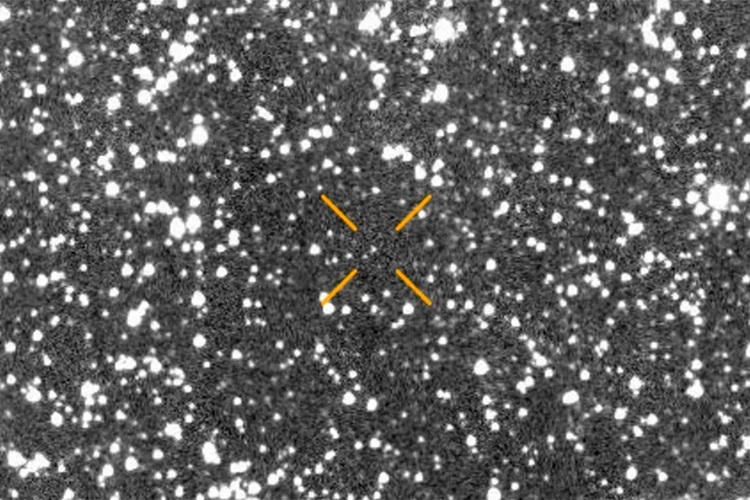
The discovery belongs to ATLAS, the Asteroid Terrestrial-impact Last Alert System, a NASA-funded network of small wide-field telescopes built to spot rocks heading for Earth. Its Chilean unit at Río Hurtado made the first report. Within hours the Minor Planet Center had the object under a temporary label, and other observers began searching their older images. They found it there too. Searches turned it up in frames from June, and NASA’s planet-hunting TESS satellite had caught it as early as 7 May 2025, weeks before anyone knew what it was.
The name is a catalogue entry and nothing more. The “3I” means third interstellar object. ATLAS is the survey that found it. Its formal comet designation is C/2025 N1 (ATLAS). Every later story that found hidden meaning in those letters, a “third eye” or a coded number, began with a label that astronomers hand out by rule.
The orbit. What made 3I/ATLAS remarkable from the first week was its path. Objects bound to the Sun travel in closed ellipses. 3I/ATLAS was on a hyperbola, an open curve with no return. Far from the Sun, before our star’s gravity had added anything, it was already moving at about 58 kilometres a second. By its closest approach to the Sun it had reached about 68 kilometres a second, roughly 245,000 kilometres an hour, the fastest arrival from interstellar space yet recorded.
The dates. It passed Mars around 3 October 2025, at about 29 million kilometres, close enough for the orbiters there to look up. It reached perihelion, its closest point to the Sun, on 29 October 2025 at about 1.36 times Earth’s distance from the Sun, roughly 203 million kilometres, just inside the orbit of Mars. At that moment it sat close to the Sun in our sky, lost in the glare, which mattered later. It came nearest to Earth on 19 December 2025, at about 1.8 astronomical units, close to 269 million kilometres, nearly twice our own distance from the Sun. It passed Jupiter on 16 March 2026 at about 54 million kilometres. At no point was it a hazard to anything.
The size. This is the number that caused the most trouble. A comet near the Sun wraps itself in a coma, a glowing cloud of gas and dust that can be tens of thousands of kilometres across, and the solid nucleus hides inside it. Early brightness estimates, which counted all that light as if it came from a bare rock, produced sizes of 20 kilometres and more. Hubble’s first sharp look in July 2025 cut that down to somewhere between about 320 metres and 5.6 kilometres, and NASA later quoted 440 metres to 5.6 kilometres. Studies based on how hard the comet’s own gas pushed it suggested about half a kilometre to three quarters of a kilometre. A later Hubble study, using images from December 2025 and January 2026, arrived at an effective radius of about 1.3 kilometres. One study using spacecraft tracking estimated a mass of about 44 million tonnes. The fair summary is a small body, somewhere between a few hundred metres and a few kilometres across, measured in several ways that do not yet fully agree.
The spin. Early light curves pointed to a rotation of about 16 hours. After perihelion, Hubble images of its jets showed a wobble with a period of about 7.1 hours, which Toni Scarmato and Avi Loeb read, in a February 2026 preprint, as the nucleus precessing like a slightly unbalanced top.
The age. Here the file turns from strange to staggering. An object’s speed through the galaxy carries a rough clue to its age, because stars and their debris get stirred into faster, more tilted orbits the longer they circle the Milky Way. On that basis Aster Taylor and Darryl Seligman estimated that 3I/ATLAS is between 3 and 11 billion years old, and a separate estimate by Matthew Hopkins and colleagues ran from 7.6 to 14 billion years. Either way it is probably older than the Sun, which formed 4.6 billion years ago. That would make it the oldest comet anyone has ever seen.
Case File | The Measurements That Made It Strange
3I/ATLAS was not an ordinary comet, and the astronomers studying it said so from the start. Nearly every instrument that looked at it came back with something unusual. That is the part of the story the alien versions most often leave out. The strangeness was published, in the open, by the people measuring it.
Mostly carbon dioxide. In August 2025 the James Webb Space Telescope measured the gases streaming off the comet and found about eight times more carbon dioxide than water, one of the highest ratios ever seen in a comet. Webb also found carbon monoxide, carbonyl sulphide and water ice, and in December added methane, the first methane detected in an interstellar object, at about eleven times the level relative to water seen in typical solar system comets.
Nickel without iron. In the summer of 2025, spectra from the Very Large Telescope in Chile, analysed by a team led by Rohan Rahatgaonkar, showed nickel vapour around the comet while it was still almost four times farther from the Sun than Earth, a distance where comets are normally too cold to release metals at all. Iron did not appear until the comet had moved in to about 2.6 astronomical units. Cyanide gas was there too. Metal-free nickel had been seen once before in an interstellar comet, Borisov, and in some solar system comets. The leading natural explanation is nickel carbonyl, a fragile nickel compound that can form in cold ices and break apart in sunlight at low temperatures.
A methanol-rich coma. The ALMA radio array in Chile measured methanol and hydrogen cyanide in September 2025 and found methanol-to-cyanide ratios of about 79 and 124 on two dates, among the highest ever measured in a comet. Only one solar system comet, the oddball C/2016 R2, has shown more. ALMA’s maps also showed the two gases leaving in different ways, the cyanide coming straight off the nucleus and some of the methanol coming from icy grains already drifting in the coma.
Glassy dust. Infrared measurements found amorphous silicates, the glassy kind, and none of the crystalline silicates common in solar system comets. That suggests its dust never went through the heating our own comets’ dust experienced.
A tail pointing the wrong way. Through the summer of 2025, Hubble and other telescopes saw a glow stretching toward the Sun instead of away from it. Ordinary comet tails point away, pushed by sunlight and the solar wind. Eric Keto and Avi Loeb, in a peer-reviewed paper in Monthly Notices of the Royal Astronomical Society, explained it as an uneven stretch of the comet’s snow line. On the sunlit side, icy grains survive long enough to travel farther before they evaporate, so the coma extends toward the Sun. After perihelion the familiar tail grew in, and by April 2026 ESA reported a tail about 5 million kilometres long.
A push that was not gravity. Like many active comets, 3I/ATLAS drifted slightly off a pure-gravity path, nudged by jets of escaping gas acting like small thrusters. Davide Farnocchia at NASA’s Jet Propulsion Laboratory measured an offset of about four arcseconds around perihelion. Tracking by orbiters at Mars and by the Psyche spacecraft helped pin it down.
A blue glow. Around perihelion, solar-observing spacecraft saw the comet brighten fast and turn bluer than sunlight reflected off dust. Blue light in comets often comes from ionised gas, carbon monoxide among it.
X-rays. In late November 2025 Japan’s XRISM observatory watched the comet for 17 hours, and on 3 December ESA’s XMM-Newton watched it for about 20. Both saw an X-ray glow, the first ever detected from an interstellar comet. XRISM found it spread over a region about 400,000 kilometres around the nucleus. That is what happens when the solar wind’s charged particles steal electrons from a comet’s gas, a process called charge exchange, known in comets since the 1990s.
The isotopes. The most important result arrived in June 2026. A team led by Martin Cordiner, publishing in Nature, measured the hydrogen isotopes in the comet’s water and found deuterium at about 0.98 percent of the hydrogen, more than ten times the level in solar system comets, along with carbon isotope ratios unlike anything measured here. Their reading is that the ice formed below about 30 kelvin, around minus 243 degrees Celsius, in a system poor in heavy elements, and that the material may have been assembled as long as about 12 billion years ago. That is an inference from chemistry and from models of how the galaxy’s chemistry changed over time, not a stopwatch reading. But it points to the same answer as the orbit. This is something very old, from somewhere very cold.
The nitrogen. In September 2026 Léa Ferellec, Cyrielle Opitom and Colin Snodgrass, using the WEAVE instrument on the William Herschel Telescope in La Palma, detected five different ions in the comet’s plasma tail at once and found it unusually rich in molecular nitrogen. Nitrogen ice survives only in extreme cold, which suggests 3I/ATLAS formed far out in its home system, below about minus 240 degrees Celsius, where its star’s warmth barely reached.
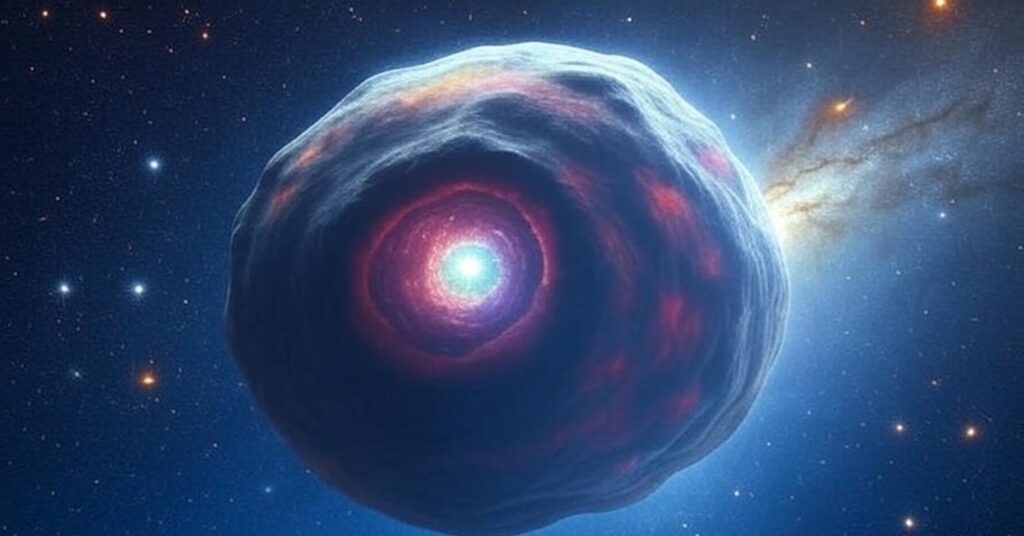
Each of these findings was argued over in public, in journals and preprints, by named people. None of them needed anything except a comet from a place unlike ours.
Case File | Who Was Watching
For nearly every claim that follows, it matters how many independent eyes were on this object. NASA alone pointed about a dozen missions at it, among them Hubble, Webb, the Mars Reconnaissance Orbiter, the MAVEN orbiter, the Perseverance rover, the solar observatories SOHO, STEREO and PUNCH, and the Lucy and Psyche spacecraft. ESA’s Mars Express and ExoMars Trace Gas Orbiter watched it pass Mars, and its Juice probe, on the way to Jupiter, caught it in November 2025. China’s Tianwen-1 imaged it from Mars orbit. On the ground, Gemini, Keck, the Very Large Telescope, ALMA, the Nordic Optical Telescope and many smaller observatories tracked it night after night, joined by amateur astronomers around the world.
From 27 November 2025 to 27 January 2026 the International Asteroid Warning Network, the body that coordinates planetary defence observations, ran a campaign on 3I/ATLAS as a practice exercise in precise tracking. And radio astronomers listened. That part deserves its own section, because it answers the question most people still type into search engines.
Did 3I/ATLAS Send a Message to Earth?
No observatory on Earth or in space recorded a message from 3I/ATLAS. Not a burst, not a pattern, not a carrier tone. This is not an absence of looking. It is the result of looking hard.
On 18 December 2025, less than a day before the comet’s closest approach to Earth, the Breakthrough Listen project pointed the 100-metre Green Bank Telescope in West Virginia at it and searched four receiver bands covering 1 to 12 gigahertz for narrow radio signals of the kind only a transmitter makes. The search flagged hundreds of thousands of candidate hits, which is normal, because Earth is loud with radio. Every one traced back to human interference. The team reported no credible technosignature down to about a tenth of a watt of equivalent transmitter power, weaker than a walkie-talkie, at a distance of 270 million kilometres.
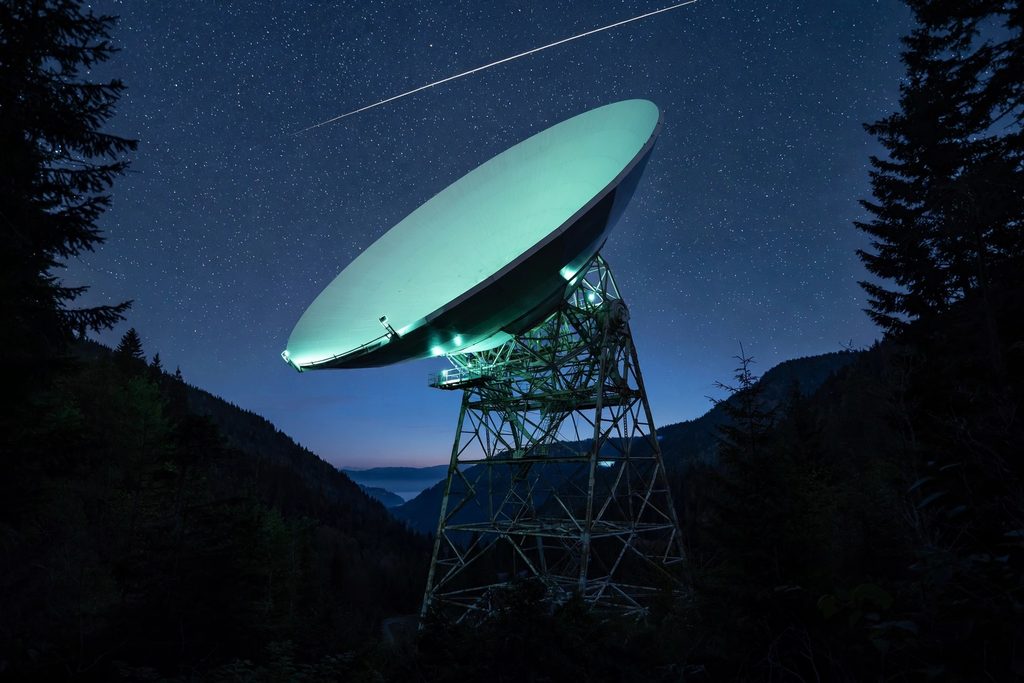
It was not the only search. Breakthrough Listen and its partners also used the Allen Telescope Array in California, searching 1 to 9 gigahertz, and the MeerKAT array in South Africa, which found nothing artificial but did pick up the natural radio signature of hydroxyl from the comet’s water. A team led by Sofia Sheikh worked through some 74 million signals from the Allen Telescope Array and found none that belonged to the comet. China’s FAST, the largest single-dish radio telescope in the world, observed it four times between October 2025 and January 2026, timed to its passage by Mars, its perihelion, its closest approach to Earth and a later date. Searching around the hydrogen line, it found no credible narrowband signal and ruled out transmitters stronger than about three thousandths of a watt.
A null result never proves that nothing could be there. A transmitter could use frequencies nobody searched, or stay silent. What the searches establish is narrower and firmer. Within the bands, sensitivities and methods used, 3I/ATLAS sent nothing.
The viral versions of the message story, the coded prime numbers, the “zettabyte” data burst, the leaked Deep Space Network assessment, each have their own entry in the archive below. Each one leads back to a video or a post with no named observatory, no data and no author.
Avi Loeb and the Spacecraft Hypothesis
Almost every alien story about 3I/ATLAS borrowed a name, and the name was Avi Loeb’s. He deserves to be described accurately, which means neither as a prophet nor as a crank.
Loeb is a Harvard astrophysicist who has argued for years that interstellar objects should be checked for signs of technology. He took that position publicly with ’Oumuamua, and pursued it on the floor of the Pacific, where his team dredged up tiny metal spheres from the path of a 2014 meteor. On 16 July 2025, two weeks after discovery, he and two co-authors posted a paper suggesting that 3I/ATLAS might be a piece of alien technology. They pointed to the early size estimates, the lack of obvious comet chemistry at that point, and a path that ran unusually close to the plane of the planets. Other astronomers pushed back within days. Chris Lintott and David Kipping criticised the paper, and Darryl Seligman pointed out that the object was already showing comet activity.
What happened next is the part the internet forgot. Loeb built a ranking he called the Loeb Scale, from 0 for natural to 10 for confirmed technology, and placed 3I/ATLAS at 4. He told reporters repeatedly that it was “most likely a comet of natural origin.” He made a specific, testable prediction about its acceleration, set out in File 08 below, and said in advance what result would rule out his more exotic idea. When the Mars images were held up by the US government shutdown, he said the delay was “probably not a sign of extraterrestrial intelligence but rather of terrestrial stupidity.” When rumours spread that the comet’s cyanide would poison Earth, he calculated that any gas it released would be swept away by the solar wind millions of kilometres from the comet. And he co-authored the natural explanation for the anti-tail.
On 19 November 2025 NASA released images from its whole fleet. “This object is a comet,” said Amit Kshatriya, the agency’s associate administrator. “It looks and behaves like a comet, and all evidence points to it being a comet.” Nicola Fox, head of NASA’s science directorate, added: “We haven’t seen any technosignatures.”
Loeb’s willingness to ask was science. The stories that grew from his questions were not his, and most of them contradicted what he concluded.
Evidence Archive | Every Claim We Traced
Between July 2025 and March 2026 we published twenty investigations into 3I/ATLAS. Most of them followed a single viral claim back to its source. They are gathered here in the order the claims surfaced, each with what it said, what we found, and where it ended. The original articles now lead to this page, so nothing we traced has been lost. It has been put in one place.
File 01 | The Spaceship in Disguise (July 2025)
The claim. Within days of discovery, videos declared the new object an alien craft disguised as a comet, citing its speed, its “impossible” size and its colours. Some tied it to Mars, to ’Oumuamua and to a lost Martian civilisation.
What we found. Every one of those features had a plainer explanation that the data soon provided. The speed is what an object from another star should have, since it carries its own velocity from its home system plus whatever the Sun adds. The size came from early estimates that mistook the bright coma for the nucleus. The colours in the most shared images were filter composites, in which astronomers assign colours to different wavelengths to separate features, so the picture is a map of light, not a photograph of a painted hull. The reddish tint of the comet itself matches organic material darkened by billions of years of cosmic radiation, the same chemistry that reddens icy bodies beyond Neptune.
The statistical arguments, that its path lined up too neatly with the planets, ran into a basic problem. Telescopes only find objects that pass through the parts of the sky they watch, at brightnesses they can detect. Once an object is found, someone can always pick a coincidence that looks unlikely after the fact. The question that matters is how surprising the alignment was before anyone knew which feature to emphasise.
Where it ended. The comet grew a coma and tails, released gas, and behaved as a comet in every instrument. Debunked.
File 02 | The 46-Kilometre Object and the Message (August 2025)
The claim. A widely shared story said 3I/ATLAS was 46 kilometres across, far too big for a comet, and that it was transmitting a message toward Earth.
What we found. The 46-kilometre figure came from treating the whole glowing coma as a solid body. Hubble’s images in July 2025 had already ruled it out, placing the nucleus at no more than 5.6 kilometres. The glow had an ordinary cause, sunlight on gas and dust. No observatory reported any transmission, then or later. The radio searches described above came after this claim, and they found nothing.
Where it ended. This was the question our readers searched for most, and it has the clearest answer on this page. No message. Debunked.
File 03 | The Dark Web Leak and the Orbit-Shifting Megastructure (August 2025)
The claim. A “leaked” Deep Space Network assessment, posted on the dark web, supposedly showed that 3I/ATLAS was an artificial megastructure transmitting prime numbers on the hydrogen line and steering toward a Lagrange point to shift Earth’s orbit. An astronomer identified only as “OBB” was quoted backing it. NASA was said to be degrading Webb images to hide the truth.
What we found. No leaked file has ever been produced, and no astronomer called OBB appears in any institution or publication we could find. The hydrogen line, at 1420.4 megahertz, is a central frequency in radio astronomy, and that is the problem with the claim. It was among the first places every search listened, and nobody heard prime numbers there. Webb’s data on the comet were published openly in the scientific literature for anyone to read. As for the orbit, Lagrange points are places where a tiny object can sit balanced between two large ones. They give the small object stability. They give it no power over the large ones. A comet a few kilometres across could not move Earth from anywhere, and Earth’s position is measured continuously by observatories and spacecraft around the world. It has not moved.
Where it ended. No leak, no OBB, no signal, no shift. Debunked.
File 04 | The Death Star Comet and the Doomsday Preparations (September 2025)
The claim. This one braided four stories together. The comet carried a carbon-13 signature from a nuclear reactor. Its cyanide would poison Earth. France was quietly preparing its hospitals. And earthquakes, including the deadly one in Afghanistan, were linked to “neutron fluctuations” from the object.
What we found. We could find no paper, preprint or credible report of a carbon-13 anomaly in 3I/ATLAS, let alone one traced to reactor graphite. The gases measured were carbon dioxide, carbon monoxide and water. The cyanide was measured too, and Loeb himself showed it could never reach us. The French hospital story was an ordinary defence and healthcare planning report with no link to any comet. Earthquakes are driven by the movement of tectonic plates, and the Afghanistan earthquake struck in a well-studied seismic zone. The story cited Loeb’s work throughout, while his own verdict was the opposite of the story’s.
Where it ended. Four headlines, none connected to each other or to the comet. Debunked.
File 05 | The Wow! Signal Connection (September 2025)
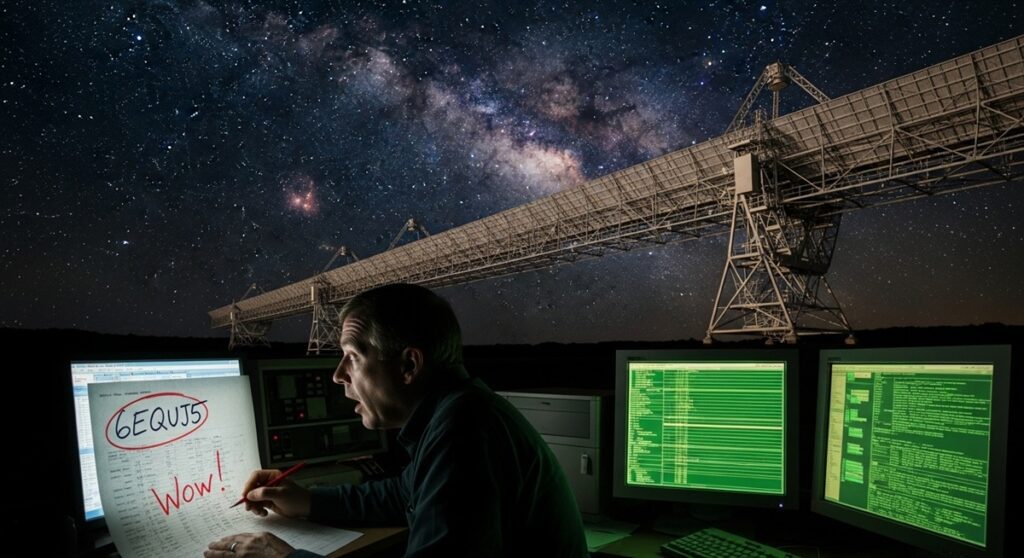
The claim. 3I/ATLAS came from the same part of the sky as the Wow! signal, the most famous unexplained radio burst in the history of SETI, so the two must be connected.
What we found. This is the one link with a respectable origin. On 15 August 1977 the Big Ear radio telescope at Ohio State University recorded a strong, narrow signal near 1420 megahertz that lasted about 72 seconds. The astronomer Jerry Ehman circled the printout and wrote “Wow!” beside the code 6EQUJ5. It has never been heard again, and the Wow! signal has its own file in the archive. Loeb noted that the direction 3I/ATLAS came from lies within about nine degrees of where the signal was recorded, and estimated the chance of that at about 0.6 percent. He flagged it as a coincidence to note, not as evidence. In 1977 the comet would have been hundreds of astronomical units away, and nothing suggests it was transmitting then any more than in 2025, when every major radio search came up empty.
Where it ended. A coincidence of direction, honestly reported. The Wow! signal remains unexplained on its own terms. As a connection to 3I/ATLAS, debunked.
File 06 | The Q-Ball and the ESA Physicist (October 2025)

The claim. An anonymous European Space Agency physicist, part of a secret working group, had concluded that 3I/ATLAS was a Q-ball, a lump of exotic dark matter, which explained its mass and behaviour.
What we found. Q-balls are not invented. The physicist Sidney Coleman described them in 1985 as clumps of a certain kind of field that can hold together and carry a conserved charge, and they appear in serious theoretical work on dark matter. That is what made the story sound credible. But extraordinary claims leave a trail, an author, a paper, a talk, an affiliation, and this one left none. We found no ESA physicist, no working group and no publication. ESA’s own material describes 3I/ATLAS as a comet. A Q-ball would also have to explain everything the telescopes saw, a coma, dust, molecular emission lines, changing chemistry and a push from escaping gas. Exotic physics was never needed to explain an object visibly shedding ice.
Where it ended. A serious idea attached to a source who does not exist. Debunked.
File 07 | The Missing Footage, the Photo Behind the Sun and the Network Prophet (October 2025)
The claim. NASA’s STEREO-A spacecraft had a suspicious gap in its footage. A “Death Star” photograph showed the object behind the Sun. An anonymous “network prophet” had predicted it all. And the Mars images were being withheld.
What we found. STEREO-A observed the comet continuously from 11 September to 2 October 2025, and NASA pointed out that it remained visible from several spacecraft at once. No observatory on Earth can photograph a small object directly behind the Sun’s disk, and the photograph circulated with no source, no instrument and no date. The prophet’s prediction was worded loosely enough to fit almost anything after the event. The Mars images were delayed, by about four weeks. The cause was the US government shutdown that began on 1 October 2025, which paused NASA’s public releases.
Where it ended. A paperwork delay and an unsourced picture. Debunked.
File 08 | The Unexplained Acceleration and Loeb’s Test (November 2025)
The claim. The comet’s non-gravitational acceleration could not be explained by outgassing, and its new blue colour was the glow of an engine.
What we found. The acceleration was measured and published, and Farnocchia’s four-arcsecond offset was a solid result. What made this case unusual is that Loeb turned it into a falsifiable test. He calculated that a natural rocket effect strong enough to explain the push would require the comet to lose about a sixth of its mass, and predicted that this should show up as a large plume of gas in November and December 2025. If no plume appeared, he said, the acceleration might be regarded as a technological signature. On the blue colour he offered two readings, an engine, or “simply a signature of ionized carbon monoxide for a natural comet.”
The weeks around perihelion were the hardest time to see the comet, because it sat close to the Sun in our sky. Once it emerged, the picture filled in. The comet showed a strong coma, a dust tail and an ion tail, and kept growing a tail that ESA measured at about 5 million kilometres by April 2026. The gas Loeb said a natural comet would need was there.
Where it ended. A fair test, set in advance, that came back natural. As a sign of technology, debunked. The acceleration itself remains good comet science.
File 09 | The Metal Sphere, the Seven Vanishing Jets and the Archons (November 2025)
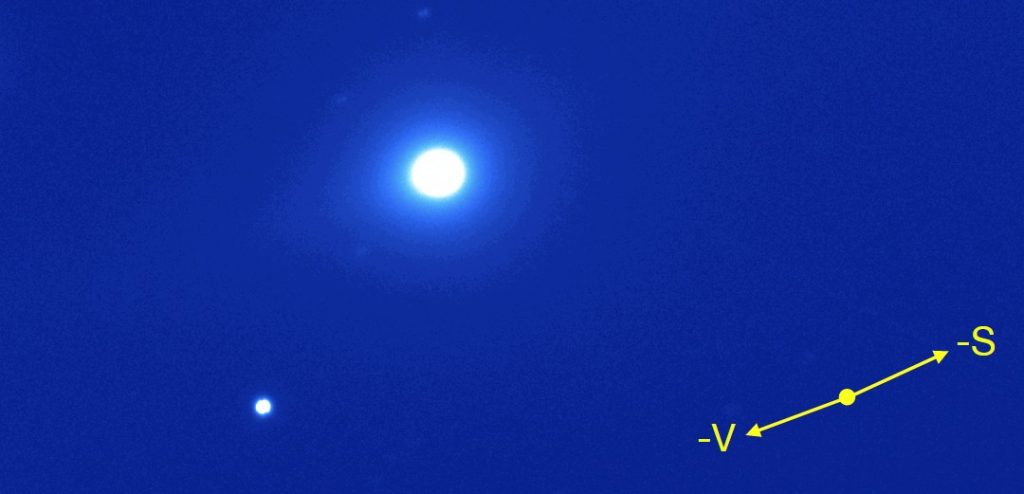
The claim. The most elaborate of all. Leaked Mars orbiter images showed a gleaming metal sphere with a dark circular aperture, later “cross-validated” by the Nordic Optical Telescope. Seven gas jets seen by amateurs vanished within a week, which no natural cloud could do. And the whole object fitted the Gnostic idea of the Archons, wardens watching a prison planet through a single dark eye.
What we found. The Mars image in question is the HiRISE frame taken by the Mars Reconnaissance Orbiter on 2 October 2025, from about 30 million kilometres. HiRISE was built to photograph the Martian surface from a few hundred kilometres up. Pointed at a faint comet a hundred thousand times farther away, it delivered an image at about 30 kilometres per pixel. The entire nucleus, at no more than 5.6 kilometres, was smaller than a single pixel. What the image shows is the coma, a fuzzy ball of gas and dust. No instrument in the solar system could have resolved a hatch on its surface. The Nordic Optical Telescope images show a comet with a coma and a tail. Jets on comets switch on and off as different patches of ice rotate into sunlight, and the “seven jets” were features in processed amateur images, not seven measured structures. The tail did not vanish. It kept growing for months.
Where it ended. An object smaller than one pixel read as a spacecraft, with a myth laid over it. Debunked.
File 10 | The Pyramid Activation (November 2025)

The claim. 3I/ATLAS was arriving to switch on a dormant machine beneath Giza. Its passage would align with the pyramids, and the activation would come by the end of January 2026.
What we found. The prediction had something most prophecies avoid, a deadline. That made it testable. We tried to follow it back to an original speaker, a dated recording, an archived page, anything showing it existed before the event, and could not. Then the deadline came. January 2026 passed. No energy event was recorded at Giza, no observatory reported anything new from the pyramids, and no chamber opened. The comet, meanwhile, kept its predicted course away from the Sun. The Great Pyramid has open questions of its own, about how it was built and what its inner spaces were for, and they deserve serious attention. A machine waiting for a comet is not one of them.
Where it ended. A dated forecast met its date, and nothing happened. Debunked.
File 11 | The Zettabyte Transmission and the Pope (November 2025)
The claim. 3I/ATLAS had beamed a zettabyte of data at Earth, and authority over first contact, once held by a United Nations “alien ambassador,” had passed to the Pope.
What we found. No observatory, dataset, paper or named team stands behind the zettabyte. The radio searches at Green Bank, the Allen Telescope Array, MeerKAT and FAST found no transmission of any size. The UN part is older than the comet. In September 2010 British newspapers reported that Mazlan Othman, then head of the UN Office for Outer Space Affairs, would become Earth’s point of contact for extraterrestrials. She denied it at once. “It sounds really cool but I have to deny it,” she wrote, in an email quoted by the Guardian. The meeting where she was supposed to announce it was about near-Earth asteroids. There was no appointment to hand on, and there is no UN or Vatican record of any handover. The Vatican Observatory does employ astronomers, and Catholic theologians have written about life beyond Earth. That is not a mandate.
Where it ended. One unsourced number welded to a fifteen-year-old story that was denied the week it appeared. Debunked.
File 12 | The Sumerian Prophecy and the Alaska Summit (December 2025)

The claim. An ancient Sumerian prophecy foretold a green harbinger from the heavens. 3I/ATLAS, glowing green with a tail pointing at the Sun, was that harbinger, and the summit held in Alaska in August 2025 was the world’s leaders responding to it.
What we found. The Mesopotamians did read the sky as a message. Babylonian scholars kept omen records across centuries, linking eclipses, planets and comets to the fate of kings. But “the Sumerian prophecy” as it circulates online is not a text. It is a composite of Sumerian literature, Akkadian omen collections and later Babylonian astronomy, from different periods and genres, none of which names or describes an object like this one. The green colour of many comets comes from carbon molecules glowing in sunlight. The sunward tail already had its peer-reviewed explanation. And no participant, record or statement connects the Alaska summit to the comet.
Where it ended. Four facts that each exist, joined by nothing but closeness in time. Debunked.
File 13 | The Silencing of MAVEN (December 2025)

The claim. NASA’s MAVEN orbiter went silent because of 3I/ATLAS, and a second point of light near the comet was a companion craft.
What we found. MAVEN observed the comet, successfully. Over about ten days in late September and early October 2025 its ultraviolet spectrograph measured the hydrogen around it, adding to the record of its water. It kept working normally for two months afterward. Contact was lost on 6 December 2025, as the spacecraft came out from behind Mars. Tracking data showed it rotating in an unexpected way. NASA’s anomaly review board, formed in February 2026, found that MAVEN had entered safe mode and was spinning at an unusually high rate, which kept its solar panels from the Sun, drained its batteries and shut down its radio. NASA ended the mission on 3 June 2026. The board is still working on what started the spin, and that open question is about the spacecraft’s own systems. MAVEN launched in November 2013 for a one-year primary mission and worked at Mars for more than eleven years. The “companion” was a point of light in processed images that no observatory has found again.
Where it ended. Two events in the same season, separated by two months of normal operation. Debunked.
File 14 | The Third Eye and the X-Ray Reactor (December 2025)
The claim. The X-ray glow around 3I/ATLAS came from a reactor core, and the “3I” in its name was a coded “third eye,” timed to its 19 December flyby.
What we found. The X-rays were historic, the first from an interstellar comet. Their shape is the answer. XRISM found them spread across about 400,000 kilometres around the nucleus, and XMM-Newton saw a diffuse glow. A reactor would be a point source inside the nucleus. A wide halo is what charge exchange between the solar wind and a large cloud of comet gas produces, exactly as ESA expected before the observations began. The name, as the case file explains, is a catalogue number. And 19 December came and went with the comet 270 million kilometres away, on the path predicted months earlier.
Where it ended. Familiar comet physics on material from another star, and a label read as a symbol. Debunked.
File 15 | “NASA Warns” as the Comet Reverses Course (January 2026)
The claim. NASA had issued a warning that 3I/ATLAS had reversed course unpredictably, that jets on its night side proved the Sun was not driving it, and that it had been moved under threat-monitoring protocols.
What we found. NASA issued no such warning. The jets were there and they were interesting. After perihelion, Hubble images showed a strong jet pointed toward the Sun and smaller jets around it, studied in a run of papers and preprints through early 2026. Activity on a comet’s night side has a natural cause, heat stored in the sunlit side and carried around to the dark side as the nucleus turns. The trajectory never reversed. The Jupiter encounter distance was calculated months ahead and arrived on schedule, the mark of a path that is well understood.
Where it ended. A warning that was never issued, laid over open research. Debunked.
File 16 | Project Lucifer and the Second Sun (January 2026)

The claim. Space agencies are secretly trying to ignite Jupiter into a second sun, using the plutonium in their probes as fuses, and 3I/ATLAS, passing near the giant planet, was the missing catalyst.
What we found. The idea comes from fiction. In Arthur C. Clarke’s 1982 novel 2010: Odyssey Two, an alien intelligence turns Jupiter into a small star that the characters name Lucifer. It moved into conspiracy lore when NASA ended its Galileo mission in 2003 by sending the probe into Jupiter, and again when Cassini plunged into Saturn in 2017. Both crashes were planned, to keep the spacecraft from contaminating moons that might host life. Neither planet ignited, and physics explains why. Jupiter would need about eighty times its present mass to sustain fusion even as the smallest red dwarf. A few kilograms of plutonium, or a comet a few kilometres across passing 54 million kilometres away, adds nothing. The name carries its own borrowed weight, as it does in the claim that America is named for Lucifer.
Where it ended. A novel read as a plan. Debunked.
File 17 | The 2028 Apocalypse (January 2026)
The claim. 3I/ATLAS is the harbinger of a mass-death event beginning in 2028, foretold by the shadow on the steps of Ahaz, the fourth seal of Revelation, medieval signs of the end, Plato’s Timaeus, the Kreutz sungrazing comets and ancient geological catastrophes.
What we found. Each source exists. None says what the claim needs. In 2 Kings 20 and Isaiah 38 the shadow moves backward as a sign to King Hezekiah, on steps linked to his father Ahaz. The passage describes no comet and no shift in Earth’s axis, which would have been noticed by every sky-watching culture on the planet if it had happened. Revelation’s pale horse is apocalyptic imagery that scholars have read in many ways, none of which yields a date in 2028. Medieval lists of end-time signs are history, not instrument logs. Plato wrote about cycles of destruction as philosophy. The Kreutz comets are a family of sungrazers that share a common parent, and 3I/ATLAS, coming from another star, cannot belong to it. And no route in epidemiology runs from a comet 270 million kilometres away to a human pandemic.
Where it ended. The comet had already passed Earth safely a month before the prophecy was posted. Debunked.
File 18 | The AI Probe at Jupiter (March 2026)

The claim. As it passed Jupiter, 3I/ATLAS would release devices, perhaps at Jupiter’s Lagrange points, or was itself an AI-piloted probe seeding organisms on Earth.
What we found. Loeb did float the idea that an artificial object might release devices near Jupiter, clearly labelled as a hypothesis to test. The test was the encounter itself. On 16 March 2026 the comet passed Jupiter at the distance calculated months before, and no observation recorded a deployment, a split or anything unexpected. Panspermia, the idea that life’s building blocks can travel between star systems on comets and rocks, is a serious field, but it studies whether simple molecules survive the trip. It says nothing about deliberate seeding, and no astronomer has proposed an AI pilot.
Where it ended. A prediction with a date, met by an ordinary flyby. Debunked.
Why One Comet Drew So Many Stories
Oumuamua set the pattern in 2017. An object from another star arrives without warning, does something new, and is studied in public in real time. Every early, uncertain number becomes a headline before it can be refined. A respected scientist says the possibility of technology should not be ruled out, and the sentence travels without him.
3I/ATLAS added scale. It stayed visible for months, it was watched by more instruments than any interstellar object before it, and the data arrived almost daily, each preprint a new handhold. Read the eighteen files together and the same mechanism shows up again and again. A true fact is lifted from its context. A second true fact is placed beside it. Then a third. A comet, a Sumerian omen, a summit in Alaska. A spacecraft failure, a pixel, a dark aperture. Closeness in time is read as connection, revision is read as concealment, and a gap in a fast-moving investigation is read as evidence.
The claims also share a calendar problem. Many of them attached themselves to a date, the end of January, 19 December, the Jupiter flyby, 2028. The comet kept every appointment the orbital calculations gave it, and missed every one the stories gave it.
The Verdict | Debunked
3I/ATLAS is a comet from another star system. That is what every instrument showed, from the first Hubble image to the last X-ray. It had a coma, tails, jets and a push from its own escaping gas. It released carbon dioxide, water, carbon monoxide, methane, methanol, cyanide, nickel and iron. It glowed in X-rays the way comets do. It passed Mars, the Sun, Earth and Jupiter on schedule. It was searched for radio signals by four of the most sensitive instruments on Earth, and it stayed silent.
Every claim that it was more than that, a spacecraft, a transmitter, a weapon, a key, a herald, was followed to its source. None held. The verdict on the claims in this file is Debunked.
What the Verdict Does Not Close
Don’t let the stamp mislead you. Debunking the stories did not make 3I/ATLAS ordinary. It made it clearer.
We now hold measurements of ice that may have formed in the cold outskirts of another planetary system around 12 billion years ago, when the Milky Way was young and the Sun was still billions of years from existing. We do not know which star it came from. We do not know what that system looked like, whether it had planets, or what loosened its outer edge and set this fragment wandering. We do not know why its gas was so dominated by carbon dioxide, or why its nickel came first. The answers, if they come, will come from the data gathered in those nine months, because the comet will not wait. By around 2189 it will be as far from the Sun as the inner edge of the Oort cloud, and after that it will be gone into the dark it came from.
That is the mystery to keep. Not what built it, but what world it came from, and what that world was like long before ours.
The same pattern played out on a smaller scale with Comet MAPS, a comet whose own discoverers rejected the alien reactor story attached to it. When Webb finds something strange on a distant planet, the same test applies, as it did with the signs of life reported on K2-18b. And for the larger question behind every alien claim on this page, why a galaxy this old seems so quiet, see our file on the Fermi paradox.
To see how this file’s verdict compares with the rest of the archive, visit the Verdict Index.