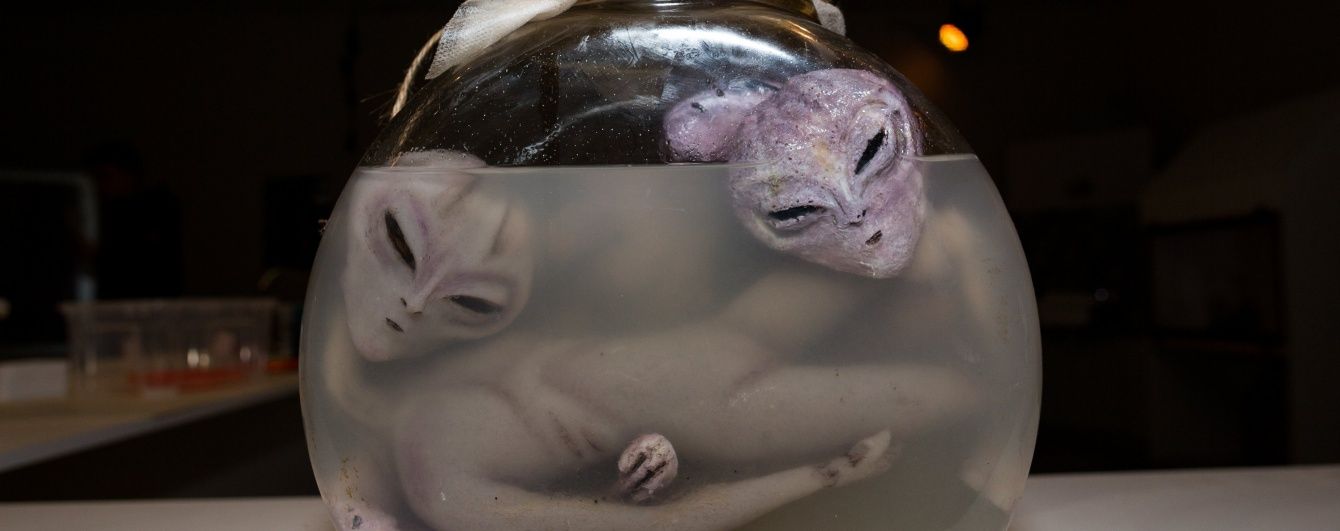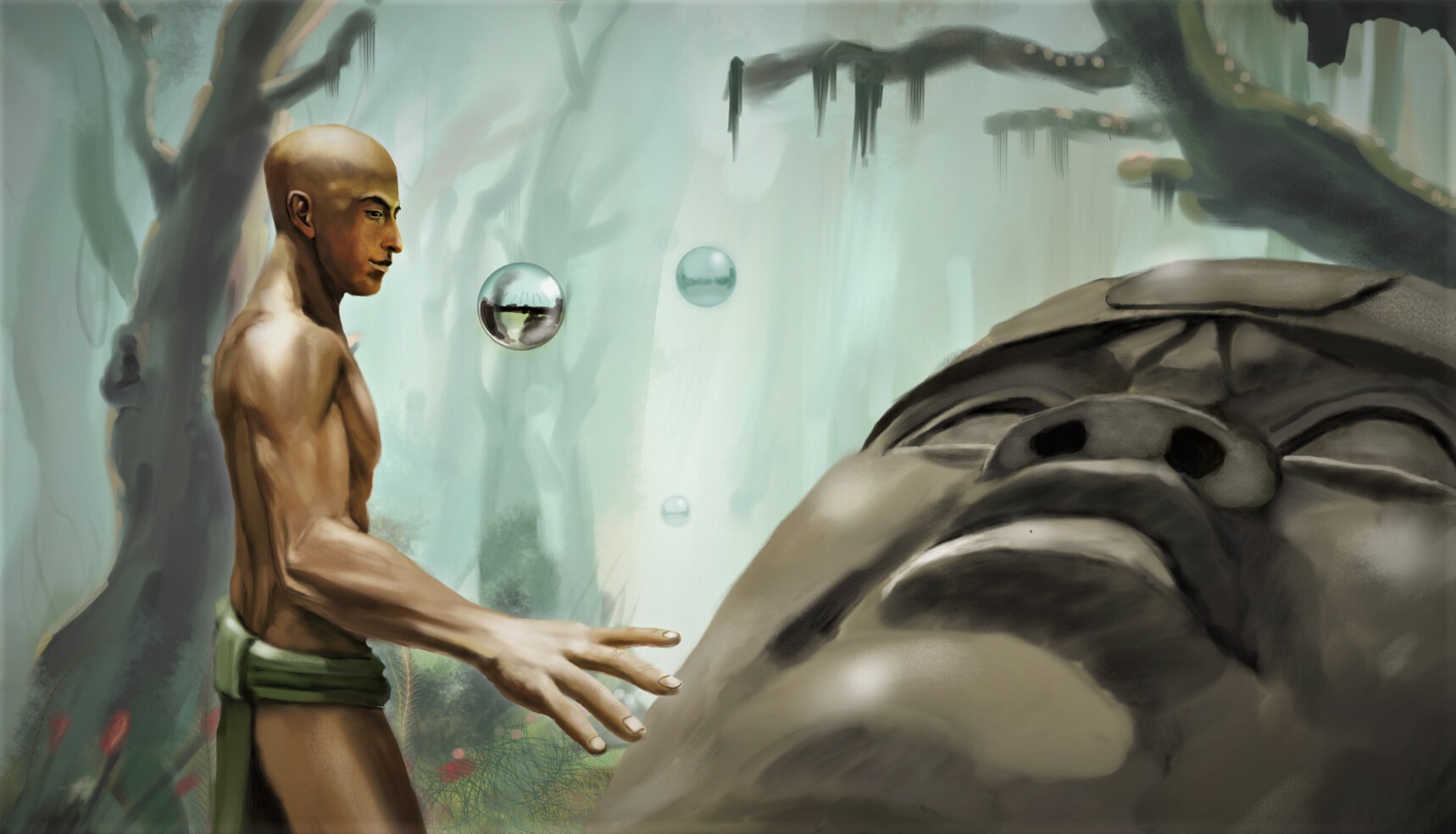




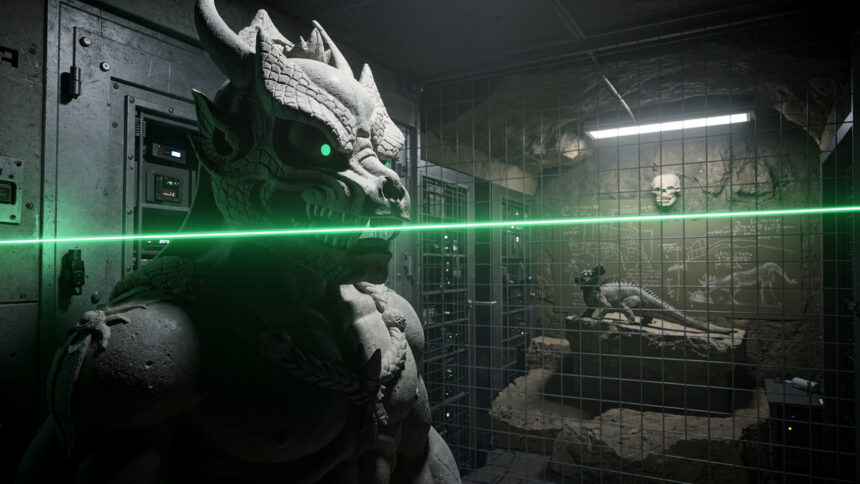
The statue is gone. What replaced it in the record is a private acquisition notice and a wall of non-disclosure agreements thick enough to function as an answer in itself.
The Horyuji temple complex in Nara prefecture, Japan, is the oldest surviving wooden structure on the planet. Built in 607 CE under the patronage of Prince Shotoku, it has stood through fourteen centuries of fire, earthquake, and war as a repository of early Buddhist iconographic tradition. What it also held, in its inner sanctuaries until a removal that was processed quietly through the mechanism of commercial asset acquisition, were statues. Not the serene, stylized Buddhas that anchor every catalogue of the complex. A subset of guardian figures whose anatomical specifications created a problem for every framework that currently manages the official history of the site.
The heads were saurian. Muscular humanoid bodies. Necks that carried the architecture of a serpentine skull with precision that stylized temple art does not produce accidentally. The figures were not decorative. Their placement within the sanctuary followed the positional logic of guardian figures in every tradition that uses them: threshold positions, facing outward, oriented toward whatever the interior space was considered too significant to leave unguarded.
They were removed. The paper trail ends at a private collection with no public catalogue.
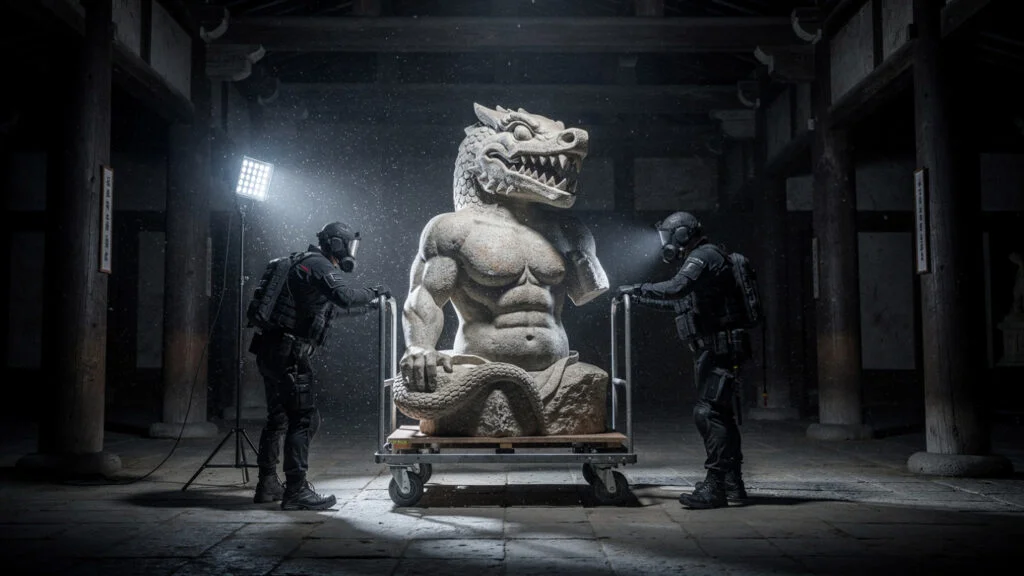
This sequence, anomalous artifact identified, quietly transferred to unverifiable private holdings, official record amended to reflect the absence as though the presence never occurred, is not unique to Nara. It is a pattern with enough documented instances across enough jurisdictions to constitute a methodology rather than a coincidence.
What the Artists Were Drawing
The comfortable explanation for saurian humanoid figures in ancient sacred art is the psychological archetype. The serpent as a symbol of wisdom, transformation, or danger appears across human cultures because the human nervous system has a hardwired response to serpentine forms. The iconography, in this reading, is the projection of a universal fear onto a convenient physical template.
This explanation requires ignoring the specificity of the figures.
A psychological archetype produces generalized serpent imagery. It produces the stylized coil, the abstracted scale pattern, the symbolic staff. It does not produce anatomically consistent bipedal humanoids with saurian facial architecture, human limb proportions, and physical attributes that recur with morphological precision across cultures separated by oceans and millennia.
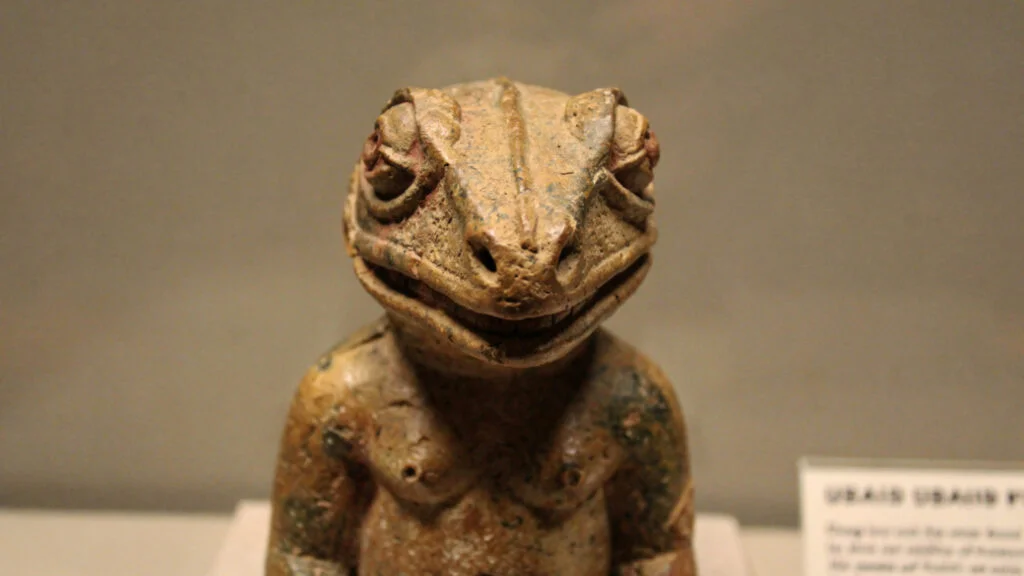
The Ubaid figurines predate every civilization that has been used to explain them. Recovered from Tell al-Ubaid in southern Iraq and dated to between 5500 and 4000 BCE, the figures depict slender humanoids with elongated lizard-like heads, almond eyes set in non-human skull architecture, and in several cases a female figure nursing an infant with the same morphological characteristics. The British Museum holds examples. They are catalogued as ritual objects of uncertain function and their physical characteristics receive minimal commentary in the official literature.

At Kom Ombo in Upper Egypt, the dual temple built during the Ptolemaic period and dedicated jointly to Sobek and Horus, the Sobek carvings present a muscular human body carrying a crocodilian head with a precision of detail, the jaw structure, the orbital ridge, the nasal architecture, that goes beyond the conventional Egyptian convention of animal-headed deities used as symbolic shorthand. The temple at Kom Ombo was built at a site with a pre-existing sacred history. The deity it houses in the Sobek form was not invented by the Ptolemies. They were recording something older.
In Mesoamerica the feathered serpent tradition encoded in Quetzalcoatl and his Mayan equivalent Kukulkan presents a composite: a being that combines avian and serpentine characteristics in a form that the cultures preserving the tradition did not treat as metaphor. The founding myths of multiple Mesoamerican civilizations attribute technological and agricultural knowledge to these figures. The calendar system. The agricultural cycles. The architectural principles encoded in the pyramid complexes whose alignment precision required astronomical knowledge that the conventional timeline of Mesoamerican civilization does not fully account for.
The Vedic Naga tradition is the most explicit in the ancient record about the subterranean dimension. The Nagas are not surface beings. They rule underground kingdoms of considerable sophistication, possess advanced knowledge of medicine, metallurgy, and what the texts call the science of gems, and interact with surface humanity through intermediary figures who have the right of passage between the two levels. The Mahabharata dedicates substantial narrative space to the conflict between the surface and subterranean factions, a conflict whose resolution leaves the Nagas in their underground domain and the surface world under a different administration.
Ecuador. The gold figurines recovered from pre-Columbian sites in the highland regions depict winged figures with elongated skulls and what the researchers who have examined them describe as reptilian skin texture rendered in the metal with a precision that suggests the artists were working from observation rather than imagination. The figurines are small enough to be catalogued as ceremonial objects. They have not generated the institutional attention that their morphological specificity arguably warrants.
The global distribution of this iconographic tradition predates global contact. The artists in Nara and the artists in Mesopotamia and the artists in the Nile valley and the artists in the Ecuadorian highlands were not copying each other. They were drawing what they saw.
What Dale Russell Found in Alberta
In 1982, Canadian paleontologist Dale Russell at the Canadian Museum of Nature published a formal assessment of the evolutionary potential of Stenonychosaurus inequalis, a late Cretaceous theropod dinosaur whose fossil record indicated a brain-to-body ratio significantly exceeding any other known reptile and approaching the lower range of primate values.
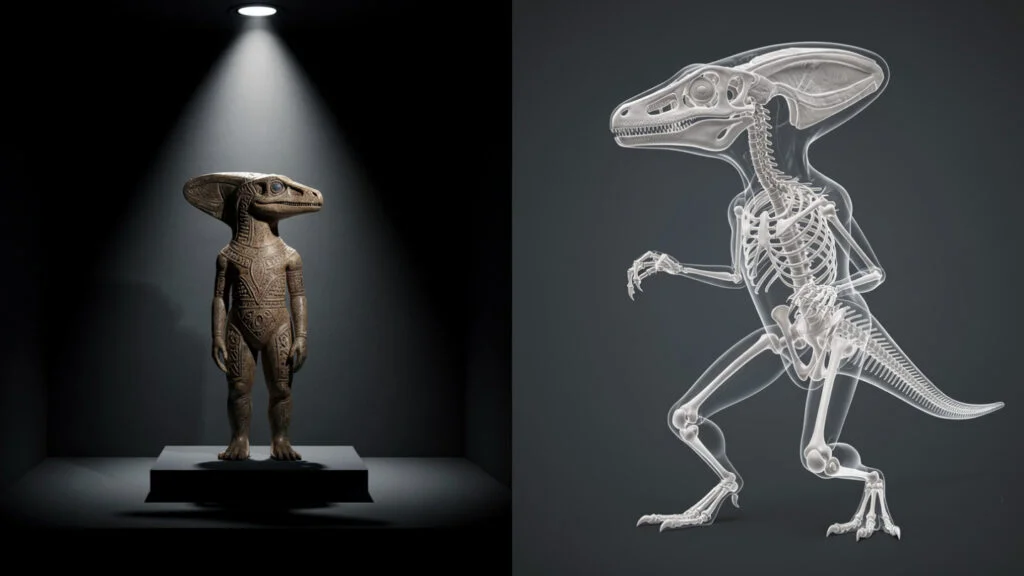
Russell’s question was this: if the extinction event at the end of the Cretaceous period had not occurred, what would the evolutionary trajectory of this lineage have produced over the subsequent sixty-five million years? The morphological modeling he conducted with sculptor Ron Séguin produced what they called the Dinosauroid: a bipedal figure with an enlarged cranial vault, reduced forelimbs, upright posture, and forward-facing eyes indicating predatory stereoscopic vision.
The resulting figure was not human. But it was humanoid in the precise sense that matters: bilaterally symmetric, bipedal, with a cranial architecture capable of housing a brain of sufficient complexity for tool use and social organization. It stood approximately 1.35 meters tall. Its hands retained three fingers with an opposable digit. Its eyes occupied the forward-facing orbital position of an active predator.
Russell’s modeling was published in the peer-reviewed literature. It was received as an interesting intellectual exercise and then filed under paleontological speculation. The implication that the theropod lineage was capable of producing an intelligent bipedal species given sufficient time did not generate the follow-on research that the morphological data would seem to warrant.
The extinction event that prevented Stenonychosaurus from running its full evolutionary course occurred sixty-five million years ago. Modern geology and paleontology date the Chicxulub impact to that same period. What the impact reset, by this reasoning, was not just the surface biosphere. It was the evolutionary trajectory of a lineage that had been running for approximately one hundred and sixty-five million years and had, by the terminal Cretaceous, produced at least one genus with the neurological architecture for intelligence.
Sixty-five million years is a long time to develop an underground civilization if a sufficient remnant population survived the impact event in subterranean environments that the surface extinction did not reach.
The Hinin of the Edo Period
The four-tier social structure of Edo period Japan under the Tokugawa Shogunate is extensively documented: the samurai, the farmers, the artisans, the merchants. Below this structure, outside it in a way that the official taxonomy did not formally accommodate, existed a demographic category recorded in historical documents as Hinin. The word translates directly as non-human.
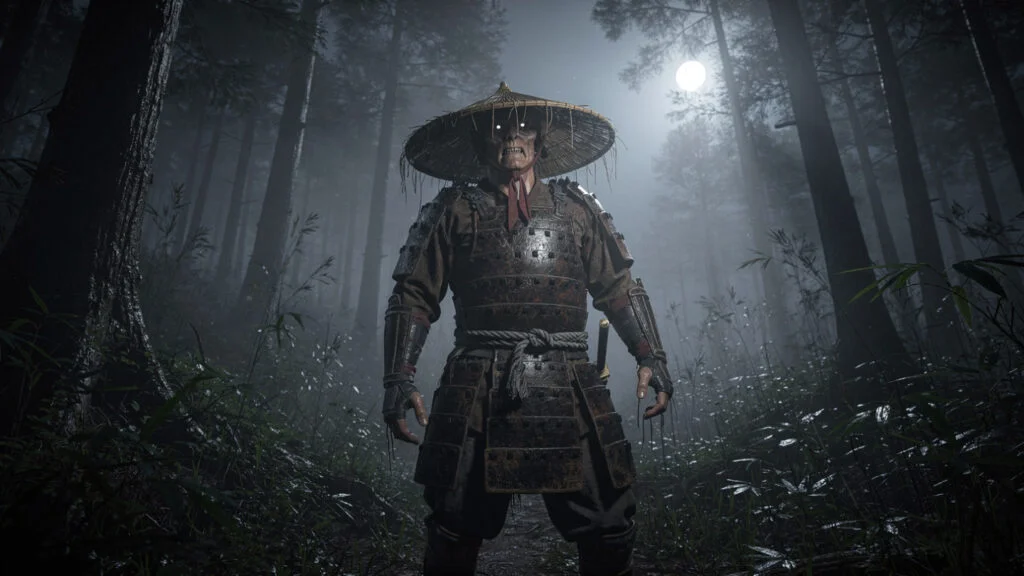
The Hinin were not a criminal class or a conquered ethnic group in the conventional sense. They were confined to territories, primarily dense forest regions and what the records describe as subterranean valley sectors away from human settlements. Their physical attributes are noted in period documents with a specificity suggesting the authors were recording genuine observational data rather than creating a social metaphor: exceptional nocturnal capability, physical strength exceeding the human average, a diet centered on raw animal tissue.
The Shogunate’s relationship with this group was pragmatic. The Hinin were granted exclusive contracts for the manufacture of specialized leather armor and weapon components, industries that the ritual purity codes of mainstream Japanese society designated as contaminating for ordinary citizens. More significantly, they were used as state executioners and enforcement agents, deployed specifically because their presence generated a biological fear response in the general population that conventional samurai enforcers did not produce at the same intensity.
The etymology of the samurai class and its relationship to the enforcement functions developed during the period of Hinin utilization is a direction that academic historiography has not pursued with any particular enthusiasm.
The Gold Requirement
Zecharia Sitchin’s 1976 work The 12th Planet made a claim about the Anunnaki that most commentary has treated as the least credible element of his larger framework. It is arguably the most and therefore the most testable.
The Anunnaki, in Sitchin’s translation of the Sumerian texts, did not come to Earth for territorial expansion or biological curiosity. They came for gold. The scale of the mining operations they established in southern Africa, dated by the archaeologist Michael Tellinger to approximately 200,000 years ago on the basis of the geological age of the mining sites, suggests an industrial rather than a decorative motivation.
The physiological claim embedded in the Sitchin translation is that refined monatomic gold, when processed and consumed, interacts directly with the neurological infrastructure of the Anunnaki in ways that amplified cognitive processing speed and maintained the coherence of what the texts describe as their extended lifespans. This is not a claim Sitchin invented. It is present in the Sumerian source texts in a form that his critics have disputed on translation grounds but not on the grounds of the texts not containing the relevant passages.
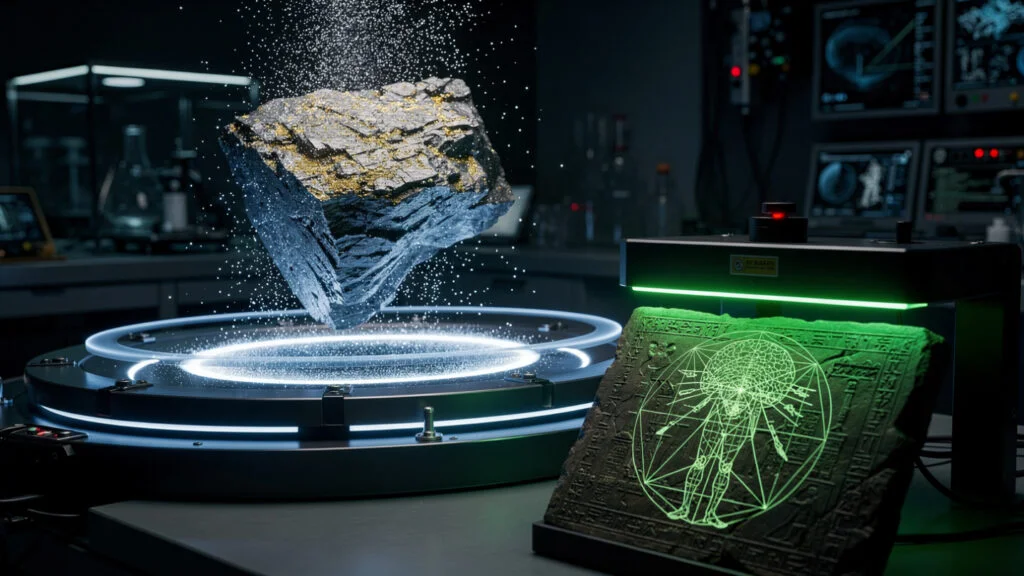
Monatomic gold, also designated orbitally rearranged monatomic elements or ORME gold, is a subject of genuine contemporary materials science. David Hudson’s research in the late 1970s and 1980s identified a class of metallic substances in the transition metal group, including gold, that in their monatomic state display superconductive properties, zero-point energy interactions, and biological effects in human tissue that have not been fully characterized in the peer-reviewed literature. Hudson’s patents exist. The research he commissioned at Cornell University produced results. The institutional follow-up to those results has been minimal in the public domain.
The connection between the ancient physiological claim in the Sumerian texts and the contemporary materials science of monatomic gold has not been formally investigated by any institution with the resources to do so. The absence of that investigation is its own data point.
What the Removal Means
The statues at Horyuji were not the only anomalous artifacts to pass through the mechanism of private acquisition in the past two decades. The pattern recorded across multiple sites and multiple artifact categories, prehistoric giant bones removed from university collections following private approaches with institutional funding attached, pre-deluge manuscripts transferred from public archives to foundations with no public catalogue, anomalous mummies reclassified and removed from display pending ongoing research that has not produced published findings, describes a consistent operational logic.
Objects that introduce a permanent contradiction to the official timeline of human evolution do not survive in public collections indefinitely. The mechanism for their removal does not require conspiracy in the dramatic sense. It requires only that the institutions managing the official timeline have sufficient resources to make the removal financially attractive to the institutions currently holding the contradictory evidence, and sufficient legal frameworks to ensure that non-disclosure becomes a condition of the transaction.
The Horyuji statues introduced a contradiction. Bipedal saurian humanoids rendered with anatomical precision in the guardian positions of one of the oldest and most significant temple complexes in Japan cannot be accommodated within the current official account of what the planet’s intelligent inhabitants have looked like for the past two hundred thousand years.
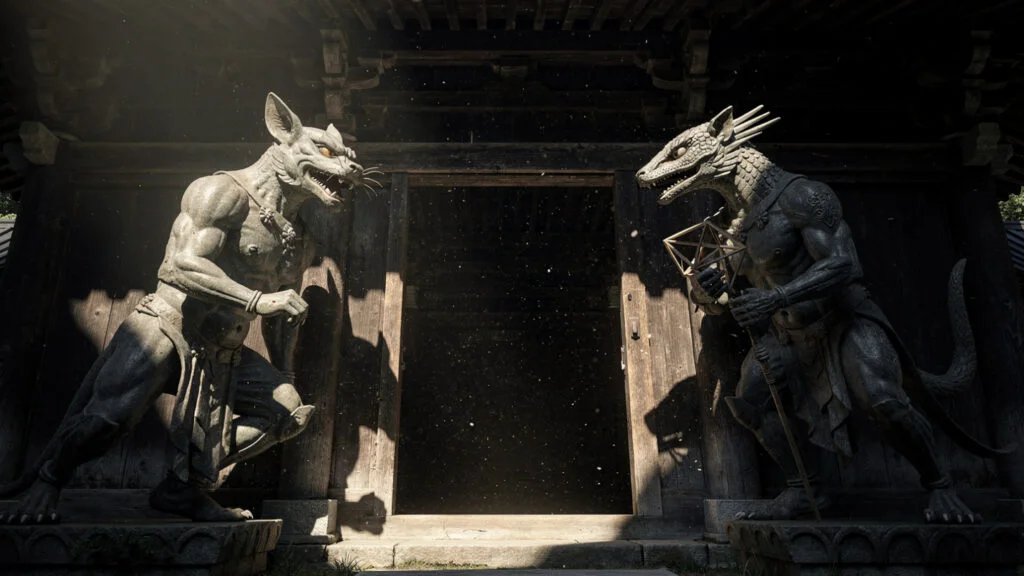
They were removed. The private collection that holds them has not published a catalogue.
The removal is the answer to the question the statues were asking. An institution confident in the official timeline does not spend money removing the evidence that contradicts it.
Dale Russell’s Dinosauroid sits in the Canadian Museum of Nature as a hypothetical. The Ubaid figurines sit in the British Museum as ritual objects of uncertain function. The Naga texts sit in university Sanskrit departments as mythology. The Hinin records sit in Edo period archives as a social curiosity.
Each of them is asking the same question. The answer to each of them is currently in a private collection somewhere, behind a non-disclosure agreement, waiting for the moment when the cost of keeping it there exceeds the cost of what would happen if it were returned to public view.
That calculation has not yet changed.
When it does, the revision to the official account of what has shared this planet with the human species will not be incremental. It will arrive as the thing that was always obvious in retrospect.
The oldest guardian figures in the oldest temple in Japan had saurian heads. The artists who made them were not imagining anything.
That reptilian statue was not hidden because it was fake. It was hidden after people started asking what it actually depicted.