



The word is gone.
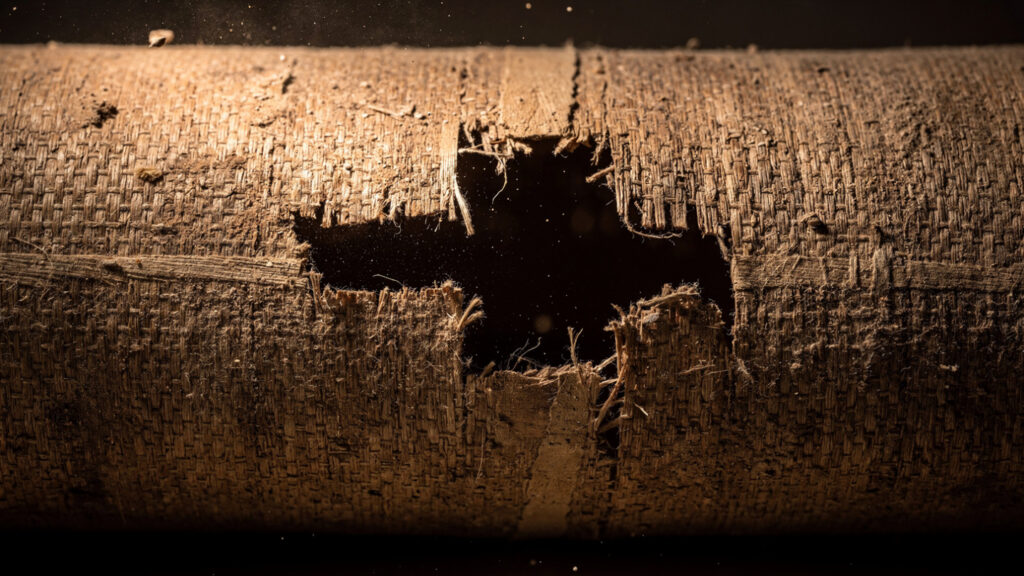
In the Gospel of Philip, one of the fifty-two texts found in a sealed jar near Nag Hammadi in 1945, there is a passage describing the relationship between Jesus and Mary Magdalene. The text states that Jesus loved her more than all the disciples and used to kiss her often on her blank. The word for the location of the kiss is missing. The papyrus is damaged at precisely that point. A hole in the manuscript, caused by the same dry heat and time that preserved every other word in the codex for sixteen centuries, removed the one word that would have resolved the question the passage raises.
Scholars have been arguing about that hole for eighty years.
The argument is not primarily about what the missing word was. It is about what the passage means regardless of which word filled the gap, and what the institutional decision made in 591 CE by Pope Gregory I reveals about why the question was made so difficult to answer in the first place.
These are two separate facts that have never been fully read together: a physical lacuna in a second-century manuscript, and a deliberate misidentification made by the head of the Western church four and a half centuries later. The lacuna preserved ambiguity. The misidentification resolved it in the wrong direction, for reasons the institutional record itself makes visible without ever acknowledging them.
This piece reads them together.
The Physical Object
The Gospel of Philip is Nag Hammadi Codex II, tractate three. The physical manuscript is Coptic, written on papyrus, and dates as a physical object to approximately the fourth century CE, though the tradition it records is older. It is held in the Coptic Museum in Cairo. Scholars can examine it. Photographs of every page are in the public record.
The passage in question appears in what scholars number as logion 55 or 63 depending on the versioning system used. Karen King of Harvard Divinity School, whose scholarship on the Gospel of Philip and on Mary Magdalene’s role in early Christianity is among the most rigorous in the field, translates the surrounding text as follows: the companion of the Savior is Mary Magdalene. The Savior loved her more than all the disciples and used to kiss her often on her mouth. The rest of the disciples were offended by it and expressed disapproval. They said to him, why do you love her more than all of us?
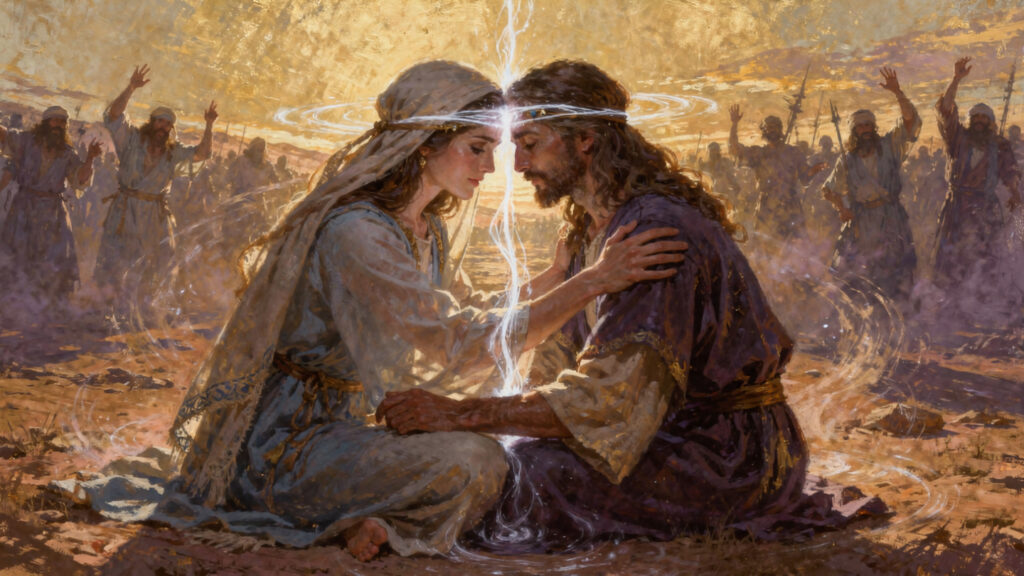
The word mouth in King’s translation is a reconstruction. The Coptic manuscript at that point has a lacuna, a gap where the papyrus is missing. The word for the location of the kiss is not there. What is there is the surrounding grammatical structure, which establishes that the kiss happened on a specific body part and that the disciples’ reaction to it was sufficient to prompt a question about preferential love.
Whether the missing word was mouth, forehead, cheek, hand, or something else entirely changes the passage’s meaning along a spectrum from physical intimacy to ritual spiritual transmission. In the Gnostic theological framework that the Gospel of Philip embodies, the kiss carries a recognized technical meaning: it is the mechanism by which gnosis, direct spiritual knowledge, is transmitted from the teacher to the student. The Gnostic kiss is not necessarily physical. It is the act of transmission itself, the breath carrying knowledge from one consciousness to another.
Whether the disciples’ offense was at physical intimacy or at Mary’s privileged access to transmission that they did not receive, is the question the missing word would have answered. The hole in the papyrus preserves the ambiguity. The 591 CE sermon resolved it by changing the subject entirely.
What the Gospel of Philip Actually Says About Mary
Before examining what Gregory did, it is worth establishing what the Gospel of Philip says about Mary Magdalene in the passages that are not damaged, because those passages are clear and their implications have been consistently underemphasized in the popular discussion of the lacuna.
The word translated as companion in the passage above is the Greek loan word koinonos, which appears in the Coptic text untranslated. Koinonos carries a range of meanings in Greek whose selection depends on context: companion, partner, associate, consort, or spouse. In the New Testament, the same word appears in contexts ranging from business partnership to spiritual fellowship. The Gospel of Philip’s use of it to describe Mary’s relationship with Jesus is, at minimum, a claim about the intimacy and centrality of their relationship, regardless of which end of the semantic range the author intended.
More significant than the koinonos passage is what the Gospel of Philip says about Mary in the context of the syzygy, the Gnostic theological framework of complementary paired principles whose union is required for spiritual completion. The text presents Mary as the figure who completes the divine masculine principle that Jesus embodies. Whether this is a theological statement about Mary’s symbolic function or a statement about her actual relationship with Jesus is the interpretive question the Gnostic framework makes genuinely ambiguous, because in Gnostic theology the symbolic and the actual are not always separable.

Elaine Pagels, whose 1979 book The Gnostic Gospels won the National Book Award and the National Book Critics Circle Award and remains the most accessible scholarly treatment of the Nag Hammadi texts for a general audience, shows that in multiple Gnostic traditions Mary Magdalene is presented as the primary recipient of direct transmission from Jesus, the student whose understanding exceeded that of the male disciples, and the figure whose privileged access to esoteric knowledge made her a problem for traditions that were simultaneously constructing an all-male institutional hierarchy.
The Gospel of Mary, a separate text found in an earlier discovery whose content partially overlaps with the Nag Hammadi tradition, is explicit on this point. In that text, Peter challenges Mary’s authority directly: did he really speak privately with a woman and not openly to us? Did he choose her over us? Mary’s response, and her defense by Levi, reveal an early Christian community in which the question of Mary’s authority and her privileged relationship with Jesus was already a contested institutional matter.
The Gospel of Philip’s lacuna sits in the middle of this institutional contest. The damaged word is not an accident that happened to fall in an unimportant place. It happened to fall at precisely the most contested point in a text whose overall argument gives Mary Magdalene a centrality that the tradition that survived institutional selection systematically denied her.
591 CE: The Homily
On September 14, 591 CE, Pope Gregory I delivered a homily at the Church of San Clemente in Rome. He was addressing the Gospel of Luke’s account of a sinful woman who washed Jesus’s feet with her tears and dried them with her hair. The text does not name the woman. Gregory named her.
He said she was Mary Magdalene.
He also said, in the same homily, that the seven demons cast out of Mary Magdalene by Jesus, described in Luke 8:2, represented the seven deadly sins. Mary Magdalene was therefore, in Gregory’s formulation, a woman from whom seven categories of moral failing had been expelled, and who had expressed her repentance by washing Jesus’s feet in a public display of humble penitence.
The biblical record does not support this identification. The sinful woman of Luke 7 is unnamed and the text provides no basis for identifying her with Mary Magdalene, who appears in the following chapter as a separate figure. The seven demons of Luke 8:2 are described without any specification of their character, simply as demons, with no indication that they represent moral failings rather than, for example, illness or the kind of spiritual affliction that the ancient world attributed to demonic presence in multiple contexts whose moral dimension is not automatic.
Gregory’s homily was not an interpretation that struggled against the textual evidence. It was a deliberate identification made by the head of the Western church, delivered from a pulpit in Rome, whose institutional weight was sufficient to make it doctrine within the tradition that recognized his authority.
The identification had three effects whose combined operation transformed Mary Magdalene’s institutional status completely.
It merged three separate women, the unnamed sinful woman of Luke 7, Mary Magdalene of Luke 8 and the resurrection accounts, and Mary of Bethany of John 11-12, into a single composite figure. The three distinct women of the New Testament became one woman whose characteristics were drawn from all three but whose identity was anchored to the one whose institutional problem Gregory was solving.
It defined Mary Magdalene’s primary identity as a penitent sinner. Whatever she had been before the expulsion of the seven demons, whatever her relationship with Jesus, whatever her role in the community described in the gospels, was now secondary to the fact of her prior sinfulness and her subsequent repentance. The woman who appears in all four gospels as the first witness to the resurrection became, institutionally, the woman who had been a sinner and was saved.
It made her famous for the wrong thing. The Mary Magdalene of subsequent Christian art, literature, and devotion is Gregory’s Mary: the weeping penitent, the reformed sinner, the woman whose love for Jesus expressed itself in tears and humility rather than in the privileged transmission recorded in the Gnostic texts. The image is so deeply embedded in Western cultural consciousness that correcting it requires, for most people, a genuine encounter with what the texts actually say.
What Gregory Knew
The question of whether Gregory’s 591 CE identification was ignorant error or deliberate revision is the analytical question that the institutional context of his papacy most directly addresses.
Gregory was not a careless reader. He was one of the most learned men of the sixth century, whose theological writings rank among the most careful and precise of the early medieval period. His Moralia in Job, a thirty-five volume commentary on the Book of Job, demonstrates an exegetical precision that makes the careless conflation of three distinct women in a single homily implausible as an explanation.
The institutional context of Gregory’s papacy is relevant. He became Pope in 590 CE, one year before the homily. The Western church he inherited was constructing an institutional hierarchy whose structure required the exclusion of women from positions of authority and transmission. The Gnostic traditions that preserved Mary Magdalene’s centrality as a transmitter of gnosis were being actively suppressed, the same suppression that led to someone burying the Nag Hammadi texts in a sealed jar rather than destroying them, at approximately the same historical period that Gregory’s papacy was consolidating institutional orthodoxy.
Whether Gregory knew about the Gospel of Philip’s Mary is not established by the available documentary record. The text was suppressed, not publicly circulating, and its content about Mary would not have been easily accessible to him. But Gregory did not need to know the Gospel of Philip to understand what he was doing. The Gospel of Mary’s contest between Peter and Mary over authority was already recorded in texts that were being suppressed during exactly this period. The tradition of Mary’s privileged access to Jesus was sufficiently present in the communities whose beliefs Gregory’s institution was consolidating against that the institutional problem she represented was real and visible without requiring access to those particular Gnostic texts.
Karen King’s own scholarly position is precise on this point: what we can say is that the identification Gregory made served the institutional interests of a church that was simultaneously arguing that women could not hold positions of teaching authority, and that the primary transmitter of Jesus’s teaching was Peter rather than Mary.
The homily made Mary a penitent. The institutional tradition needed her to not be a teacher.
The Eastern Church’s Different Answer
The Eastern Orthodox tradition never accepted Gregory’s identification. In the Eastern church, Mary Magdalene is remembered as the Apostle to the Apostles, the title derived from John 20’s account in which Jesus appears to her first at the tomb and instructs her to carry the news of the resurrection to the disciples. Her feast day in the Eastern calendar, July 22, celebrates her as an equal to the apostles rather than as a penitent sinner.
The Eastern tradition’s preservation of Mary’s apostolic status is the most direct evidence that Gregory’s 591 CE identification was a Western institutional decision rather than a theological consensus. The same biblical texts available to Gregory were available to the Eastern theologians who read them differently, who did not merge the three women, and who did not define Mary’s primary identity as a sinner reformed.
Two traditions, one body of texts, two completely different institutional identities for the same woman. The difference between them is not exegetical. It is institutional.
The Rehabilitation
The Catholic Church’s official reversal of Gregory’s identification came in 1969, when Pope Paul VI’s revision of the Roman Rite’s calendar separated the three figures Gregory had merged. The unnamed sinful woman of Luke 7 was formally distinguished from Mary Magdalene. Mary of Bethany was similarly distinguished. The 1,378 year old institutional identification was quietly reversed without a formal acknowledgment that it had been wrong.
In 2016, Pope Francis elevated Mary Magdalene’s feast day to the same liturgical status as the feast days of the apostles, the level the Eastern tradition had always assigned it. The Vatican’s press release described her as the Apostle to the Apostles, the Eastern tradition’s title, and characterized her relationship with Jesus as one of profound closeness rather than reformed sinfulness.
The rehabilitation was real. The acknowledgment that the original identification was a deliberate institutional revision rather than an honest exegetical mistake was not made.
The Lacuna and What It Preserves
Return to the hole in the papyrus.
The Gospel of Philip’s damaged word sits at the most contested point in the most contested relationship in the early Christian textual record. Whatever word filled that gap described something between Jesus and Mary Magdalene that the disciples found significant enough to question and that the text’s author found significant enough to record.
If the word was mouth, the passage describes physical intimacy whose particular character the Gnostic framework makes theologically significant rather than simply romantic. If the word was forehead, it describes a transmission gesture whose meaning in the ancient Mediterranean world is the ritual placement of a blessing or a teaching. If the word was cheek, it describes the greeting kiss of the ancient Near Eastern world whose significance in a community under institutional pressure was the public declaration of a relationship of equality and mutual recognition.

In each case, the disciples’ question is the same: why her and not us. The question is about preferential access, not about physical contact. The disciples are asking about transmission, about teaching, about the particular intimacy of a teacher who chose one student over the others for the communication of something they all wanted.
The word that filled the lacuna answered which kind of intimacy the author was describing. The word is gone. The question the disciples asked remains.
Gregory’s 591 CE identification answered a different question entirely: not which intimacy, but what kind of woman. The move is a familiar institutional pattern, visible across multiple suppressed traditions: the substitution of a question about knowledge and authority with a question about moral status, so that the figure whose knowledge and authority presented an institutional problem could be permanently defined by the second question rather than the first.
The Nag Hammadi jar preserved the text with the hole in it. The hole preserved the question. Gregory’s homily was the institutional answer to a different question that made the first one harder to ask for nearly fourteen centuries.
The papyrus is in Cairo. The hole is still there. The word is still missing. The disciples’ question, why her and not us, was never answered by anyone whose answer the institutional tradition preserved.
It was only ever answered by the tradition that got buried.
The Mary Magdalene lacuna is a single damaged word, and an entire later tradition was built on the assumption of what it must have said.