



There is an experience so ordinary that it is almost never examined. A person decides. They choose what to eat, who to call, whether to stay or leave, whether to forgive, whether to believe, whether to speak, whether to remain silent. They make plans for tomorrow and remember decisions from yesterday. They look back at something they did and say, sometimes with satisfaction and sometimes with regret, I chose that. The sentence feels complete. But it contains a question that philosophy has never managed to close.
What exactly makes a choice someone’s own? A person does not choose the genes with which they arrived, the nervous system that determines how intensely they experience fear, reward, stress, or pleasure, their parents, their childhood, their first language, their culture, the economic circumstances into which they were born, the teachers who shaped their early understanding, the accidents that became important memories, or the people whose approval taught them what it meant to be valued. Long before a person is capable of examining any of these influences, they are already participating in the construction of the person who will eventually sit down and make choices. And yet, when that person finally chooses, the experience is unmistakably personal.
This is the Freedom Problem. It is not simply the question of whether human beings possess free will, a question philosophers have debated for more than two millennia without settling what free will would actually require. Some accounts emphasize the ability to have acted otherwise. Others emphasize whether an action genuinely originates in the person, whether it follows from the person’s reasons and values, or whether the person exercises the kind of control required for moral responsibility. The deeper question here is more intimate: how free can a person be when so much of the person doing the choosing was formed before the person knew there was anything to examine?
That question leads somewhere stranger than either extreme. It does not require concluding that free will is an illusion, and it does not require pretending we are completely independent authors of ourselves. It asks whether freedom might exist in degrees, and whether one of the ways it grows is through becoming aware of what previously operated without our attention.
The Self Arrives After the Story Has Already Begun
Imagine a child learning what the world is. The child does not begin with a blank philosophical slate and independently investigate reality. The child enters an already constructed world: words for things before the child understands those things, rules before the child understands why the rules exist, emotional categories before the child can analyze them, family stories before the child can distinguish memory from interpretation, and social expectations before the child possesses the vocabulary to question them. The child learns what counts as good, bad, beautiful, shameful, dangerous, admirable, and normal. Some of those lessons are explicit. Most are not. A child notices what makes adults angry, what earns affection, what receives attention, what produces laughter, what creates embarrassment, and what makes other people withdraw, and the nervous system learns these patterns long before the adult mind develops a theory about them.
This is not evidence of some hidden program controlling humanity. It is something much more ordinary and much more consequential: it is how a human being becomes a human being. Language is inherited. Culture is inherited. Categories are inherited. Much of what we call common sense was already common before we arrived. By adulthood, the conditioning can become almost invisible precisely because it has become familiar. The person does not experience it as conditioning. The person experiences it as me.

That distinction matters. A belief repeated since childhood can feel like a fact. A fear learned early can feel like intuition. A preference reinforced for decades can feel like identity. A social expectation absorbed so completely that it never has to be spoken can feel like reality itself. The more completely a pattern is internalized, the less it resembles an external influence. It becomes part of the chooser.
Nobody Chooses the Starting Position
Nobody chooses the starting conditions of their life. This does not mean everything that happens afterward is predetermined. It means something more modest and easier to establish: we begin from somewhere we did not select. A person born into one family will encounter different assumptions from a person born into another. A person raised in a society that treats one behavior as admirable may encounter it very differently from someone raised in a society that treats the same behavior as shameful. A person repeatedly rewarded for competition may develop different instincts than someone repeatedly rewarded for cooperation.
None of this means culture determines every belief. Human beings resist their environments all the time. People reject the religion in which they were raised. They leave political movements they once defended. They abandon family expectations. They recover from destructive patterns. They deliberately cultivate traits their childhood did not encourage. But notice what makes that transformation possible: the person must first encounter something capable of challenging the existing model. A book. A conversation. A relationship. A crisis. A piece of evidence. An experience. Sometimes simply a question that refuses to disappear. The new influence then becomes part of the history that produces the new choice.
This creates a paradox at the heart of the Freedom Problem: we may become freer through causes we did not choose. A teacher can change the direction of a life. A friend can expose a hidden assumption. Therapy can reveal a pattern that once appeared to be personality. Meditation can make an automatic reaction visible. Education can make an inherited belief questionable. The fact that something influenced a person does not automatically make the resulting decision unfree. If it did, freedom would be impossible by definition, because every human decision occurs within a history of influences.

The philosophical debate is therefore not simply about whether causes exist. They obviously do. It is about what kind of causal history is compatible with meaningful agency. Contemporary philosophy contains substantial positions arguing that freedom can coexist with causal determination, while other positions maintain that genuine freedom requires a stronger form of independence from prior causes, and there is no consensus that the empirical discovery of influences on behavior has settled the metaphysical question. That distinction is essential. Otherwise a fascinating scientific question becomes an overconfident philosophical conclusion.
The Brain Does Not Wait for Consciousness
The modern version of the problem becomes more complicated when neuroscience enters the room. Human behavior is not produced by a little conscious executive sitting inside the skull and issuing commands to an otherwise passive machine. Neural processing begins before conscious reflection in many situations, and learned behaviors can become sufficiently automatic that they require little deliberate attention.
The most influential evidence for this came from physiologist Benjamin Libet, who published the finding with three co-authors, Curtis Gleason, Elwood Wright, and Dennis Pearl, in the journal Brain in 1983. Subjects were asked to flick their wrist whenever they felt the spontaneous urge, while EEG recordings tracked their brain activity. Libet’s team found that a measurable buildup of neural activity, the “readiness potential,” began roughly 300 to 500 milliseconds before subjects reported becoming consciously aware of their intention to move. The finding was widely interpreted as evidence that the brain “decides” before consciousness does.
Subsequent analysis has shown that interpretation is considerably more complicated than the popular version suggests. Philosopher Alfred Mele has argued directly, across several books including Effective Intentions and Free: Why Science Hasn’t Disproved Free Will, that Libet’s own data doesn’t establish what the headlines claimed, measuring the precise moment of conscious intention is genuinely difficult, and a readiness potential preceding awareness is not the same as a decision having already been made. Neuroscientist Aaron Schurger went further in 2012, proposing that the readiness potential itself may be a statistical artifact of how the recordings were averaged, a byproduct of ordinary neural noise crossing a threshold rather than a genuine pre-conscious decision signal. That last point is worth protecting from sensationalism: the brain doing something before a person consciously notices it is not the same as science proving that people never choose.
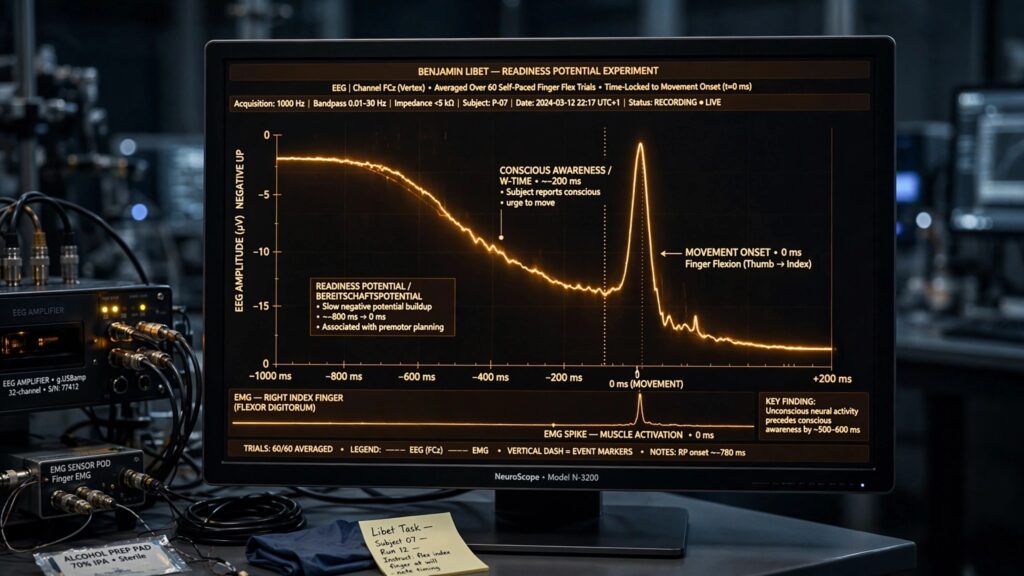
The distinction matters because the popular version of the story is much stronger than the evidence. If a person suddenly decides to move a finger, there may be neural activity preceding the conscious awareness of intending the movement. That tells us something important about the relationship between conscious experience and neural preparation. It does not automatically tell us whether the person had no agency, whether consciousness plays no causal role in the larger decision process, or whether the philosophical concept of free will has been disproved. The scientific result is therefore more interesting than the headline: consciousness may not be the first place where every decision begins. That should change how we understand ourselves. It should not end the conversation.
The First Reaction Is Not Necessarily the Final Choice
Someone is insulted. Before a response can be formulated, the body may already have reacted: attention narrows, muscles tense, anger appears, a memory activates, and the person interprets the event through everything they have previously learned about disrespect, humiliation, status, and threat. Then something else can happen. The reaction is noticed. Not necessarily immediately. Perhaps ten seconds later. Perhaps ten minutes later. Perhaps years later, when a person finally recognizes a pattern that has repeated throughout their life.
But the distinction is important. There is the reaction, and there is the recognition of the reaction. That recognition does not place a person outside their biology, they are still the organism experiencing the anger, and it does not magically create a completely independent self. What it does is introduce another stage into the process. Instead of simply stimulus leading to reaction leading to action, there can be stimulus, reaction, awareness, evaluation, and only then action. The additional stages are not proof of metaphysical freedom, but they are clearly relevant to practical agency. A person who experiences an impulse and immediately obeys it has fewer opportunities for reflection than a person who can notice the impulse before acting, and that difference is not imaginary. It is one reason contemporary discussions of consciousness and agency sometimes consider freedom not as a simple all-or-nothing property but as something that may have degrees or dimensions.
This may be the most useful way into the problem. Instead of asking whether the human being is completely free, ask where freedom appears to increase.
The Space Between Desire and Obedience
Wanting something is not yet an action. Fear is not yet a decision. Believing something does not require defending it. Anger does not require becoming the anger. The distinction sounds simple until it becomes clear how often human beings collapse these stages into one: a desire becomes a command, a fear becomes a prediction, a thought becomes a fact, a feeling becomes a moral verdict, an identity becomes a prison. The person says, “I am this way,” when what may be more accurate is, “This is the pattern that has become easiest for me to repeat.”

That does not mean every recurring pattern is unhealthy, nor that every spontaneous reaction should be distrusted. Automaticity is essential to human life. We could not consciously deliberate about every movement, perception, and decision we make. The goal cannot therefore be to eliminate automatic processes. It is to know which ones deserve examination. That is where freedom becomes less like an abstract metaphysical possession and more like a discipline.
A person cannot choose every thought that enters their mind, but they may be able to choose which thoughts they continue. They cannot choose every emotion that arises, but they may be able to choose what they do with it. They cannot choose the history that formed them, but they may be able to decide which parts of that history continue to govern them. That is a much smaller claim than “human beings are completely free.” It is also a much more defensible one.
The Desire Mistaken for One’s Own
There is another layer. Suppose a person wants something intensely. How do they know the desire belongs to them in the strongest sense? Perhaps they want wealth because wealth represents security, and security became important because instability marked their childhood, an instability never consciously remembered as the source of the ambition. Perhaps the ambition became socially rewarded, and the reward strengthened it, until the original fear disappeared from awareness while the desire remained, and the person simply knows what they want. Or perhaps a person believes they want a particular career because it is prestigious, when what they actually want is the approval that prestige provides. Perhaps someone believes they want an argument won because the argument matters, when what they actually want is to avoid the humiliation of being wrong. Perhaps a person believes they are defending a principle when they are defending an identity.
None of these possibilities can be assumed in any individual case. But the possibility itself is important, because if freedom means acting according to what we genuinely want, we have to ask a prior question: how much do we understand about the origins of what we want? John Locke saw a version of this problem centuries ago when he distinguished between the will, desire, and freedom of action, and asked whether human beings can meaningfully be free in relation to what they themselves will. The question remains difficult precisely because the will is not obviously an independent object standing outside the psychological processes that produce it.

The problem therefore becomes recursive. If I choose according to my desires, what determines my desires? And if I attempt to change my desires, what determines the person attempting the change? There may be no simple point at which an entirely unconditioned self suddenly appears. Perhaps there does not need to be.
When Influence Becomes Manipulation
The question becomes more serious when another person or institution deliberately learns how to shape the conditions under which a person chooses. Influence is unavoidable. Parents influence children. Teachers influence students. Friends influence friends. Art influences audiences. Arguments influence beliefs. Communities influence behavior. No human being can live without influence.
Manipulation is different, although the boundary is not always obvious. Contemporary philosophy distinguishes ordinary influence from more radical forms of manipulation and asks when psychological influence becomes sufficiently intrusive to undermine meaningful agency or consent, a debate that becomes particularly difficult when influence operates through mechanisms people do not consciously notice. Consider the simplest example: a medical treatment can be described in terms of its survival rate or its mortality rate. The numerical information may be equivalent while the framing changes how people respond. Philosophical discussions of manipulation and “nudging” use cases like these to examine whether influencing a person’s decision through psychological mechanisms outside conscious awareness compromises autonomy, or whether such framing is simply an unavoidable part of communication.
That ambiguity matters. If every influence were manipulation, education would be manipulation. If no influence counted as manipulation, almost anything could be justified as persuasion. The important question is therefore not whether someone was influenced. It is whether the influence interfered with the capacities through which a person can understand, evaluate, and revise their own reasons. That gives a more precise definition of the danger: the problem is not that something changes a person’s mind. The problem is when something is designed to change a person’s mind while making it harder for them to notice that their mind is being changed.
The Modern Environment of Choice
This is where an ancient philosophical problem meets a very modern environment. Human beings have always lived inside systems that influence attention and desire. What has changed is the scale at which those influences can now be measured, tested, and optimized. A digital platform can observe what holds a person’s attention. A commercial system can learn which presentation produces a stronger response. A political campaign can test different messages against different audiences. A recommendation system can continually adjust what appears next.
None of this means a person has become a puppet. That would be another overstatement. People ignore advertisements. They resist propaganda. They change platforms. They distrust recommendations. They deliberately seek opposing information. They surprise the systems attempting to predict them. But the environment matters. A decision is never made in a vacuum. The options presented, the information emphasized, the emotional atmosphere surrounding the choice, and the friction attached to each alternative can all influence what becomes easier to choose.
Modern neurotechnology makes the philosophical issue even sharper because some interventions can directly affect nervous-system activity and behavior, raising questions about autonomy, authenticity, identity, and personhood. Current technologies remain limited in what they can accomplish, but the ethical problem is already real: if intervention can change the machinery underlying choice, where does influence end and interference begin? The future version of this problem may not look like someone forcing a person to act. It may look like a system becoming extraordinarily good at arranging the conditions under which the person voluntarily acts.
That is why freedom cannot be reduced to the absence of physical coercion. A person can be physically free and psychologically constrained. A person can have many options and still feel unable to choose among them. A person can possess information and still inhabit an environment designed to determine which information receives attention. The architecture of choice matters.
The Most Dangerous Prison Does Not Feel Like a Prison
There is a reason conditioning is difficult to see. If someone is chained to a wall, the constraint is obvious. If someone is told they are forbidden to leave, the constraint is obvious. But if a person is taught from childhood that leaving would make them worthless, disloyal, sinful, ridiculous, or unsafe, the constraint can eventually operate without anyone standing there to enforce it. The person enforces it themselves.

Again, this does not mean every inherited belief is false. Some inherited rules are wise. Some traditions preserve knowledge that would otherwise disappear. Some cultural constraints protect people from genuine harm. The point is not to become suspicious of everything inherited. It is to become capable of distinguishing inheritance from truth, one of the central disciplines of intellectual freedom.
A belief does not become true because it is ancient. It does not become false because it is ancient either. A desire does not become authentic because it feels intense. A thought does not become reliable because it feels obvious. A social norm does not become morally correct merely because everyone in a community follows it. The ability to ask these questions is not rebellion for its own sake. It is examination, and examination is where the possibility of freedom begins to become concrete.
The Responsibility Problem
But there is a danger on the other side. Once people discover how heavily conditioned human behavior can be, it is tempting to move from understanding to absolution. “I am not responsible. My childhood made me this way.” “My brain made me do it.” “Society conditioned me.” “The algorithm manipulated me.” Some of these statements may contain genuine explanations. Explanation, however, is not automatically exoneration.
A person’s history can explain why a destructive pattern developed without making the pattern harmless. A neurological predisposition can influence behavior without necessarily eliminating every possibility of regulation. Social conditioning can constrain a person without proving that no resistance is possible. This is why free will and moral responsibility have remained so closely connected in philosophy. The question is not merely whether a person caused an action in some ultimate metaphysical sense. It is also what kind of control, awareness, and responsiveness to reasons makes praise, blame, accountability, or forgiveness appropriate.

That creates a difficult but necessary balance. Understanding the machinery should increase compassion without automatically eliminating responsibility. The person who understands why they became angry may become better able to stop repeating the pattern. The person who discovers why they fear abandonment may become better able to stop controlling other people. The person who recognizes inherited prejudice may become capable of challenging it. The person who sees how easily their attention is manipulated may become more deliberate about where they place it. Knowledge of conditioning does not have to become an excuse. It can become the beginning of responsibility.
The Freedom to Examine the Self
Perhaps this is where the entire argument turns. If we cannot choose our starting conditions, perhaps freedom does not begin with choosing who we were. It begins with examining who we became. That examination can be uncomfortable because it threatens the story of the completely self-created individual. We like to imagine that our beliefs are ours because we reasoned our way to them, our preferences are ours because we selected them, and our identity is ours because we deliberately assembled it. Sometimes that is true. Often it is only partly true.

The mature position may be neither pride nor despair. It is curiosity: why do I believe this, why does this frighten me, why do I want this so badly, why does this person make me angry, why does this explanation feel satisfying, what evidence would actually change my mind, and which parts of my identity become threatened when this belief is questioned? These questions do not guarantee correct answers. They do something more modest. They make the machinery visible. And that matters because a process that can be observed can sometimes be interrupted, examined, and altered. Not always. Not perfectly. But sometimes.
Awakening Is Not Becoming Unconditioned
This is where the idea of awakening often goes wrong. There is a seductive fantasy that somewhere beyond conditioning exists a completely pure self, untouched by culture, biology, memory, language, or history, finally liberated from the machinery that shaped ordinary human beings. There is no established scientific evidence for such a person, and the philosophical problem does not require one. If anything, the more interesting possibility is less dramatic: awakening may not mean becoming free from conditioning. It may mean becoming aware of conditioning without being completely governed by it.
The difference is enormous. A person still has a history, still has preferences, still has fears, still possesses an identity, still inhabits a body whose biology influences their experience, still lives inside a language and a culture. But the relationship changes. Instead of saying, “This is simply who I am,” a person can sometimes say, “This is a pattern I have inherited.” Instead of saying, “This must be true because it feels true,” they can ask, “What is producing the feeling of certainty?” Instead of saying, “I had no choice,” they can ask, “At what point did the range of choices become narrower than I realized?” And instead of replacing one rigid belief system with another, a person can remain uncertain long enough to discover what the evidence actually supports.
That may be a more demanding form of awakening than certainty. It is certainly less glamorous. But it is also harder to manipulate.
The Paradox of Becoming Free
There is a final paradox. The more deeply we investigate freedom, the less plausible the completely independent self becomes. The self is embodied, historical, relational, and linguistic. It is shaped by memory, environment, and culture. Its desires have causes. Its beliefs have histories. Its habits have origins. Its identity is partly inherited and partly constructed. Yet from within that conditioned system, something remarkable happens: the system can begin to examine itself.
A human being can become aware of a fear and ask where it came from. A belief can investigate the reasons for believing itself. A habit can notice the moment before it repeats. A culture can become aware of its own assumptions. A civilization can examine the stories through which it understands itself. That does not place consciousness outside causation. It places reflection inside causation. And perhaps that is enough to change what happens next.

The freedom question may therefore have been framed too absolutely for too long. The question is often whether the human being is free or determined, as though the answer must be one word. But a human life is not one moment. It is a sequence. At one moment a person is conditioned. At another, they notice the conditioning. At another, they resist it. At another, they fail. At another, they understand why they failed. At another, they try again. The person who emerges from that process is not an uncaused being, but neither is that person simply identical with every impulse that passes through them.
There is a difference between being moved by something and knowing that one is being moved by it. There is a difference between having a desire and being compelled to obey it. There is a difference between inheriting a worldview and examining it. There is a difference between reacting and responding. Those differences may not solve the metaphysical problem of free will. They may be something more useful. They may describe where human freedom actually lives.
The Uncomfortable Possibility
Perhaps freedom is not the ability to become completely independent of everything that shaped us. Perhaps that kind of freedom was never available. The body has causes. The mind has a history. The personality has conditions. The culture has inherited assumptions. The nervous system carries patterns that began before conscious reflection. No one steps outside all of that. But a person can sometimes step back far enough to see one part of it, and when that happens, the next action does not have to be identical to the last one.
That is a small freedom. It may also be the only kind that can be honestly demonstrated from inside a human life. The mystery is what happens when those small freedoms accumulate. A person notices one pattern, then another. A belief becomes examinable. A fear becomes distinguishable from a fact. A desire becomes something that can be questioned rather than obeyed automatically. An inherited identity becomes something that can be revised. Eventually, the person may discover that what they called “myself” was never a single thing. It was a history, a body, a memory, a culture, a set of habits, a collection of desires, a model of the world, and, somehow, an awareness capable of looking at all of them.

That does not prove that consciousness is separate from the machinery that produces it. It does not prove that we possess metaphysical freedom. It does not prove that awakening reveals another layer of reality. It establishes something smaller, something we can actually observe: a human being can become aware of the forces that shape the human being. And once that happens, the future is no longer merely a repetition of the past. Not necessarily. Not completely. But enough to make the question of freedom worth asking again.
Because perhaps the opposite of freedom is not being caused. Perhaps the opposite of freedom is being caused without ever knowing it. And perhaps the beginning of freedom is not the discovery of an untouched self waiting somewhere behind the conditioning, but the moment the conditioning becomes visible. That is where the next choice begins.
The Foundations