




There is a problem hidden inside every attempt to understand reality, and it is so obvious that we almost never see it.
The instrument doing the investigating is itself part of the thing being investigated. We do not stand outside reality and look in. We are organisms inside reality, using nervous systems that evolved inside reality, equipped with senses that sample only a fraction of what exists, brains that compress those signals into usable representations, memories that alter what we notice, languages that divide experience into categories, cultures that teach us which categories matter, and prior beliefs that influence what we expect to find before the next piece of information arrives. Before consciousness ever asks what reality is, the machinery of consciousness has already decided which portion of reality will become available to the question. This does not mean that reality is imaginary, and it does not mean that everything is subjective. It means something more disturbing and more consequential: whatever reality ultimately is, the reality available to a human observer is always reality through a filter.
This distinction is easy to underestimate because the filter is normally invisible. A healthy visual system does not announce that it has converted electromagnetic radiation into the experience of color. The auditory system does not announce that it has transformed pressure waves into the experience of sound. Memory does not label every recollection as a reconstruction. Attention does not reveal what it discarded. Prediction does not identify the assumptions it used to fill gaps in incoming information. Language does not display the categories it imposed upon an otherwise continuous world. The finished experience simply arrives, apparently complete, apparently immediate, apparently external. The tree appears to be there. The voice appears to be there. The face appears to be there. The threat appears to be there. The self appears to be there. Reality seems to have presented itself directly. Yet between whatever exists outside the observer and the experience occurring inside the observer lies an extraordinarily elaborate process of selection, transformation, prediction, compression, interpretation, and reconstruction.
The central question of this Foundation is therefore not whether reality exists independently of us. That question can become a philosophical maze very quickly. The more useful question is narrower and more dangerous: how much of the reality we experience is supplied by the world, and how much is supplied by the observer?
That question has been asked in different languages for thousands of years. Plato placed human beings inside a cave where representations could be mistaken for reality. Buddhist philosophy examined the way perception, craving, categorization, and identification construct the experienced world. Advaita Vedanta distinguished ultimate reality from the forms through which it is ordinarily apprehended. Descartes discovered that the apparent certainty of the external world could be philosophically suspended. Kant argued that the mind does not encounter reality without structure but experiences phenomena through forms and categories supplied by the conditions of cognition. Phenomenology later turned the investigation toward experience itself, asking how the world appears to consciousness before theoretical explanation is imposed upon it. Modern neuroscience approaches the same territory from another direction, describing perception not as passive reception but as an active process in which the brain continuously combines incoming sensory information with prior expectations to construct its best available model of what is happening.
These traditions do not prove that the universe is a mental construction, nor do they establish that mystical descriptions of reality are literally correct. Their convergence establishes something more modest and, precisely because it is more modest, more difficult to dismiss: the human experience of reality is mediated. We never encounter the world without an observer.
The World Seen Is Not the World the Eyes Receive
The first mistake is to imagine perception as a camera. A camera receives light and records an image. The human visual system does something fundamentally different. Light enters the eye, is converted into neural signals, processed through multiple stages, integrated with information from other sensory systems, compared against expectations and prior representations, and eventually contributes to the conscious experience of a world populated by stable objects, surfaces, distances, colors, faces, movement, and meaning. What is experienced as seeing a cup is therefore not the direct arrival of a cup inside consciousness. It is the result of a biological system inferring the presence of a cup from patterns of information arriving through a sensory channel.
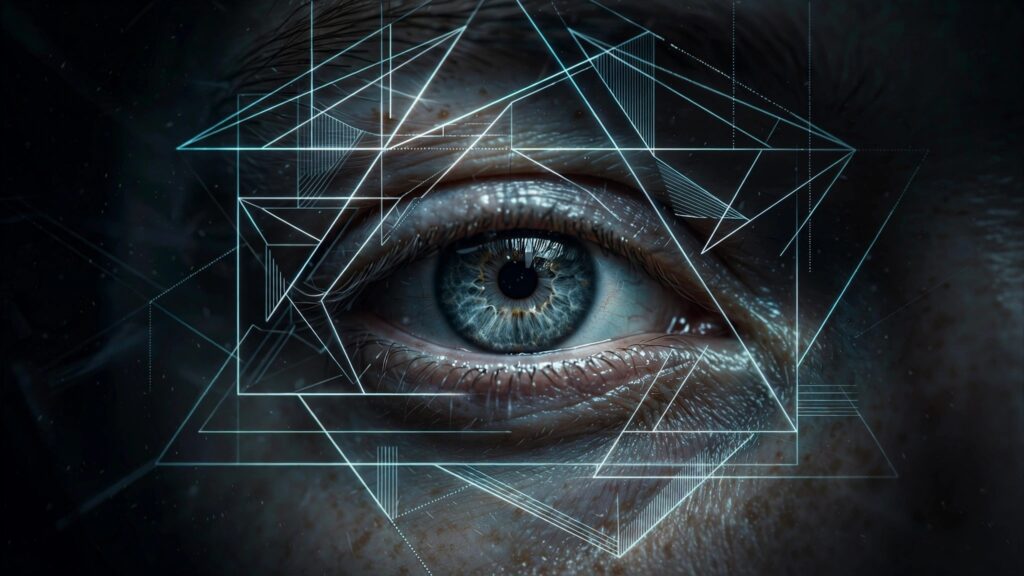
This distinction becomes visible whenever the system is given ambiguous or incomplete information. Optical illusions are not merely entertaining exceptions to normal perception. They reveal the machinery that ordinary perception hides. When two identical stimuli appear different because of surrounding context, when a stationary image appears to move, when a missing object is perceptually completed, or when the same physical stimulus produces different experiences depending upon expectation and context, the observer is being shown something that ordinary consciousness normally conceals: perception is not simply receiving information, perception is interpreting information.
The same principle extends beyond vision. The brain does not wait for complete sensory certainty before constructing experience because complete sensory certainty almost never arrives. Biological systems evolved under conditions of incomplete information. An organism that waited to know exactly what was hiding in the grass before responding to movement would have been selected against by organisms willing to make rapid predictions from ambiguous evidence. The nervous system therefore operates under an ancient computational compromise: infer what is probably happening quickly enough to act, then update the model when new information arrives.
That arrangement is extraordinarily effective. It is also the beginning of the trap.
Because a prediction that works sufficiently well does not feel like a prediction. It feels like reality.
The Brain Does Not Merely Receive the World
Modern theories of perception increasingly describe the brain as an inference-generating system rather than a passive receiver. Predictive-processing frameworks, despite important disagreements over their precise formulation and scope, share a basic intuition: the brain continuously generates expectations about incoming sensory information and adjusts those expectations in response to prediction errors. In this picture, perception emerges from an interaction between signals arriving from the environment and models generated within the nervous system. The observer is therefore not standing at the end of a pipeline in which reality enters unchanged. The observer is participating in the construction of the experience.
This does not mean that the brain invents the external world from nothing. That distinction matters enormously. The fact that perception is constructed does not imply that the object being perceived is fictional. A mountain does not cease to exist because the visual experience of the mountain is neurally constructed. A physical injury does not become imaginary because pain involves interpretation. The external world imposes constraints on the observer, and those constraints are precisely why perception can be useful. The important point is that the conscious experience of the mountain is not identical to the mountain itself. It is the nervous system’s model of the mountain, generated from limited information under particular biological conditions.
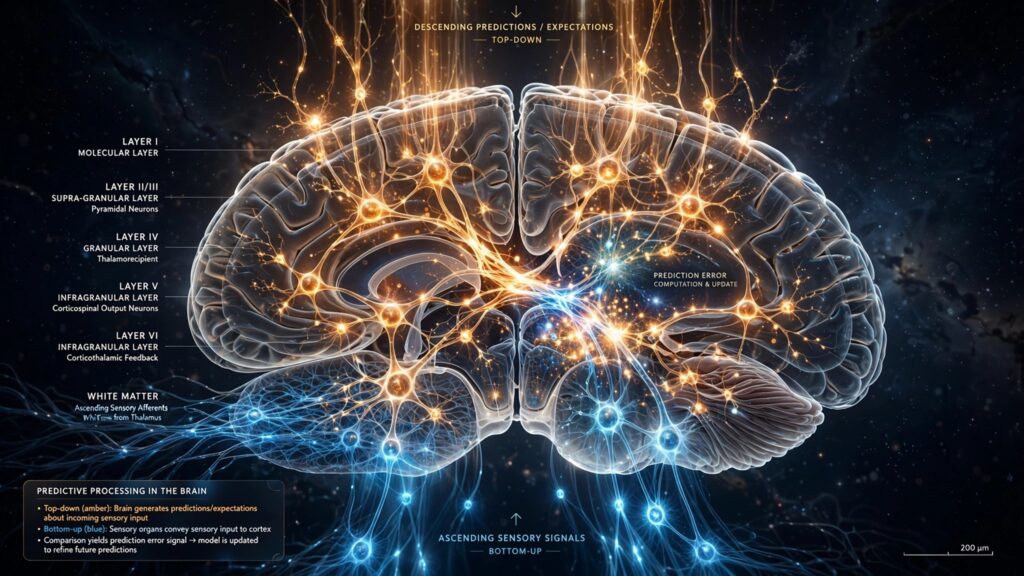
The difference may sound philosophical until its consequences are followed all the way through. If perception is a model, then changing the model can change the experienced world without necessarily changing the underlying physical conditions. Attention can alter what becomes perceptually salient. Expectations can influence interpretation. Context can change meaning. Emotion can change what is noticed and what is ignored. Prior experience can make one person recognize a pattern that another person does not see. Fear can transform an ambiguous sound into a threat. Desire can transform coincidence into significance. Expertise can make previously invisible structure suddenly obvious. The same environment can therefore produce radically different experienced realities in different observers without requiring the external environment itself to change.
The observer is not merely looking at reality. The observer is continuously negotiating a model of reality.
The Unseen World Is Larger Than the Experienced World
There is another implication that is even more fundamental. Human perception is not merely imperfect. It is radically selective. The electromagnetic spectrum extends far beyond the narrow range of wavelengths that human vision can detect. Sound exists across frequencies outside ordinary human hearing. Organisms throughout the natural world possess sensory capacities that humans do not share: some detect polarized light, some perceive ultraviolet patterns, some detect magnetic fields, some sense electrical signals, and many detect chemical information at resolutions inaccessible to us. There is no single universal sensory window through which every organism experiences the same world. There are different biological interfaces sampling different dimensions of a reality that exceeds any one organism’s access.

A bee does not experience the flower exactly as a human does. A bat does not inhabit the same perceptual environment as a human. A dog does not receive the same informational world from a city street that its human companion receives. Yet none of these organisms is necessarily hallucinating the world. Each is extracting a different subset of information from it, using a different biological interface for survival. The question then becomes unavoidable: what would reality look like without any particular organism’s interface?
We do not know.
That answer should be treated not as an intellectual failure but as a boundary condition. Human beings have developed extraordinarily powerful instruments for extending perception beyond biological limits, but every instrument still produces measurements that must ultimately be interpreted by observers using conceptual frameworks. We can detect wavelengths our eyes cannot see, particles our senses cannot perceive, gravitational effects too subtle for direct sensation, and structures separated from us by immense distances, but the data still enters a chain of representation. The instrument extends the filter, it does not eliminate the existence of the filter.
Science is therefore not the abolition of mediation. It is one of humanity’s most sophisticated methods for disciplining mediation. Its extraordinary achievement is not that it gives us a completely unfiltered view from nowhere. It gives observers methods for testing whether their models survive repeated measurement, independent observation, prediction, replication, and attempts at falsification. Science does not remove the observer from the system. It builds procedures designed to prevent any one observer from becoming the system’s unquestioned authority.
Plato Saw the Problem Before Neuroscience Had a Name for It
More than two thousand years before predictive processing became a subject of neuroscience, Plato constructed one of the most enduring thought experiments in Western philosophy: prisoners confined inside a cave mistake shadows projected onto a wall for the structure of reality itself. The allegory is often reduced to a simple lesson about ignorance, but its deeper relevance is epistemological. The prisoners do not merely lack information. They have organized their entire understanding of existence around the information available to them. Their categories, expectations, language, social world, and certainty are all built from the same restricted perceptual environment.
The crucial feature of the cave is therefore not the shadows. It is the observer’s inability to recognize that the shadows are shadows.
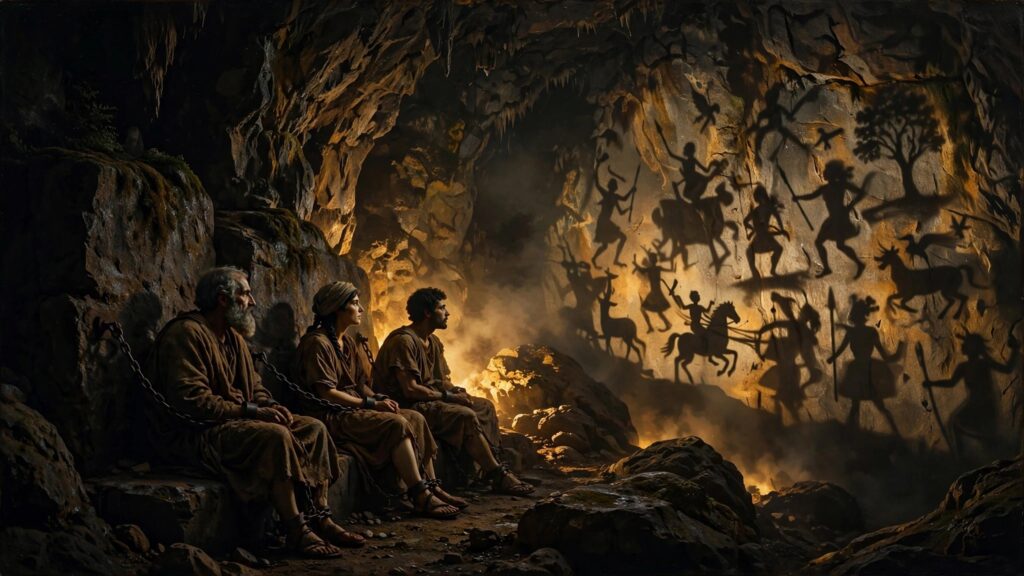
That is the more sophisticated version of the problem confronting modern consciousness. We do not merely experience representations. We normally experience representations as reality. The brain does not place a small label in consciousness saying, “This is an internally generated model constrained by sensory evidence, prior expectation, memory, attention, and biological architecture.” The model arrives with the phenomenological authority of direct experience. That is why the deepest assumptions are often the hardest to see. The observer is most trapped not by a belief it consciously chose but by a structure it mistakes for the world itself.
Kant’s Revolution | Reality and Experience Are Not the Same Question
Immanuel Kant pushed the problem further. His philosophical revolution did not require the claim that the external world is unreal. Instead, he distinguished between whatever reality may be independently of human cognition and the reality as it appears through the structures by which human cognition organizes experience. The distinction is famously expressed through the difference between the noumenon and the phenomenon, although Kant’s position is more precise than the popular shorthand suggests. We do not simply receive a ready-made world. Experience is possible because the mind contributes forms and categories through which sensory information becomes an intelligible world.
This is one of the most important distinctions the Reality Filter must preserve. The claim is not that there is no reality outside perception. The claim is that the reality we experience is reality as rendered through the conditions of the observer. That distinction prevents two opposite errors. The first is naive realism: the assumption that the world appears to consciousness exactly as it exists independently of consciousness. The second is radical subjectivism: the assumption that because perception is constructed, reality itself must therefore be nothing more than personal invention. Both conclusions go further than the evidence permits.

Between those extremes lies a more uncomfortable position: there may be a reality independent of us, but we never encounter it without some mode of access.
The Self Is Part of the Filter
The most consequential component of the filter is not the eye, the ear, or even attention. It is the sense of being a particular person to whom experience is happening.
The ordinary self feels continuous. There is a person who woke yesterday, is reading this sentence today, and expects to exist tomorrow. Memories are experienced as belonging to the same subject. Thoughts appear to be my thoughts. Emotions appear to belong to me. The body feels like the boundary between self and world. The visual field seems to originate from somewhere behind the eyes. Decisions appear to emerge from an internal center of agency. This coherent self-model is so deeply integrated into ordinary consciousness that questioning it can initially seem nonsensical.
Yet neuroscience and cognitive science increasingly reveal that the sense of self is not a single indivisible mechanism. It is assembled from multiple processes involving bodily signals, memory, attention, interoception, social cognition, prediction, autobiographical narrative, and representations of agency and ownership. Disorders of body representation, depersonalization, certain neurological conditions, split-brain research, illusions of body ownership, and carefully controlled experimental manipulations have all demonstrated that aspects of the self that feel fundamental can be altered, divided, displaced, or temporarily reorganized.
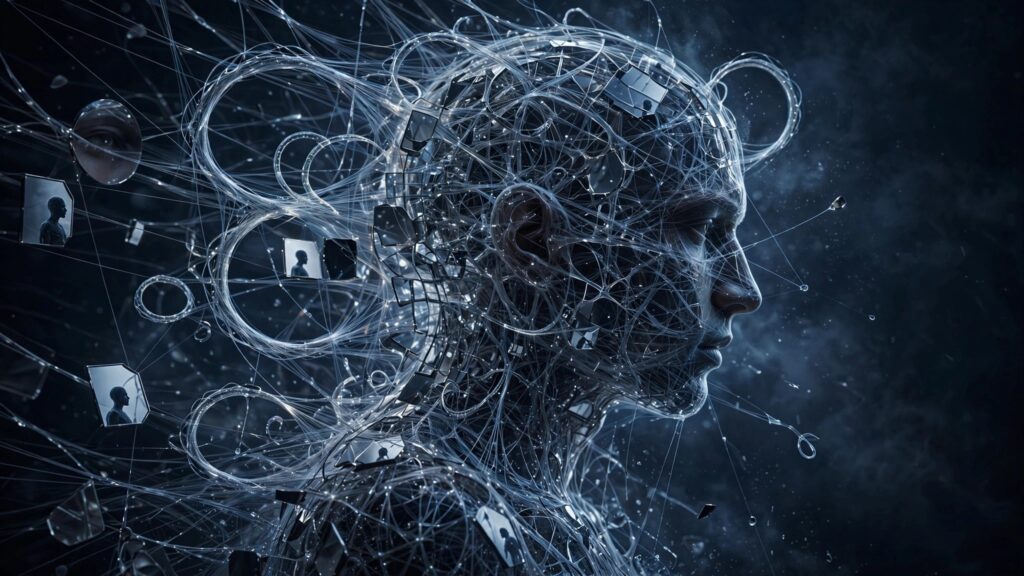
This does not prove that the self is an illusion in the sense that nothing exists. It demonstrates something subtler: the experience of being a self is itself an object of construction. The observer is therefore not outside the filter. The observer, as ordinarily experienced, is one of the things the filter constructs.
That changes the entire problem.
If the self is partly a model generated by the same system that models the external world, then consciousness is not simply constructing a picture of reality and placing a little observer inside it. It is constructing a picture of reality that includes a representation of the observer as one of its central elements. The system is modeling the world and modeling itself modeling the world.
The observer is inside the representation.
Why Beliefs Become Invisible
This is where the Reality Filter becomes socially consequential. A perceptual system that uses prior information to interpret new information will naturally become more efficient as it learns. But the same mechanism that allows expertise can create rigidity. Once a model becomes sufficiently established, incoming information is not encountered in a neutral state. It is evaluated against what the observer already expects. Information consistent with the model is easily incorporated. Ambiguous information can be interpreted in ways that preserve the model. Contradictory information may receive disproportionate scrutiny, be discounted, rationalized, forgotten, or treated as evidence of an external conspiracy against the model itself.
Psychology has documented many versions of this phenomenon under different names, including confirmation bias, motivated reasoning, belief perseverance, attentional bias, and the backfire-like effects that can occur when identity is threatened. These mechanisms do not belong exclusively to one political tribe, one religion, one scientific camp, or one conspiracy community. They are properties of human cognition. That is precisely what makes them dangerous.
A person can become trapped inside a false model while remaining completely sincere. The model does not need to be consciously defended. It can become part of identity, and once identity is involved, information that threatens the model can feel like a threat to the person who holds it. At that point, changing one’s mind is no longer experienced as updating an explanation. It is experienced as losing part of the self.
This is why the observer problem cannot be solved simply by acquiring more information. A person can possess enormous quantities of information and remain trapped inside the same interpretive architecture. More data does not automatically produce more accurate perception if the mechanism selecting, weighting, and interpreting the data remains unchanged.
The problem is not always ignorance.
Sometimes the problem is the architecture through which knowledge is recognized.
Expectation Can Become a Lens
The same principle helps explain why people can inhabit radically different experiential worlds while standing in the same physical environment. Expectation changes attention. Attention changes which information becomes salient. Salience changes interpretation. Interpretation changes emotional response. Emotional response changes subsequent attention. The resulting experience then appears to confirm the original expectation.
A person who expects danger scans constantly for threat and therefore notices ambiguous signals that another person ignores. A person who expects rejection detects hesitation as evidence of rejection. A person trained to see patterns in astronomical data notices structures that a novice overlooks. A musician hears distinctions in sound that an untrained listener cannot easily identify. A physician notices a constellation of symptoms that appears invisible to someone without the relevant model. Expertise therefore demonstrates the constructive power of perception in its most beneficial form: learning changes what the observer can see.
But the same mechanism can operate in the opposite direction. If the learned model is inaccurate, the observer may become exceptionally skilled at detecting evidence for an error. The better the observer becomes at navigating the model, the harder the model can become to escape.
This is the paradox of the Reality Filter: the same machinery that makes us intelligent enough to build models of reality can make us resistant to recognizing that we are inside a model.
The Placebo Is Not Magic. It Is a Warning
The placebo effect provides one of the clearest demonstrations that expectation can alter embodied experience without requiring the expected external mechanism to operate in the ordinary way. Expectations, conditioning, context, learning, and meaning can influence pain, stress, symptoms, and other physiological and subjective outcomes through identifiable biological pathways. The lesson is not that illness is imaginary or that positive thinking can cure everything. The lesson is more precise: what the organism believes is happening can become part of what the organism physically experiences.
The nocebo effect makes the same point from the darker direction. Expectation of harm can contribute to real symptoms and physiological responses. The person does not need to be pretending. The body can participate in the prediction. The expectation becomes part of the causal environment.
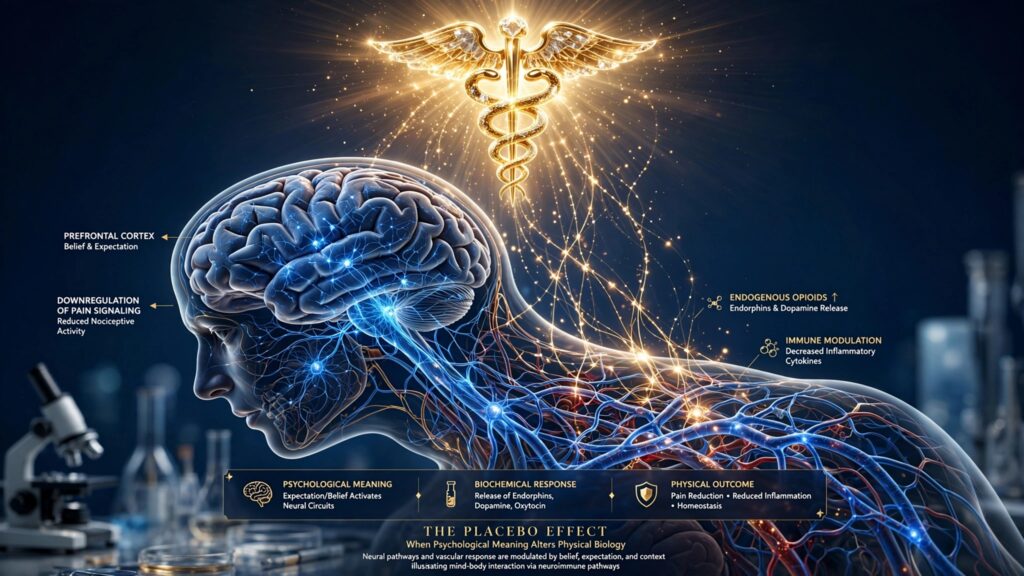
This should permanently complicate the simplistic division between “real” and “imagined.” An experience can be internally generated and still have real consequences. A belief can be mistaken and still alter physiology. A story can be fictional and still change behavior. A symbol can have no physical power over the world and yet possess enormous power over human beings because human beings organize action around meanings.
The filter does not merely determine what we see. It can help determine what happens next.
Culture Builds Filters Before We Are Old Enough to Question Them
No human being enters the world with a completed interpretation of existence. We inherit language, categories, stories, institutions, rituals, moral systems, symbols, family narratives, educational assumptions, social expectations, and definitions of what counts as normal. Before an individual has the cognitive independence to evaluate those structures, they have already become part of the environment through which experience is interpreted.
A child does not merely learn words. The child learns that the world can be divided according to those words. The child does not merely learn a religion, political ideology, national identity, or family mythology. The child learns what kinds of events those frameworks consider meaningful and what kinds of questions they make difficult to ask. Later, when the adult encounters ambiguous evidence, the inherited model is already present, silently influencing which interpretations feel obvious and which feel absurd.

This is why two intelligent people can encounter the same event and honestly report radically different realities. They may not simply disagree about the facts. They may be selecting, weighting, organizing, and interpreting the facts through different inherited models.
Neither person necessarily experiences themselves as interpreting. Each experiences themselves as seeing clearly.
The Algorithm Has Entered the Filter
Modern technology has introduced a new layer into this ancient problem. Human beings once received most of their informational environment from immediate physical surroundings, family, community, institutions, and relatively slow-moving media systems. Digital platforms can now continuously select which information appears in front of an individual, often using behavioral data to optimize for engagement. The result is not merely a larger information environment. It is an increasingly personalized perceptual environment.
An algorithm does not need to convince a person of a proposition directly. It can simply determine which propositions a person encounters repeatedly, which emotional stimuli receive attention, which social identities appear dominant, which examples become salient, which opposing arguments are presented in their weakest forms, and which patterns are reinforced through repetition. The observer then performs the final interpretive work. The machine does not need to construct the belief completely. It only needs to influence the informational conditions under which the belief is constructed.

This creates a historically unusual possibility: the human reality filter can itself become an object of optimization. Attention can be measured. Emotional responses can be measured. Engagement can be measured. Preferences can be inferred. The informational environment can then be adjusted in response. What earlier civilizations achieved through ritual, propaganda, social pressure, or institutional authority can now be supplemented by systems capable of personalizing the stream of information presented to each observer at extraordinary scale.
The deepest manipulation therefore does not necessarily involve making people believe something false. It can involve controlling which possibilities become cognitively available in the first place.
The Spiritual Traditions Were Investigating the Filter From the Inside
This is where the ancient contemplative traditions become relevant, but only if we resist the temptation to use neuroscience as retroactive proof of every mystical doctrine ever proposed. Meditation does not establish Advaita metaphysics. Psychedelic experiences do not automatically prove a spirit world. Near-death experiences do not, by themselves, establish survival of consciousness after death. Mystical certainty is not equivalent to scientific demonstration. These distinctions are essential.
What the contemplative traditions do provide is something different: extraordinarily long-running investigations into the structure of experience itself. Buddhist practices examine attention, craving, identification, perception, and the construction of self. Advaita inquiry asks what remains when the assumptions constituting the separate self are examined directly. Christian contemplative traditions examine the distinction between ordinary mental activity and deeper forms of prayer and awareness. Sufi traditions describe the dissolution of ordinary egoic identification. Taoist traditions investigate the relationship between conceptual distinctions and direct experience. Different traditions interpret their findings differently, but many share a methodological intuition that modern psychology is now rediscovering in secular language: the contents of consciousness are not identical to consciousness itself, and the ordinary sense of self may not be as transparent or fundamental as it appears.
That does not tell us what consciousness ultimately is. It tells us that the observer can become an object of observation.
And once that happens, something extraordinary becomes possible.
The Observer Can Begin to Watch the Filter
Most people experience thoughts as information about reality. A thought appears, and consciousness immediately evaluates its content: true, false, useful, threatening, desirable, offensive, important, irrelevant. Meditation and related practices can introduce a subtle shift in which the thought itself becomes an object of awareness. Instead of simply thinking, “This person is dangerous,” the observer can notice, “There is a perception of danger arising.” Instead of simply believing, “I am a failure,” the observer can notice, “There is a self-referential pattern producing the experience of failure.” The content has not necessarily disappeared. What has changed is the relationship between consciousness and the content.
That distinction is the beginning of metacognition: the capacity to represent one’s own cognitive processes. It is also the point at which the ancient language of awakening begins to acquire a modern psychological interpretation. Awakening, stripped of metaphysical assumptions, can be understood as increasing awareness of the mechanisms through which experience is constructed. The person does not necessarily acquire access to an ultimate cosmic truth. They become less likely to confuse their current model with the whole of reality.
This may sound like a modest achievement until its implications are followed. A person who can observe their own assumptions has acquired a degree of freedom from those assumptions. A person who can distinguish sensation from interpretation has gained freedom from automatically treating interpretation as fact. A person who can recognize emotional activation before acting on it has created a gap between stimulus and behavior. A person who can recognize the construction of identity can begin to question which parts of identity are inherited, which are adaptive, which are defensive, and which remain meaningful after examination.
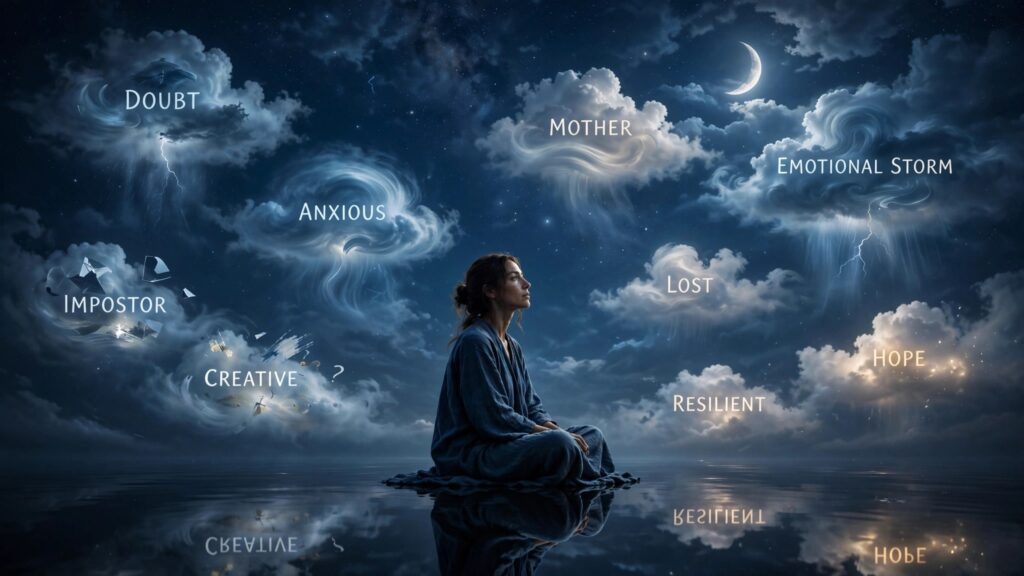
The goal is not to eliminate the filter. That would be impossible while remaining a functioning human organism.
The goal is to become aware that there is a filter.
The Most Dangerous Filter Is the One Believed Already Escaped
This is where every serious investigation of consciousness eventually encounters a trap of its own. Once a person discovers that ordinary perception is filtered, the mind immediately wants to construct a new theory explaining what lies beyond the filter. A person leaves materialism and adopts spirituality. Another leaves religion and adopts materialism. Another discovers simulation theory. Another becomes convinced that consciousness is quantum. Another concludes that ancient civilizations possessed hidden knowledge. Another becomes certain that extraterrestrial intelligence explains the anomalies. Another decides that all of these possibilities are merely psychological projections.
The vocabulary changes. The structure remains.
The observer discovers that one model is incomplete and then mistakes the next model for the territory itself.
This is why skepticism can become a filter just as easily as belief. A person who dismisses every anomaly before investigating it is not necessarily more rational than a person who accepts every anomaly as proof. Both have allowed the conclusion to precede the examination. One protects an existing model by rejecting evidence. The other protects an existing model by absorbing every ambiguity into it. The disciplined position is harder: investigate the anomaly, preserve uncertainty where uncertainty remains, distinguish observation from interpretation, and resist the psychological demand to close the question merely because an open question is uncomfortable.

The mature observer does not ask only, “Is this claim true?” The mature observer also asks, “What would make me believe it? What would make me reject it? Which assumptions are operating before I evaluate the evidence? What evidence am I not noticing? Which part of my identity is attached to the conclusion? And can I still examine the claim if the answer threatens the story I have about myself?”
The Filter Is Not the Enemy
It would be tempting to turn all of this into a condemnation of perception, as though human consciousness were trapped inside a defective machine and enlightenment consisted of escaping the biological interface. That conclusion would be too simple. The filter is not merely a prison. It is also the reason a human being can function.
Reality contains vastly more information than a biological organism can process. A nervous system that attempted to consciously represent every photon, molecule, vibration, chemical gradient, bodily signal, historical memory, possible future, and environmental interaction would not become enlightened. It would become incapable of action. Biological intelligence requires compression. It requires attention. It requires forgetting. It requires prioritization. The filter is therefore not evidence of evolutionary failure. It is one of the conditions that makes conscious life possible.

The problem begins when a useful compression is mistaken for the complete territory.
A map is valuable precisely because it leaves most of the territory out. A map containing every molecule would cease to be useful as a map. The danger arises when the map forgets that it is a map.
Reality Does Not Have to Be Imaginary for Experience to Be Constructed
This distinction deserves to be stated as plainly as possible because it is where discussions of consciousness frequently collapse into false alternatives. If perception is constructed, that does not mean there is no external world. If the self is constructed, that does not mean nothing exists. If the brain interprets sensory signals, that does not mean physical objects are hallucinations. If culture influences belief, that does not mean facts are purely relative. If mystical experiences are shaped by expectation, that does not mean they contain no meaningful information about the person experiencing them.
Construction and reality are not opposites.
A photograph is constructed from light but refers to something outside itself. A scientific model is constructed from observations but can accurately predict phenomena. A map is constructed but can guide a person across a real landscape. A self-model is constructed but can organize a real organism capable of suffering, choosing, loving, remembering, and acting. The existence of mediation does not abolish truth. It makes the problem of truth more demanding.
And Then There Is the Hardest Question
Everything discussed so far concerns the construction of experience. But one question remains underneath it: why is there experience at all?
Neuroscience can increasingly describe correlations between brain activity and conscious states. Psychology can investigate attention, memory, perception, emotion, decision-making, and self-representation. Computational theories can model aspects of cognition. Predictive frameworks can describe how nervous systems may generate increasingly useful models of their environments. None of this, by itself, resolves the philosophical question of why any of those processes should be accompanied by subjective experience in the first place.
There is something it is like to see red. There is something it is like to feel pain. There is something it is like to remember a childhood room, hear music, experience grief, fall in love, become frightened, or sit quietly and notice the movement of one’s own thoughts. The existence of a world-model inside a nervous system is one question. Why that model is accompanied by experience is another.
This is the boundary at which the Reality Filter must stop pretending that one explanatory framework has already won. Materialism, idealism, panpsychism, dualism, emergentism, information-based theories, computational accounts, and spiritual metaphysics each illuminate different aspects of the problem, but none has earned the right to declare the mystery closed merely by naming its preferred ontology.
The honest conclusion is not that consciousness is supernatural.
It is that consciousness remains insufficiently explained.
The Filter Changes the Question of Awakening
If ordinary perception is filtered, if the self is partly constructed, if beliefs influence interpretation, if expectations can influence physiology, if culture supplies categories before conscious reflection begins, and if technology can increasingly manipulate the informational environment from which those categories are built, then awakening cannot simply mean acquiring a more exotic explanation of reality.
It cannot mean replacing one unquestioned belief system with another.
It cannot mean becoming certain that everything is material.
It cannot mean becoming certain that everything is spiritual.
It cannot mean becoming certain that the universe is simulated, that ancient civilizations knew the answer, that mystical experiences reveal another dimension, or that every unexplained phenomenon has a hidden intelligence behind it. Those may be hypotheses worth investigating. They are not substitutes for the investigation itself.
The deeper form of awakening is epistemic before it is metaphysical. It begins when consciousness becomes capable of noticing the machinery by which it turns information into certainty.
The question changes from “What do I believe about reality?” to “How does believing happen inside me?”
That is a much more dangerous question because it cannot be answered by adopting another doctrine. It requires observation of the observer.
The Reality Filter and the Architecture of the Foundations
This is why the Reality Filter belongs near the center of the Foundations. The Whirlpool Principle asks how consciousness becomes entangled in self-reinforcing systems. The Observer Trap asks whether the observer can ever completely step outside the model through which reality is known. The Reality Filter asks what that model is made of: sensation, prediction, memory, attention, language, identity, culture, expectation, and meaning. The Sovereignty Problem will then ask what freedom can possibly mean when the mechanisms producing desire and belief are themselves conditioned. The Meaning Engine will examine how consciousness transforms events into symbols, narratives, and significance. The Death Boundary will confront what happens when the biological conditions supporting the ordinary filter fail. And The Return will ask the question that remains after all the deconstruction: if a human being becomes more aware of the machinery producing experience, how should that person live?
The Foundations therefore do not form a collection of unrelated mysteries. They form a sequence. First, consciousness becomes entangled. Then the observer discovers that it is inside the system it is trying to understand. Then the observer discovers the filter. Then it discovers that even its desires and choices may be conditioned. Then it discovers that meaning itself is something consciousness generates. Then it encounters the ultimate boundary of the biological system. Finally, it has to return to ordinary life without pretending that uncertainty has disappeared.
The Great Error Is Not Seeing a False World
The great error is subtler.
It is seeing a partial world and believing that the partiality is invisible.
Human perception is astonishing precisely because it works. It transforms an overwhelming universe into an environment in which a biological organism can navigate, predict, cooperate, reproduce, create, remember, and survive. The fact that it is filtered is not evidence that it is useless. The fact that it is constructed is not evidence that it is false. The fact that the self is assembled is not evidence that the person is meaningless. The fact that every observer carries assumptions is not evidence that truth does not exist.
It means that truth and experience are not identical.
It means that the world we experience is an achievement of the observer as well as an imprint of whatever exists beyond the observer.
And it means that humility is not an optional virtue in the investigation of reality. It is a methodological necessity.
The Observer Must Become Part of the Experiment
There is a point at which every investigation of reality reaches the same methodological wall. The observer wants to stand outside the system long enough to see the system objectively, but the observer is itself one of the system’s products. We cannot simply step outside perception in order to inspect perception. We cannot remove language and then describe what remains using language. We cannot eliminate every prior assumption before forming another assumption. We cannot become a view from nowhere.
But we can become more aware of the conditions under which we are looking.
That is the possibility hidden inside the problem.
Science does it through methodological controls, replication, adversarial testing, measurement, and communal correction. Philosophy does it by exposing assumptions and following arguments beyond comfortable conclusions. Meditation does it by turning attention toward the processes of attention themselves. Psychology does it by making cognitive biases observable. Art does it by disrupting habitual perception. Education does it by exposing the mind to models different from its inherited ones. Dialogue does it by forcing a private model to encounter another observer’s model. None of these methods produces an omniscient perspective. Together, they can make the filter less invisible.
The objective is therefore not to become an observer without a filter.
There may be no such observer.
The objective is to become an observer who knows that the filter is there.
And That Changes What It Means to Be Certain
Certainty is one of the most powerful experiences consciousness can generate, and one of the easiest to confuse with truth. A conviction can feel absolute because the brain has successfully integrated a perception, interpretation, emotional response, memory, and identity into a coherent model. The feeling of certainty tells us that the system has reached stability. It does not, by itself, tell us that the model corresponds perfectly to reality.
This is why the strongest intellectual position is not permanent skepticism. Permanent skepticism is itself a conclusion about what can be known. The stronger position is calibrated confidence: confidence proportional to evidence, openness proportional to uncertainty, and the willingness to revise a model when reality refuses to cooperate with it.

The same principle applies to extraordinary claims. An anomalous experience can be real without its interpretation being established. A mystical experience can be profound without proving a particular theology. A coincidence can be meaningful to the person who experiences it without establishing a supernatural mechanism. A UAP observation can be genuinely unexplained without proving extraterrestrial visitation. A near-death experience can radically transform someone’s life without automatically settling the metaphysics of consciousness. A psychedelic encounter can feel more real than ordinary reality without establishing what, if anything, exists independently of the brain during that experience.
This is not an attempt to diminish the mystery.
It is an attempt to protect the mystery from our need to explain it too quickly.
The Filter May Be the First Door
For thousands of years, human beings have described moments in which the ordinary organization of experience seems to loosen: contemplative absorption, mystical union, ego dissolution, altered states, profound encounters with nature, near-death experiences, lucid dreams, psychedelic states, and sudden experiences of radical presence. Some interpret these events as contact with God. Others interpret them as contact with deeper consciousness. Others as unusual brain states. Others as evidence of dimensions of reality normally inaccessible to the senses. Still others regard them as psychologically generated experiences with no external referent.
The Reality Filter does not decide between those interpretations.
It asks a prior question: what happens when the ordinary machinery by which reality is organized changes?
That question is scientifically legitimate even when the metaphysical conclusions remain unsettled. If the structure of perception can change, then the structure of the experienced world can change. If the sense of self can change, then the relationship between observer and observed can change. If the observer can become aware of the processes constructing its own experience, then consciousness can begin investigating not merely the contents of reality but the mechanism by which reality becomes present to consciousness at all.
That may be the first genuine step beyond the cave.
What We Know. What We Don’t. What Remains Open.
What we know is that human perception is selective, mediated, and dependent upon biological and cognitive processes. We know that sensory systems do not provide exhaustive access to the physical environment. We know that attention determines which information receives processing priority. We know that memory is reconstructive rather than a perfect recording. We know that expectations, context, learning, and prior beliefs can influence perception and interpretation. We know that the sense of self has multiple components and can be experimentally and neurologically altered. We know that cultural and linguistic frameworks shape how human beings categorize and describe experience. We know that social and technological environments can influence what information people encounter and therefore influence the conditions under which beliefs are formed.
What we do not know is whether human consciousness can ever access reality completely independently of the structures that make human experience possible. We do not know whether the brain is best understood as generating consciousness, transmitting it, constraining it, or participating in a relationship more complicated than any of those metaphors capture. We do not know whether altered states reveal previously inaccessible aspects of an external reality or primarily reveal the extraordinary generative capacity of the nervous system. We do not know whether mystical traditions have correctly identified a metaphysical reality beyond ordinary perception or have developed sophisticated descriptions of unusual but entirely endogenous states of consciousness.
And we should resist the temptation to turn those unknowns into certainty simply because the questions are profound.
But something important has already been established before any metaphysical conclusion is reached: the observer is not transparent.
We do not simply see reality and then form beliefs about it. We participate in constructing the experienced world through the very mechanisms by which we perceive, remember, interpret, predict, categorize, and identify.
The Question That Remains
Once this is understood, the entire project of understanding reality changes character. The question is no longer simply, “What is out there?” It becomes a paired investigation: What is out there, and what must happen inside the observer for whatever is out there to become an experience?
Those are not the same question.
The first concerns ontology: what exists. The second concerns epistemology and consciousness: how whatever exists becomes known, experienced, interpreted, and turned into a model. Confusing the two is one of the oldest errors in the investigation of reality. A perception is not automatically a fact about the world. A feeling of certainty is not automatically knowledge. A powerful experience is not automatically an external event. And an inability to explain an experience is not evidence that every extraordinary explanation is therefore true.

The discipline required is harder than belief and harder than disbelief.
It is the ability to remain present at the boundary between what has been observed and what has been inferred.
That boundary is where the observer becomes visible.
And once the observer becomes visible, another possibility appears: perhaps the greatest expansion of consciousness is not the acquisition of a larger worldview, but the discovery that every worldview has a viewpoint.
Perhaps the goal is not to find the perfect map.
Perhaps it is to become incapable of mistaking the map for the territory.
Because the moment consciousness recognizes that the world it experiences is filtered, modeled, interpreted, and continuously reconstructed, the old question (What is reality?) opens into a deeper one.
Who, exactly, is doing the seeing?
And if the observer is itself part of the reality it is trying to understand, then perhaps the final frontier is not somewhere beyond the universe.
Perhaps it is the machinery between reality and the experience of being here.
The filter is not the world.
But neither is the world available to us without it.
And that is where the next question begins.
If the observer cannot escape the filter, can it at least become free enough to see the filter while it is operating?
The Foundations