


Paradise Lost is a cathedral built by many architects across centuries, not a single blind man’s window into literal events. John Milton wrote it as a deliberate, self-described epic poem, published in 1667, drawing openly on Homer and Virgil’s classical conventions to retell the biblical Genesis account. But Milton’s own material reaches back further still, into a centuries-older Jewish apocalyptic tradition, the Book of the Watchers within 1 Enoch, composed in the third to first centuries BCE, and its stranger companion text, the Book of Giants, both established sources for exactly the war-in-heaven imagery Milton inherited rather than invented. He was blind for over a decade before he began composing, dictating his verse to members of his household and other amanuenses over a period of years, a painstaking creative process, not passive channeled visions.
That’s a towering, genuine literary achievement built from traceable layers of tradition. It was never intended, by its author or the tradition he drew from, as historical documentation.
Who Milton Actually Was, and How He Actually Wrote
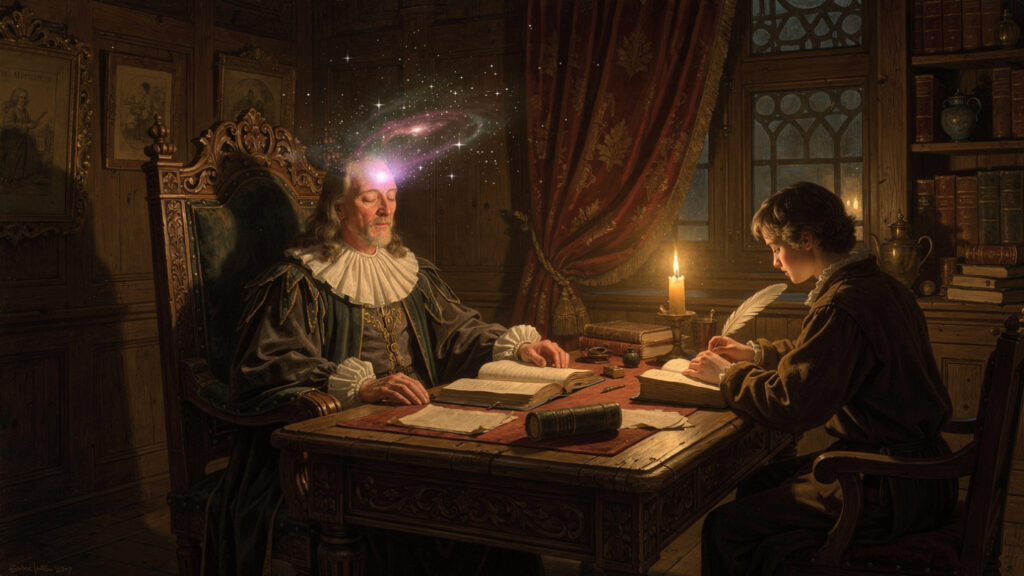
The biography deserves precise telling, since it directly contradicts the “prophet” framing. Milton was born in London in 1608, educated at St. Paul’s School and Cambridge, and spent his career as a political writer and Secretary of Foreign Tongues under Cromwell’s government, penning documented, still-studied pamphlets like Areopagitica in 1644. He went completely blind around 1651-52, a decade before he began composing Paradise Lost. He composed the poem after becoming completely blind, dictating his verse to members of his household and other amanuenses over a period of years, finishing around 1663 and publishing in 1667. That’s a well-attested, painstaking method of composition through memory and daily discipline, not passive reception of nighttime visions. Milton had originally planned an epic about King Arthur before deliberately choosing biblical subject matter instead, a known creative decision, not a discovery imposed on him.
Where the War-in-Heaven Imagery Actually Came From
The sources themselves deserve precise sourcing, since Milton didn’t invent his angelic war from nothing. The Book of the Watchers, part of 1 Enoch, composed in the third to first centuries BCE, describes rebellious angels descending, teaching forbidden knowledge, and facing judgment, actual Aramaic fragments of it, catalogued as 4Q201 through 4Q204, were recovered among the Dead Sea Scrolls and confirm the text predates Christianity entirely. A separate, related text found at Qumran, the Book of Giants, elaborates the same tradition further, and both works name specific figures, including a Watcher leader called Samyaza and another, Azazel, credited with teaching metalworking and weapons-craft. The New Testament itself alludes to this same tradition directly, in Jude 6 and 2 Peter 2:4, without quoting it at length. 1 Enoch remains canonical scripture in the Ethiopian Orthodox Church today. Milton, a formidably well-read scholar of biblical and apocryphal literature, was working within a centuries-deep lineage of angelic-rebellion tradition, not reporting eyewitness testimony of his own.
Why Paradise Lost Reads Like an Epic, Because It Deliberately Is One
This is where the actual literary craft deserves credit. Milton structured the poem explicitly on classical models: beginning in medias res, in the middle of the action, exactly as Homer’s Iliad and Virgil’s Aeneid do, then filling in the War in Heaven’s backstory through Raphael’s later narration. He revised the work into twelve books for its 1674 edition specifically to mirror the Aeneid’s structure. He opens by invoking a muse, a standard classical epic convention Milton adapts to Christian purpose, deliberately signaling to educated readers that he’s writing within an established literary tradition, not making a factual claim to eyewitness knowledge. Scholars have studied these classical borrowings in exhaustive detail for centuries precisely because they’re intentional, sophisticated literary choices, the mark of one of the best-read poets of his era, not evidence of supernatural access to historical events. One nuance is worth holding onto rather than flattening: Milton does write, in Book IX, of a celestial patroness who “deignes / Her nightly visitation” and “dictates to me slumbring,” and he invokes a Heavenly Muse directly in Book III while describing his own blindness. The poem genuinely dramatizes divine inspiration as part of its own literary fabric. What the historical record doesn’t establish is that Milton believed he was literally receiving a verbatim transcript of forgotten history, a meaningful distinction between a poet using inspiration as a classical and biblical trope, and a claim to documentary access.
Abdiel | The Individual Who Refused the Crowd
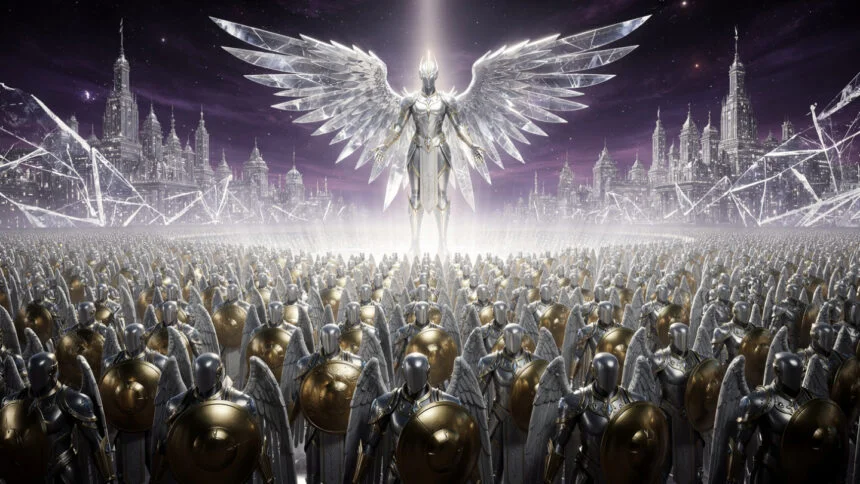
Milton’s Heaven is genuinely worth taking seriously as an imaginative structure, not just a battlefield, complete with military formations, councils, competing loyalties, and political rhetoric, clear evidence of a poet using the vocabulary of armies and empire to make the supernatural intelligible to seventeenth-century readers who understood civil war firsthand. Within that structure, Abdiel is one of Milton’s most interesting inventions: a single angel who hears Satan’s persuasive rhetoric, watches the entire host swayed by it, and alone refuses to follow the crowd. That’s not a minor detail. It’s Milton dramatizing individual conscience resisting collective ideological pressure, a serious theme with obvious relevance to a poet who’d lived through England’s own civil war and watched allegiances shift on a mass scale. The war in Heaven isn’t primarily a battlefield report. It’s Milton’s vehicle for asking what rebellion, authority, persuasion, and conscience actually mean.
From Cosmic Architecture to Human Architecture
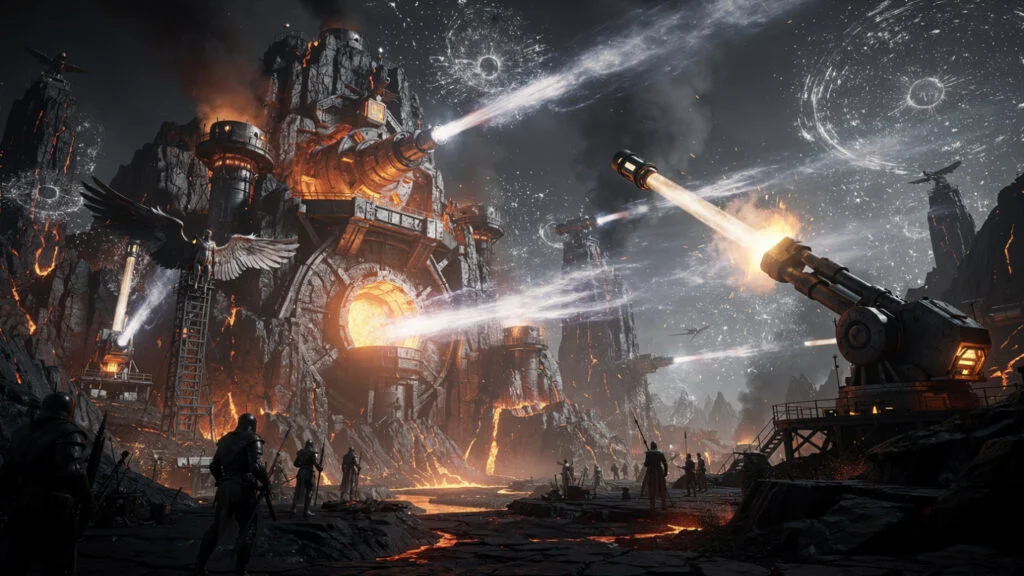
Milton’s fallen angels are described as builders, engineers, and miners, Mulciber raising Pandemonium from gold and volcanic stone. Later speculative traditions often transfer that imagined supernatural engineering onto actual ancient monuments, and that’s precisely where a literary narrative quietly becomes a historical claim, the exact point where the evidence has to be separated from the poetry it borrowed its imagery from.
What the Archaeology Actually Shows
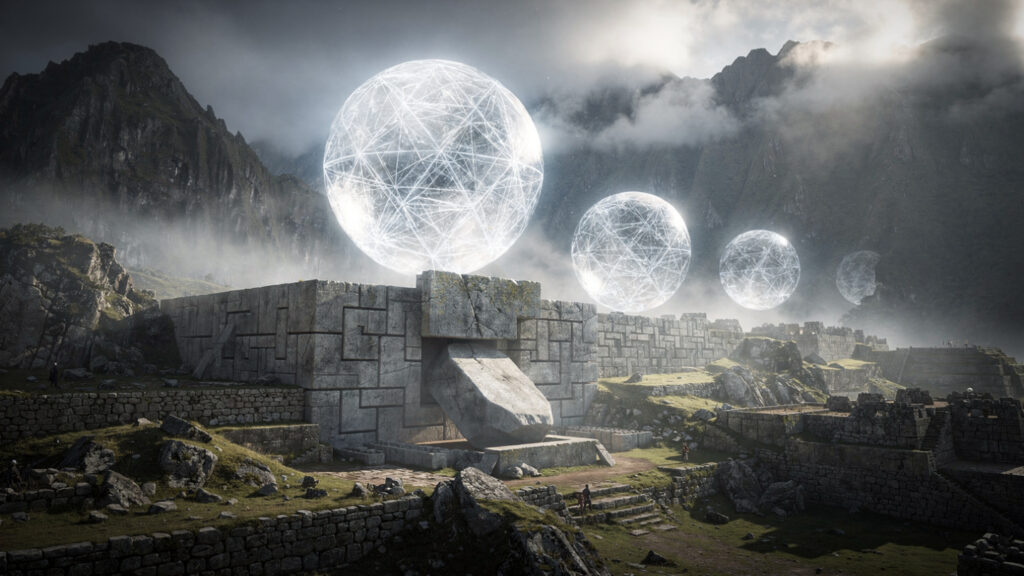
The actual engineering deserves full, accurate credit, since human achievement here is remarkable enough without inventing a builder. At Sacsayhuamán and Ollantaytambo, Inca engineers used documented techniques including controlled abrasion, repeated test-fitting, and possibly limited use of bronze tools to achieve their famously tight stone joints, methods reconstructed by archaeologists and experimentally replicated in modern trials. Baalbek’s massive trilithon blocks were quarried, transported on rollers or sledges, and positioned using ramps, levers, and enormous coordinated labor forces, a documented, staggering feat of Roman-era engineering built on a site with earlier occupation layers. Lalibela’s churches in Ethiopia were carved directly downward out of solid volcanic rock beginning in the 12th century, a known excavation technique, not construction from separate blocks, requiring extraordinary planning but no unknown method. India’s Barabar caves were cut and polished using iron tools and abrasive techniques during the Mauryan period, producing their famous mirror-smooth interior surfaces through extremely skilled, well-attested stonework. Every one of these is a genuine human engineering triumph, independently developed by different civilizations solving the same basic problem, moving and shaping enormous stone, with the tools and organized labor available to them.
When Theology Becomes a Historical Claim
The demon-identification claim deserves genuine comparative-religion context rather than flat correction. Some early Christian writers really did identify pagan deities with demons, a documented historical position with its own intellectual roots, not a modern invention. Ancient thinkers had already developed frameworks for explaining one culture’s gods in another culture’s terms: interpretatio graeca and interpretatio romana, well-documented ancient practices of equating foreign deities with one’s own pantheon, and Euhemerus, a documented fourth-century BCE Greek writer, proposed that gods were originally human rulers later deified, a theory that shaped centuries of later mythography. Christian writers inherited both impulses and added their own theological framework on top, sometimes reading pagan gods as deceptive spirits rather than either human memory or genuine divine beings. That’s a traceable intellectual history worth understanding on its own terms. Baal worship among the Canaanites and Phoenicians, Egyptian religion centered on Osiris, Isis, and Horus, the Greco-Roman pantheon, and Vodou, a living religious tradition with communities and practitioners today, are each documented religious systems with their own extensive histories, and each deserves study within that documented history rather than being flattened into a single demonic-front theory borrowed from a poem never intended as anthropology.
The Question Milton Actually Leaves Us
Milton did not need to be a prophet for Paradise Lost to be extraordinary. The genuine mystery was never whether he secretly recovered a historical record of a war in heaven. It’s how a blind seventeenth-century poet, working in darkness, drawing from scripture, apocryphal tradition stretching back to Qumran, classical epic, theology, and his own political experience of rebellion and civil war, constructed one of the most psychologically and cosmologically elaborate visions of the supernatural ever written, and made it feel internally coherent more than three centuries later. The War in Heaven may not be a historical document. But Milton’s questions about rebellion, authority, persuasion, and individual conscience, the questions Abdiel embodies by refusing to follow the crowd, are unmistakably genuine. That, perhaps, is the more enduring mystery.