



The strangest part of the Watcher story is not that angels came to Earth. It is that they taught.
In the Book of Enoch, a group of heavenly beings descends into the human world, takes human women, produces offspring associated with the giants, and then begins transmitting knowledge that humanity was apparently never meant to possess. The catalogue is remarkably specific: metalworking, enchantment, astrology, the movements of the heavenly bodies, the properties of plants and roots, cosmetics, weapon-making and forms of magical practice.
That changes the question. If the story were simply about angels falling into lust, it would be another ancient account of divine beings violating a boundary. But Enoch makes knowledge itself part of the transgression. Something crosses from the celestial world into the human one, and what crosses is not merely blood or sexuality. It is information.
The text is not evidence that supernatural beings actually descended to Mount Hermon and taught prehistoric humanity these things. It cannot establish that. What it does establish is that an ancient Jewish tradition imagined the origins of certain human capabilities as the result of knowledge being transmitted across a forbidden boundary. That is strange enough without pretending we already know what it means.
The Story Behind the Watchers
The Watcher tradition develops an older biblical episode found in Genesis 6, where the “sons of God” see the daughters of men, take them as wives, and produce the figures later associated with the Nephilim. Genesis gives the episode only a few lines. The Book of Enoch turns those few lines into an entire cosmology.
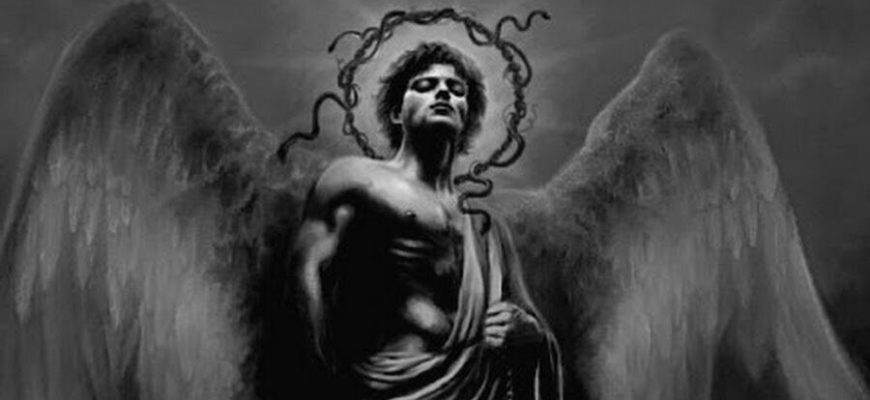
The beings become the Watchers, celestial figures assigned to observe the human world. They descend to Earth, with Mount Hermon becoming the location around which the rebellion is organized, and under the leadership of figures including Shemihazah and Azazel, they cross the boundary between the heavenly and human realms.
The important thing is that Enoch does not treat their descent as an isolated sexual transgression. Their arrival produces consequences for the entire human world. The Watchers teach. And the knowledge they transmit is presented as part of the corruption. That is one of the most distinctive features of the story. The problem is not simply that humanity encounters beings from above. The problem is that humanity receives something from them that it was not supposed to receive.

The Book of Enoch preserves the Watcher story in the Book of the Watchers, the earliest major section of 1 Enoch, alongside a much larger collection of visions, heavenly journeys, astronomical material and apocalyptic judgment. The surviving Ethiopic tradition preserves the complete work, while fragments of several sections, including the Watcher material, were also found among the Dead Sea Scrolls, specifically Aramaic fragments of roughly ten to eleven manuscripts recovered from Qumran Cave 4. The tradition itself therefore belongs to a real ancient literary world, even though the supernatural events it describes remain matters of belief rather than independently established history.
That distinction matters throughout this subject. The text is historical evidence. The events described by the text are not thereby historically verified. The first tells us something certain about ancient thought. The second remains an open question.
What the Watchers Were Supposed to Know
The catalogue of forbidden knowledge is where the story becomes genuinely unusual. In the standard R.H. Charles translation of 1 Enoch, first published in 1912, Azazel is associated with teaching humanity the working of metals, the manufacture of weapons, ornaments, cosmetics and other arts. Other Watchers are associated with enchantments, astrology, the signs of the earth, the movements of the sun and moon, and various forms of occult practice. The exact wording and numbering vary between translations and textual traditions, which is one reason these passages should be cited against a specific edition rather than quoted from an unidentified online translation.
The cumulative effect is remarkable. The Watchers are not portrayed as handing humanity one miraculous invention. They are transmitting a curriculum. Metallurgy. Weapons. Adornment. Magic. Divination. Astronomy. Plants. The hidden structure of the natural world. And knowledge concerning things that the ancient author regards as spiritually dangerous.
That makes the Watcher story fundamentally different from a simple “fallen angel” narrative. It is a story about the origin of knowledge. The ancient author is effectively asking a question that has never disappeared: where did humanity’s dangerous knowledge come from? The answer supplied by Enoch is not gradual human discovery. It is unauthorized transmission.
The Boundary Was the Point
There is a pattern running through the story that becomes easier to see when the individual details are placed together. The Watchers belong to one order of existence. Humanity belongs to another. The boundary between them is supposed to remain intact. Then the Watchers cross it. They take human partners. Their offspring become associated with violence and disorder. And the knowledge of the heavenly beings enters human society.
The entire catastrophe therefore becomes a story about boundaries being breached. The sexual transgression and the intellectual transgression are connected. The Watchers do not merely enter the human world. They bring part of their world with them.
That is why the knowledge catalogue matters so much. If the story were concerned only with illicit sexuality, there would be no need for pages of instruction concerning metals, enchantments, celestial movements and the properties of plants. The author has deliberately connected the corruption of humanity with the acquisition of knowledge that lies outside the proper human order.
This is one reason the Watcher tradition has remained so fertile for later interpretation. The story can be read as theology. It can be read as mythology. It can be read as an ancient attempt to explain the sudden appearance or spread of particular technologies and occult practices. It can even be read, by modern readers, through the language of contact between civilizations. But those readings are not equivalent. The text itself gives us the first layer. Everything beyond it is interpretation.

Azazel and the Technology of Transgression
Azazel is particularly important because his teaching is not abstract. He is associated with the practical arts of civilization. Metals can be worked. Weapons can be manufactured. Decorative materials can be produced. The human body can be altered and adorned. Knowledge becomes capability. And capability becomes power.
That sequence is surprisingly modern. A technology is rarely just information. Once a society knows how to do something, the social possibilities change with it. Metalworking changes warfare. Weapons change political power. Astronomy changes calendars and prediction. Medicinal knowledge changes the relationship between humans and disease. Writing changes memory. Computing changes the relationship between humans and information.
The Enochic author obviously did not possess our technological categories. But the underlying intuition is recognizable: knowledge changes the civilization that possesses it, and some knowledge can be morally dangerous. The Watchers therefore become something more interesting than supernatural villains. They become the mythological embodiment of knowledge arriving before humanity is ready for its consequences. That is an interpretation, not something Enoch explicitly says in those words. But it is an interpretation the structure of the story makes possible.
The Women and the Forbidden Arts
One of the most striking and frequently overlooked elements of the story is the role assigned to the women who receive this knowledge. The Watchers teach various forms of enchantment and occult practice, while other passages associate the transmission with cosmetics, jewelry and the decoration of the body. This has sometimes been turned into a straightforward story about the corruption of women. The ancient material deserves more care than that.
The women are not presented as inventors of the knowledge. They are recipients of it within a story whose central mechanism is knowledge crossing from one order of beings into another. That matters because the underlying pattern appears elsewhere in ancient literature. Humanity encounters something outside the permitted order. The knowledge is acquired. The boundary is crossed. The consequences follow. The same structure appears in different forms in stories about forbidden fruit, stolen fire, illicit divine knowledge and dangerous wisdom.
The Watcher story belongs to that much larger human argument about whether knowledge is always a blessing. Sometimes the most dangerous thing a civilization can acquire is not a weapon. It is an understanding of how the weapon works.
The Giants Are the Consequence
The Watcher story does not end with knowledge. The supernatural beings mate with human women, and their offspring become the giants. In Enoch, the giants’ violence becomes one of the reasons the Earth is filled with corruption and bloodshed. The result is not a glorious hybrid civilization. It is collapse.
This is important because it tells us what the author thinks the knowledge has produced. The Watchers introduce capabilities. Human society absorbs them. The boundary between heaven and earth collapses. The result is not enlightenment. It is disorder.
The narrative eventually turns toward judgment. The Watchers are condemned, their offspring face destruction, and the flood becomes part of the divine response. Later sections of 1 Enoch continue the judgment of Azazel and the other rebellious beings. The message is therefore not simply that forbidden knowledge exists. It is that knowledge without the moral order capable of governing it becomes destructive. That idea has survived remarkably well.
Was This an Ancient Memory of Something Real?
This is where modern interpretation becomes difficult. One possibility is the simplest: the Watcher story is a theological myth created to explain why humanity possesses forms of knowledge that the author regarded as morally corrupting. Another possibility is that the story preserves older traditions about the origins of particular technologies, transformed over generations into supernatural narratives. A third possibility is that the Watchers represent memories of powerful human groups who were later mythologized as divine or semi-divine teachers.
And then there is the interpretation that has become particularly popular in modern alternative history: perhaps the “heavenly beings” were not supernatural entities at all, but visitors from another civilization whose knowledge was perceived by ancient humans as divine. That last interpretation is possible as a speculative reading. It is not established by the text.

There is no archaeological evidence demonstrating that extraterrestrial Watchers landed on Mount Hermon. There is no scientific evidence showing that metallurgy or astronomy was introduced to prehistoric humanity by non-human visitors. The Book of Enoch cannot bear that evidentiary weight. But dismissing the question entirely would also miss something. The ancient text really does describe knowledge arriving from outside humanity’s ordinary order. That is not a modern invention. It is the story. The question is what produced the story.
The Watchers and the Nephilim
The connection to the Nephilim is equally important. Genesis gives only a compressed account of the “sons of God,” the daughters of men and the mighty figures associated with them. The Enochic tradition expands the episode into a much larger explanation of the Nephilim, the Watchers and the violence that precedes the Flood. Later traditions developed the story further, and the relationship between Genesis, 1 Enoch and other Second Temple Jewish writings is complex rather than reducible to one single original account.
That complexity is actually useful. It shows that the Watcher story was not static. It was being interpreted. Expanded. Reworked. Connected to different theological questions. The tradition itself became a living experiment in explaining one of the strangest passages in Genesis. And the question at its center remained remarkably stable: what happened when the boundary between the human and heavenly worlds was crossed?
The Witch Question
This is where the story reaches beyond Enoch itself. Later cultures would develop elaborate categories for people believed to possess hidden knowledge: witches, magicians, diviners, sorcerers, astrologers and healers. Those traditions are historically diverse and cannot simply be traced back to the Watchers. But the conceptual resemblance is worth noticing.
The witch, in many traditions, is dangerous not merely because she possesses power. She is dangerous because she possesses knowledge that ordinary people are not supposed to possess. She knows the hidden properties of plants. She knows spells. She knows rituals. She knows things about bodies, fertility, illness, death and fate.
The Watcher tradition provides one ancient model for explaining where such knowledge might have come from. Not from ordinary human discovery. From a breach. From beings who crossed the boundary and taught humanity what it was not supposed to know. That does not make the Watchers the historical origin of witchcraft. It does show how deeply the idea of forbidden knowledge transmitted by an outsider is embedded in the ancient imagination.

The Prometheus Problem
There is an even larger comparison worth making, carefully. Greek mythology gives humanity Prometheus, who steals fire from the gods and gives it to humans. The Watcher story gives humanity supernatural teachers who transmit forbidden knowledge. The stories are not the same. Their religions, historical contexts and moral structures are different. But the underlying problem is strikingly similar: humanity possesses something it was not originally supposed to possess. Fire. Knowledge. Technology. Power.
The gods, or heavenly beings, possess capabilities beyond the human order. A boundary separates them. Someone crosses it. Humanity receives the forbidden inheritance. And civilization changes forever.
That pattern appears often enough across human cultures to deserve examination without requiring a single historical explanation for every version. Perhaps humans repeatedly invented the same story because knowledge really does feel like stolen fire. Perhaps societies repeatedly remembered moments when powerful outsiders introduced new technologies. Perhaps the stories preserve fragments of older traditions that became mythological. Or perhaps the similarity reflects something deeper about the human relationship with knowledge itself. The evidence does not decide between those possibilities.
What the Book of Enoch Can Actually Establish
This is where the modern reader has to resist two opposite temptations. The first is to dismiss the Watchers as nothing more than primitive superstition and move on. The second is to treat the story as a literal historical report of extraterrestrial intervention. Neither response does justice to the evidence.
The Book of Enoch is an ancient text preserving an elaborate tradition about celestial beings, human beings, forbidden knowledge, hybrid offspring, cosmic boundaries and divine judgment. Its Watcher material has real antiquity and importance within the history of Jewish apocalyptic literature. It also influenced later religious tradition. The New Testament letter of Jude itself contains a tradition about angels who abandoned their proper dwelling and were punished, and separately quotes a prophecy attributed to Enoch almost word for word, a passage long discussed alongside the Watcher story.
What the text does not provide is independent confirmation that the Watchers physically existed. It does not prove extraterrestrials. It does not prove ancient genetic engineering. It does not prove that metallurgy came from another civilization. It does not establish that the women of the story were historical witches. And it certainly does not allow a modern reader to convert every supernatural detail into a technological description simply because the vocabulary feels surprisingly familiar. Those conclusions require evidence from somewhere else. That evidence has not been produced.
But the Story Leaves a Stranger Question Behind
There is nevertheless something here that is difficult to dismiss as merely trivial. The Watcher tradition does not portray humanity as discovering everything alone. It imagines civilization as receiving an inheritance from outside itself. And it treats that inheritance as morally ambiguous from the beginning. The knowledge is useful. It is also dangerous. It makes humanity more capable. It also makes humanity more destructive.
That tension is still with civilization. Every major technological breakthrough creates the same question in a new form. What should humanity know? What should humanity build? What should humanity be allowed to do simply because it has discovered how? And what happens when capability outruns wisdom?
The ancient author answers those questions through angels, giants and divine judgment. The modern world answers them through nuclear weapons, biotechnology, artificial intelligence and systems capable of altering the environment on a planetary scale. The vocabulary has changed. The problem has not.
What If the Watchers Were Never Meant to Be Read Literally?
There is another possibility worth taking seriously. Perhaps the Watchers are not primarily a story about where technology came from. Perhaps they are a story about what happens when knowledge arrives without the wisdom to contain it.
That reading makes the strange catalogue suddenly coherent. Metalworking is power. Weapons are power. Astrology is an attempt to predict the heavens. Magic is an attempt to manipulate hidden forces. Knowledge of plants is power over the body. Cosmetics are power over appearance and social perception. Knowledge of reproduction is power over life itself.
The Watchers hand humanity increasingly powerful ways of intervening in reality. And the ancient author watches the consequences. The result is violence. Perhaps that is the warning buried beneath the mythology. Not that knowledge is evil. That knowledge without responsibility can become indistinguishable from catastrophe.
The Question the Watchers Leave Behind
The most defensible conclusion is therefore also the least sensational. The Watchers are not established historical beings. The Book of Enoch is not an eyewitness report. There is no demonstrated evidence that extraterrestrials taught ancient humanity metallurgy, astrology or magic.
But an ancient tradition really did preserve a remarkably elaborate account in which supernatural beings cross into the human world and transmit knowledge that changes civilization. The tradition connects that transmission to sexuality, technology, occult practice, violence, hybrid offspring and the eventual destruction of the old world. The underlying text is real, the tradition is ancient, and the questions it raises are considerably older than modern theories about ancient astronauts.
And perhaps that is where the story becomes most interesting. Because the Watchers were imagined as dangerous not simply because they were powerful. They were dangerous because they knew something humanity did not know. They crossed a boundary and brought the knowledge back with them.
Whether that is an ancient theological explanation, a mythologized memory of cultural transmission, a symbolic account of civilization’s loss of innocence, or a distorted record of something we still do not understand is a question the text cannot settle. But it leaves humanity with an unsettling possibility: perhaps the oldest stories about forbidden knowledge were never really asking who the Watchers were. Perhaps they were asking what happens to a civilization when it learns something powerful before it has learned what to do with it.
And that question has never stopped being relevant. The fallen angels tradition survived outside the canon for a reason. It kept answering a question Genesis chose to leave alone.