No researcher named Andrey Volkov, no Skoltech genetic-decryption study, no “Book of Nephilim,” and no 2023 declassified documents showing CIA and Vatican suppression appear in any credentialed Dead Sea Scrolls scholarship.
The Established Discovery
The Dead Sea Scrolls were discovered in 1947 by a Bedouin shepherd in caves overlooking Qumran, and archaeologists and biblical scholars have studied them continuously ever since. They rank among the most significant archaeological discoveries of the 20th century, containing ancient copies of biblical texts, sectarian community documents, and apocryphal literature including fragments of the Book of Enoch.
This needs a direct correction: no decryption using “Russian AI algorithms” has produced newly revealed content from the scrolls. Legitimate advances in scroll imaging do exist and are genuinely important, discussed below, but they involve multispectral photography and digital image enhancement of already-known fragments, not the discovery of hidden or previously unreadable text through AI decryption.
The Book of Enoch
The Book of Enoch is genuine, ancient apocryphal literature, and fragments of it were found among the Dead Sea Scrolls. It does describe a “Watchers” narrative involving fallen angels and giant offspring called Nephilim, a well established part of ancient Jewish apocalyptic literature that scholars have studied extensively for over a century.
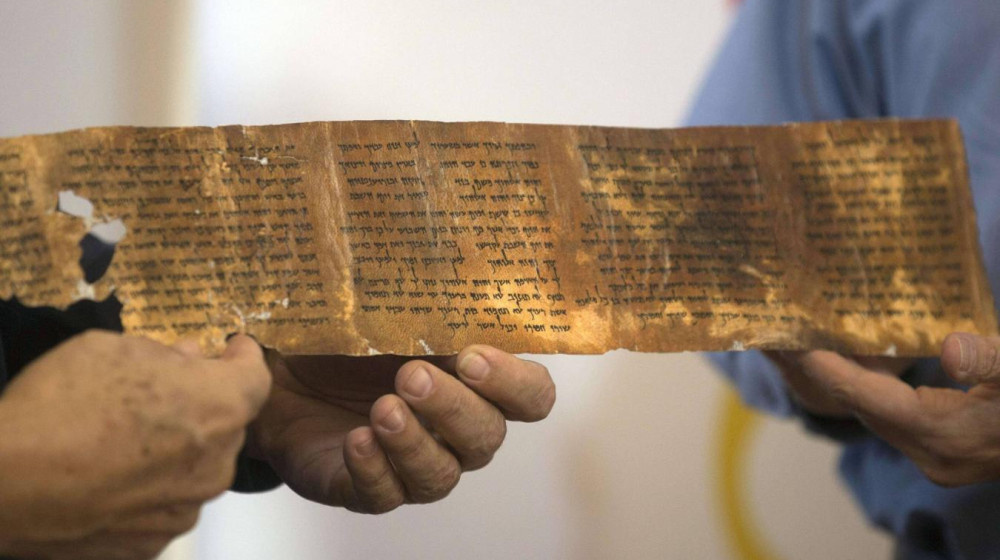
No text called “the Book of Nephilim” exists as a separate, named work within the Dead Sea Scrolls corpus. The Nephilim appear as a motif within Enochic literature and in the Hebrew Bible itself, but this piece’s claim of a distinct “Book of Nephilim” containing genetic-engineering language has no traceable source in any Dead Sea Scrolls catalog or academic publication.
“Andrey Volkov” and the Numerology Claim
No researcher named Andrey Volkov, “Doctor of Historical Sciences,” could be located in connection with the Institute of Oriental Studies of the Russian Academy of Sciences, a real academic institution, or with any published Dead Sea Scrolls research. The specific quote and numerological claim attributed to him has no traceable source in any academic publication.
The Skoltech Study
Skoltech, the Skolkovo Institute of Science and Technology, is a real Russian research university. No published 2024 Skoltech study analyzing Dead Sea Scrolls text against bioengineering terminology could be located in any academic database or science publication. The specific “87 percent” statistic has no traceable source.
The Suppression Story
This needs the most important correction. The well established reason the Dead Sea Scrolls took decades to fully publish had nothing to do with Vatican or CIA suppression. A small international team was granted exclusive publication rights in the 1950s, and this small group worked slowly, creating an academic bottleneck that scholars and journalists criticized for decades as unnecessarily restrictive.
This academic monopoly was broken in a well established 1991 event: the Huntington Library in California, which held a complete photographic set of the scrolls, publicly announced it would make its photographs freely available to all researchers, effectively ending decades of restricted access almost overnight. This mundane story of institutional gatekeeping and its resolution through a library’s decision to open its photographic archive is the actual, verified history, not any coordinated government suppression involving declassified 2023 documents, which don’t exist.
What Scroll Research Is Actually Discovering
Real advances in scroll research are happening, and they’re remarkable enough without invented genetic-engineering claims. Multispectral and infrared imaging techniques, developed and refined by research teams over the past two decades, have revealed previously illegible text on damaged fragments by capturing wavelengths of light beyond normal human vision. Researchers have also used machine learning models to assist in handwriting analysis, helping identify how many different scribes contributed to specific manuscripts, a genuinely fascinating application of modern technology to ancient text, entirely distinct from the piece’s invented “AI decryption” claims.
Conservation scientists continue studying the physical composition of scroll materials, including leather, papyrus, and ink chemistry, using standard, well-established materials science techniques. No published study has reported metal inclusions of unidentifiable composition in any scroll fragment.

Radiocarbon Dating and What It Actually Confirmed
The scientific dating that has actually been performed on the scrolls is worth explaining, since it’s genuinely interesting and directly checkable. Radiocarbon dating conducted at multiple independent laboratories, including testing at the University of Arizona and testing in Zurich, has confirmed the scrolls’ age ranges from roughly the third century BCE to the first century CE, results that closely align with the independent paleographic dating scholars had already established by studying the actual style of the ancient handwriting. This cross-verified dating, two entirely separate scientific methods converging on the same timeframe, is exactly the kind of rigorous, replicated verification that gives scholars confidence in the scrolls’ antiquity and origin, without requiring any invented decryption technology to establish their significance.
The Community Behind the Scrolls
What archaeology has established about who actually produced and used these texts is worth knowing. Excavations at the nearby Qumran settlement, conducted by archaeologists since the 1950s, have uncovered evidence of a structured communal settlement, including ritual bathing pools, communal dining areas, and a scriptorium where scribes likely copied manuscripts. Most scholars connect this settlement and its scrolls to the Essenes, a historically documented Jewish sect mentioned by ancient writers including Josephus and Pliny the Elder, though academic debate continues over the precise details of the community’s identity and practices. This ongoing scholarly conversation, grounded in archaeological evidence and ancient literary sources, represents exactly the kind of legitimate historical uncertainty that research continues to investigate honestly, rather than requiring an invented suppression conspiracy to explain what remains openly debated among scholars.
What the Corpus Actually Contains
The actual breadth of the Dead Sea Scrolls corpus is worth cataloging, since it’s genuinely more diverse and interesting than any single sensational claim could capture. Scholars have identified roughly 900 separate manuscripts among the roughly 15,000 fragments recovered, including copies of nearly every book of the Hebrew Bible, with a complete Isaiah scroll standing as one of the collection’s most celebrated finds. Beyond biblical texts, the corpus includes sectarian legal documents, community rules governing daily life, liturgical poetry and hymns, and astronomical and calendrical texts reflecting the community’s actual, practical concerns about tracking sacred time. This wide-ranging collection offers historians an extraordinarily rich window into ancient Jewish religious and communal life, precisely because it wasn’t curated or selected for dramatic effect. It survived by accident, preserved in dry desert caves, and represents a comprehensive cross-section of what one ancient community actually read, wrote, and valued, considerably more valuable as historical evidence than any single invented artifact could be.
Why the Scrolls Don’t Need Embellishment
The Dead Sea Scrolls are genuinely one of history’s most important archaeological finds, offering direct evidence of Jewish religious life and textual transmission in the centuries surrounding the turn of the era. Biblical scholars, historians, and archaeologists have spent nearly eighty years studying them, publishing peer-reviewed findings that have genuinely reshaped understanding of early Judaism and Christianity’s origins. That substantial scholarly achievement needs no invented genetic engineering, no fabricated Russian institute, and no imaginary suppression conspiracy to remain one of the most significant archaeological stories of the modern era.