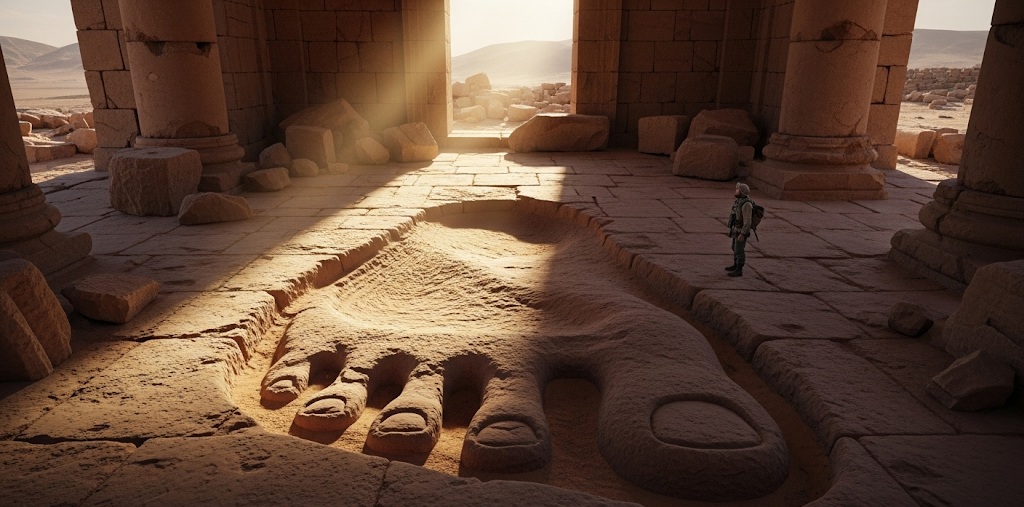
The Rephaim are real figures in ancient Near Eastern literature. The enormous tomb marker associated with Abel is real. The giant footprints carved into the floor of the ancient temple at Ain Dara were real. What is not real is the leap that turns those things into archaeological proof of a vanished race of giant humans.
That distinction matters because the Rephaim story sits at the intersection of several different traditions that are often flattened into one. The Hebrew Bible speaks of Rephaim in more than one context: sometimes as an ancient population associated with unusually powerful warriors, and elsewhere as beings associated with the dead and the underworld. Earlier Ugaritic texts from the Late Bronze Age preserve the related term rpum, apparently connected in some contexts with deceased royal figures or supernatural ancestral beings, although scholars continue to debate exactly how the Ugaritic and biblical traditions developed in relation to one another. Then there are the physical monuments: the enormous so-called tomb of Abel at Nabi Habeel and the extraordinary carved footprints of Ain Dara. Both are genuine. Neither does what the modern giant theory asks them to do.
The Giant Tomb That Isn’t Evidence of a Giant
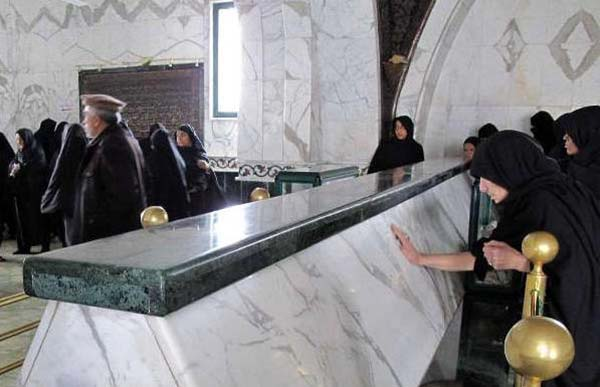
High in the mountains west of Damascus, overlooking the Zabadani region, stands the Nabi Habeel mosque, a pilgrimage site associated by religious tradition with Abel, the son of Adam. The building itself is not an antediluvian monument waiting to be excavated. It’s an Ottoman-era shrine, traditionally dated to 1599 and associated with Ahmad Pasha, constructed many centuries after the biblical story of Abel had already become embedded in Jewish, Christian, and Islamic tradition.
Inside is the feature that has made the site irresistible to giant-hunters: an enormous tomb marker reported at roughly 7 meters, or 23 feet, in length. Photographs make the scale immediately apparent, and that’s where the mystery begins for modern audiences. If the tomb belongs to Abel, the argument goes, then surely Abel must have been enormous. But that conclusion assumes the object is an ordinary grave marker designed to correspond to the physical dimensions of the person buried beneath it. There is no archaeological basis for making that assumption.
The more important distinction is between a grave and a cenotaph. A cenotaph is a symbolic memorial, a tomb-like monument that does not necessarily contain the remains of the person it commemorates. Religious landscapes throughout the Near East contain shrines and monumental markers whose significance comes from tradition and veneration rather than from an archaeologically demonstrable body lying beneath them. The Abel tradition itself cannot be independently verified archaeologically, and the existence of a gigantic commemorative structure therefore tells us something much more secure about the history of religious memory than it tells us about Abel’s physical height.
That leaves an important negative fact that giant theories routinely conceal: there has been no published archaeological examination demonstrating that a seven-meter human body lies inside this monument. There is no excavated skeleton, no osteological measurement, and no scientific analysis establishing that the structure was constructed to accommodate a seven-meter-tall man. The enormous object is real. The enormous human being is an inference.
The Ain Dara Footprints Really Are Enormous
Then there’s Ain Dara, and this is where the story becomes genuinely extraordinary without requiring a giant.
The ancient temple at Tell Ain Dara in northwestern Syria was one of the great surviving examples of Syro-Hittite religious architecture. Excavations led by Syrian archaeologist Ali Abu Assaf began in the early 1980s, and the temple has generally been placed within the Late Bronze Age/Early Iron Age transition, with phases of construction and decoration spanning roughly the second and early first millennia BCE. Its basalt reliefs, monumental sculpture, and architectural similarities to descriptions of the biblical Temple of Solomon made it one of the most important archaeological sites in the region.
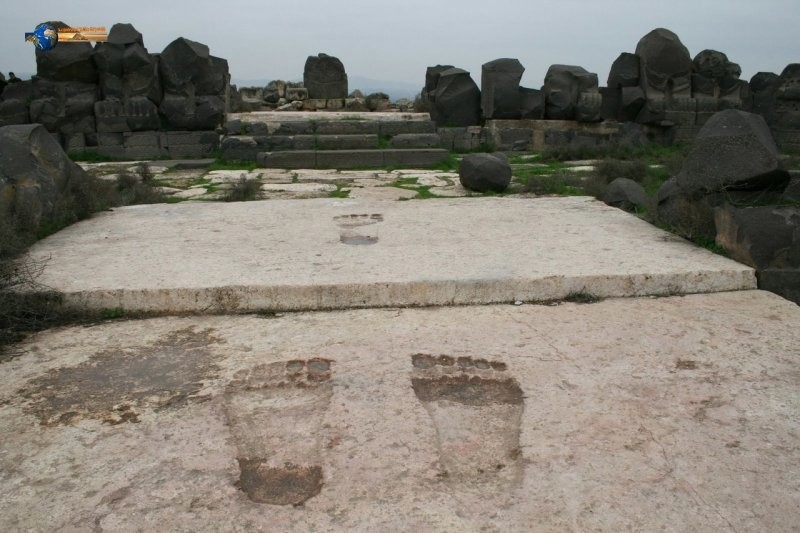
And then there are the footprints. Carved into the stone thresholds are enormous human-like footprints roughly a meter in length. They are not an internet fabrication. They are not optical illusions. They are not modern additions. They were deliberately carved into the architecture of the temple itself.
That last point destroys the most spectacular version of the mystery while making the archaeology more interesting. The footprints were carved. They were part of the temple’s religious architecture. Archaeologists studying the monument interpret them as representations of a deity entering the sacred space and approaching the inner sanctuary, a visual expression of divine presence rather than an ancient equivalent of a forensic footprint left behind by an unusually large human being. Comparative scholarship has also examined Ain Dara within the broader history of religious footprint symbolism, including the way footprints can represent the presence, movement, or authority of a deity without implying that the deity literally walked across the stone as an ordinary human would.
In other words, the ancient builders were not necessarily trying to show us the size of a man. They were showing us the scale of a god. The distinction is crucial. A religious artist can carve an enormous footprint for exactly the same reason that ancient cultures produced gigantic statues, oversized thrones, colossal weapons, or exaggerated divine figures: scale communicates power. Ain Dara’s footprints therefore belong much more comfortably to the history of ancient religious symbolism than to the history of biological anthropology.
What Happened to Ain Dara Is More Shocking Than the Giant Story
There is, however, a darker mystery surrounding Ain Dara that deserves far more attention than the giant-footprint legend.
In January 2018, during the Syrian conflict and the Turkish military operation in the Afrin region, the temple was struck by an air attack. ASOR’s Cultural Heritage Initiatives documented two impact craters in the temple itself, including damage in the areas where the monumental footprint-bearing thresholds had stood. Its analysis concluded that attribution to a Turkish airstrike was credible and that the weapons were consistent with JDAM-guided munitions, possibly GBU-38s. Because of the precision of the weapons and the location of the strikes, ASOR noted the possibility that the temple area itself had been deliberately targeted, while stopping short of claiming to know the attacker’s precise intention.
The destruction did not stop with the bombing. In 2019 the site was subjected to extensive bulldozing and illegal excavation, and the enormous basalt lion associated with Ain Dara disappeared. Later research using satellite imagery established that the lion was still present in July 2019 but gone by September, placing its disappearance within a remarkably narrow window. Archaeologists and heritage specialists subsequently documented extensive destruction of the site’s surface and lower town, with heavy machinery tearing through archaeological deposits that had survived for millennia.
By January 2022, satellite imagery showed that much of the surrounding archaeological landscape had been bulldozed, leaving the stone-built temple complex standing amid a radically altered site. A 2026 study of satellite imagery has now placed Ain Dara within a broader pattern of systematic damage to Syrian archaeological sites, showing just how much information can disappear when ancient landscapes are treated as disposable ground rather than irreplaceable archives.
The irony is brutal. The internet continues to circulate photographs of Ain Dara as evidence that giants once walked the earth, while the actual archaeological evidence that could tell us who built the temple, how its religious symbolism developed, and how the surrounding settlement functioned has been damaged by war, looting, and mechanized destruction. The footprints were never the thing we most needed to preserve. The entire archaeological context was.
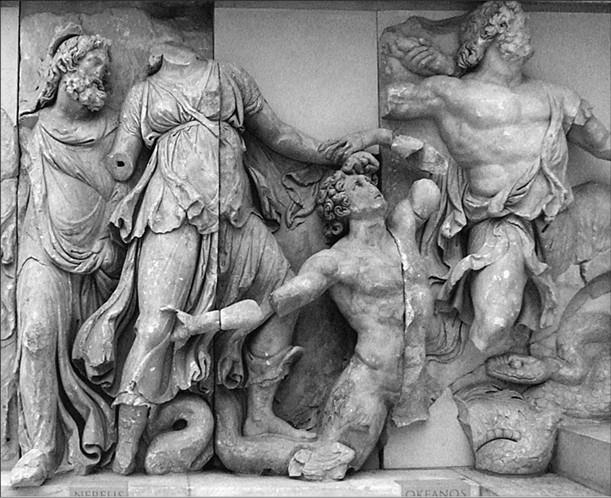
The Bible Really Does Talk About Giants
None of this means the biblical giant traditions are invented by modern conspiracy culture. They are ancient, and the texts themselves are explicit enough to explain why the legend has survived.
Genesis 6:4 describes the Nephilim as appearing in the world in connection with the mysterious “sons of God” and human women. Numbers 13:33 has Israelite spies describing the descendants of the Anakim and saying that they felt like grasshoppers beside them. Deuteronomy 3:11 identifies Og, king of Bashan, as the last survivor of the Rephaim and gives the dimensions of his enormous eres, traditionally translated as a bed: nine cubits long and four cubits wide. Second Samuel 21:20 describes an extraordinary warrior from Gath with six fingers on each hand and six toes on each foot, calling him a descendant of the Rephaim.
There’s no need to rescue these passages from the text. The ancient authors really did describe extraordinary beings and unusually powerful human enemies. The question is what those descriptions were doing inside the literature.
Og is especially revealing. His enormous bed or bier is sometimes presented online as though the Bible had accidentally preserved the dimensions of an actual giant’s coffin. But the interpretation is much less straightforward. The Hebrew word eres can mean a bed or couch, and scholars have proposed several possibilities for the object described in Deuteronomy, including a monumental bed, a sarcophagus, a trophy, or another symbolic object. The familiar idea that the “iron” bed was actually a basalt sarcophagus is an old and influential interpretation, but it is not a settled archaeological fact. Modern scholarship has specifically challenged attempts to turn the passage into a straightforward archaeological report of a giant’s tomb.
That uncertainty is not a weakness. It is the evidence doing what evidence is supposed to do.
The Six-Fingered Warrior Wasn’t a Hybrid
The six-fingered warrior of Gath presents another problem for modern giant mythology. Six fingers and six toes sound supernatural until you remember that polydactyly is a real human congenital condition. It is uncommon, but it is not impossible, not extraterrestrial, and not evidence of a separate species. The biblical writer is interested in the warrior’s extraordinary appearance because it contributes to his legendary status, modern readers sometimes transform that literary detail into biological evidence that the ancient world contained a population of nonhuman hybrids.
That transformation says more about modern expectations than about the ancient text. An ancient author did not need to possess a modern genetic explanation in order to describe a rare human trait accurately. A person with six fingers could have existed. A warrior could have been unusually tall. A king could have been remembered as physically enormous. None of those possibilities requires a vanished race.
But Were Some Ancient People Exceptionally Tall?
Absolutely. And this is where the story becomes more interesting than the usual debunking.
Human gigantism is a real medical phenomenon. Excess growth hormone before the growth plates close can produce extreme height, while excess growth hormone after skeletal maturity produces acromegaly, which alters the bones and soft tissues in a different way. These conditions are rare, but palaeopathologists have identified probable cases in ancient skeletal remains, including individuals whose unusually large bones and characteristic cranial changes are consistent with gigantism or acromegaly. One medieval skeleton from Spain, for example, has been studied as a probable case of gigantism/acromegaly, while other archaeological cases have been identified in prehistoric populations.
That matters because a rare medical condition can become culturally enormous. Imagine a society in which almost everyone is considerably shorter than the tallest person anyone has ever seen. A single exceptionally tall warrior would not need to be seven meters tall to become extraordinary. He would only need to be extraordinary relative to the people around him.
Over generations, stories change. A powerful enemy becomes a giant. A giant becomes one of the ancient giants. A legendary population becomes a people who once occupied the land. And eventually the story is read backwards as though the myth itself were a census.
The Rephaim Were Not Always Giants
This is perhaps the most important piece of the puzzle, because the word Rephaim does not behave like the name of a single biological species.
In the Hebrew Bible, the term appears in several different contexts. Some passages associate the Rephaim with ancient populations and formidable warriors. Other passages use Rephaim for the dead, particularly the dead who inhabit the realm of Sheol. The word can therefore occupy a strange boundary between an ancient people remembered in heroic tradition and a supernatural category associated with the dead.
Then the Ugaritic evidence makes the picture even more complicated. At Ras Shamra, ancient Ugarit on the Syrian coast, Late Bronze Age texts preserve the term rpum. These texts are among the most important evidence in discussions of the ancient Rephaim tradition. Some scholars understand the rpum as deceased royal ancestors or divinized dead kings summoned in ritual contexts. Others have emphasized the difficulty and fragmentary nature of the texts and caution against assuming that the Ugaritic and biblical categories are identical.
Either way, the evidence creates a problem for the simplest giant-race theory. Long before modern conspiracy literature began assembling “giants” from scattered ancient traditions, the relevant words were already being used in different religious and literary contexts. The ancient Near East did not hand us one perfectly preserved file labelled REPHAIM: SPECIES OF GIANT HUMAN. It handed us fragments: warriors, ancestors, dead kings, legendary populations, and beings associated with the world beyond ordinary human life. That’s much messier. It’s also much more interesting.
The Footprints Fit the Religion Better Than the Giant Theory
Once that textual complexity is understood, Ain Dara looks different too. The footprints are not isolated curiosities waiting for a biological explanation. They belong to a temple whose entire architectural language is symbolic. Its basalt reliefs depict supernatural and mythological imagery, its monumental scale establishes the importance of the deity, and the footprints transform the entrance itself into an image of divine movement and presence.
Scholarship on the Ain Dara footprints has examined them comparatively precisely because footprint imagery is unusual in ancient Near Eastern art. Their interpretation is debated in detail, including questions about the identity of the deity represented and the precise ritual meaning of the imagery. But that debate takes place inside a shared archaeological premise: the footprints are carved representations, not casts of tracks left by a biological giant.
And that’s an important distinction between mystery and mystification. The fact that we do not know every detail about a symbol does not make every explanation equally plausible. Archaeology does not become less interesting when it says, “We know what this is, but we are still debating exactly what it meant.” That is precisely where serious investigation begins.
So Where Did the Race of Giants Come From?
Partly from the texts themselves, partly from the way later religious traditions interpreted those texts, and partly from modern readers collapsing categories that ancient cultures did not necessarily keep separate. The Nephilim became giants. The Anakim became giant descendants. Og became the enormous survivor of a primordial race. The Rephaim became synonymous with giants in popular imagination. Enormous monuments were then recruited as physical confirmation, even when those monuments belonged to completely different periods and religious traditions, sometimes stitched together with the same imagery used for real angelic and divine hierarchies in other traditions.
That’s how a mythology acquires an archaeological footprint without archaeology actually producing one. The process is remarkably familiar. Start with an ancient text describing extraordinary beings. Find an enormous object whose original purpose is uncertain. Find an ancient carving that resembles a human footprint. Add photographs stripped of archaeological context. Connect everything through a single narrative. Then treat the fact that the objects really exist as proof that the narrative connecting them must also be true.
But real objects do not authenticate invented connections between them.
What the Evidence Actually Supports
The Rephaim were not invented by modern giant-hunters. They belong to genuine ancient Near Eastern literature, and their history is considerably stranger than the modern “race of giants” version. The biblical texts really do preserve traditions about formidable ancient peoples and extraordinary warriors. Ugaritic texts preserve related traditions involving the rpum and the realm of the dead. Ancient people really could be exceptionally tall, and rare medical conditions such as gigantism and acromegaly provide one plausible reason why extraordinary individuals could become memorable figures in oral and literary traditions.
But the two pieces of physical evidence most often presented as the knockout proof do not survive scrutiny as evidence of giant humans. The enormous structure at Nabi Habeel belongs to a much later religious shrine and cannot establish the physical dimensions of the biblical Abel. The Ain Dara footprints are genuine, enormous, and deliberately carved, but their archaeological context identifies them as religious imagery representing divine presence rather than literal tracks made by a giant.
And there is an uncomfortable final irony. While the internet argues over whether a carved footprint proves that giants once walked Syria, the actual archaeological site has been bombed, looted, bulldozed, and stripped of part of its monumental sculpture. The real evidence did not need to be hidden by governments, buried by secret societies, or suppressed by archaeologists. War and looting did something far more ordinary and far more devastating: they destroyed pieces of it.
The Rephaim therefore leave us with something better than proof of giants. They leave us with evidence of how ancient people remembered the dead, imagined divine power, described formidable enemies, and transformed exceptional human beings into legends. They leave us with temples whose symbols still resist complete interpretation, texts whose vocabulary changed across centuries, and archaeological landscapes whose destruction has made some questions permanently harder to answer. The giants may be the least interesting part of the story. The truly strange thing is how much of the ancient world survives only as fragments, and how quickly we mistake the fragments for a single lost civilization.