




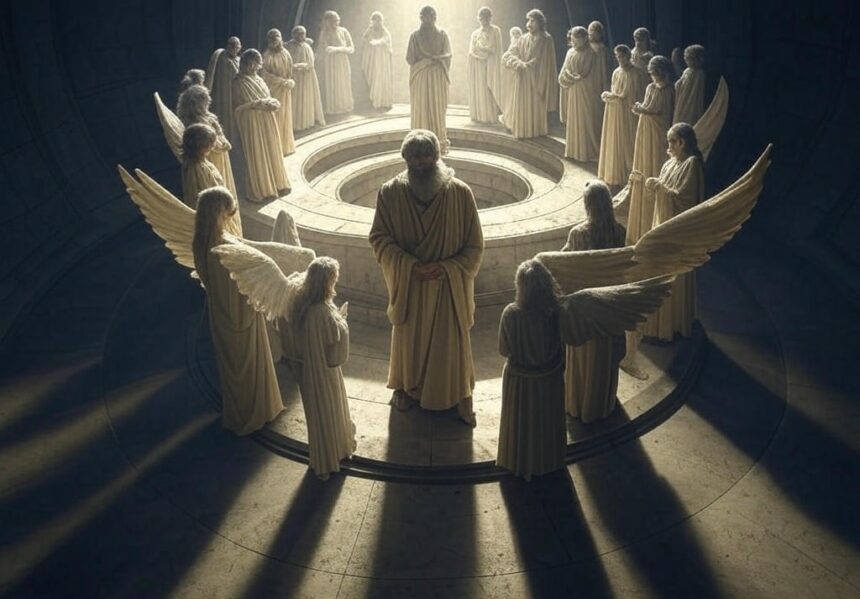
God stands in an assembly. That is the plain claim of Psalm 82’s opening line, and the Hebrew word used for the assembly around him, elohim, is the same word used for God himself one clause earlier. Whatever is standing in that room, the text calls it by the same name it calls its ruler. Most readers pass over the line without slowing down, helped along by translations that quietly soften the second elohim into “judges” or “rulers” so the sentence stops sounding like what it says. Taken at face value, it says God is judging other gods.
This is not a fringe reading smuggled in by conspiracy theorists. It is a recorded, decades-old area of Hebrew Bible scholarship, built by named academics working from the original languages, currently the subject of real and ongoing disagreement among people with doctorates in the field. It has not been hidden by anyone. It has been argued about in print for over forty years.
What The Text Actually Says
Four passages carry most of the weight in this discussion, and each is worth taking on its own terms before asking what they add up to.
Psalm 82 opens with God standing in the divine assembly, pronouncing judgment among beings the text calls elohim, the same word used elsewhere in the Hebrew Bible for God himself, for pagan deities, and, less frequently, for other kinds of powerful beings. The psalm goes on to condemn these figures for judging unjustly and sentences them to die like mortals, language that only makes sense if the beings being judged were understood as something other than ordinary human rulers to begin with.
Psalm 89 asks who among the “sons of God,” bene elim in the Hebrew, can be compared to the Lord, placing these figures in what the text calls the assembly of the holy ones. The same phrase, sons of God, appears in the prose frame of Job, where it describes beings who present themselves before God alongside a figure called the satan, again clearly distinct from human beings in context.
First Kings 22 goes further than mere description. The prophet Micaiah recounts a vision of God enthroned with the host of heaven arrayed on either side, soliciting proposals for how to lure a king to his death, weighing one spirit’s plan against the others before approving it. Whatever this scene is doing theologically, it depicts something closer to deliberation than command.
None of these passages are obscure or textually disputed. They sit in the standard Hebrew text used across Jewish and Christian traditions alike. What is disputed is what to make of them.
The Deuteronomy 32 Problem
The passage that carries the most scholarly weight, and the most textual complication, is Deuteronomy 32:8 to 9, part of the Song of Moses. In the Masoretic Text, the version underlying most modern Bible translations, God is described as setting the boundaries of the nations according to the number of the sons of Israel. In the Dead Sea Scrolls, specifically a fragment catalogued as 4QDeuteronomy-j, and in the ancient Greek Septuagint translation, the same passage reads sons of God instead.
That is not a minor variant. Sons of Israel describes a fixed, known quantity, the tribes descended from Jacob. Sons of God describes an entirely different category of being, divine rather than human, and it changes the sentence from a statement about Israel’s internal structure into a claim that God divided the nations of the earth among a set of subordinate divine beings, reserving Israel as his own direct portion. Scholars who favor the Dead Sea Scrolls and Septuagint reading argue it is the more difficult, and therefore more original, text, the kind of theologically uncomfortable wording a later scribe would be more likely to soften into something safer than to invent from nothing. Scholars who favor the Masoretic reading argue the surrounding verses, which reference the sons of Israel by name just before and after, make more contextual sense as written, and that the Qumran community responsible for the scroll had its own well-known interest in angelology and cosmic hierarchy that could have shaped how it preserved or altered the text.
This is a live, technical argument inside textual criticism, not a settled fact hidden by institutions and not a hoax invented by fringe writers. Both readings have working scholars defending them in published, peer-reviewed venues today.
Who Actually Built This Case
The idea that ancient Israel’s religious world included a structured heavenly council did not originate on the internet, and it did not originate as an attack on institutional Christianity. The foundational academic treatment is E. Theodore Mullen Jr.’s 1980 study, The Divine Council in Canaanite and Early Hebrew Literature, a work of comparative Ancient Near Eastern scholarship examining how Israelite descriptions of God’s heavenly court echo and diverge from the divine councils attested in Ugaritic texts describing the god El presiding over his own assembly of divine sons.
The scholar most responsible for bringing this material to a general audience is Michael S. Heiser, who held a PhD in Hebrew Bible and Ancient Semitic Languages from the University of Wisconsin-Madison and worked for years as a scholar with Logos Bible Software before his death. His 2015 book, The Unseen Realm: Recovering the Supernatural Worldview of the Bible, builds directly on the Deuteronomy 32 textual case, arguing that the Hebrew Bible’s authors worked within what he called a Deuteronomy 32 worldview, in which the nations were placed under the authority of lesser elohim after the incident at Babel, some of whom later turned against their assigned charges. The book became a bestseller within evangelical publishing, not a banned text kept out of print. It sits on the shelves of seminary bookstores.
Framing this material as a secret institutions don’t want believers to find gets the actual situation backward. It is a body of published, footnoted, argued-over scholarship with a visible paper trail running from Ugaritic archaeology in the twentieth century through a mainstream Christian publisher in the twenty first.
The Neighbors Had One Too
None of this developed in isolation. Excavations at the ancient Syrian city of Ugarit, beginning in the 1920s, recovered a substantial archive of tablets describing the Canaanite pantheon in detail, including a high god named El who presides over an assembly of divine sons, often called the council of El or the sons of El, deliberating and occasionally quarreling much like the scene in First Kings 22. Scholars studying these texts alongside the Hebrew Bible noticed the overlap decades before either Mullen or Heiser wrote a word: Israelite poetry uses titles for its God, El Elyon, El Shaddai, that are simply the Canaanite high god’s own names, applied to Yahweh.
Mark S. Smith, a scholar of Northwest Semitic languages who has written extensively on this convergence, has argued that early Israelite religion likely emerged from within this broader Canaanite religious world rather than standing entirely apart from it, with Yahweh gradually absorbing El’s titles, his throne, and eventually his council, before later editorial layers of the Hebrew Bible worked to sharpen the distinction between Israel’s God and everyone else’s. On this account, the divine council passages are not late theological experiments or foreign intrusions. They are residue, the visible seams where an older, regionally shared picture of divine government was inherited, then slowly reworked to fit a demand for exclusive loyalty to a single God that the earliest texts do not yet fully assume.
The Case Against Taking It Literally
The strongest objections to all of this do not come from people trying to protect a comfortable theology, and it would be a mistake to wave them off that way. Reformed and Jewish interpreters have long read Psalm 82’s elohim as human judges rather than divine beings, pointing to the psalm’s own content, corrupt rulers who die like mortals, as evidence the target of the condemnation is earthly authority abusing its power, not literal deities. This reading has real textual support: the psalm never explicitly places its elohim in heaven the way Job or First Kings does, and Israelite prophetic literature elsewhere does compare human rulers to gods as a rhetorical device, not a metaphysical claim.
The objection to the Deuteronomy 32 reading is similarly serious rather than evasive. Critics of the Dead Sea Scrolls and Septuagint variant point out that the verses immediately surrounding it, referencing the sons of Israel by name in verse 7 and again in verse 9, form a more coherent unit if the disputed phrase also refers to Israel, and that a scribal community as theologically invested in angelic hierarchy as the one at Qumran is not a disinterested witness to what the original text said. Weighing a single fragmentary scroll against the entire weight of the later Masoretic tradition is not an obviously safe bet, and scholars who make that case are doing ordinary textual criticism, not protecting an institution from an inconvenient truth.
This Was Argued, Not Suppressed
Heiser’s work has drawn serious engagement precisely because it makes a real, checkable claim rather than an unfalsifiable one. Reviews in evangelical academic venues have generally welcomed his willingness to take the divine council material seriously rather than translating it away, while raising pointed methodological questions about how much weight a single Qumran fragment should carry against the entire Masoretic tradition, and about how far a Deuteronomy 32 reading can be extended into New Testament theology before the connections become speculative rather than textual. More critical assessments have gone further, arguing that the Qumran community’s own theological interests in cosmic dualism and angelic hierarchy make its version of Deuteronomy 32 a less neutral witness than Heiser’s argument requires, not a more reliable one.
That disagreement, conducted in journal articles, published reviews, and seminary blog posts with footnotes, is what a live academic debate actually looks like. It is the opposite of suppression. Suppression would mean nobody was allowed to argue about it. What actually happened is closer to the normal, slow churn of textual scholarship, one generation’s comparative Ugaritic philology becoming the next generation’s popular theology becoming the following generation’s target for methodological pushback.
Why Translations Read Differently
Part of why this material feels unfamiliar even to regular Bible readers comes down to translation choices made long before anyone alive today opened a modern printed Bible. Elohim is grammatically plural in Hebrew but is used overwhelmingly as a singular noun referring to Israel’s God, which means translators have to decide, verse by verse, whether a given instance means God, gods, or something in between, based on context rather than the word’s form alone. In most of the passages discussed here, that judgment call has historically been made in the direction of minimizing the plural reading, rendering elohim as judges, mighty ones, or angels rather than gods, choices defensible on linguistic grounds but which also happen to produce a text friendlier to later monotheistic expectations than a more literal rendering would. This is not evidence of a conspiracy. Translation always involves interpretation, and interpreters working within a tradition tend to produce translations that fit comfortably within it. The effect, intentional or not, is that most English Bibles quietly resolve an ambiguity the Hebrew text itself does not resolve.
What The New Testament Does With It
The concept does not vanish after the Old Testament, though its later use is narrower than the sweeping claims sometimes made for it. In John’s Gospel, Jesus responds to accusations of blasphemy by quoting Psalm 82 directly, asking why he should be condemned for calling himself God’s son when scripture itself calls other beings gods. It is a legal, rhetorical move rather than a theological essay, but it only works if Jesus expects his audience to recognize Psalm 82’s plural elohim as a real category rather than a metaphor to be explained away.
Paul’s letter to the Ephesians warns believers that their struggle is not against flesh and blood but against rulers, authorities, and powers in the heavenly realms, language that maps onto the same territorial, hierarchical picture of the spiritual world found in the Hebrew Bible’s council imagery, even as later Christian tradition folded these figures into a simpler framework of angels and demons.
What’s Actually At Stake
None of this requires abandoning monotheism to take seriously. The scholarly consensus, where one exists, is not that ancient Israel worshipped many equal gods, but that its religious language developed out of a broader Ancient Near Eastern world in which a high god presiding over a council of lesser divine beings was the ordinary way to describe cosmic order, and that Israel’s scriptures carry the marks of that inheritance even as their theology moved toward the exclusive monotheism that later Judaism and Christianity would formalize. Whether that movement should be read as development, correction, or editorial suppression of an earlier and more polytheistic Israelite religion is exactly the kind of question that divides scholars who all agree on the underlying texts.
The disagreement runs deeper than any single verse. It touches how each side understands the Hebrew Bible itself, as a document that unfolds and reworks its own theology across centuries of composition and editing, or as a more unified witness whose apparent tensions dissolve once read on its own terms. Neither position requires bad faith, and neither has managed to fully close the case on the other, which is precisely why the argument is still running in journals and seminary classrooms rather than having been settled and shelved.
What isn’t in serious dispute is that Psalm 82 says what it says, that the Deuteronomy 32 textual variant is real and attested in the manuscript record, and that people with the relevant languages and credentials have been arguing about what to do with both for more than four decades, in public, with their names attached.
The CIA’s own declassified Gateway Process research shows a comparable pattern of real scholarship next to real, unresolved mystery