



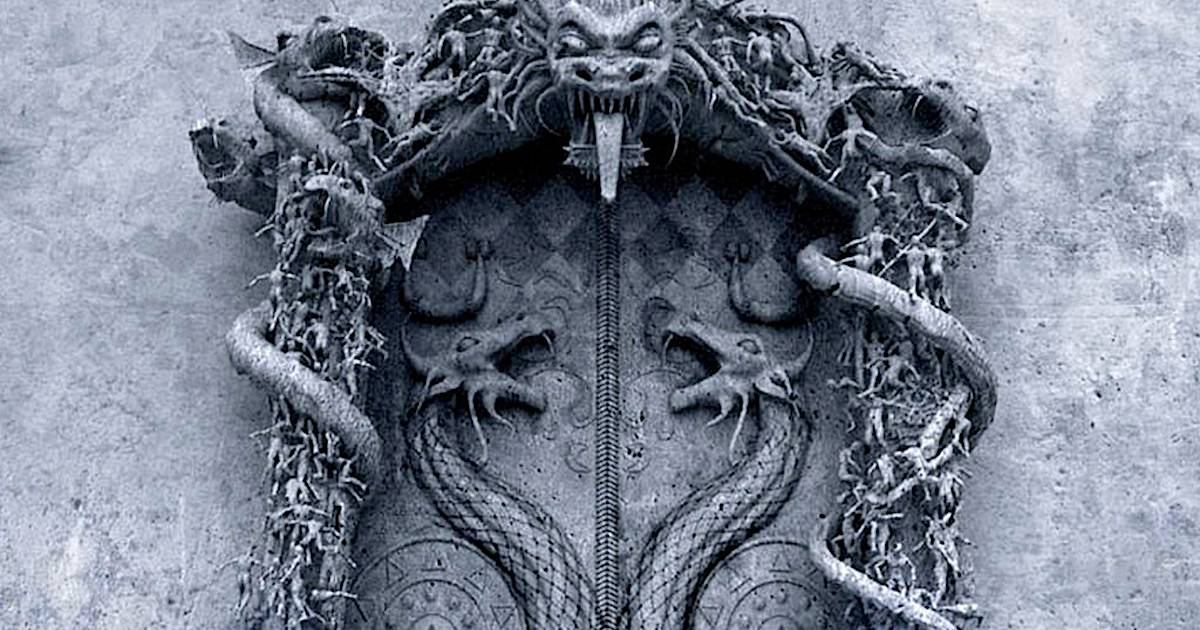
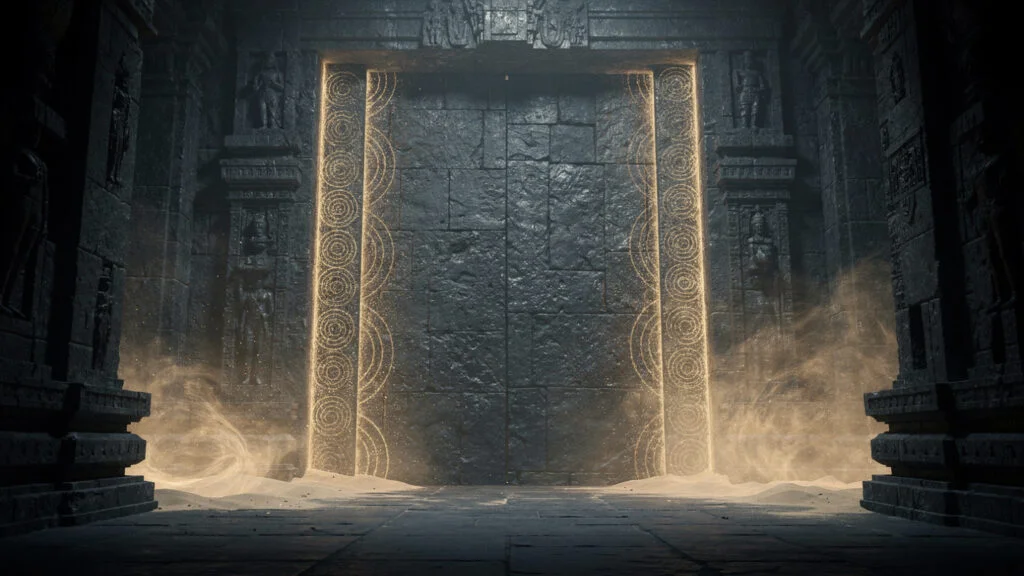
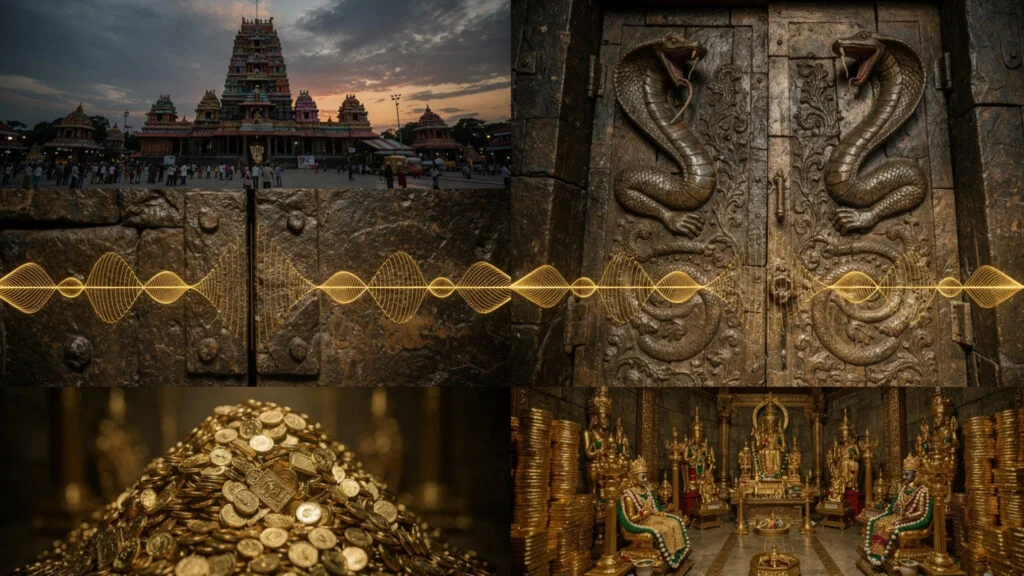
The door has no handle. No bolt. No latch. No visible hinge. No keyhole. No mechanism of any kind that a person approaching it could identify as the means by which it opens.
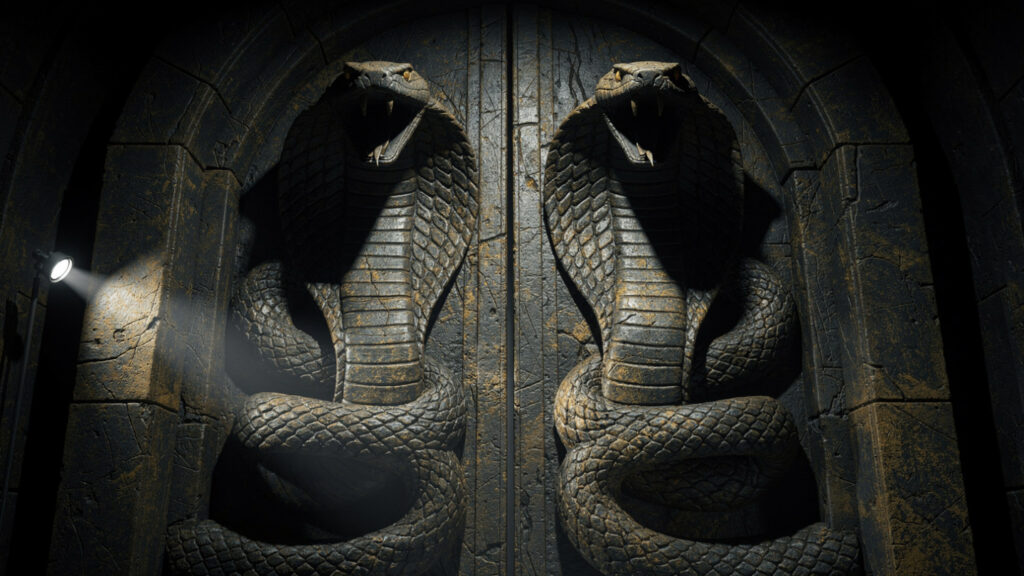
It is covered with the images of two enormous cobras.
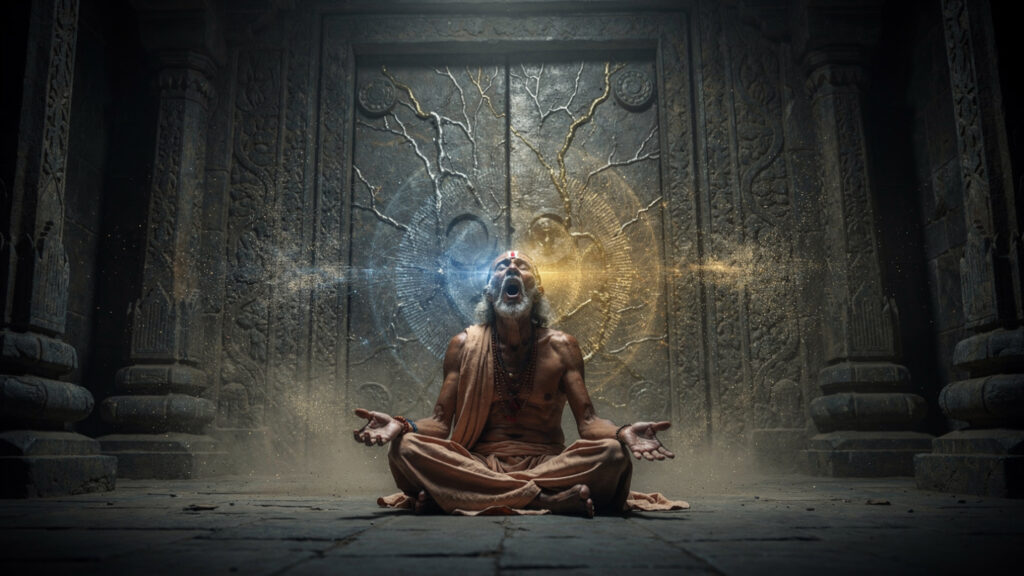
The priests who have served at the Sree Padmanabhaswamy Temple in Thiruvananthapuram, Kerala, for generations have an account of why the door has no conventional opening mechanism. It was sealed with sound. A chant called the Garuda Mantra, performed by an initiated practitioner at the level called Sadhus, produced an acoustic effect at the door’s surface that locked it in a way that only the same chant, performed correctly, can reverse.
The practitioners who knew the Garuda Mantra are dead. The knowledge of how to perform the chant at the level and with the precision required to produce the acoustic effect has been lost. No living person, according to the priests who have served the temple for generations, currently possesses the capacity to open Vault B.
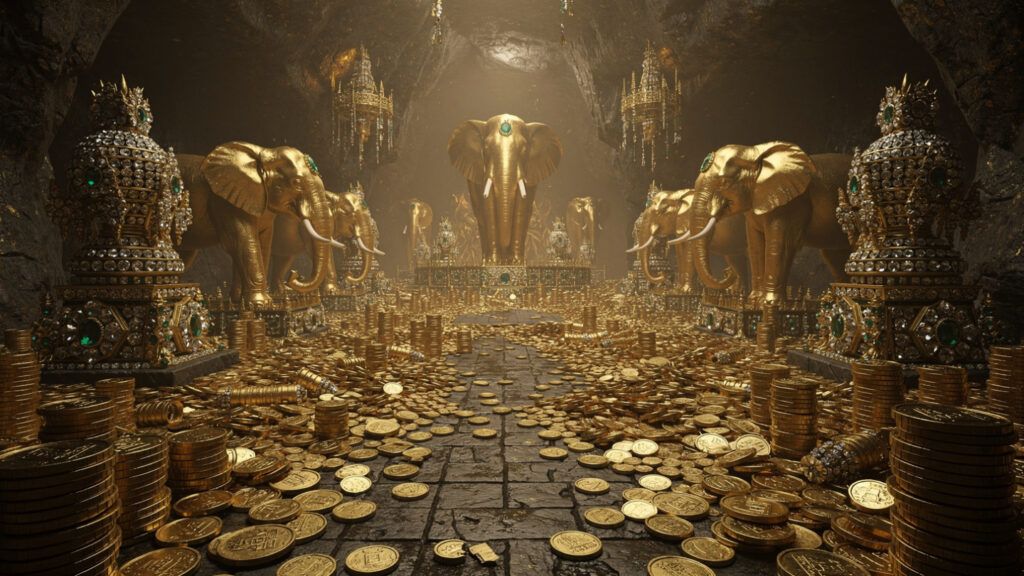
What is behind Vault B has not been seen by any documented human witness in centuries. What is known from the five vaults that were opened in 2011, by order of the Supreme Court of India, establishes a context for the estimate of what Vault B might contain. The five opened vaults held approximately $22 billion in gold, jewels, and artifacts. The estimate for Vault B, extrapolated from the density of wealth in the surrounding chambers, runs to considerably more.
The material wealth is not the most interesting thing about Vault B.
The Temple
The Sree Padmanabhaswamy Temple is one of the 108 Divya Desams, the most sacred temples within Vaishnavism, dedicated to Vishnu in his form as Padmanabha, the lotus-navel, the deity reclining on the cosmic serpent Ananta. Its significance is not that of a regional temple with local importance but of a pan-Indian pilgrimage destination whose sanctity has been maintained continuously for over two thousand years.
The Sangam literature, the body of classical Tamil poetry dated to approximately 500 BCE to 300 CE, contains multiple references to the temple. The references establish that the temple’s reputation and pilgrimage function were already fully established in this period. The temple had accumulated enough significance to be referenced in the most important literary corpus of the era by the time of the earliest surviving records.
No founding date for the temple is recorded. The absence of a founding date in a culture that meticulously records the histories of its major institutions is itself significant: the temple predates the institutional memory that would have preserved its founding. The ninth-century poet-saints of the Nalayira Divya Prabandham, the canonical collection of Vaishnava devotional poetry, describe the temple and its associated city as having walls of gold. The description is understood by scholars as hyperbole expressing the city’s wealth rather than as literal architectural description, but the five opened vaults have established that the hyperbole, if that is what it was, was not as extravagant as it seemed.
The Travancore royal family claimed a theological relationship with the temple that distinguished them from conventional property owners or rulers. They described themselves not as owners of the temple’s wealth but as servants of Lord Padmanabha, the deity to whom the temple is dedicated. The wealth in the vaults belonged not to them but to the god, held in trust by the royal family and the temple priests on his behalf. This theological position was maintained consistently across legal challenges and in the Supreme Court proceedings that ordered the vaults’ opening in 2011.
The distinction matters for understanding what Vault B contains. In a practice that accumulated wealth as an offering to a deity rather than as a personal or institutional asset, the most sacred chamber would hold not the most monetarily valuable objects but the most theologically significant ones. The cobra door and the acoustic sealing mechanism indicate that Vault B was considered something categorically different from the storage chambers opened in 2011.
What the Opened Vaults Contained
The Supreme Court of India’s 2011 order directing an inventory of the temple’s vaults followed a petition filed by T.P. Sundararajan, a former Indian Administrative Service officer and devotee of the temple, who argued that the temple’s assets were not being properly managed and that their extent was not publicly known. The inventory committee included former IAS officers, representatives of the Archaeological Survey of India, and representatives of the royal family of Travancore.
The committee’s findings, documented in its submissions to the Supreme Court, produced descriptions that the Indian press covered with a combination of national pride and documented astonishment.
Vault A contained approximately 2,000 pounds of gold coins, the oldest dating to approximately 200 BCE, along with jewelry, gold utensils, and ritual objects. The dating of the oldest coins establishes that the temple was accumulating wealth at a scale reflected in the vault’s contents for at least two thousand and two hundred years without interruption.
The other opened vaults, designated C through F, contained gold idols, some of considerable size, diamond necklaces described in the inventory as containing several thousand stones each, golden elephants at various scales, and what the inventory described as uncounted bags of gold coins from multiple periods and multiple geographic origins. The coins from different regions of the world indicate that the temple’s wealth accumulated through offerings from pilgrims who came from across the trading world of the medieval period, bringing currency that they converted to devotional offering.
A ceremonial costume described in the inventory as a coco-palm shell of gold with emerald tassels indicates the level of craft involved in the objects: not simple bullion storage but specific, crafted objects whose production required skilled metalworkers who were themselves operating within a sophisticated institutional culture.
The Forbes estimate of approximately one trillion dollars in total temple wealth, published in 2015, reflects an extrapolation from the documented contents of the opened vaults to an estimate of Vault B’s likely contents based on the pattern established by the chambers whose contents are now inventoried. The estimate is necessarily speculative for the unopened vault. The documented $22 billion in the five opened chambers is not speculative. It is in the Supreme Court’s inventory record.
The Acoustic Sealing
The Garuda Mantra account at Sree Padmanabhaswamy is specific enough in its physical description to be evaluated against the documented physics of acoustic effects on matter.
The account states that Vault B was sealed by a chant performed by an initiated practitioner at the required level of capability. The chant produces an acoustic effect at the door’s surface that creates a sealed state. The same chant, performed with the required precision, reverses the sealed state. Without the chant, the door cannot be opened by any conventional physical means.
The physical basis for acoustic effects on solid matter is documented science. Hans Jenny’s cymatics research, recorded in the Anunnaki mathematics piece in this library, demonstrated that sound frequencies produce geometric patterns in vibrated particles and fluids. The patterns are reproducible: the same frequency produces the same pattern consistently. At sufficient intensity, acoustic effects on crystalline and metallic structures are measurable: resonant frequencies can shatter glass, strain metals, and produce structural changes in solid materials.
The mechanism by which an acoustic effect could seal a door without visible mechanical latching involves the resonant properties of the materials at the door’s boundary. A door constructed from materials with acoustic resonance properties, sealed against a frame constructed from materials with complementary resonance properties, could be held in a sealed state by acoustic energy that maintains the resonant relationship between door and frame. Removing the acoustic energy would release the seal. Applying the wrong acoustic energy, the wrong frequency or the wrong amplitude, could reinforce the seal or damage the materials rather than releasing it.
This is not established as the mechanism at Vault B. The door has not been subjected to acoustic analysis that would determine its material composition and resonance properties. What is established is that the physical principle described in the Garuda Mantra account, acoustic effects on solid matter that can produce sealed and unsealed states, is not physically impossible. It is an application of acoustic physics that the conventional history of technology does not credit ancient India with possessing but that the broader framework of ancient technological knowledge documented throughout this library places in a recognizable pattern.
The Pyramid Texts in the Egypt cluster describe Thoth as capable of moving objects with the power of his voice. The Anunnaki mathematics piece covers the frequencies associated with 432 Hz and their effects on matter at the cellular and structural level. The Benin walls piece covers the Benin civilization’s use of fractal mathematics before Mandelbrot formalized the concept. The pattern across this library is of technical knowledge appearing in ancient contexts that the conventional history of technology places centuries or millennia later.
The Garuda Mantra sealing the door of Vault B fits this pattern exactly.
The Nagaraja
The two cobras painted on Vault B’s door are not decorative in any conventional sense. Their placement and scale indicate a theological function: the Nagaraja, the king of the serpents, is one of the primary protective deities associated with underground wealth and hidden knowledge in Hindu belief.
The Naga material recorded in the Inner Earth piece in this library describes the Naga as an underground civilization with advanced knowledge and technology whose relationship to the surface world includes domains of protection, intervention, and the guarding of treasures kept in the underground realm. The Nagaraja as a deity is the ruling intelligence of this belief system, and the cobra imagery at threshold positions in Hindu sacred architecture consistently marks boundaries between the ordinary surface world and domains whose access is restricted to initiates or to the deity’s own authority.
The placement of cobra imagery at the entrance to the most restricted vault in one of the most sacred temples in India is consistent with a deliberate invocation of Naga protective belief. Whether this invocation is purely symbolic, activating the theological protection of the Nagaraja through representation, or whether it reflects a knowledge of the Naga account’s basis in actual underground intelligence as the Inner Earth piece covers, is a question the available evidence cannot resolve from outside.
What it establishes is that the builders of Vault B’s door were operating within a theological framework whose beliefs describe underground realms as genuinely inhabited by types of intelligence with relationships to surface human civilization. They placed their most sacred and most carefully sealed chamber under the protection of the guardians that belief associates with underground wealth and hidden knowledge.
What the temple priests maintain, that no living human can open Vault B, and what the Vedic astrologers maintain, that attempting to open it through improper means would produce catastrophic results, are both consistent with a chamber that was sealed not merely to protect material wealth from theft but to prevent access to something whose disturbance would have consequences beyond the material.
Emily Gilchriest Hatch’s 1933 visitor’s guide to Travancore records multiple deaths among those who attempted to force entry to the sealed vault over the preceding decades. Whether the deaths reflect the acoustic mechanism’s physical effects on those who triggered it, the protective intervention associated with the Nagaraja, or the coincidental mortality of people engaging in dangerous physical activities around an ancient stone structure, the pattern of death associated with unauthorized access appears in the pre-modern record.
The 2011 Legal Battle and Its Limits
The Supreme Court’s 2011 inventory order was a landmark ruling in Indian property law, establishing that the temple’s assets are held in trust for the public through the deity and that their management must be publicly accountable. The ruling produced the inventory that revealed the temple’s documented wealth to the world.
The ruling did not extend to Vault B. The question of Vault B’s opening became the subject of separate legal proceedings that have continued through multiple court levels since 2011. The Kerala High Court, the Supreme Court’s specialized panels, and the Travancore royal family’s legal representatives have each taken positions on whether Vault B should be opened, by whom, and under what conditions.
The royal family’s position has been consistent: the door should not be opened by conventional means because belief holds that the Garuda Mantra is the only appropriate mechanism for access, and no living person possesses the required capability. Opening the door through physical force would not simply be logistically dangerous, it would be theologically catastrophic in terms the Vedic astrologers have been about: revelation scenarios extending in their consequences beyond the temple’s premises.
The Supreme Court’s most recent substantive orders regarding Vault B have stopped short of mandating its forced opening, recognizing the complexity of the claims involved and the absence of any emergency justification for overriding established requirements.
The chamber has not been opened. The legal proceedings that could order its opening have not reached a final determination. The chant that would open it correctly has been lost.
The door is sealed. The cobras guard it. The special forces maintain perimeter security. The wealth inside, if the extrapolations from the opened vaults are correct, is of a scale that surpasses any other single location of concentrated ancient wealth in the documented world.
And it is sealed with a mechanism that no one alive knows how to operate.
What Might Be Inside
The material extrapolation from the opened vaults to Vault B’s contents produces the trillion-dollar estimates. That extrapolation is based on the assumption that Vault B is a storage chamber of similar function to the opened vaults, scaled larger.
The theological and architectural evidence suggests something different.
The opened vaults are storage chambers. Their contents are categorized as wealth, as devotional objects, as ceremonial materials. The inventory is comprehensible within the framework of a wealthy temple accumulating offerings over two millennia.
Vault B’s features, the acoustic sealing mechanism of a complexity that has outlasted the knowledge required to operate it, the Nagaraja protection invoked at its threshold, the belief that unauthorized access produces catastrophic consequences at a scale beyond the local, and the absence of any conventional access mechanism, suggest that it is not simply a larger version of the storage chambers.
The claim made by multiple Indian researchers and by what is maintained at the temple itself is that Vault B contains objects whose significance is not primarily material but whose nature requires the level of preparation and capability that the Garuda Mantra’s requirements represent. In the theological framework of the temple, the most valuable things a civilization could preserve would not be gold or jewels but objects of spiritual or technological significance whose improper handling would produce effects beyond the material.
The Vimana accounts recorded in the ancient artifacts piece in this library and the acoustic technology material recorded across multiple pieces in this library both suggest that the technical knowledge that ancient civilizations possessed was not primarily metallurgical or architectural but acoustic and energetic. Objects that embody or enable these capacities would be exactly what a civilization that took them seriously would seal in the most secure way it knew and protect with the most powerful threshold guardians it could invoke.
The chant that sealed the door was a technical act within a system of practice that treated sound as a primary operational medium for effects on the physical world. The chant that would open it is the same act reversed. Belief holds that neither act is possible for an ordinary practitioner: the level of training and capability required to produce the acoustic effect at the relevant scale is not accessible through casual practice.
The knowledge is lost. The door is sealed. Whatever is inside has not been disturbed in centuries.
The cobras hold the threshold. Belief holds that they will hold it until someone with the right knowledge approaches.
No one has approached with the right knowledge yet.