



“The last trump” is not a modern prophecy about Donald Trump. It is a four-century-old English phrase describing the final trumpet call in Paul’s account of the resurrection. The wording comes directly from the 1611 King James Bible, where 1 Corinthians 15:52 reads “at the last trump,” while modern English translations generally say “at the last trumpet.” The resemblance to a modern president’s surname is real as a word, but that resemblance is not evidence that the translators of 1611 were encoding a prediction about a future political figure. The fascinating story is not that the Bible secretly named a president. It is that an archaic translation, a modern theory of historical cycles, disputed prophetic claims, and genuine technological upheaval can be braided together until coincidence begins to look like design.
The distinction matters because the individual pieces are real. Paul really did write about a final trumpet, more than fifteen centuries before the King James translators ever touched the passage. The King James translators really did choose “trump.” William Strauss and Neil Howe really did argue that American history moves through recurring generational cycles. Edgar Cayce really did leave a large archive of purported trance readings, including readings concerning American political figures. Artificial intelligence really is advancing quickly enough that leading AI researchers now publish concrete forecasts about transformative systems arriving within years. What has not been established is the hidden bridge connecting those things into a single prophecy. That bridge is where interpretation begins.
The “Trump” in the Bible Was a Trumpet
The starting point is linguistic, and it is much less mysterious than modern prophecy culture makes it sound. In 1 Corinthians 15:52, the Greek word is salpinx, meaning a trumpet. Paul describes the resurrection and transformation of the dead and living in connection with the sounding of this final trumpet. The King James translators rendered the word with the English noun “trump,” a word that already existed as an older form of “trumpet.” The KJV therefore did not turn a neutral Greek word into a coded reference to a future surname, it preserved an English word that has since become archaic in ordinary usage. Modern translations such as the NIV, NKJV, ESV and NASB make the meaning immediately obvious by using “trumpet.”
That distinction becomes especially important when the phrase is read backward through modern political history. Today, “Trump” is overwhelmingly associated with a particular American family name and presidency. In the English of the King James Bible, however, trump could simply mean a trumpet. The word itself was not invented for the Bible, nor was its appearance in 1 Corinthians unique to some secret translation tradition. Even later English dictionaries continued to define “trump” as “a trumpet,” while explicitly citing 1 Corinthians 15:52 as an example. The modern double meaning exists because English changed around the old text, not because the old text anticipated the modern politician.
There is another point that matters more than the 1611 date itself. Paul’s trumpet imagery is not a King James invention at all. It predates the KJV by roughly fifteen hundred years. Paul speaks of a trumpet at the resurrection, and 1 Thessalonians describes the “trump of God.” The KJV gave that much older idea a particularly memorable English form in 1611. What survived for four centuries in English was therefore not a secret prediction planted by the translators, but a piece of biblical language, itself already ancient when it reached them, whose meaning remained recognizable even as one of its words became obsolete.
The Phrase Became Eschatological Language Long Before Donald Trump
Over the centuries following 1611, different Christian traditions debated exactly what Paul meant by the “last” trumpet and how it related to other trumpet passages. Some interpreters connected it with the return of Christ, some associated it with the resurrection of believers, others debated whether it had any relationship to the seventh trumpet in Revelation. That disagreement is itself revealing. The phrase has never possessed one universally accepted prophetic timetable. Even within Christian interpretation, “last” has required interpretation: last in what sequence, last for whom, and last in relation to which event?
By the nineteenth and twentieth centuries, dispensationalist theology and later evangelical popular culture gave the language an even wider audience. “The last trump” became associated in some circles with the gathering or transformation of believers and, eventually, with elaborate end-times systems involving tribulation, Antichrist, Israel, world government and the return of Christ. But these systems should not be projected backward onto the 1611 translation itself. The biblical phrase came first. The elaborate prophetic architecture came later.
Then the Modern “Trump” Appeared
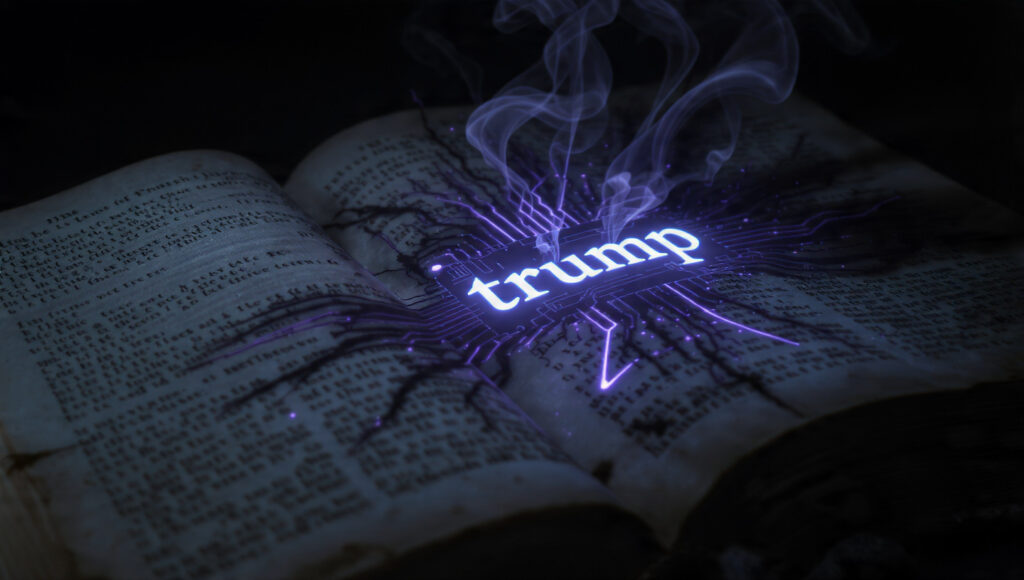
This is where the modern coincidence becomes irresistible, and dangerous. Once Donald Trump became one of the most recognizable political figures in the world, an ancient English phrase containing the word “trump” acquired a second visual meaning for contemporary readers. A phrase that once meant “the final trumpet” could now be displayed beside photographs of a president whose surname is literally Trump. The human brain is extraordinarily good at detecting patterns after the relevant pieces are already visible. What looks like a prediction when viewed from the present can look like nothing more than ordinary language when viewed from 1611.
That does not make the modern association meaningless. It makes it culturally interesting rather than historically predictive. The coincidence can become a symbol, a metaphor, or a political meme without becoming evidence that the King James translators knew anything about the future. The crucial test is simple: is there a historical document from the seventeenth century showing that “trump” was intended to identify a future presidential surname? There is no such evidence. The word had an ordinary meaning at the time, and the surrounding passage plainly concerns a trumpet.
What Strauss and Howe Actually Predicted
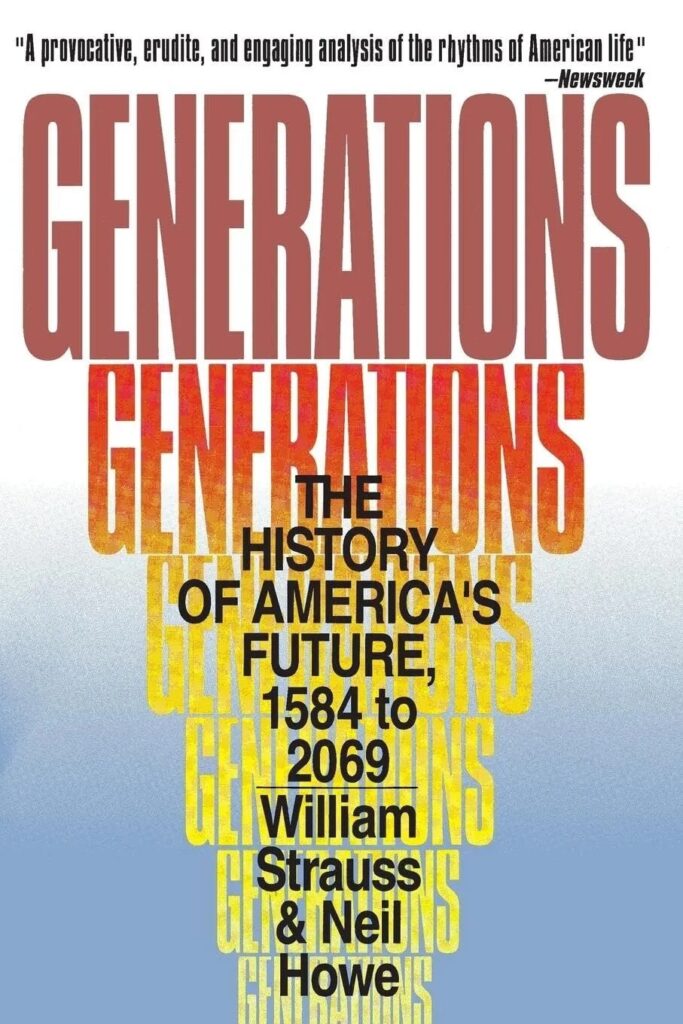
The next layer is considerably more respectable because it is not a secret prophecy at all. William Strauss and Neil Howe developed their generational theory in Generations (1991) and expanded it in The Fourth Turning (1997). Their argument was that American history exhibits recurring generational patterns, with roughly 80-to-100-year “saecula” divided into four recurring “turnings”: a High, an Awakening, an Unraveling and a Crisis. Their later work argued that the United States entered a new Fourth Turning around the financial crisis of 2008 and that the present crisis would reach a climax around the early 2030s. Howe returned to the argument in his 2023 book The Fourth Turning Is Here.
That is a real published theory. It is also a theory, not an established law of history. The distinction matters because online retellings often transform Strauss and Howe from authors proposing a controversial cyclical interpretation into something closer to prophets who mathematically calculated the future. They did neither. Their framework is an attempt to interpret recurring social patterns and use those patterns to make forecasts. The fact that some of their timing claims appear striking does not convert the entire framework into a predictive mechanism capable of identifying a particular president, event or supernatural endpoint.
And there is a particularly revealing overlap with modern “last trump” narratives: the dates. A theory that places a major American crisis in the late 2020s or early 2030s naturally becomes attractive to people already searching biblical or prophetic language for an explanation of the same period. Suddenly the old trumpet, the “Fourth Turning,” political upheaval and technological disruption can appear to be different descriptions of one approaching event. But chronological proximity is not causal evidence. Two predictions pointing toward the same decade do not become one prediction merely because people place them next to each other.
The Edgar Cayce “44th President” Problem
The Edgar Cayce layer requires even more caution. Cayce left an enormous body of purported psychic readings, and the Association for Research and Enlightenment maintains an extensive archive of that material. Cayce did make readings concerning political figures and political futures, the archive itself contains examples of presidential ambitions and predictions. But that is not the same thing as establishing the viral claim that Cayce predicted a specific “44th president” in a form that maps neatly onto modern politics. The responsible historical position is narrower: the specific 44th-president prophecy should not be treated as authenticated merely because it is repeatedly attributed to Cayce online.
The numbering issue surrounding American presidents makes the story even easier to manipulate. Grover Cleveland served two non-consecutive terms and is counted as both the 22nd and 24th president, meaning that presidential numbering itself contains an unusual historical wrinkle. But that is simply how the constitutional office is recorded. It does not provide evidence for a prophecy. A numbering ambiguity can explain why two people might disagree over who occupies a particular ordinal position, it cannot manufacture an original Cayce document that has not been produced.
This is the point at which a serious investigation has to resist both extremes. It is too strong to claim that every Cayce-related story has been conclusively disproven merely because a particular internet version cannot be found. It is equally wrong to repeat the prophecy as established fact because thousands of websites repeat the same wording. The evidentiary question is not “How many people have quoted it?” It is “Where is the original reading, what is its date and reading number, what exactly does it say, and can an independent researcher verify the citation?” Until those questions are answered, the 44th-president claim remains an attribution, not a demonstrated prediction.
Why These Threads Keep Getting Braided Together
The most interesting part of the story is therefore not whether one prophecy secretly predicted another. It is why unrelated systems keep being assembled into a single narrative. The KJV phrase offers ancient authority. Strauss and Howe offer a historical timetable. Cayce offers the aura of individual prophecy. Contemporary politics supplies recognizable characters. And technological upheaval supplies the feeling that something genuinely unprecedented is happening. Each piece answers a different kind of uncertainty, but once they are placed on the same timeline they begin to look like components of one hidden design.
This is how retrospective prophecy works. A phrase survives for centuries because it is broad enough to remain meaningful. A theory supplies a period in which a crisis supposedly should occur. A disputed prediction supplies a person or event. Then current events provide the emotional charge. The process runs backward: instead of starting with an independently verifiable prediction and waiting to see whether reality fulfills it, people start with reality and search backward for language that can be made to resemble it. The resemblance can become extraordinarily persuasive without ever becoming evidence.
AI Has Given the Old Language a New Deadline
Artificial intelligence has made this pattern especially powerful because, unlike a vague prophecy, the underlying technological transformation is real. Leading AI companies themselves now publish unusually aggressive forecasts. Anthropic CEO Dario Amodei’s 2024 essay “Machines of Loving Grace” and his subsequent 2026 essays “The Adolescence of Technology” and “Policy on the AI Exponential” describe highly capable “Powerful AI,” what he calls a “country of geniuses in a datacenter,” as potentially only one to two years away, with intellectual capabilities potentially matching or exceeding Nobel-level performance across major disciplines. In his 2026 policy work, Amodei argued that AI capabilities were advancing rapidly enough to require governments to prepare for biological, cyber, economic and loss-of-control risks. These are not occult claims. They are public technological forecasts from the person building the systems in question.
Sam Altman has likewise described a rapidly changing trajectory, writing that 2025 brought AI agents capable of substantial cognitive work, that 2026 could bring systems capable of generating novel insights, and that 2027 could bring robots able to perform tasks in the physical world. None of those statements establishes a biblical timetable, but they do explain why the early 2030s have acquired such narrative gravity. A generation already surrounded by predictions of historical crisis, political transformation and increasingly capable machines does not need much encouragement to reinterpret old apocalyptic vocabulary. “The last trump” becomes a metaphor for the moment when one technological and social order gives way to another.
And here the story becomes genuinely more interesting than the conspiracy theory. The future really is uncertain. AI could transform scientific research, labor, warfare, economics and governance much faster than institutions can adapt. It could also develop more slowly, encounter technical limits, or produce a far messier transition than today’s forecasts imply. The uncertainty is real enough that even the companies making the forecasts are simultaneously discussing enormous opportunity and catastrophic risk. We do not need a supernatural timetable to explain why people are reaching for end-of-an-era language.
The Dates Do Not Make a Prophecy
This is where the various timelines should be separated rather than combined. Paul’s trumpet imagery is roughly two thousand years old. The King James Bible dates the specific English wording to 1611. The documented eschatological use of “the last trump” developed across the centuries that followed. Strauss and Howe published their generational framework in the 1990s and later placed the culmination of the current Fourth Turning around the early 2030s. Cayce’s readings belong to the first half of the twentieth century, while modern AI forecasts belong to the twenty-first. These are layers of history, not links in a demonstrated chain of prediction.
The temptation is to treat the convergence of dates as confirmation. If one framework says “the end,” another says “the crisis,” another says “the transformation,” and modern technology appears to be accelerating, then the pieces seem to reinforce one another. But this is precisely where evidentiary standards matter most. A prediction has to be evaluated against what was actually written before the event, not against how well a later reader can fit it to events after the fact. A phrase with centuries of interpretive flexibility can be made to resemble many futures. That flexibility is evidence of cultural power, not predictive precision.

What Actually Connects, and What Doesn’t
There is a connection, but it is not the one usually claimed. The connection is cultural. Every generation inherits old symbols and then tests them against its own crisis. Christians across the centuries following 1611 could hear “the last trump” as a warning of judgment. Nineteenth-century believers could hear it through revival and apocalyptic expectation. Twentieth-century Christians could place it inside increasingly elaborate end-times systems. Twenty-first-century audiences can now hear the same words beside a president named Trump, a generational theory pointing toward the 2030s, and AI systems that may alter the structure of society. The words remain fixed, the world around them changes.
That is why the phrase keeps returning. It is unusually adaptable. It contains finality, transformation, judgment, resurrection and the end of an existing order, all compressed into three words. Those themes are almost perfectly suited to moments when people believe their civilization is approaching a threshold. The mistake is not noticing the resemblance. The mistake is confusing resemblance with prediction.
There is also a deeper historical irony. The original biblical passage is not primarily about identifying a political leader who will stand at the end of history. Paul is talking about death and transformation: the dead raised, the living changed, mortality replaced by immortality. Whatever one believes about the theology, that is the subject of the passage. Turning “trump” into a presidential surname changes the center of gravity from resurrection to politics. Turning it again into a technological deadline changes it from theology to futurism. The phrase can survive all three transformations precisely because it is powerful enough to carry meanings that its original translators, and the apostle whose words they were translating, could never have anticipated.
The “last trump” is real. The 1611 wording is real. Paul’s trumpet imagery predates that wording by roughly fifteen hundred years. Strauss and Howe’s crisis theory is real. Cayce’s archive is real. The acceleration of AI is real. What has not been demonstrated is the secret equation that turns those facts into one prophecy pointing toward a predetermined political or technological finale.
And perhaps that is the more revealing discovery. We keep reaching for the same language because the human experience of living through an uncertain transition has not changed nearly as much as the technology around us has. When institutions fracture, when politics becomes existential, when a new technology appears capable of rewriting the rules, and when the future becomes difficult to model, people search old texts for a sentence that says the chaos has a destination.
The King James translators were not naming Donald Trump. Strauss and Howe were not decoding Paul. Edgar Cayce’s unverified presidential prophecy does not become authentic because it fits a modern timeline. And AI does not need to be the fulfillment of an ancient trumpet to represent a genuine historical threshold.
The last trump has survived for centuries, and its underlying imagery for far longer than that, because every age eventually believes it might be living near the end of something. The prophecy is not that the same event keeps arriving. The historical fact is stranger: we keep changing what we think the trumpet is announcing.
A closely related mapping of modern political figures onto ancient prophecy runs through the Last Trump story, where a centuries old translation gets reattached to Donald Trump using the same interpretive method.