




Rabbi Jonathan Cahn has spent much of his career reading contemporary America through the language of ancient prophecy. His books have connected modern political and cultural events to biblical patterns, national judgment, and the return of ancient forces. His September 2025 book, The Avatar: The Return of the Ancients & the Future of America, takes that framework somewhere considerably more specific.
Its central claim is not merely that ancient religious ideas have returned. Cahn argues that ancient pagan powers are active again through human beings, functioning as modern “avatars” of the entities once worshipped as gods. And the book does not leave those human vessels anonymous. Cahn maps specific American political figures directly onto figures from the biblical Books of Kings: Bill Clinton as the idolatrous king Ahab, Hillary Clinton as his wife Jezebel, Joe Biden as their son Jehoram, Kamala Harris as Jezebel’s daughter Athaliah, and Donald Trump as Jehu, the warrior anointed to destroy Ahab’s house and its pagan altars.
That makes The Avatar more than another book about spiritual warfare. It is a concrete claim about what is operating behind contemporary American history.
The interesting question is therefore not whether the story is dramatic. It plainly is. The interesting question is what happens when a spiritual interpretation of history becomes specific enough to make claims about identifiable people, identifiable events, and supposedly observable consequences.
What Cahn Actually Means by an “Avatar”
The word itself has an older history than its modern technological meaning suggests. In Hindu traditions, an avatar is a manifestation or descent of a deity into embodied form. Cahn takes that concept and places it inside a specifically biblical framework, connecting the ancient gods of pagan worship with the Hebrew shedim, spiritual beings associated with idolatry.
His argument is that the ancient gods were not merely imaginary characters invented by primitive cultures. Behind them were real spiritual entities. Those entities, in Cahn’s account, have continued to seek influence through human beings. The modern world may believe it has outgrown the old gods, but the underlying spiritual reality has not disappeared. It has simply changed its vessels.
That distinction is fundamental to the book. Cahn is not arguing that modern political leaders are consciously pretending to be ancient deities. The claim is more expansive and more disturbing: a human being can function as an avatar without necessarily understanding the spiritual force supposedly operating through them.
The political surface is therefore only the visible layer. Behind it, Cahn sees an older conflict continuing.
How Tenuous Are the Connections, Actually?
This is where the argument stops being an abstract meditation on mythology and becomes something that can actually be examined.
Reviewer Tim Challies, working through the book’s roughly 300 pages, documented the kind of evidence Cahn treats as significant. For Harris, one example involves her childhood years in Berkeley, near the San Francisco Bay, where shells, including scallop shells, can be found on the shore. Cahn connects this to the Hindu goddess Lakshmi, whose birth myth involves emerging from ocean foam onto a lotus, and reads the coastal geography of Harris’s childhood as an echo of that myth.
For Trump, Cahn’s most extended example concerns the July 2024 assassination attempt in Butler, Pennsylvania, where the bullet grazed his ear. Cahn connects this to the ancient priestly consecration ritual described in Exodus and Leviticus, in which blood was applied to a priest’s right ear, right thumb, and right big toe. He notes that Trump’s wound, and the reported location of a subsequent injury to his foot, roughly track that same three-point pattern. He then adds that the town’s name, Butler, derives from an old French word for cupbearer, a royal household role historically associated with guarding a ruler against assassination, and reads the coincidence as confirmation that the event functioned as an anointing.
Those two examples are representative of the book’s method rather than its most extreme moments. The pattern repeats across roughly 300 pages: a geographic detail, a linguistic coincidence, or a physical detail is matched to an ancient text, and the match is presented as evidence of a hidden mechanism connecting the two.
A general discussion of spiritual warfare can be interpreted as a theological warning about human nature. A framework built from connections like these, applied to specific living politicians, becomes something else: an interpretive system in which almost any detail can be read as confirmation, applied directly to contemporary political reality.
The India Story
Cahn does not present the avatar framework only as an interpretation of scripture. He also offers experiences that he regards as evidence of the spiritual reality underlying it.
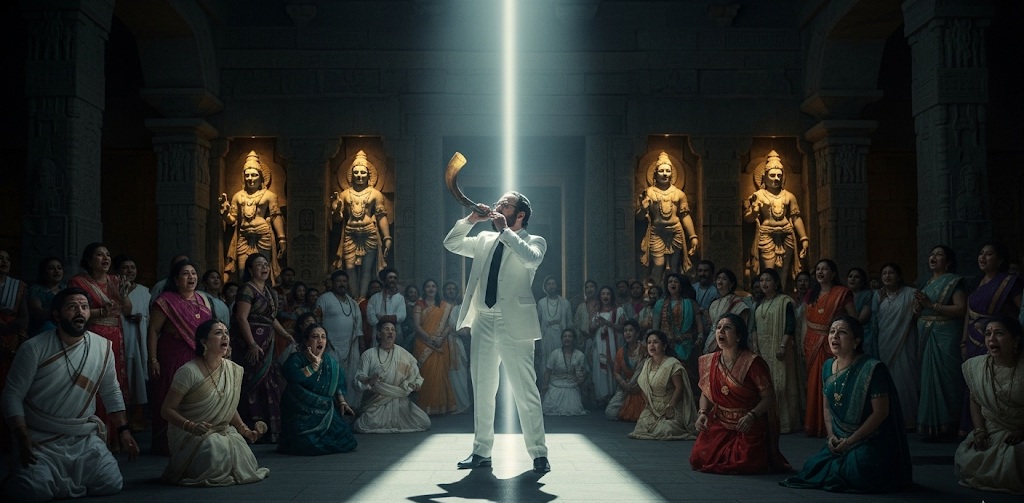
One of the most striking accounts concerns a ministry trip to India. Cahn describes encountering Krishna worship and interprets the religious environment through his understanding of ancient spiritual entities. During a sermon, he says, he sounded a shofar, after which thousands of people reportedly began manifesting what he interpreted as spiritual distress before experiencing release.
Within Cahn’s theological framework, the episode has an obvious meaning. The ancient spiritual powers are real. The shofar represents the authority of God. The reaction demonstrates a confrontation between the two.
But the story contains an important epistemic distinction that should not be lost simply because the underlying theology is sincere. An event being interpreted as evidence of spiritual warfare is not the same thing as independently establishing that spiritual warfare caused the event. Those are two different claims. The first belongs to interpretation. The second requires evidence capable of distinguishing that interpretation from competing explanations.
That distinction becomes particularly important because Cahn has recounted similar mass responses elsewhere, including claims of millions responding to a single evening of preaching in Nigeria.
The Skeptic From Inside the Same Tradition
Tim Challies is not an outside critic approaching Cahn’s theology from an unrelated worldview. He is a prominent evangelical reviewer writing within the same broad conservative Christian tradition in which Cahn’s work is situated.
Challies read The Avatar and was substantially less persuaded by its claims. Regarding the Nigeria account specifically, Challies wrote that such numbers “would be incredible if true, but I rather doubt it is.” He also described the book’s treatment of scripture as reflecting “a woeful understanding of Scriptural events, biblical interpretation, and contemporary times alike.”
That criticism is important precisely because it does not require rejecting the supernatural in principle. The disagreement is happening inside the same broad religious universe. That is a useful corrective to a common mistake in discussions of extraordinary religious claims: assuming that skepticism necessarily comes from people who have already rejected the worldview in which the claim is made.
Sometimes the disagreement is much narrower. Two people can accept the possibility of divine action while disagreeing sharply about whether a particular story establishes that divine action occurred. That is a much more interesting dispute.
From American Gods to Spiritual Warfare
There is an obvious cultural comparison available here. Neil Gaiman’s American Gods imagines ancient gods surviving in modern America while new gods representing media, technology, and contemporary culture rise around them. The television adaptation made the premise even more visually explicit.
Cahn’s The Avatar is not evidence for Gaiman’s fictional universe. Nor is Gaiman’s novel evidence for Cahn’s theology. The resemblance is structural. Both works imagine modern society as inhabited by older spiritual powers whose influence has not disappeared merely because the modern world has stopped naming them in the same way.
But one is fiction. The other is presented as a claim about reality. That boundary matters. A compelling narrative structure can make an idea easier to imagine without making the idea more evidentially established.

This Did Not Begin With The Avatar
Cahn’s argument also makes more sense when placed inside the longer history of American evangelical spiritual-warfare thinking. The belief that political and cultural events may reflect an underlying struggle between divine and demonic powers has a substantial history within American Christianity. Figures such as C. Peter Wagner helped popularize forms of “strategic-level spiritual warfare” in the 1990s, developing a vocabulary in which cities, institutions, cultures, and political developments could be interpreted through an explicitly spiritual conflict.
Cahn’s earlier work follows a related pattern. His 2011 book The Harbinger interpreted the September 11 attacks and subsequent American events through passages from the biblical Book of Isaiah, constructing a prophetic relationship between ancient Israel and contemporary America. A more recent book, The Return of the Gods, argued that specific Canaanite deities, Baal, Ashtoreth, and Molech, are active spiritual beings currently operating in America, laying the direct groundwork for The Avatar’s more specific, personalized version of the same claim.
The underlying method is consistent: ancient text provides the pattern, modern events provide the apparent correspondence, and the interpretation connects the two. That method can be extraordinarily powerful psychologically because it converts historical uncertainty into narrative coherence.
A confusing political event is no longer merely confusing. It has a place. A cultural transformation is no longer merely a transformation. It is part of a battle. A political opponent is no longer merely wrong. They may represent something ancient.
And once that framework is accepted, contemporary history becomes legible in an entirely different way.
The Problem With a Self-Sealing Interpretation
This is where the epistemic problem becomes unavoidable.
If an unexpected political event occurs, it can be interpreted as evidence that the spiritual conflict is intensifying. If an expected event does not occur, the failure can be attributed to timing, divine intervention, human choice, incomplete understanding, or another hidden variable. If a political leader behaves in a way that appears consistent with the prophecy, that becomes confirmation. If the leader behaves inconsistently, the spiritual force can be said to be operating indirectly.
The danger is not that every spiritual interpretation is automatically false. The danger is that an interpretive system can become structured so that almost nothing could count against it. That is the point at which explanation begins to resemble immunity from falsification.
And that distinction matters regardless of whether the underlying religious worldview is accepted. A proposition does not become empirically stronger merely because the mechanism proposed for it is invisible.
What the Book Can Establish
There are several claims here that can be established without resolving the supernatural question.
Jonathan Cahn wrote and published The Avatar. The book explicitly advances a framework in which ancient pagan spiritual powers remain active. It applies that framework to identifiable contemporary political figures, across the political spectrum, not selectively to one side. Cahn has described dramatic experiences that he interprets as evidence for the reality of those powers. Reviewers, including Christians operating within his own broad theological tradition, have challenged the reliability and interpretation of some of those claims.
Those are historical and documentary questions. They can be investigated.
The stronger claim, that ancient pagan entities literally operate through contemporary political figures, is different. That is not something a publisher description can prove. Nor can a dramatic anecdote prove it. Nor can the fact that millions of people find the interpretation meaningful. Those things establish that the belief exists. They do not independently establish its supernatural cause.

The Age of Avatars?
Perhaps the most revealing part of The Avatar is therefore not whether Cahn has discovered the hidden mechanism behind American politics. It is that the ancient vocabulary of gods, demons, prophecy, possession, and spiritual warfare remains remarkably capable of describing the modern world for people who accept its premises.
The names change. The political institutions change. The technology changes. The old question survives: what, exactly, is operating behind the visible world?
Cahn’s answer is radical. He believes some of the oldest spiritual powers known to humanity are still here, still seeking vessels, and still shaping the course of nations. That is his claim. It is a serious claim because he makes it seriously. But seriousness is not verification.
The distinction is important enough to preserve even when the subject is religion, even when the experiences described are extraordinary, and even when the interpretation feels internally coherent.
A spiritual war may be a theological conviction. An avatar may be a theological possibility. A political leader may genuinely appear, to a believer, to embody something ancient. None of those statements automatically turns interpretation into evidence.
And that may be the deeper question beneath the book itself. Not whether the ancient gods have returned. But how quickly human beings, confronted with a world they cannot fully control, begin looking behind the visible actors for invisible ones.
Sometimes that search produces theology. Sometimes it produces mythology. Sometimes it produces conspiracy. And sometimes, as The Avatar demonstrates, all three can begin occupying the same narrative space.