The Ethiopian Orthodox Tewahedo Church owes a debt to the world and the world owes one back.
The church’s debt: it preserved, in the ancient Ge’ez language through sixteen centuries of liturgical transmission, texts that the rest of Christianity stopped copying. The world’s debt: it almost never noticed.
The whole of Christendom and the whole learned world owes a debt of gratitude to the church of Ethiopia for the preservation of those documents. Among these books is the Book of Enoch, which throws so much light on Jewish thought during the centuries immediately preceding the Christian era. The Book of Jubilees has also been preserved entire only in the Ethiopic version. This is not alternative research rhetoric. It is the Ethiopian Orthodox Church’s own institutional website stating what the Ethiopian canon preserved that nobody else did.
The Book of Enoch, quoted directly in the New Testament’s Letter of Jude, was copied continuously by the Ethiopian church for over a thousand years after the rest of Christianity stopped. It was recovered for Western scholarship only in 1773, when James Bruce brought three Ge’ez manuscripts from Ethiopia to Europe, the first copies of the full text seen in the West for over a thousand years. The Dead Sea Scrolls, discovered in 1947, then confirmed that the text was widely used in first-century Jewish communities.
The Ethiopian church knew this all along. Western scholarship needed a Scottish adventurer and a Judean cave to confirm what Addis Ababa had never lost.
This is the story. It does not require embellishment. It does not need a dying monk or invented Ge’ez terminology. The real facts are extraordinary enough to carry a masterpiece without fabrication.
The piece circulating as recovered Ethiopian eschatology is a fabrication whose mechanics deserve the same analytical precision the library brought to the Pegasus Chronology, the Valiant Thor mythology, and the Reptilian Hypothesis. Not because the fabrication is malicious. Because understanding how it works is the knowledge that protects the tradition it claims to represent.
The Construction Anatomy
Manufactured ancient wisdom follows a recognizable construction pattern whose components are identifiable once named.
The first component is the anchor. Every successful fabricated ancient text embeds itself in a real, established body of religious material whose documented existence gives the invented content institutional shelter. The stronger the tradition, the more credible the fabricated content appears by proximity.
The broader Ethiopian canon is an exceptionally strong anchor. The Ethiopian Orthodox Tewahedo Church was geopolitically isolated from European canonical purges. Because of this, they preserve a broader canon containing between 81 and 88 books including Enoch, Jubilees, and the Paralipomena of Jeremiah, which Ethiopian sources explicitly describe as part of the church’s canonical corpus. Every element of this is documentable. Every element is also precisely the kind of claim that sounds like alternative research fringe content to a mainstream audience, which means its truth is treated with the same skepticism that should be reserved for the fabricated elements layered on top of it.
This conflation is the anchor’s value to the fabricator: suppression and canonical difference become the plausibility coating for invented content whose character would be immediately recognized as modern if it arrived without the coating.
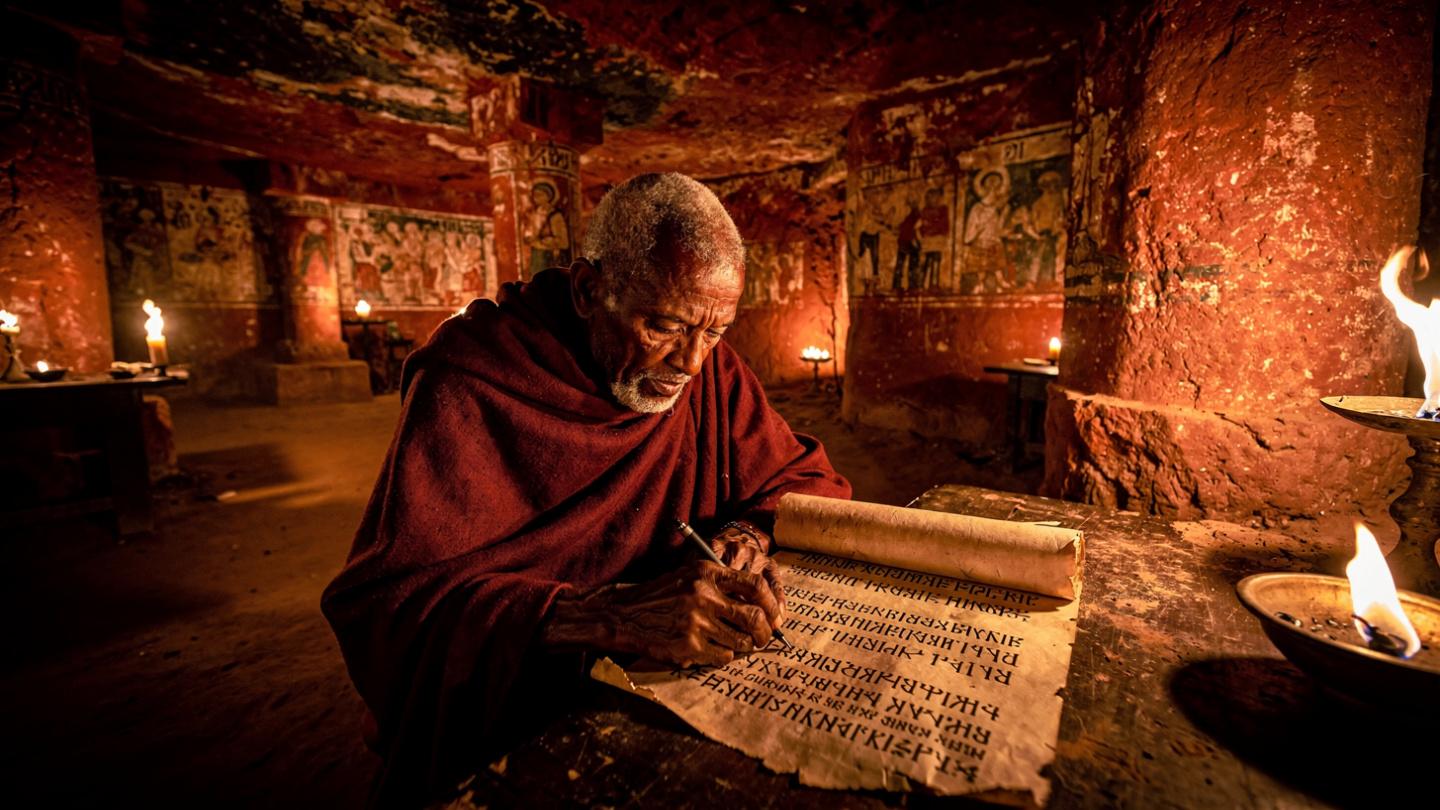
The second component is the unverifiable witness. The elderly monk from the high-altitude monasteries of the Ethiopian Highlands who brought these omissions to light before his passing is a classic narrative device whose function is dual: it provides a transmission pathway for content that has no paper trail, and it makes verification impossible by design. The monk is dead. His monastery is unnamed. His manuscripts are undescribed. The content he transmitted exists only in the transmission, not in any physical archive.
The unverifiable witness is structurally identical across multiple examples of manufactured wisdom: the anonymous Rosicrucian brother whose cipher manuscript was found by John Dee, the dying Tibetan lama whose oral transmission was received by Alexandra David-Néel, the unnamed Sufi master whose teaching appears in novels presenting themselves as memoirs. The framing varies. The function is constant: content without a checkable source cannot be disproven through archival investigation.
The third component is the linguistic costuming. The four Ge’ez stage names, Etsatä Res’an, Etsatä Chawata, Etsatä Nesi’an, and Detsatä Teshis’o, are constructed to sound authentically Ge’ez to ears that do not know Ge’ez. The construction follows the correct phonological patterns. The word Etsatä is a real Ge’ez term relating to burning or fire. The compound terms sound plausible as ancient eschatological stages.
They do not appear in any Ge’ez scholarly database, any published translation of the Mäshafä Kidan, any Ethiopian Orthodox institutional source, or any academic literature on Ethiopian eschatology. A search across the accessible scholarship produces zero results. The terms were constructed by someone who understood enough about Ge’ez phonology to make invented terms sound real to a non-specialist audience. This is not coincidence. It is the craft of manufactured ancient wisdom applied to linguistic costuming.
The fourth component is the contemporary philosophy in ancient dress. The four stages describe oblivion, spectacle, false shepherd, and great silence. These map precisely onto the intellectual concerns of twenty-first century digital culture: epistemic erosion through convenience, the attention economy, institutional religious corruption, and the silence of authentic interiority in an era of perpetual noise.
The diagnostic assessment is precise: the four-stage framework’s conceptual architecture reflects Guy Debord’s Society of the Spectacle and digital-age cognitive inertia mapped onto ancient terminology. This is not accidental parallel. Ancient eschatological texts describe the concerns of their own moment, not ours, because they were written by people living in their moment. A text written in the fourth century CE about the end times describes Roman imperial collapse, Persian military pressure, and the theological crisis of Christianization. It does not describe the attention economy.
A text that describes our moment with contemporary precision was written in our moment. The ancient costume does not change the authorship.
The fifth component is the psychological sophistication. The Seven Seals of the Heart, the seal of comfort, the seal of pride, the seal of fear, the seal of distraction, the seal of false community, the seal of false mercy, the seal of religion, represent a coherent psychological framework for understanding the barriers to authentic spiritual development in the contemporary context. As a modern analytical tool, it is well constructed. As an ancient text, it does not exist.

The move from the Book of Revelation’s cosmic exterior seals to internal psychological blockages is not an ancient esoteric reading. It is a modern psychological reframing of apocalyptic imagery in therapeutic terms. This reframing is intellectually legitimate and culturally significant. It is also recognizably modern. No ancient monastic commentary describes an internal psychological chart of spiritual barriers organized around contemporary social pathologies including false community and the compulsive filling of silence with noise.
Ancient spiritual frameworks describe their own pathologies. Ours are ours.
Why the Ethiopian Canon Became the Vessel
The choice of the Ethiopian canon as the anchor for this fabrication is not arbitrary. It reflects a recognizable pattern in how manufactured ancient wisdom selects its carriers.
The ideal carrier for manufactured ancient wisdom has three properties. It must be documented, so that the established facts establish institutional credibility. It must be inaccessible, so that most readers cannot verify claims against original sources. And it must be suppressed, so that the narrative of recovered hidden knowledge is structurally coherent with the tradition’s actual history.
The Ethiopian Orthodox Tewahedo Church was geopolitically isolated from European canonical purges. Because of this, they preserve a broader canon formally listing roughly 81 books including Enoch, Jubilees, and the Paralipomena of Jeremiah. The Ge’ez language in which the canonical texts survive is an extinct language no longer spoken as a native tongue and studied only by specialists. The texts themselves are physically located in Ethiopian monasteries whose access requires institutional permission. The canonical politics of Nicaea and subsequent councils are well established as having produced Western canonical selections that excluded texts the Ethiopian tradition preserved.
All three properties are present. The tradition is documented. The primary sources are inaccessible to most readers. The suppression narrative is accurate for many of the texts the Ethiopian canon preserved.
This combination makes the Ethiopian tradition a high-value carrier for manufactured content whose verifiability is limited to specialists. A reader who wants to check whether the four-stage Ge’ez framework appears in the Mäshafä Kidan faces an access problem: the Mäshafä Kidan is not widely available in English critical translation, the Ge’ez language requires specialist training to read, and the Ethiopian Orthodox monastic establishment is not generally oriented toward facilitating external scholarly verification of online claims about its texts.
The fabrication works precisely in the space between the well established tradition and the inaccessible primary sources. The anchor is real. The content is invented. The distance between them is what the fabrication lives in.
What the Mäshafä Kidan Actually Contains
The Mäshafä Kidan, also known as the Testament of Our Lord Jesus Christ, is a two-part work which presents itself as containing the teachings of Jesus to the apostles during the 40 days between Jesus’ resurrection and ascension. The Book of the Covenant is recognized as two books in the broader New Testament canon of the Ethiopian Orthodox Church.
The text is a church order document, meaning its primary concern is the correct administration of the Christian community: the proper conduct of bishops, priests, and deacons, the administration of the Eucharist, the organization of the liturgical calendar, and the maintenance of orthodox doctrine against false teachers. Its apocalyptic content appears in its opening sections and is consistent with the genre conventions of early Christian apocalyptic literature, warning against false prophets, institutional corruption, and the tribulations of the end times.
What it does not contain is a four-stage sociological analysis of digital-age cognitive inertia. What it does not contain is a seven-stage psychological framework for identifying internal barriers to spiritual development organized around contemporary social pathologies. What it does not contain is a prophecy about the Last Empire as an invisible web of synthetic comfort and hyper-entertainment.
The apocalyptic warnings in the Mäshafä Kidan warn against false teachers who claim authority they do not possess, against the corruption of church hierarchy, and against the tribulations that accompany the close of the age. These warnings are coherent with the text’s genre, its period, and its institutional function. They do not require modern sociological framing to be significant. They are significant because they are genuine.
The fabrication’s disservice to the Mäshafä Kidan is not that it distorted the text. It is that it replaced the text with something that reads more compellingly than the text for a contemporary audience, then attributed the replacement to the original. Anyone who subsequently encounters the actual Mäshafä Kidan will find it less dramatic than the fabricated version, which is the precise mechanism by which manufactured ancient wisdom permanently displaces the authentic tradition it claimed to represent.
What the Book of Enoch Actually Contains
The Book of Enoch’s complete survival in Ge’ez is the single most significant fact about the broader Ethiopian canon for the library’s existing framework, because the Book of Enoch is the foundational text for the Watchers and Nephilim material whose content the library’s dedicated pieces develop at length.
The Book of Enoch, translated from the Ge’ez by R. H. Charles in 1906 in the first English critical edition and subsequently verified by the Dead Sea Scrolls fragments that confirmed the text’s first-century BCE circulation in Jewish communities, contains the most extensive surviving pre-Christian account of the Watchers: the two hundred angels who descended to Mount Hermon, took human wives, taught forbidden knowledge, and produced the Nephilim whose violence precipitated the flood.
This is not manufactured ancient wisdom. This is a real ancient text whose content predates the New Testament period and whose survival in Ge’ez is the only reason the complete narrative exists anywhere. Every library piece that develops Watchers and Nephilim material is ultimately dependent on what the Ethiopian church preserved when the rest of Christianity stopped copying.
The Book of Jubilees, also known as the Little Genesis, has been preserved entire only in the Ethiopic version. It presents an alternative chronology of Genesis through Exodus organized by jubilee periods of 49 years, with material about the Watchers and the pre-flood period that supplements and diverges from the standard Genesis account in ways whose theological implications alternative researchers have developed extensively.

The Ascension of Isaiah, whose complete survival is also credited to the Ethiopian church, contains the earliest known account of the descent and ascent of Christ through the seven heavens and the hostile powers inhabiting each level, a cosmological framework whose structural parallel with what the library’s Nag Hammadi piece is the cross-traditional connection the library’s consciousness cluster develops.
These texts are extraordinary. They survive because of the Ethiopian church’s well established preservation practices through sixteen centuries of Ge’ez liturgical transmission. They do not require fabricated additions to be analytically significant. Their content is the information gain the library offers.
The Canonical Politics of Nicaea
The manufactured piece’s claim that the Council of Nicaea systematically suppressed the African canon for reasons of imperial political control contains a core and a significant distortion.
The core: The Ethiopian Orthodox Tewahedo Church’s canon differs both in the Old and New Testaments from that of any other churches. The existence of regional canonical variation in late antiquity is standard patristic scholarship. Syriac, Greek, Latin, and Ethiopian churches developed with different textual ecosystems for centuries.
The distortion: Nicaea was primarily concerned with Christological doctrine, specifically the relationship between Father and Son, not with comprehensive canonical selection. The canonical politics that shaped Western Christianity’s 66-book Protestant Bible and 73-book Catholic Bible emerged from multiple councils across centuries, not from a single imperial edict at Nicaea.
The claim that Nicaea’s imperial gatekeepers identified the Ethiopian texts’ eschatological framework as threatening and eliminated them is the fabrication’s institutional narrative, not the actual history. What is established is that canonical selection across multiple churches and centuries produced variation whose character reflects theological priorities, linguistic communities, and institutional histories rather than a single coordinated suppression operation.
What is also well established is that texts including the Book of Enoch were excluded from canonical circulation in Western church bodies for reasons including their pseudepigraphical character, their theological content’s tension with emerging orthodox positions, and the practical reality that fewer copies were being made as institutional attention shifted toward other texts. Whether this constitutes suppression depends on definitions. What it produced is the recorded fact: complete survival only in Ge’ez.
The story is complex. The fabricated story is simple, emotionally satisfying, and wrong in its institutional claims while being correct in its general characterization of Western canonical narrowing.
The Damage Manufactured Ancient Wisdom Does
The manufactured Ethiopian eschatology piece does something that distinguishes it from simple misinformation: it appropriates the institutional authority of a significant tradition and uses that authority to circulate content the tradition never produced.
A reader who encounters the piece, finds its four-stage framework compelling, and shares it as recovered Ethiopian wisdom has effectively communicated something false about the Ethiopian Orthodox Church’s canonical tradition. They have also, with each share, made the fabricated framework more associated with the Ethiopian tradition in the digital record, which progressively obscures the tradition whose content is more significant than the fabricated version.
This is the mechanism by which manufactured ancient wisdom damages the traditions it parasitizes: not through direct refutation but through displacement. The fabricated framework is more shareable, more emotionally resonant with contemporary concerns, and more immediately legible than the Mäshafä Kidan’s institutional church order content. In the attention economy it describes, the fabricated version wins the competition for audience engagement. The tradition loses ground to its own counterfeit.

The Watchers tradition in the Book of Enoch, whose complete survival depends entirely on the Ethiopian church’s well established preservation practices, deserves a reader who comes to it knowing what it actually is. The Mäshafä Kidan, whatever its actual apocalyptic content, deserves a reader who approaches it as the historical church order document it actually is rather than as a vessel for contemporary sociological critique.
The manufactured wisdom piece does not give its readers those texts. It gives them something that feels more immediately relevant precisely because it was written about them, not for them from the distance of sixteen centuries.
The Forensic Mystic Standard
The library’s analytical framework is not primarily concerned with debunking. Debunking is the conclusion. The analytical work is in understanding why things work.
The manufactured Ethiopian eschatology piece works for identifiable reasons. It anchors invented content in a suppressed tradition. It uses linguistic costuming that sounds authentic to non-specialist ears. It frames modern philosophical concerns in ancient terminology that makes them feel confirmed rather than contemporary. It employs an unverifiable witness whose authority cannot be checked. It embeds the fabrication deep enough in well established history that extraction requires specialist knowledge most readers do not have.
These mechanics are recorded across the history of esoteric literature. The Corpus Hermeticum, whose texts present themselves as ancient Egyptian wisdom transmitted through Hermes Trismegistus, was demonstrated by Isaac Casaubon in 1614 to have been composed in the early Christian era rather than in ancient Egypt. The Protocols of the Elders of Zion, whose fabrication mechanics are extensively recorded, was composed in the nineteenth century and presented as ancient recovered documentation. The Priory of Sion mythology, whose construction appears in detail by scholars including Pierre Plantard’s own later confession, invented a medieval secret society whose documentary record was fabricated and planted in archives.
The Ethiopian eschatology piece is not in the same category of harm as the Protocols. Its construction serves spiritual rather than political purposes. But the mechanics are identical: historical anchor, invented content, unverifiable witness, linguistic costuming, contemporary concerns in ancient dress.
What the broader Ethiopian canon deserves is the analytical treatment the library has given the Nag Hammadi texts, the Dead Sea Scrolls, and the Watchers and Nephilim framework: documentation of what the texts actually contain, development of the cross-cultural connections those texts support, and the information gain that comes from treating suppressed ancient content with the precision it earned through sixteen centuries of preservation in Ge’ez.
The Ethiopian church preserved the complete Book of Enoch. It preserved the complete Book of Jubilees. It preserved the Ascension of Isaiah. It preserved the Mäshafä Kidan. It preserved the Ascension of Isaiah. Without Ethiopia’s preservation of the Ge’ez manuscripts, the complete text of the Book of Enoch would not exist anywhere.
That is the story. The Watchers descended. The Nephilim were born. The flood came. The texts recording it survived in one language, in one church, on one continent, for sixteen hundred years.
No dying monk required. No fabricated Ge’ez terminology needed. No invented four-stage framework necessary.
The tradition is more extraordinary than anything manufactured to replace it.