



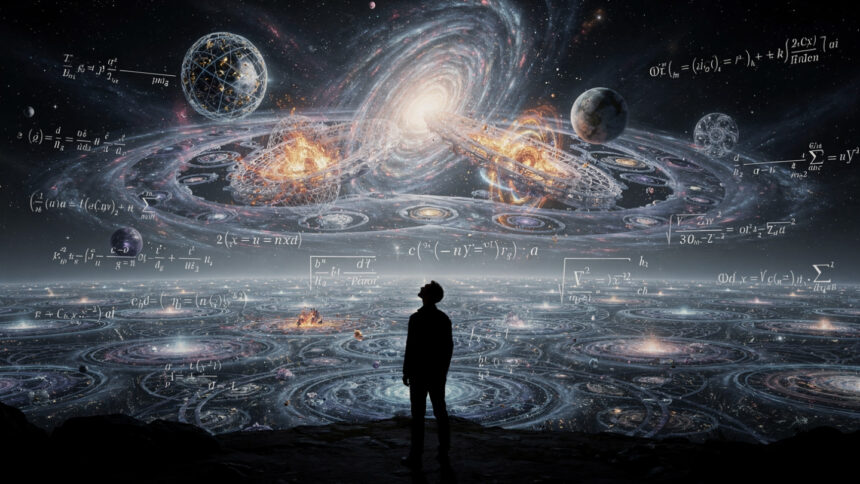
Ask ten cosmologists what happened before the Big Bang and you may get ten different answers. Some will tell you there was no “before.” Others will describe a universe that existed before ours, a previous cosmic cycle, a quantum state from which spacetime emerged, or an inflationary multiverse in which our observable universe is only one bubble among potentially countless others. None of this means modern cosmology has collapsed. Quite the opposite. The strange part is that the Big Bang model works extraordinarily well at describing the universe we can observe while remaining remarkably silent about the question most people assume it answers: whether the universe actually had a beginning.
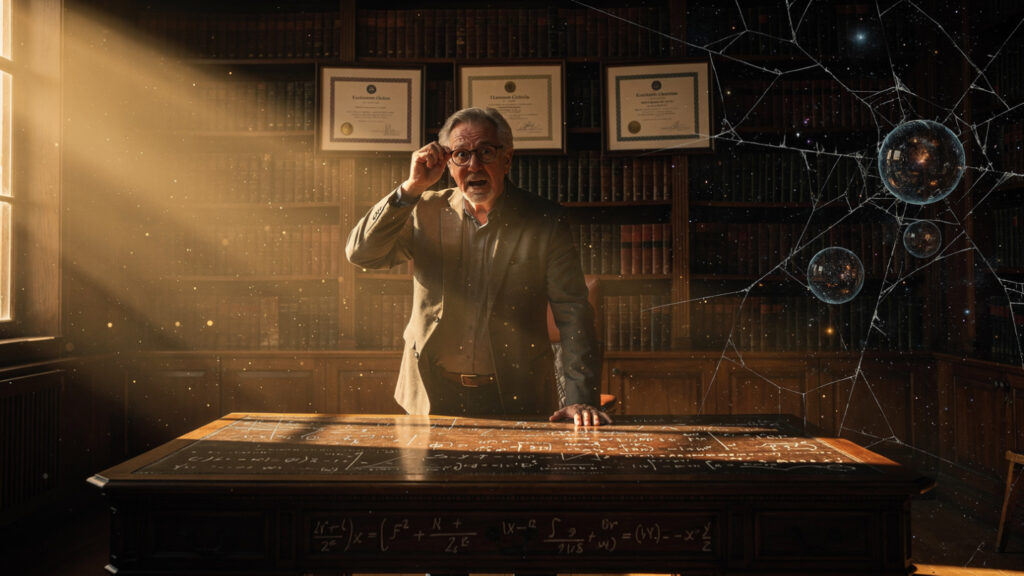
Every map has an edge. Sometimes that edge marks the end of the territory. Sometimes it marks only the point where the cartographer ran out of information. For roughly a century, cosmology has been extraordinarily successful at mapping the universe backward through time, toward an early state that was hotter, denser and radically different from the cosmos we see today. But when we push the equations far enough toward that boundary, something unsettling happens. The mathematics stops giving us a trustworthy description of reality. We reach the edge of the map, and the oldest question in the room remains standing on the other side.
The Big Bang Never Really Meant What People Think It Meant
The Big Bang model is, at its documented core, a description of cosmic evolution from an extremely hot, dense early state into the universe we observe today. Its foundations are not speculative. The cosmic microwave background, the observed abundance of the light elements, and the expansion of the universe provide several independent lines of evidence for that history. Cosmology has been extraordinarily successful because those observations converge on the same broad picture: the universe was once much hotter and denser than it is now, and it has been expanding and cooling for roughly 13.8 billion years.
But there is a crucial distinction hiding inside the phrase Big Bang. The evidence tells us about an early hot, dense universe and its subsequent evolution. It does not, by itself, tell us that this state was the absolute beginning of everything that ever existed. When classical general relativity is extrapolated all the way backward, its equations lead toward a singularity, a regime in which the theory itself ceases to provide a physically adequate description. That is not a secret doorway in the equations. It is a warning sign. The theory has been pushed beyond the conditions where we know it can be trusted, precisely where quantum gravity is expected to become important.
Then Physicists Started Asking What Was Beyond the Edge
This is where the story becomes considerably more interesting than the familiar picture of a universe exploding out of a point. Physicists did not simply accept the apparent boundary and stop asking questions. They kept extending the mathematics, and in doing so they discovered that “the beginning” can mean several radically different things depending on which theory you use to describe the earliest universe.
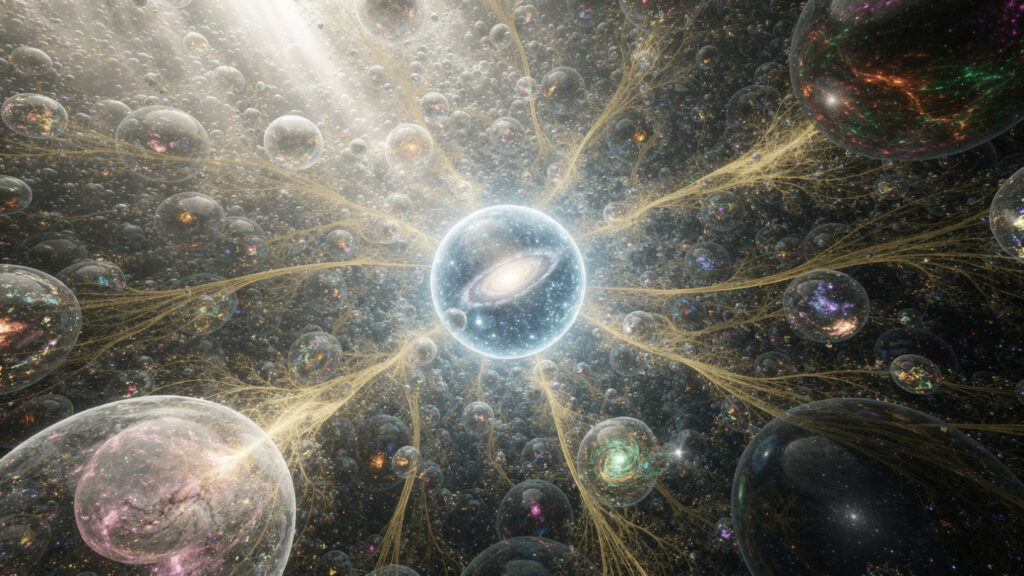
Alan Guth’s inflationary model, developed in the early 1980s, was introduced to address genuine problems in cosmology, including why the observable universe appears so geometrically flat and why widely separated regions have such similar temperatures. Inflation proposed a period of extraordinarily rapid expansion in the early universe. Andrei Linde subsequently developed versions of inflation in which inflation does not necessarily end everywhere. Instead, it can continue in some regions while ending in others, producing an immense structure of “bubble” universes. Our observable cosmos would then be one region within a much larger inflationary reality.
Roger Penrose approached the problem from another direction. His conformal cyclic cosmology proposes that the extremely remote future of one cosmic aeon could, under particular mathematical conditions, be related to the beginning of another. Paul Steinhardt and Neil Turok developed cyclic and ekpyrotic models in which what looks like a beginning could instead emerge from interactions involving higher-dimensional structures. None of these ideas has replaced the standard cosmological model, and none has been established as the explanation of cosmic origins. What matters is something subtler: the apparent beginning of the universe is not a closed scientific conclusion simply because the classical equations run into a boundary when extrapolated backward.
These physicists are not standing outside cosmology throwing stones at the Big Bang. They are working from inside the field, accepting the enormous body of evidence for cosmic expansion and an early hot universe while asking what deeper physics might lie underneath it. The map is not being destroyed. It is being tested for where it stops being sufficient.
The Strangest Possibility Is That “Before” Makes No Sense
There is an even stranger possibility, and it does not require another universe hiding somewhere beyond ours. It is the possibility that the question itself is malformed.
In ordinary experience, “before” seems almost impossible to imagine without another moment preceding it. But time is not an external stage on which the universe happens. In general relativity, time is part of spacetime itself. That creates a problem when we ask what happened before the earliest meaningful description of spacetime. We may be asking for a location on a temporal coordinate system at precisely the point where that coordinate system no longer works.
This problem becomes particularly stark in attempts to combine quantum mechanics with gravity. The Wheeler-DeWitt equation, for example, famously appears without an ordinary external time parameter. One interpretation of this result is that time may not be fundamental in the way everyday intuition assumes. It could emerge from relationships between physical systems, with clocks and change becoming meaningful only within a particular quantum state.
Stephen Hawking and James Hartle’s no-boundary proposal takes the idea even further. In that framework, the earliest universe can be described in mathematical terms where the distinction between time and space changes near the origin, removing the need for a conventional temporal boundary. Hawking famously compared the situation to the surface of Earth: asking what lies south of the South Pole is not a question whose answer happens to be unknown. The coordinate system has reached a place where the direction “south” no longer describes another destination.
If something like this is correct, there may be no hidden event sitting just before the Big Bang waiting for a telescope to discover it. There may be no “before” in the ordinary sense because the physical structure required for “before” had not yet emerged. That is not the same thing as proving that nothing existed before the Big Bang. It is a much stranger claim: that our grammar may be asking the universe a question the universe does not contain.
JWST Is Showing What Happens When the Map Gets Better
We do not have to go all the way back to quantum gravity to watch cosmology confront the limits of its maps. The James Webb Space Telescope has provided a remarkable real-time example.
JWST has observed galaxy candidates at extraordinarily high redshifts, corresponding to periods only a few hundred million years after the Big Bang. Some early observations appeared to show galaxies that were surprisingly massive and chemically mature for such an early cosmic epoch. That produced headlines suggesting the standard picture of galaxy formation might be in serious trouble.
The reality has been more interesting, and more scientific, than the headlines. Some apparently extreme candidates were subsequently found to have been affected by issues including redshift interpretation and the difficulty of estimating stellar masses from early observations. A specific, published paper by Jay Krishnan and Kevork Abazajian, appearing in Physical Review D in April 2026, traced much of the apparent tension directly to that stellar-mass estimation problem, showing that once the systematic uncertainty is properly modeled, most candidate galaxies stop looking anomalous at all. That doesn’t close the case. Other researchers continue to investigate whether the remaining tension in the most extreme individual cases can be explained through more efficient star formation, unusual stellar populations, rapid bursts of activity, revised assumptions about galaxy growth, or, potentially, physics that has not yet been incorporated into existing models.
That distinction matters. A scientific anomaly is not automatically a revolution, but neither is it something scientists simply erase because it is inconvenient. It becomes a problem to be measured, reproduced, challenged, revised and, if necessary, incorporated into a better theory. That is what a map being redrawn actually looks like. Not one photograph destroying a century of physics, but thousands of researchers gradually discovering which features of the old map were accurate, which were approximations, and which disappeared entirely when the territory was finally viewed at higher resolution.
The Problem With the Word “Beginning”
There is another reason the question refuses to stay simple. “Beginning” sounds like a physical event, but it may actually be a category humans impose on continuous processes.
Biologists face versions of the same problem when asking when life began. Was it the first self-replicating molecule? The first metabolism? The first membrane? The first system capable of Darwinian evolution? There is no guarantee that nature contains a single timestamp corresponding to the word life.
Historians encounter the problem constantly. When did Rome begin? When did civilization begin? When did agriculture begin? The dates we choose are useful because they organize enormous amounts of information, but the underlying processes rarely respect the boundaries imposed by the calendar. A civilization accumulates. A species emerges gradually. A human life can be assigned several defensible “beginnings,” depending on what exactly we mean by the word.
Cosmology may be confronting the ultimate version of the same problem. We have an extraordinarily well-supported description of the universe evolving from an early hot, dense state. But that does not necessarily mean the universe itself began at that moment in the everyday sense of the word. The distinction between those two claims is tiny in language and enormous in physics.
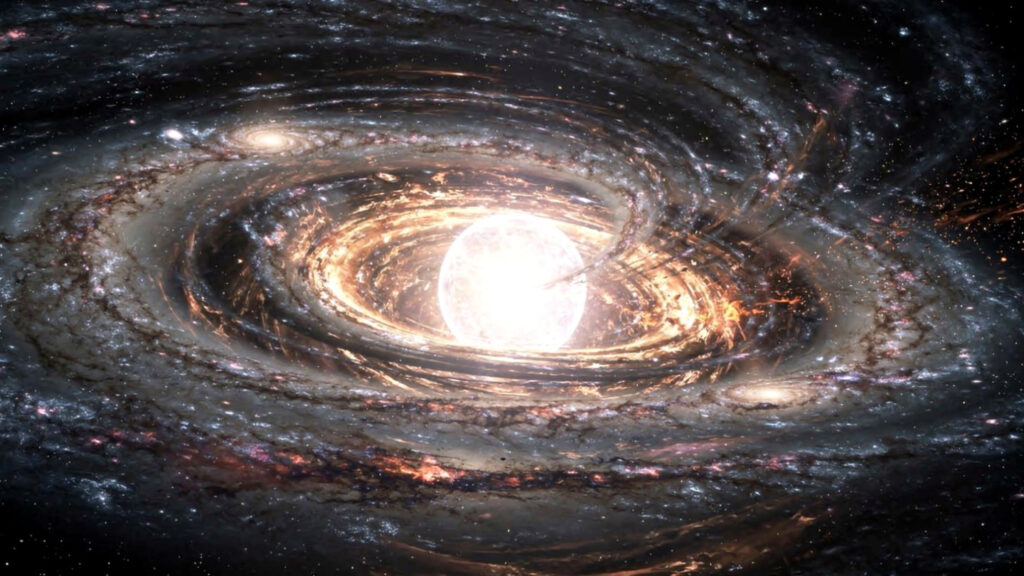
The Big Bang Is Not the Mystery. The Edge of the Map Is.
Guth, Linde, Penrose, Steinhardt, Turok, Hartle, Hawking and the many physicists still working on quantum cosmology are not trying to replace established evidence with fantasy. They are doing something much more difficult. They are taking a theory that works astonishingly well and asking where it stops being enough.
Some of the proposed extensions will be wrong. Most probably will be. That is not a failure of cosmology. It is how theoretical physics works. An idea survives by producing mathematics that works, predictions that can in principle be tested, and explanations that fit the evidence better than the alternatives. The existence of dozens of competing ideas about cosmic origins is not evidence that scientists know nothing. It is evidence that we have reached a question for which the existing evidence does not yet select a single answer.
And that leaves us with a distinction that is easy to lose in popular accounts of the Big Bang. We know an enormous amount about the early universe. We know that it expanded. We know that it was once dramatically hotter and denser. We have relic radiation from that era. We can calculate the production of the light elements and compare those calculations with observation. We can follow the universe’s history through billions of years of structure formation. The evidence is extraordinary.
What we do not yet know is whether that early state was the beginning of reality itself.
Maybe there was an earlier universe. Maybe there was a quantum state from which spacetime emerged. Maybe cosmic time extends through cycles we cannot yet observe. Maybe inflation is part of a much larger structure. Maybe there is no meaningful “before” at all. Or perhaps every one of these pictures is wrong, waiting for a theory of quantum gravity capable of describing a regime where our current equations simply stop speaking.
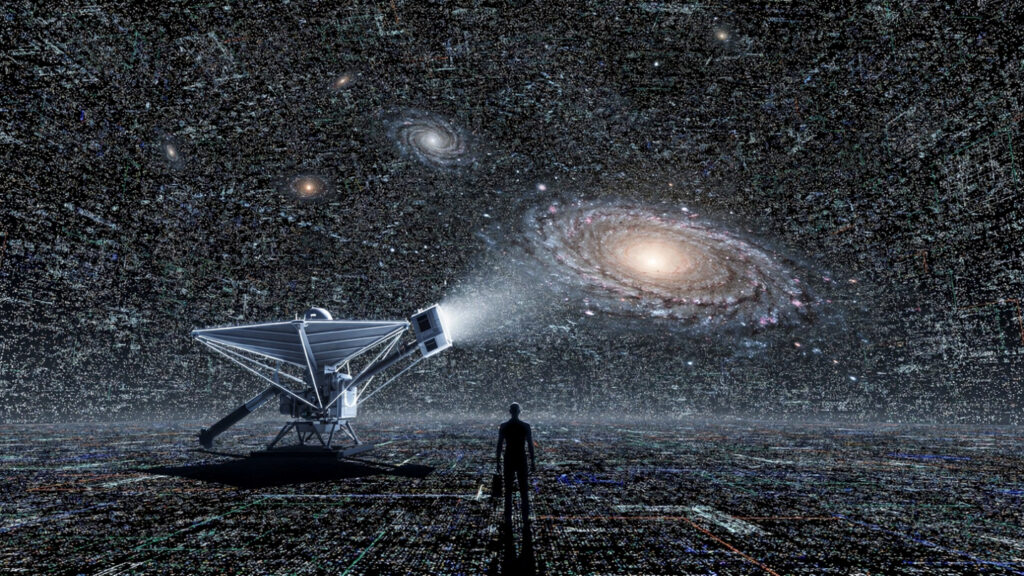
The deepest mystery may therefore not be what happened before the Big Bang. It may be whether before was ever the right word.
For all the precision of modern cosmology, we are still standing at an edge. The difference is that physicists increasingly understand what that edge actually represents. It is not necessarily the end of the universe. It may be the end of our current description of it.
And that is a much stranger place to stand.
Tully’s Laniakea mapping and Lopez’s Big Ring belong to that same published, not suppressed, category of genuinely large cosmic structures.