Jalal Jafari is a real PhD researcher in laser and plasma physics at Shahid Beheshti University in Tehran, and in March 2025 he published a striking theoretical claim about the Great Pyramid of Giza: its latitude, he argued, corresponds to the speed of light in a vacuum to seven decimal places. The coincidence is real. The problem is that the Great Pyramid occupies a range of latitude values wide enough to contain roughly 2,000 different seven-decimal coordinates, meaning that the celebrated number can be obtained only after choosing a particular point on the monument, choosing latitude rather than longitude, and choosing the physical constant to compare against.
That is a very different thing from an ancient civilization encoding the speed of light into the pyramid’s location. And while the numerical claim has become tangled with stories about the monument functioning as some kind of ancient transmitter, something genuinely extraordinary really has been found inside the pyramid: a nine-metre hidden corridor discovered by scientists using cosmic particles to see through solid stone. The corridor is real. The transmitter is not.
The Number That Looks Impossible
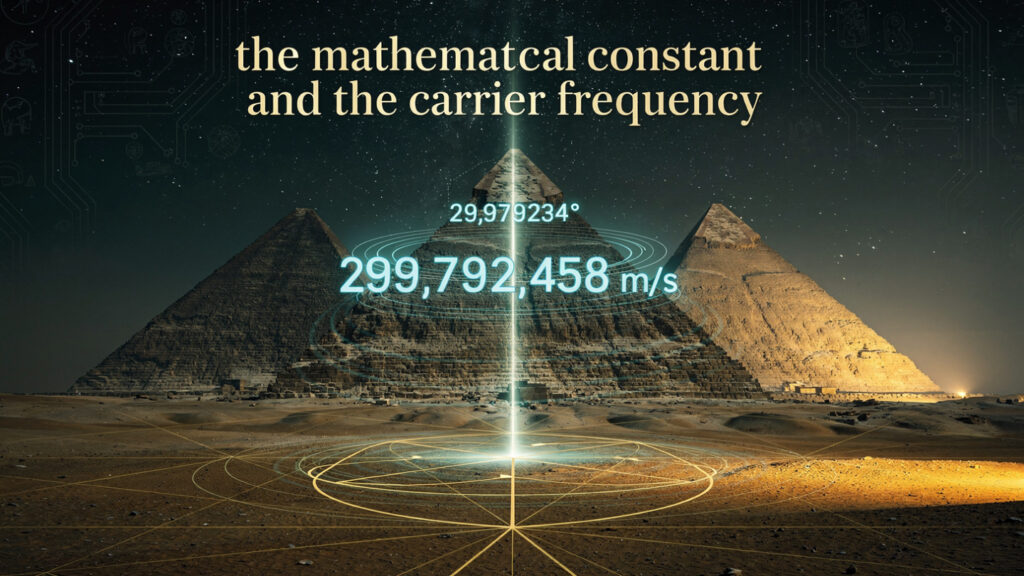
Jafari’s argument begins with a number that seems almost too precise to dismiss as coincidence. His paper, The Pyramids of Giza as Gravitational Beacons: A Theoretical Investigation, dated March 29, 2025, gives the Great Pyramid’s latitude as approximately 29.979234 degrees north and places that figure beside the speed of light in a vacuum: 299,792,458 metres per second. Strip away the units and the resemblance is immediately visible. The digits appear to line up with extraordinary precision, and Jafari describes the correspondence as statistically extraordinary.
But the important question is not whether the digits match. They do. The important question is what, exactly, has been demonstrated by the match. A numerical coincidence becomes evidence of design only when the procedure used to discover it is sufficiently constrained that other plausible numbers, locations, measurements, and constants could not have produced an equally impressive result. In this case, those freedoms are substantial, and once they are made explicit, the apparent miracle becomes much less mysterious.
Jafari’s Pyramid Is More Than a Coordinate
Jafari’s paper does not stop at the observation that the latitude resembles the speed of light. He proposes a much more ambitious theoretical picture in which Earth’s orbit around the Sun behaves somewhat like a repeating gravitational carrier wave and the Great Pyramid, through its fixed mass, position, and relationship to Earth’s rotation, could theoretically modulate that pattern. The analogy is drawn from communications technology: a carrier can be altered by a transmitter to encode information, and Jafari explores whether an analogous process could have occurred on a planetary scale.
The paper also points toward the remarkable orientation of the Giza pyramids and the Great Pyramid’s exceptionally close alignment with the cardinal directions. That ancient surveying achievement is not controversial. The sides of the Great Pyramid are aligned to the cardinal points with an error of only a fraction of a degree, an extraordinary accomplishment for a structure built more than four millennia ago. The difficulty comes when that genuine ancient precision is used as support for a modern communications model for which no physical transmission mechanism has been demonstrated.
Jafari himself presents the transmitter hypothesis as theoretical and acknowledges that further work would be necessary. That qualification matters. A theoretical proposal can be interesting without being established, and the distance between an intriguing model and an experimentally demonstrated mechanism is exactly where much of the popular mythology surrounding the claim has been created.
The 2,000-Coordinate Problem
The most damaging objection is remarkably simple once the geometry is understood. A latitude is not a pin placed on a map. It is a line that circles the entire Earth. The Great Pyramid itself is roughly 230 metres wide at its base, which means that there is not one single latitude belonging to the physical monument. There is a range of latitudes crossing different parts of it.
Independent fact-checking analyses have calculated that approximately 2,000 distinct latitude values at seven-decimal precision, spanning roughly 29.978150°N to 29.980150°N, can intersect some portion of the pyramid. That changes the nature of the famous coincidence completely. If a researcher is free to choose the exact point on the structure, select latitude rather than longitude, and then search for a physical constant resembling the resulting number, the question is no longer simply whether an ancient architect encoded a universal constant. It becomes whether a sufficiently large search space can produce an impressive match after the target has already been selected.
This is the classic logic behind what statisticians and critics often call the sharpshooter fallacy: the target is drawn around the bullet hole after the shot has already been fired. The existence of a striking numerical correspondence is therefore not, by itself, evidence that the builders of Giza knew the modern value of the speed of light, measured it in metres per second, and deliberately placed the pyramid at a coordinate that reproduces its digits. The coincidence is fascinating. The inference is another matter entirely.
The Problem With Modern Units
There is an even deeper reason to be cautious. The speed of light is expressed here in metres per second, while the Great Pyramid’s latitude is expressed in degrees. The numerical resemblance becomes meaningful only because modern scientific culture has assigned particular numerical values to physical quantities using modern units and conventions. Change the unit system and the numerical representation of the speed of light changes. The pyramid does not move.
That distinction doesn’t make the coincidence worthless. Numerical coincidences can be genuinely intriguing. But it does mean that any claim of deliberate ancient encoding has to explain why a civilization operating thousands of years before the modern definition of the metre would have selected precisely the numerical representation that happens to look familiar to a twenty-first-century observer. Without an independent reason for that choice, the digits themselves cannot carry the historical weight being assigned to them.
Giza Has Attracted Encoded-Message Theories Before
The search for hidden mathematics in ancient monuments is hardly new. The Giza plateau has repeatedly been treated as a kind of archaeological cipher, with researchers proposing connections between the pyramids, astronomical constellations, sacred geometry, and mathematical constants. A separate, older claim holds that the Great Pyramid’s own proportions encode pi, dividing the base perimeter by twice the height and arriving at a figure close to 3.14159. Robert Bauval’s Orion Correlation Theory, developed in the late twentieth century, famously argued that the arrangement of the three major Giza pyramids corresponds to the stars of Orion’s Belt. Other claims have proposed that monuments such as Stonehenge contain encoded values of pi or other universal quantities.
Some of these observations begin with genuine measurements. That is what makes the genre so seductive. Ancient builders really did achieve extraordinary geometric precision, and the monuments really do possess measurable relationships to their landscape and to the sky. The problem arises when the number of possible measurements, units, orientations, reference points, and celestial objects becomes so large that an investigator can search until a spectacular correspondence appears. A coincidence found after a vast search is not equivalent to a prediction made before the search began.
Something Truly Is Hidden Inside the Great Pyramid
And this is where the story becomes considerably more interesting than the viral version. The Great Pyramid really does contain a previously unknown architectural space, and its discovery required technology that would have looked like magic to the people who built the monument.
In 2023, researchers working with the ScanPyramids project published a peer-reviewed study in Nature Communications describing a hidden corridor located behind the pyramid’s original entrance. The passage is approximately nine metres long, around two metres wide, and around two metres high. It was not discovered by opening the wall or drilling into the monument. Scientists detected it using muon tomography, a technique that exploits naturally occurring cosmic-ray particles to map differences in density inside massive structures.
Muons constantly rain down through Earth’s atmosphere. When they pass through dense material, some are absorbed or scattered. When they encounter an empty space, their passage is different. By measuring those changes from detectors positioned around a massive structure, researchers can reconstruct the presence of voids hidden behind metres of stone without physically disturbing the monument. The same basic principle has been used to investigate geological structures and other massive engineered objects. At Giza, it effectively allowed scientists to look inside the pyramid without opening it.
The corridor itself is therefore extraordinary enough. Researchers have proposed that its architectural purpose may have involved redistributing weight and relieving structural stress around the entrance, consistent with other load-management features found inside the pyramid. There is no published evidence that the passage functions as a radio transmitter, gravitational beacon, communications channel, or waveguide, and the researchers who discovered it have not presented it as one.
The Ancient Precision Is Real
None of this requires reducing the Great Pyramid to an ordinary building. Its engineering remains astonishing. The monument’s sides are aligned remarkably closely with the cardinal directions, its construction required the movement and placement of enormous quantities of stone, and its geometry reflects a level of surveying and organization that continues to fascinate archaeologists and engineers. Other Egyptian sites show comparable precision, including solar alignments calculated centuries apart from Giza. The absence of a modern constant hidden in its latitude does not make those achievements less impressive.
In fact, the opposite is true. The more carefully the genuine evidence is separated from the numerical mythology, the more extraordinary the ancient achievement becomes. The builders of Giza did not need a twenty-first-century value for the speed of light to produce a structure whose orientation still impresses modern surveyors. They needed observation, geometry, logistics, astronomical knowledge, and an organizational capacity capable of turning those things into one of the largest monuments ever constructed.
A Coincidence Is Not the Same Thing as a Signal
The Great Pyramid’s latitude and the speed of light produce an arresting numerical resemblance. Jafari has constructed a theoretical model around that resemblance, and the model is an interesting proposal for further discussion. But the available evidence does not establish that the pyramid was designed as a gravitational transmitter, nor does the coordinate coincidence demonstrate that its builders possessed knowledge of the modern speed of light.
The hidden corridor, meanwhile, requires no speculative physics at all. It exists. Scientists detected it, measured it, published the result, and continue to investigate what lies within the monument. That is the more compelling mystery: not that an ancient civilization secretly encoded a modern physical constant into a coordinate, but that after more than four thousand years, the Great Pyramid can still conceal an entire architectural space from the people studying it.
There is a useful lesson in the contrast. Ancient precision is real. Modern numerical coincidences are real. Hidden architecture is real. What does not automatically follow is a connection between them. The Great Pyramid does not become less mysterious when the unsupported transmitter story is removed. It becomes more mysterious, because what remains is something archaeology can actually demonstrate: an enormous human construction whose builders left behind enough genuine precision, unanswered questions, and hidden spaces to keep modern science looking inside it centuries after the last stone was set.