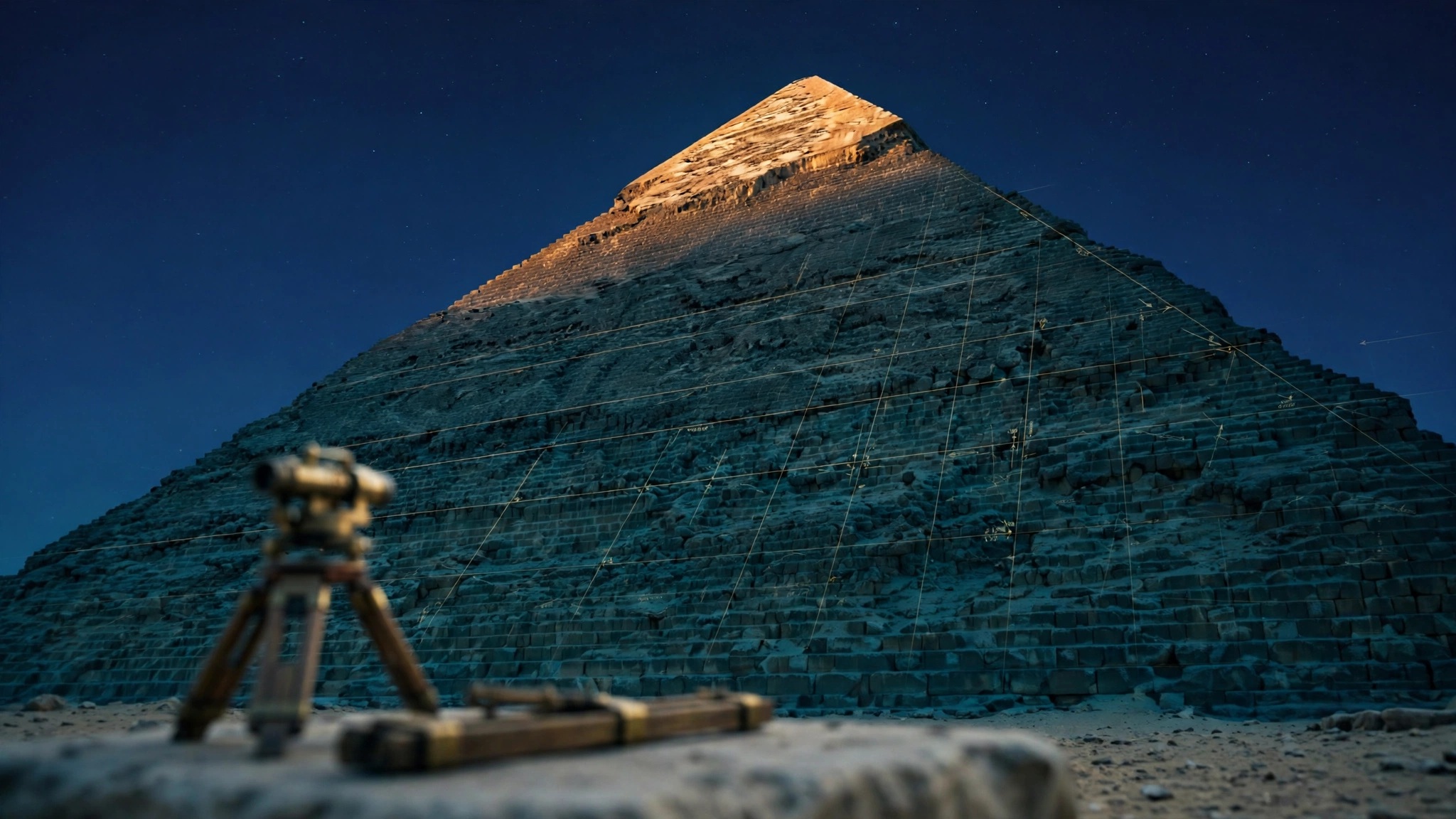
Early in 1865, Charles Piazzi Smyth, the Astronomer Royal for Scotland, moved into an empty rock-cut tomb on the Giza plateau with his wife Jessie and a crate of instruments. For four months they lived among the dead, and by day he climbed through the passages of the Great Pyramid with measuring rods, thermometers and a camera lit by burning magnesium, taking the dimensions of every corridor and chamber he could reach. He was not there to study the Egyptians. He was there to read a message he believed God had built into the stone.
Smyth came home more certain than ever that the pyramid held the value of pi, the size of the Earth, the distance to the Sun and a unit of measure older than any nation, the pyramid inch, which he believed had survived in the British inch. His followers went further. They found a calendar of history in the passages, with the birth of Christ, the end of the world and, later, the First World War marked out in inches. In the internet age the message has grown again, to include the speed of light and a prediction of the attacks of September 2001.
- What Is the Great Pyramid Message?
- The Message, Measured
- The Publisher and the Astronomer
- Pi in the Stone
- The Speed of Light Latitude
- The Centre of the World and the Distance to the Sun
- Petrie’s Survey
- A Calendar in the Passages
- The Prophecy of September 2001
- The Doors in the Shafts
- The Spaces Still Hidden
- The Message the Builders Left
- Quick Answers About the Great Pyramid
- The Verdict | Debunked
The Great Pyramid of Khufu, finished around 2560 BCE, is the most measured building on Earth, and its measurements are public. Every part of the message can be checked against them.
What Is the Great Pyramid Message?
The Great Pyramid message is the idea that the pyramid’s dimensions encode scientific knowledge and a prophetic timeline left by its builders. It began with the London publisher John Taylor in 1859 and was developed by Piazzi Smyth from 1864, and the movement it inspired is known as pyramidology. Its main claims are that the pyramid encodes pi, the Earth’s dimensions, the distance to the Sun, a sacred unit called the pyramid inch, and a chronology of world history in its internal passages. Modern additions place the pyramid on a latitude matching the speed of light and credit it with foretelling the events of 2001.
The Resonance Archive · The Measurements
The Message, Measured
Every claim on the page, set against the survey, the record or the date it rests on.
6 Debunked1 Disputed1 Unresolved1 Documented
Measurements from W. M. F. Petrie, The Pyramids and Temples of Gizeh (1883), and the ScanPyramids reports. Each row is set out in full below.
The Publisher and the Astronomer
John Taylor never went to Egypt. Working from published measurements in London, he argued in The Great Pyramid: Why Was It Built and Who Built It? that the monument was too perfect to be the work of pagan Egyptians and must have been built under divine guidance, perhaps by the patriarchs of the Bible. He proposed that its builders had used a sacred unit, the pyramid inch, a fraction longer than the British inch, twenty-five of which made up a sacred cubit. The idea drew on Isaac Newton, who a century and a half earlier had tried to recover the cubit of the Bible from measurements of the pyramid, in work described in our file on Newton’s surviving apocalypse papers.
Piazzi Smyth took Taylor’s theory to Giza. His book Our Inheritance in the Great Pyramid, first published in 1864, ran through many editions, and its title carried its argument. The inheritance was British. Smyth believed the British inch descended from the pyramid inch, and he used the pyramid in a public campaign against Britain adopting the French metric system, which he saw as a godless modern invention. His ideas fed directly into British Israelism, the belief that the British were descended from the lost tribes of Israel.
Pi in the Stone
The most quoted claim is also the strongest. Divide the perimeter of the pyramid’s base by twice its height and the result is close to pi. Using Flinders Petrie’s survey of the 1880s, the base sides average about 230.4 metres and the original height about 146.6 metres, which gives 3.1427. Pi is 3.14159. The match is good to within about a twentieth of one percent.

The Egyptians did not describe slopes as angles. They used the seked, the number of palms a face runs inward for every cubit it rises, and examples of the calculation survive in the Rhind Mathematical Papyrus, a scribe’s textbook from around 1550 BCE. The Great Pyramid’s slope is a seked of five and a half palms. A cubit is seven palms, so the face rises 28 units for every 22 it runs, and a pyramid built that way has a perimeter to height ratio of exactly 22/7, which is 3.1428. The pyramid was laid out as 440 royal cubits along each side and 280 cubits high, and those numbers give the same result.
Whether the builders chose that slope because of the circle is still argued. The physicist Kurt Mendelssohn suggested in 1974 that the Egyptians measured long horizontal distances by rolling a drum and counting its turns, which would build pi into a structure without anyone needing to know it. Others think the seked of five and a half was chosen for practical reasons and the ratio followed. The figure is there. What it meant to the builders is the open part.
The Speed of Light Latitude
The newest claim began circulating online. The Great Pyramid, it says, sits at latitude 29.9792458 degrees north, and the speed of light is 299,792,458 metres per second. The digits are the same.
The centre of the pyramid lies at about 29.97917 degrees north. The claimed line passes about eight metres from it, inside a base that measures some 230 metres from north to south. Any line of latitude between about 29.978 and 29.981 degrees crosses the pyramid.
More important, both numbers depend on human conventions that did not exist when the pyramid was built. The degree comes from the 360-part circle of Babylonian astronomy. The metre was defined in 1791 as a fraction of the distance from pole to equator, and since 1983 it has been defined by the speed of light itself, fixed at exactly 299,792,458 metres per second. Measured in kilometres per second, miles per second or any ancient unit, the match disappears. With the thousands of famous buildings and numbers available, a match of the first few digits is the kind of coincidence that is bound to turn up somewhere.
The Centre of the World and the Distance to the Sun
Smyth also claimed that the meridian through the pyramid crosses more land than any other, citing the calculations of a friend, Mr William Petrie. It does not. A meridian near 70 degrees west, running through the Americas, crosses more. When Andrew Woods calculated the geographical centre of the world’s land surface in 1973, he placed it about 150 kilometres south-east of Ankara, in central Turkey.
The distance to the Sun works in a similar way. Smyth multiplied the pyramid’s height by a thousand million and arrived close to the astronomers’ estimate of the Sun’s distance in his day. The pyramid’s height of 146.6 metres, multiplied by a billion, gives 146.6 million kilometres. The average distance to the Sun is 149.6 million kilometres, so the result is two percent short. Graham Hancock later proposed in Fingerprints of the Gods that the pyramid was a model of the northern hemisphere at a scale of 1 to 43,200. Multiplied by 43,200, the height comes close to the Earth’s polar radius.
The problem is the multiplier. A billion and 43,200 are chosen after the fact, because they produce a match. With enough measurements to choose from and freedom to pick the multiplier, a monument of this size can be made to match almost any large number in nature.
Petrie’s Survey
The man who ended scientific pyramidology began as a believer. William Matthew Flinders Petrie was the son of that same William Petrie, a friend of Smyth’s, and he grew up with Our Inheritance in the Great Pyramid. In 1880 he went to Giza to make the most accurate survey yet, partly to test Smyth’s theories. He lived in a tomb as Smyth had, and spent two seasons measuring the pyramid with instruments far more precise than any used before.

His results, published in The Pyramids and Temples of Gizeh in 1883, found the pyramid several feet smaller than Taylor and Smyth had reported. He found no trace of a pyramid inch. The building had been laid out in the Egyptian royal cubit of about 52.4 centimetres. Petrie concluded that the theory could not survive the measurements, and that its remaining believers could be left with the flat-earth believers. The survey that ended the pyramid inch went on to make his name. Petrie became the founder of scientific archaeology in Egypt.
A Calendar in the Passages
The pyramidologists’ calendar rested on one rule, one pyramid inch for each year. Starting from a chosen point in the descending passage, they measured along the corridors and read off dates. The junction of the passages marked the Exodus, the start of the Grand Gallery marked the birth or death of Christ, and the end of the Grand Gallery marked the final crisis of history.
The calendar was adopted by Charles Taze Russell, founder of the Bible Student movement, who wrote the pyramid into the third volume of his Studies in the Scriptures in 1891 as support for his prophetic dates. In editions printed between 1897 and 1903, a key passage length was given as 3,416 inches, which pointed to 1874. In editions from 1905 on, the figure became 3,457 inches, and the date moved to 1914. “The close of 1914 will be the beginning of the time of trouble,” the later edition said. In 1909 Morton Edgar, a follower who measured the passages in person with his brother John, found that neither published figure was correct, and announced that his own measurement still pointed to both dates.
The famous datings of the First World War, 1914 at the step at the top of the Grand Gallery and 1918 at the end of the low passage, come from The Great Pyramid, Its Divine Message, published by the British engineer David Davidson and H. Aldersmith in 1924, six years after the war ended. The dates that came after it, in Davidson’s scheme and others, passed without the events the passages were read to foretell.
The Prophecy of September 2001
Rodolfo Benavides was a Mexican writer, born in 1907, who worked as a miner and a migrant labourer before he turned to books. In 1960 he published Las dramáticas profecías de la Gran Pirámide, The Dramatic Prophecies of the Great Pyramid, which applied the pyramid-inch calendar to the decades ahead. It was widely read across Latin America, and he followed it with an updated edition in 1985.

The book’s schedule ran to 2001, with 17 September given as the end of an age. In the years since the attacks of 11 September 2001, the date has been quoted as proof that the pyramid foresaw them. The rest of the schedule is seldom quoted. As its readers have summarised it, the book foresaw world catastrophe and war between 1967 and 1977, a change in the tilt of the Earth’s axis by 1982, a rise in sea level of seven to twelve metres from melting polar ice, and by 2001 the loss of seventy percent or more of humanity, followed by a new climate, a new religion and a new messiah.
None of that happened. A schedule that ends at a round date at the turn of the millennium, filled with catastrophe, will always land near something in a crowded year. Benavides died in 1998, three years before his date.
The Doors in the Shafts
The pyramid’s most intriguing open question has nothing to do with inches. Four narrow shafts, about twenty centimetres square, run up through the masonry from the King’s Chamber and the Queen’s Chamber. They were once called air shafts. In 1964 the astronomer Virginia Trimble and the architect Alexander Badawy proposed that the southern shaft of the King’s Chamber pointed at the stars of Orion’s Belt, which the Egyptians linked with Osiris, and the northern one at the circumpolar stars, as if aiming the dead king’s soul at the sky. The idea is still taken seriously.
The Queen’s Chamber shafts do not reach the outside. In 1993 the German engineer Rudolf Gantenbrink sent a small robot named Upuaut 2 up the southern shaft. About sixty metres in, it stopped at a smooth slab of limestone set into the shaft, with two copper pins projecting from its face. The image of the “door” went around the world.

In September 2002 a robot built by iRobot for National Geographic drilled a narrow hole through the slab during a live television broadcast. A camera pushed through the hole found a small empty space and, a short distance beyond, a second stone. Days later the same team found a similar block with copper pins in the northern shaft. In 2011 a robot from the University of Leeds, named Djedi, carried a bending camera through the hole and looked back at the first slab. It saw the backs of the copper pins, neatly finished in small loops, and marks in red ochre painted on the floor of the space, which Egyptologists have read as builders’ marks or numerals, of the kind found elsewhere in the pyramid. The results were published in the Journal of Field Robotics in 2013.
The name Djedi comes from the Westcar Papyrus, a collection of tales written down centuries after Khufu, in which the king asks a magician named Djedi about the number of the secret chambers of the sanctuary of Thoth, which he wished to copy for his own pyramid. Work on the shafts stopped after 2011. The second stone has not been passed, and what the shafts were for, and what lies beyond their last blocks, is still unknown.
The Spaces Still Hidden
The pyramid has given up more in the past decade than in the century before. In 2017 the ScanPyramids project, using muons, particles made by cosmic rays that pass through stone, reported in Nature a large void at least thirty metres long above the Grand Gallery. In 2023 the same project announced a corridor about nine metres long behind the chevron stones over the original entrance, and an endoscope camera pushed through a joint in the stones showed its vaulted ceiling, unseen since the pyramid was built. Neither has been entered by a person, and neither has a known purpose. Physicists have also modelled how the pyramid’s mass scatters radio waves, a study described in our file on the pyramid’s electromagnetic properties.

The idea that the pyramid keeps the knowledge of a lost age is far older than Smyth. Medieval Arab writers told that it had been raised before the Flood to keep the sciences safe, a tradition followed in our file on what Ibn Battuta wrote about the pyramids. Each age has found in it the message it most wanted, divine measures for the Victorians, cosmic constants for the space age, prophecy for the turn of the millennium.
The Message the Builders Left
The pyramid is not silent. In 1837 the British officer Howard Vyse blasted his way into the low relieving chambers above the King’s Chamber and found the walls covered in red paint, the names of the work gangs who hauled the blocks, among them “the Friends of Khufu,” with the king’s name in their titles. The story of those marks is told in our file on the painted marks Vyse found. In 2013, at a harbour on the Red Sea, the French archaeologist Pierre Tallet found the oldest inscribed papyri ever discovered, among them the logbook of an inspector named Merer, who spent months ferrying limestone from the quarries at Tura to Giza for Khufu’s pyramid.
Those are the messages the builders left, written by the people who did the work. They record a kingdom able to organise thousands of labourers, feed them, move millions of tonnes of stone and set it to a slope of five and a half palms with an error of a few centimetres. The pi in the proportions may be their only mathematical signature. The rest of the message was written in Edinburgh, London, Pennsylvania and Mexico City.
Quick Answers About the Great Pyramid
Does the Great Pyramid encode pi? Its perimeter divided by twice its height is about 3.1427, close to pi. That ratio follows from the slope the Egyptians used, a seked of five and a half palms, which gives 22/7. Whether they intended a link to the circle is still debated.
Is the Great Pyramid at the speed of light latitude? Its centre lies at about 29.97917 degrees north, about eight metres from the line of 29.9792458. The match depends on the metre and the degree, both modern conventions, and the metre has been defined by the speed of light since 1983.
Did the Great Pyramid predict 9/11? No. A 1960 book by Rodolfo Benavides gave 17 September 2001 as the end of an age, but the same book foresaw floods, a shift in the Earth’s axis and the loss of most of humanity by that date.
What is behind the doors in the Great Pyramid? In the southern shaft of the Queen’s Chamber, a small empty space and then a second stone. What lies beyond that is unknown.
What is the pyramid inch? A unit proposed by John Taylor in 1859, slightly longer than the British inch. Flinders Petrie’s survey found no trace of it. The pyramid was built in royal cubits of about 52.4 centimetres.
The Verdict | Debunked
The Great Pyramid contains no encoded message beyond what its builders measured into it. Its proportions come close to pi, a result of the slope the Egyptians used, and whether that was deliberate is still argued. The speed of light latitude, the centre of the land, the distance to the Sun and the pyramid inch do not survive the measurements. The prophetic calendar was revised in print to fit its dates and read into the passages after the events, and the 2001 prediction came wrapped in catastrophes that never happened. The doors in the shafts and the voids found by muon scans are open questions, and nobody knows yet what they hold. As a coded message from the builders, the Great Pyramid message is debunked.
The wider story of Egypt’s pharaohs, pyramids and hidden chambers is gathered in our Ancient Egypt case files, and the astronomy behind the Orion and 10,500 BCE claims is examined in our file on the strange gods of ancient Egypt.
The wider story of Egypt’s pharaohs, pyramids and hidden chambers is gathered in our Ancient Egypt case files.
For how this verdict sits beside the rest of the archive, see the Verdict Index.