



A work of speculative fiction. No international scientific expedition of this kind, and no discovery matching this description, has ever been reported by any credentialed research institution or government body. No record of an “Alexei Volkov,” “Nihal Roy,” “Cao Lin,” or “Robert Smith” connected to any Antarctic expedition exists. This is an original piece of cosmic horror fiction, built around the remote strangeness of Antarctica itself.
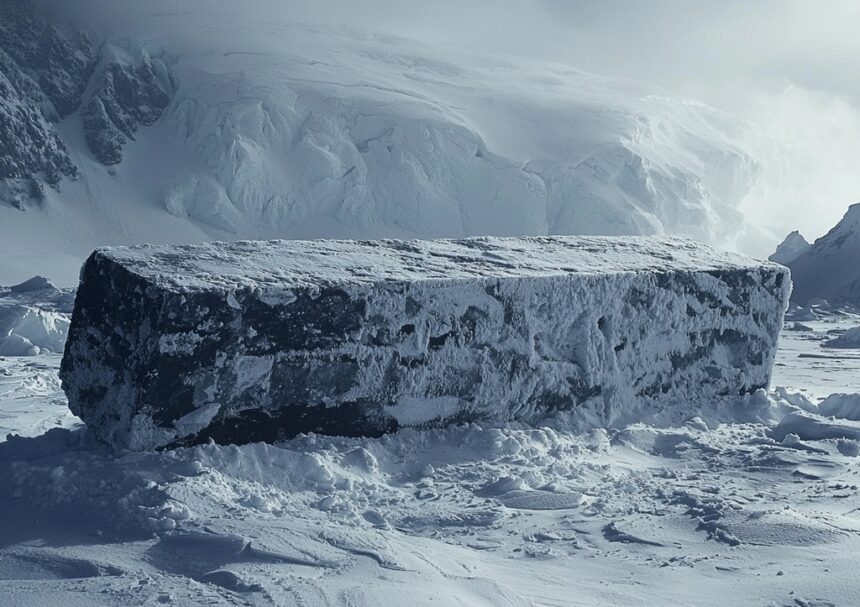
In this account, a joint expedition, American, Russian, Chinese, and Indian scientists working together in one of Earth’s most remote regions, uncovers four black sarcophagi buried in the ice. Polished to a mirror finish, warm despite the subzero cold, and etched with a language nobody on the team recognizes, the objects resist every instrument the researchers bring to bear on them.
Eerie Sounds and Unsettling Phenomena
The first night at the research station brings unsettling events, in this telling. Expedition leader Robert Smith wakes at 3 a.m., certain he’s being watched. A low rumble moves through the station, though every instrument monitoring the sarcophagi stays silent. He finds his colleagues already in the hangar, equally unsettled. A single drop of melting ice falls onto one of the objects, and it answers, a low, resonant hum that seems to come from somewhere deep inside the metal itself rather than off its polished surface.

The Message
When the team finally opens one of the sarcophagi, they find a cylinder inside, warm as if freshly forged, its surface covered in symbols that resemble runes, or code, or something with no earthly analogue at all. Then the lab’s monitor flickers on, unprompted, and displays a message in every language the system has on file:
“DO NOT WAKE UP THAT WHICH SLEEPS. OUR SLEEP SHOULD BE ETERNAL.”
Over the following days, in the telling, the messages continue and grow stranger. Equipment fails without explanation. The storage room’s temperature swings for no measurable reason. The team starts having the same dream, separately, without discussing it with each other first.
A Cosmic Warning
The most unsettling message arrives days later, longer and more specific than anything before it: a warning that the sarcophagi function as a kind of beacon, actively concealing Earth’s location and existence from something the message only ever refers to as “THEY.” The implication, never stated outright but impossible for the team to miss, is that discovery would mean annihilation, not just for the research team, but for everyone on the planet.
The Decision
Faced with a warning they can’t verify and can’t afford to simply ignore, the team makes its final, unanimous choice: rebury the sarcophagi deep in the ice, file an official report describing them only as unremarkable granite monoliths, and never speak of what they found again, not even to each other. Somewhere, thousands of light-years away, in this telling, something that was listening stops listening, at least for now.
Scientific Theories and Ethical Dilemmas
Within the narrative’s own internal logic, the team debates several possible explanations before making its final decision. Some propose the sarcophagi are relics of a prehistoric civilization with technology beyond modern human capability. Others lean toward extraterrestrial origin, pointing to the cryptic messages and the unidentifiable material as evidence. A more conservative faction within the fictional team argues for a secretive modern experiment gone wrong, though no known human technology matches what they’ve found. This layered, competing-theories structure is a deliberate storytelling choice, common across the entire genre, that lets a fictional mystery breathe without committing to a single, flattening explanation too early in the narrative, mirroring the way unresolved scientific questions often sit patiently with multiple live, competing hypotheses for years before accumulating evidence eventually favors one over the others.
The Real Science of Ice Preservation
Grounding one small piece of the premise in science: Antarctic ice does preserve things remarkably well, which is part of why “buried in the ice for millennia” works as a believable fictional setup. Ice cores extracted from Antarctica have preserved atmospheric samples, volcanic ash layers, and even ancient microorganisms for hundreds of thousands of years, peer-reviewed climate science that has produced genuinely valuable records of Earth’s past atmosphere and climate going back roughly 800,000 years through projects like the European Project for Ice Coring in Antarctica. This preservation capability is part of what makes Antarctica such fertile ground for exactly this kind of “buried for ages, waiting to be found” fiction, since the underlying physical premise, that something could remain undisturbed and well-preserved under Antarctic ice for an extraordinarily long time, is actually true, even though the specific sarcophagi in this story are not.
A Note on the Writing Itself
Appreciating this piece’s structure on its own literary terms, separate from the factual grounding above: the specific choice to give the sarcophagi a warning rather than a threat, “our sleep should be eternal” rather than any direct hostility, is genuinely effective horror craft, since it recasts the reader’s fear from the objects themselves onto the team’s own decision-making, and by extension the reader’s own curiosity. The account never actually reveals what “THEY” are, and that restraint is deliberate: an unnamed, undescribed threat is almost always more unsettling than a fully explained one, because the reader’s own imagination fills in details far more effectively than any description could. This is a well-established technique in horror and weird fiction more broadly, used deliberately by writers from H.P. Lovecraft onward, withholding the monster rather than showing it, and this piece applies that same principle competently within its own short scope.
Why Antarctica Is the Right Setting for This Kind of Fiction
The geography does a lot of the narrative work for it. The continent is the least populated, least accessible landmass on Earth, home to a small, rotating population of scientific researchers rather than any permanent civilian community, with extreme cold, months of total darkness in winter, and a well-documented history of psychological strain among researchers during long isolated postings, sometimes called “winter-over syndrome” by polar psychologists who study it. A setting this remote and disorienting needs very little embellishment to feel plausible as the site of something undiscovered, which is exactly why Antarctica recurs so often across this entire genre of fiction, from this piece to the White Walkers and Ningen legends covered elsewhere in this library.
The Antarctic Treaty, for Contrast
The genuine international framework that actually governs Antarctic research offers a useful contrast to the premise of a secret joint expedition. The Antarctic Treaty, signed in 1959 by twelve countries and now encompassing 56 signatory nations, designates the continent for peaceful, scientific purposes only, explicitly prohibits military activity, and includes binding provisions for inspection: any signatory nation can request access to any other nation’s research stations with limited advance notice, specifically to verify compliance. This functioning international transparency framework, imperfect as any international agreement is, makes a genuinely secret, multi-national, off-the-books expedition of the kind imagined here considerably harder to conceal in reality than the fictional premise requires.
The Real Psychology Behind the Atmosphere
The psychological research this atmosphere draws from gives the fiction a genuine foundation beyond pure invention. Studies of Antarctic winter-over crews, personnel who remain at research stations through the continuous darkness of the polar winter, have documented measurable psychological effects, including disrupted sleep patterns, changes in mood and cognitive function, and a documented phenomenon researchers call the “third-quarter effect,” an observed dip in morale and psychological wellbeing occurring roughly midway through an isolated posting, well after initial novelty fades and before the anticipation of departure sets in. Space agencies including NASA have studied Antarctic winter-over crews specifically because their isolation, confinement, and extreme environment closely approximate conditions future long-duration spaceflight crews would face, making Antarctic psychology relevant research with applications well beyond the continent itself. This account’s depiction of a team gradually unsettled by isolation, strange sounds, and shared unease draws, whether deliberately or not, on exactly this documented body of psychological research into what sustained isolation in an extreme environment does to the human mind.

Real Antarctic Research Stations, for Comparison
Antarctic research stations are genuinely fascinating without needing any embellishment. The United States operates stations including McMurdo Station, the continent’s largest, and the Amundsen-Scott South Pole Station, built directly at the geographic South Pole and staffed year-round despite six months of continuous darkness during the Antarctic winter. Russia, China, and India all operate their own research stations as well, Russia’s Vostok Station, site of the coldest naturally occurring temperature ever recorded on Earth, China’s Zhongshan and Kunlun stations, and India’s Bharati and Maitri stations. These functioning international facilities, staffed by scientists conducting climate, glaciology, and astronomy research, are considerably more mundane in their daily operations than this story’s fictional joint expedition, though no less remarkable for what they actually accomplish: sustained, functioning human presence in one of the most hostile environments on the planet, entirely in service of peer-reviewed science rather than any hidden discovery.
What Makes a Warning More Frightening Than a Threat
The specific phrasing of the central message does real narrative work. “Our sleep should be eternal” is a plea, not a command, and that distinction matters enormously to how the fear operates. A threat implies power and hostility directed outward. A plea implies vulnerability, something that needs to stay hidden because it, too, is afraid of what might find it if it doesn’t. That reversal, the sense that whatever built the sarcophagi might be as frightened of discovery as the humans reading the message, is a considerably more unsettling premise than a straightforward monster ever could be, because it suggests the danger isn’t the sarcophagi at all, but whatever the sarcophagi themselves are hiding from.
A Comparison: The 2016 “Antarctic Pyramid” Claim
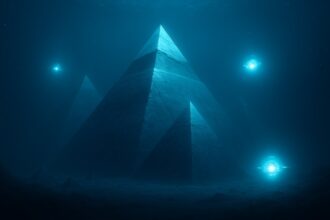
This piece compares usefully to a previously circulated internet claim about a pyramid-shaped structure supposedly spotted in Antarctica on Google Earth in 2016, since it illustrates how quickly this exact genre moves from speculative image to viral claim. That viral claim was investigated and explained by geologists as a naturally occurring nunatak, a well-documented geological term for a rocky peak protruding through a surrounding ice sheet, whose roughly symmetrical, angular shape from certain viewing angles created the visual impression of an artificial pyramid. This explanation didn’t stop the claim from spreading widely before the geological explanation caught up with it, a real-world illustration of exactly the pattern this fiction dramatizes: Antarctica’s visual strangeness, its jagged, ice-carved peaks and vast unpopulated expanses, provides constant raw material that a receptive audience can and does read as evidence of something more than geology, entirely independent of whether the specific claim in front of them is fiction, honest misidentification, or something in between.
The black sarcophagi never existed. But the genuine strangeness of a continent this remote, this cold, and this thoroughly unlike anywhere else people actually live, is enough to make the story worth telling anyway, and enough that the next piece of fiction built on the same geography, whatever shape it eventually takes, will find exactly the same fertile ground waiting for it.