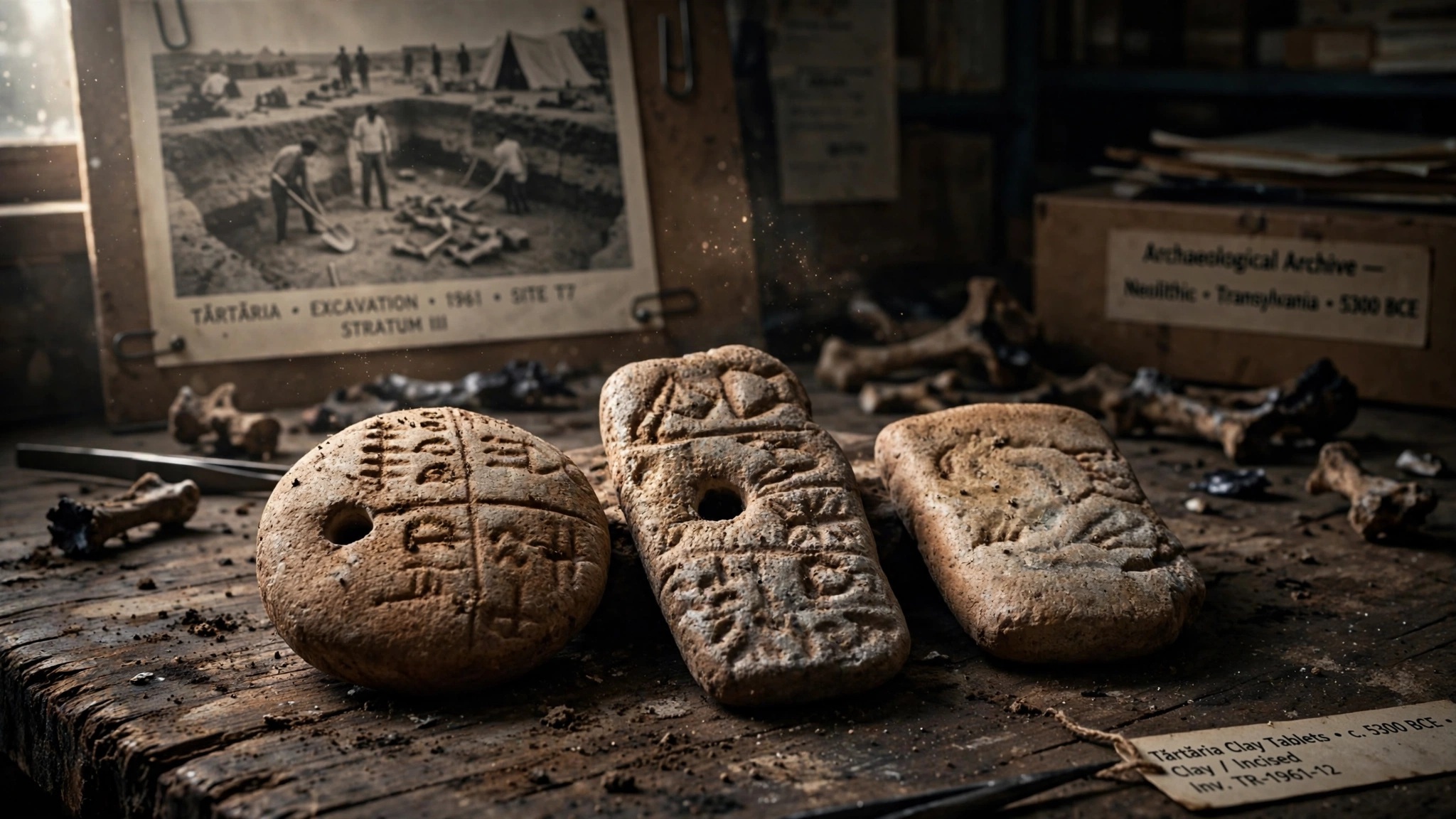
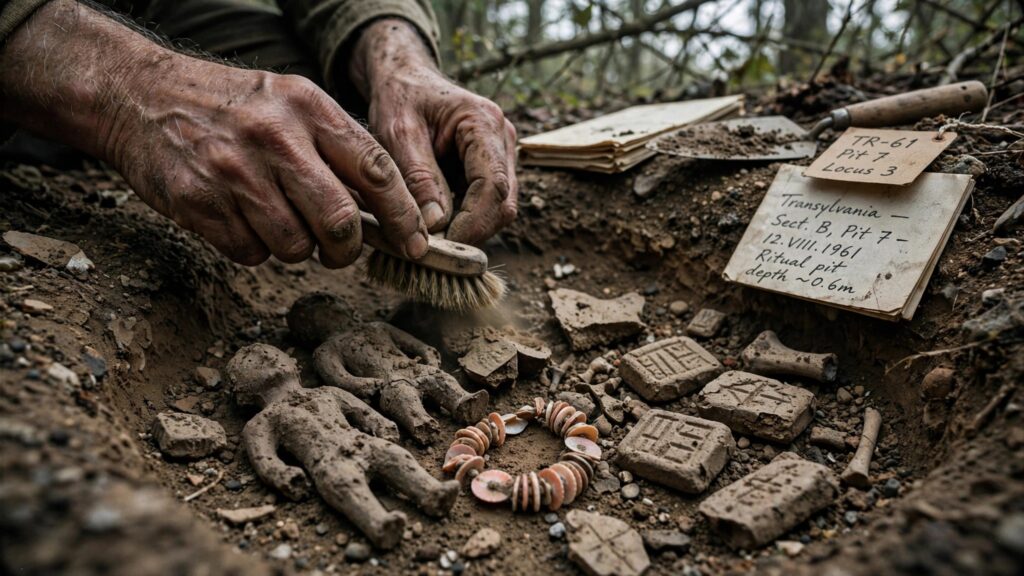
In August 1961, a Romanian excavation team working a ritual pit near the village of Tărtăria in Transylvania uncovered three small clay tablets pressed against the burnt, broken bones of an adult buried alongside twenty-six figurines and a bracelet cut from Mediterranean shell. The tablets were unfired, ordinary river clay, and someone decided to bake them in a kiln for safekeeping before anyone thought to ask what that decision would cost science six decades later: it made the clay itself impossible to radiocarbon date, ever, by any method. Everything the world thinks it knows about how old these tablets are comes from what was buried around them, not from the tablets themselves.
That single, irreversible choice is the reason this argument has now run for over sixty years without resolution.
What Actually Came Out of the Ground
Archaeologist Nicolae Vlassa led the team that excavated the site, Tărtăria-Groapa Luncii, about 30 kilometers from Alba Iulia, part of the broader Vinča culture that spread across the Balkans between roughly 5700 and 4500 BCE. The pit held two rectangular tablets, one measuring 5.3 by 3.6 centimeters and the other 6.3 by 3.15, and a round one just 6.1 centimeters across. Two of the three had holes drilled through them, small enough that all three could sit in a palm at once. Alongside them lay twenty-six clay and stone figurines, two alabaster idols, a bracelet made from Spondylus shell, imported from the Mediterranean or Aegean, and the burnt, disarticulated remains of an adult, whose sex remains disputed in the literature. Scholars have proposed the burial belonged to a local shaman, spirit-medium, or respected elder, though no interpretation has achieved consensus.

Vlassa himself was reportedly not present at the exact moment of discovery, and he never fully clarified the pit’s stratigraphy in his own later writing, a gap that would later become one of skeptics’ central objections.
The Symbols, and What Vlassa First Thought They Meant
The unpierced rectangular tablet carries a horned animal, an indistinct figure, and what looks like a branch or a tree. The other two are covered in linear, cross-hatched, comb-like marks that Vlassa, on first inspection, read as strikingly close to the earliest pictographic signs found on proto-cuneiform tablets from Sumer. Working from that resemblance and from the archaeological framework available in 1961, Vlassa initially placed the tablets around 2700 BCE, aligning them with Mesopotamia’s Uruk IV to Jemdet Nasr period, a plausible date under the assumption that Balkan and Near Eastern writing traditions had touched at roughly the same historical moment.
Then Radiocarbon Dating Rewrote the Timeline by Two Thousand Years
The real complication arrived when radiocarbon testing, applied not to the tablets but to organic material recovered from the same layer and from the broader Vinča sequence, began returning dates far older than anyone had assumed the culture to be. Instead of 2700 BCE, this associated material pointed to somewhere between 5500 and 5300 BCE, over two thousand years earlier, placing the tablets in the same broad window as Eridu-phase Sumer, before Mesopotamian proto-cuneiform is conventionally dated to have emerged. If that date holds for the tablets themselves, and it is a genuine if, it forces a real choice: either writing-like symbolism appeared independently in the Danube valley before it appeared in Mesopotamia, or two culturally unconnected regions each arrived at a comparable idea of marking clay with standardized signs, separately and by coincidence. Neither option is small. Both are still argued today.
Why This Argument Can Never Be Settled the Easy Way
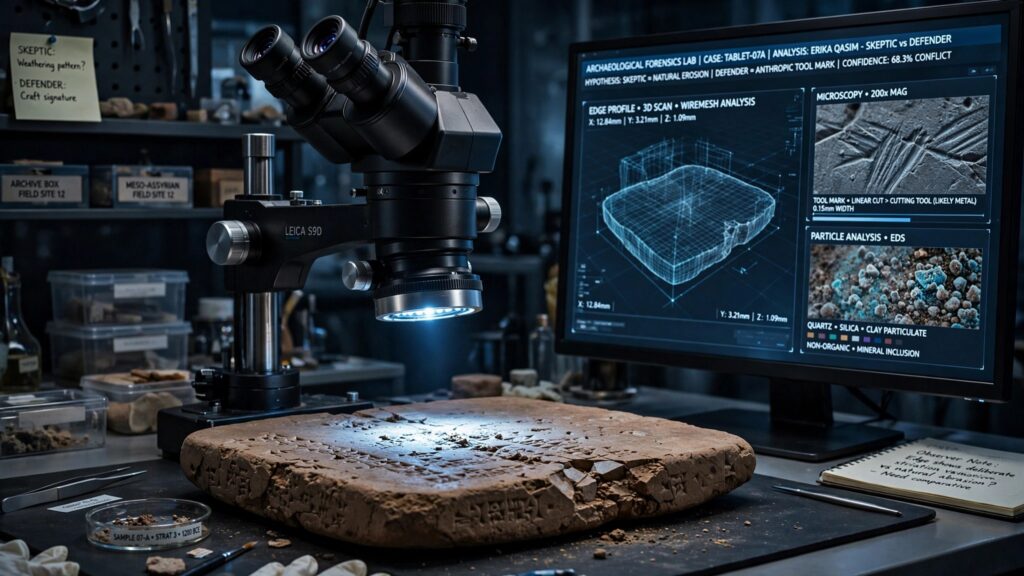
This is the part most retellings skip past too quickly, and it’s the actual crux of the whole sixty-year dispute. Radiocarbon dating measures the decay of carbon-14 in organic material, bone, wood, seed, charcoal. Fired clay contains none of that, the kiln that preserved the tablets physically for the future simultaneously erased the one direct chemical record that could have settled their age on the spot.

Every date attached to the Tărtăria tablets, on either side of the argument, is an inference built from what was buried near them, not a reading taken from the tablets themselves. That’s not a minor technical footnote. It’s the entire reason a discovery this specific, this physically small, has managed to stay unresolved for over half a century instead of being settled within a decade the way most artifact-dating disputes eventually are.
The Forgery Argument, Made by a Named Scholar in a Real Journal
The skepticism here isn’t vague internet doubt. In 2013, assyriologist Erika Qasim published “Die Tărtăria-Täfelchen, eine Neubewertung” in the German journal Das Altertum, arguing the incised signs bear a suspicious resemblance to Sumerian symbol reproductions that were circulating in popular Romanian literature at the time of the 1961 discovery, and proposing the tablets could be a modern intrusion into an older layer rather than a genuine sixth-millennium artifact. This is a real, peer-reviewed argument from a credentialed specialist, not fringe speculation, and it deserves to be treated as exactly that.
It also didn’t go unanswered. Romanian archaeologist Attila László, who was present at the Tărtăria excavation on the day the tablets were reportedly found, published a direct rebuttal in 2016 in the journal Dacia, titled “Cui bono? Thoughts about a ‘Reconsideration’ of the Tărtăria Tablets.” Separately, microscopic analysis conducted in the early 2000s by Romanian archaeologists Gheorghe and Zoia Lazarovici together with researcher Marco Merlini found soil embedded within the incised signs themselves, consistent with genuine prolonged burial rather than recent scratching, along with a clay composition matching local Vinča-period pottery from the same site. Later work in 2011 reported no evidence of modern tool marks. That combination is why most archaeologists working in this field today treat the tablets as authentic Neolithic objects while continuing to argue, sometimes sharply, about what their markings actually mean and how old that meaning really is.
Writing, Symbol, or Neither | The Interpretive Fight Underneath the Dating Fight
Even scholars who accept the tablets as genuinely ancient don’t agree on what the marks actually are. Those arguing for proto-writing point to comparable sign shapes appearing on other Vinča-culture artifacts, suggesting a shared inventory of standardized forms rather than one-off decoration, and to the signs’ rectilinear, comb-like regularity, which resembles the visual grammar of early archaic scripts more than it resembles ordinary decorative pattern-work. Critics counter that visual resemblance to writing isn’t the same as functioning as writing, and that the same geometric, cross-hatched vocabulary shows up across a wide range of Vinča pottery and figurines in contexts that are clearly ornamental rather than communicative. No one has proposed a working translation. What most specialists will say, carefully, is that the tablets belong to a broader family of similarly marked Danube-basin objects, including the Gradeshnitsa tablets from Bulgaria and the Dispilio tablet from northern Greece, evidence of a real, shared regional symbolic tradition, whether or not that tradition ever crossed the line into true writing.
A Predecessor Discovery, Eighty-Six Years Earlier

Tărtăria wasn’t even the first time this kind of marking turned up in the region, and knowing what came before it changes how surprising 1961 actually was. In 1875, Hungarian archaeologist Baroness Zsófia Torma excavated at Tordos, present-day Turdaș, on the Mureș River, a tributary feeding into the Danube, and unearthed marble fragments and pottery inscribed with symbols nobody at the time could account for, alongside female figurines and worked stone. Torma’s find sat largely unexplained for nearly a century. It took Vlassa’s tablets, found less than a hundred kilometers away and clearly part of the same symbolic tradition, to give archaeologists a second, more securely contextualized example to work from, and to turn what had looked like an isolated curiosity into evidence of something genuinely widespread.
The Wider Sign System the Tablets Belong To
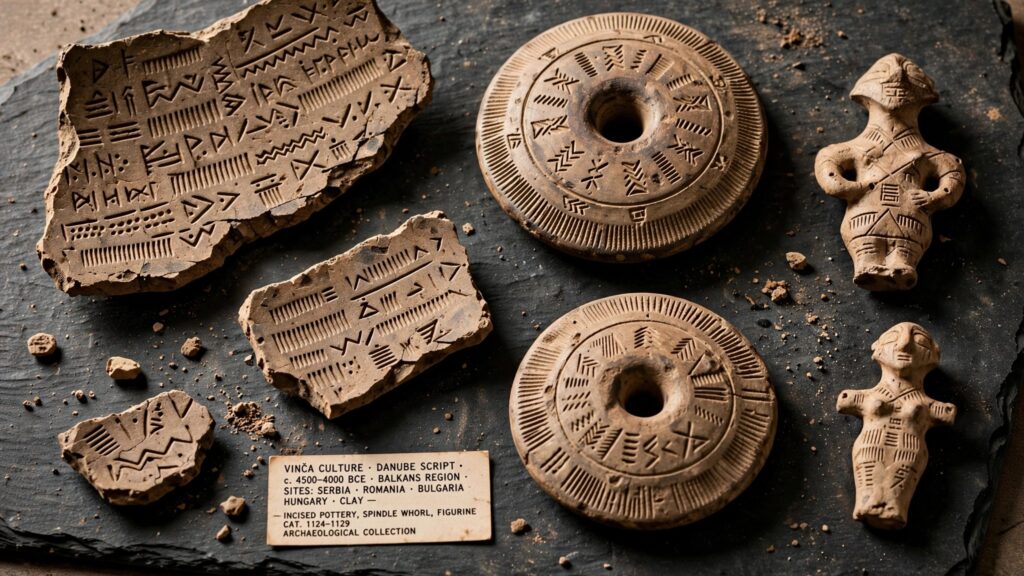
The Tărtăria tablets are the most famous example of a much larger, genuinely documented body of material, not an isolated find. American archaeologist Shan Winn spent the early 1970s cataloguing symbols from more than forty Vinča-culture sites across the Balkans, and his 1973 doctoral dissertation identified 210 distinct sign types, later expanded through further fieldwork to over 240 signs organized into fifteen categories. Winn deliberately used the term “pre-writing” rather than “script,” a term chosen specifically because much of the field resisted calling it writing outright, a caution that has persisted in the literature ever since. Archaeologist Marija Gimbutas gave this broader symbolic tradition its conceptual framing in the 1970s under the label “Old Europe,” and later researchers, including linguist Harald Haarmann, working through the Institute of Archaeomythology alongside Winn, Gimbutas’s collaborators, and Romanian archaeologists Gheorghe and Zoia Lazarovici, built out a shared, cross-referenced database now generally called the Danube script. Symbols in this tradition appear on pottery, spindle whorls, and figurines across dozens of sites spanning the central Balkans, the Hungarian Great Plain, and the Adriatic coast, in use for well over a thousand years before falling out of use around 3500 BCE.

Haarmann has been the tradition’s most forceful public advocate, arguing directly that the Danube script represents the oldest writing in the world and that its glyphs encode an as-yet-undeciphered language. That’s a real, published position from a credentialed linguist, not a fringe claim invented for this piece, but it remains a minority position rather than settled consensus. The signs are short, they appear overwhelmingly in ritual and burial contexts rather than anything resembling administrative record-keeping, and researchers including Haarmann and Marler have themselves noted the symbols cluster around female imagery and apparent religious function, a pattern more consistent with a restricted ceremonial or magical sign system than with writing in the fuller sense of a tool for recording language and transactions. No inscription long enough to test as connected language has ever been found. Every example, Tărtăria included, is a handful of isolated signs.
Where the Evidence Actually Leaves This
Strip away the two extremes, this proves Europe invented writing before Sumer, or this is a modern hoax, and what’s left is genuinely more interesting than either. The tablets are real, physically present, museum-held objects. Their material has been checked against local clay and found consistent with it. The soil packed into their incisions is consistent with long burial rather than recent forgery. And their age still cannot be measured directly, because a well-intentioned conservation decision in 1961 destroyed the one kind of evidence that could have ended the argument outright. Sixty years on, credentialed archaeologists on both sides continue publishing in peer-reviewed journals, not because the evidence is thin, but because the specific piece of evidence that would resolve it was burned away before anyone realized they would need it. That’s a rarer, and rather more honest, kind of ancient mystery than the internet’s usual version: not a cover-up, not a fraud, just a single, ordinary, irreversible mistake that quietly guaranteed a debate would outlive everyone who started it.
The Phaistos Disc raises the same unresolved question from a different direction, a single undeciphered object whose short, isolated inscription has never been matched to a fuller body of connected text.