



For many people today, the term UFO, short for Unidentified Flying Object, evokes images of flying saucers, extraterrestrial beings, and classified military files. Pop culture has linked UFOs with alien encounters, Area 51, and conspiracy theories. However, the mystery of strange objects in the sky predates modern times by centuries, possibly even millennia.
So, when did humanity really start reporting strange aerial phenomena? Was it during the Puritan settlements of the 17th century? Or were the ancient Egyptians already recording “fiery discs” in the sky thousands of years ago?
The Ancient Egyptian UFO Theory | Fiery Circles in the Sky?
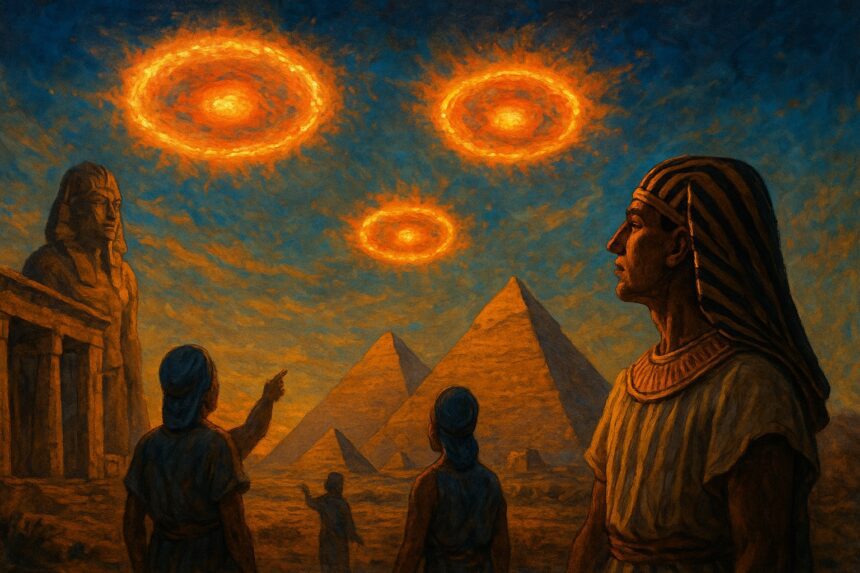
Among the most hotly debated claims in the field of historical ufology is the “Tulli Papyrus,” allegedly discovered in the archives of the Vatican Museum. The document, reportedly translated by a museum director in the 1930s, is said to describe a shocking event that occurred during the reign of Pharaoh Thutmose III, around 1480 BCE.
According to the translation, the Egyptian scribes documented an unusual celestial occurrence:
“In the year 22, a great marvel occurred… circles of fire came from the sky… they hovered in the air, silent, and then rose higher, shining brighter than the sun…”
The event reportedly lasted several days, with “fiery discs” flying over the city before vanishing as mysteriously as they appeared.
For ancient astronaut theorists, this account is taken as strong evidence of early extraterrestrial contact. But mainstream scholars remain unconvinced. In fact, by the late 1960s, it was determined that the Tulli Papyrus was likely a modern fabrication, a hoax based on mistranslations and a lack of original physical evidence. The document itself was never verified as authentic, and its origins remain murky.
Still, this hasn’t stopped the Tulli story from becoming a cornerstone in the conversation around ancient UFO sightings, fueling speculation about whether early civilizations were more familiar with the unknown than we assume.
The specific reasons Egyptologists reject the Tulli Papyrus as authentic are worth knowing directly. No Egyptologist has ever independently verified the existence of the original papyrus itself, and the document’s supposed translator, Alberto Tulli, an actual Vatican Museum director, never published his purported translation in any peer-reviewed venue during his own lifetime. Hieroglyphic scholars who examined the copied text that circulated after his death identified significant grammatical inconsistencies inconsistent with authentic 18th Dynasty Egyptian, along with vocabulary anachronisms suggesting a much later composition. Egyptologist Edward F. Wente, who reviewed the available material, concluded the text contains errors a native Middle Egyptian scribe would be extremely unlikely to make.
The Roman Chronicles | Ghostly Ships and Sky Battles
The ancient world is full of strange stories that some modern readers might interpret as sightings of UFOs or unexplained aerial phenomena. One of the earliest such reports comes from Titus Livy, the renowned Roman historian.
In his writings, Livy records that in 218 BCE, just before Hannibal’s invasion of Italy, “phantom ships” were seen sailing through the sky over Rome. These mysterious vessels, glowing and metallic, appeared during a time of war, a pattern seen in other historical UFO sightings.
Were these visions of divine omens? Atmospheric illusions? Or was something else happening in the skies of antiquity?
In the 1st century BCE, during battles involving Mithridates VI of Pontus, soldiers described bizarre lights and shapes in the sky that disrupted their formations and caused panic. Some described flying shields, swords of fire, and hovering objects that emitted unnatural light.
While ancient texts didn’t have the vocabulary we use today, the similarities to modern-day UFO reports are worth taking seriously as documented ancient testimony, even without concluding they describe literal spacecraft.
Colonial Encounters | Puritans and the Mystery Lights of the 17th Century
As European settlers established colonies in the Americas, they brought with them not only religious beliefs but also a worldview that included signs, omens, and the supernatural.
Around 1639, according to Governor John Winthrop’s journal, some Puritans in Massachusetts Bay Colony reported seeing a strange light in the sky over the Charles River. The light “flamed up” and changed direction rapidly, reportedly witnessed by multiple people.
Winthrop even noted that the observers traveled downriver only to have the light follow them at great speed. He documented that it moved “back and forth between two points,” a behavior remarkably similar to some of today’s UFO sightings.
While interpreted at the time as a divine or demonic sign, modern readers see this as one of the earliest credible unexplained aerial sightings in North America.
UFOs in the 1800s | The Mysterious Airships of the 19th Century
In 1808, a schoolteacher from Massachusetts wrote in her personal diary about “meteor-like” lights in the night sky that exhibited unusual behavior: they moved vertically, changed direction, and then vanished abruptly. These were not ordinary shooting stars or comets, they were maneuvering in ways that defied the scientific understanding of the time.
But the documented UFO craze of the 19th century began in the 1870s and 1890s, when citizens from across the United States, especially in California, Texas, and the Midwest, reported sightings of what they called “mystery airships.”
Descriptions included cigar-shaped flying craft, bright, glowing lights that moved silently overhead, and encounters with “beings” who spoke broken English or claimed to be from Mars.
Newspapers of the era treated these stories with a mix of curiosity and skepticism, but the sheer number of reports across multiple states makes it difficult to dismiss them as mass hysteria alone.
These airship sightings eerily predated the invention of modern aviation, and remain unexplained to this day.
The UFO Boom of the 20th Century | From Roswell to Radar
While early sightings laid the foundation, the true explosion of UFO interest began in the mid-20th century. In 1947, pilot Kenneth Arnold reported seeing a formation of nine shiny objects flying near Mount Rainier, Washington. He described their motion as resembling “a saucer skipping over water,” coining the term “flying saucer.”
Just weeks later, the infamous Roswell Incident occurred, where a crashed object on a ranch in New Mexico was quickly recovered by the military.
What Kenneth Arnold Actually Saw
The explanations proposed for Arnold’s original 1947 sighting are worth knowing precisely, since it launched the entire modern UFO era. Arnold, an experienced pilot with several thousand logged flight hours, described nine objects moving in formation at an estimated speed he calculated as faster than any known aircraft of the era. Atmospheric scientists have since proposed several natural explanations, including a mirage effect caused by a temperature inversion, or a flock of birds reflecting sunlight at a distance that made their speed difficult to judge accurately. Arnold himself, notably, never actually used the term “flying saucer” to describe the objects’ shape, historical records confirm he described their motion, not their form, as saucer-like, skipping across the air the way a flat stone skips across water. A newspaper reporter’s headline writer popularized the “flying saucer” phrase shortly afterward, and the shape association stuck in public imagination even though it doesn’t accurately reflect Arnold’s own original description.
What Roswell Actually Was
This needs a more complete correction than “the government said it was a weather balloon” suggests. The initial 1947 cover story was indeed a weather balloon, but declassified U.S. Air Force reports released in 1994 and 1997 confirmed the actual explanation: the debris came from a classified Cold War surveillance program called Project Mogul, which used specialized high-altitude balloon arrays fitted with microphones and radar reflectors, designed to detect sound waves from anticipated Soviet nuclear weapons tests. The unusual materials witnesses described, neoprene balloon fragments and metallic-coated radar reflectors, were genuinely unfamiliar to observers at the time precisely because the project was legitimately classified Top Secret, not because the debris was extraterrestrial. Air Force investigators also found later claims of recovered “alien bodies” likely stemmed from witnesses conflating separate, unrelated events: parachute test dummies, an injured military parachutist, and remains from an unrelated 1950s plane crash.
From the late 1940s through the 1950s, UFOs dominated public consciousness. Project Blue Book was launched by the U.S. Air Force to investigate UFO sightings. Hollywood released a wave of alien invasion films. Reports of abductions, crop circles, and men in black surged.
This was the golden age of ufology, and it left an indelible mark on global culture.
UFOs in the 21st Century | From Military Videos to Government Disclosure
Fast forward to the 2000s, and UFOs, now rebranded as UAPs (Unidentified Aerial Phenomena), made a startling comeback.
Between 2004 and 2021, the U.S. Department of Defense released and confirmed multiple videos recorded by Navy pilots. These videos showed unknown objects flying at notable speeds and performing maneuvers that remain formally unexplained by the agencies that reviewed them.
In 2021, an official U.S. government report to Congress specifically stated it could not explain the majority of over 140 reviewed UAP incidents, a documented, on-the-record acknowledgment of unresolved cases, though “cannot currently explain” is meaningfully different from confirming an extraterrestrial or otherwise exotic origin.
So, When Did UFOs First Appear?
While it’s tempting to pinpoint a single moment when UFO sightings began, the evidence suggests something far more compelling: humanity has been fascinated by the skies, and puzzled by what we see there, for thousands of years.
From the (likely fabricated) account of Pharaoh Thutmose III’s flaming discs, to Puritan-era lights in New England, to modern fighter jet encounters, the phenomenon transcends cultures, borders, and centuries.
Whether caused by natural phenomena, classified technologies, or something still genuinely unexplained, UFOs are not just a modern mystery. They are part of our shared human history.
Are We Alone, or Just Not Looking Hard Enough?
Despite technological advances and government investigations, one thing remains unchanged: our curiosity.
Some scientists believe all UFO sightings can be explained through physics, psychology, or atmospheric conditions. Others argue that we may be on the brink of confirming that we’re not alone in the universe.
But no matter what you believe, one fact is clear: human beings have always looked up, and wondered.