



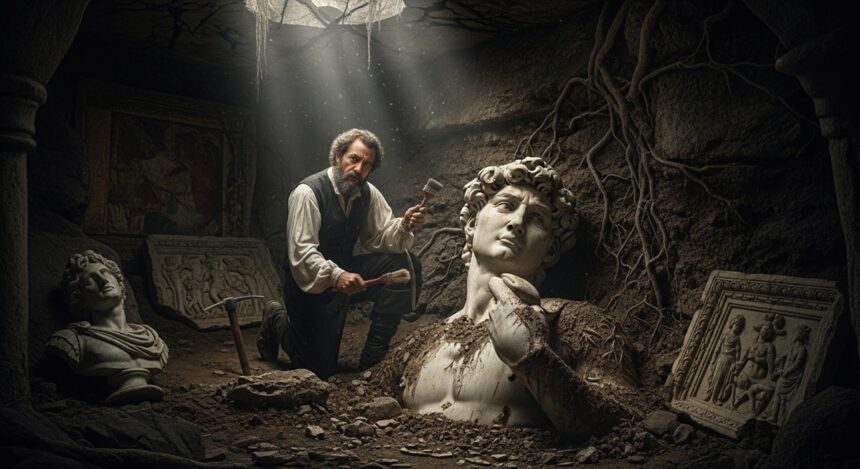
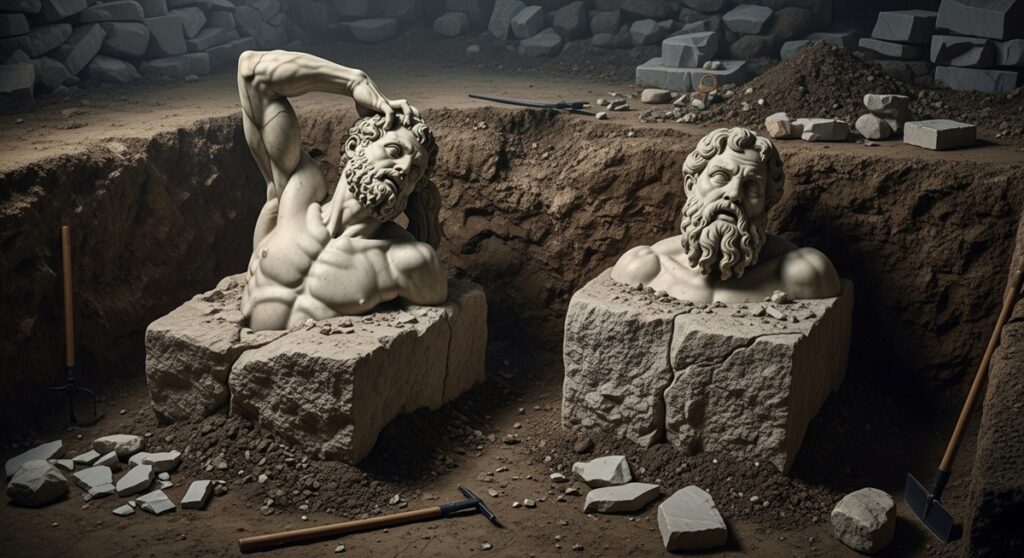
A theory circulating online claims Michelangelo didn’t carve his most famous works at all, that he excavated them from a buried, pre-flood civilization and simply cleaned them up before presenting them as his own. The theory has an identifiable source, a real name, and a real reason every credentialed art historian who has examined it rejects it outright.
Michelangelo’s actual, extensively documented life is more interesting than the invented one.
Michelangelo’s Established Life
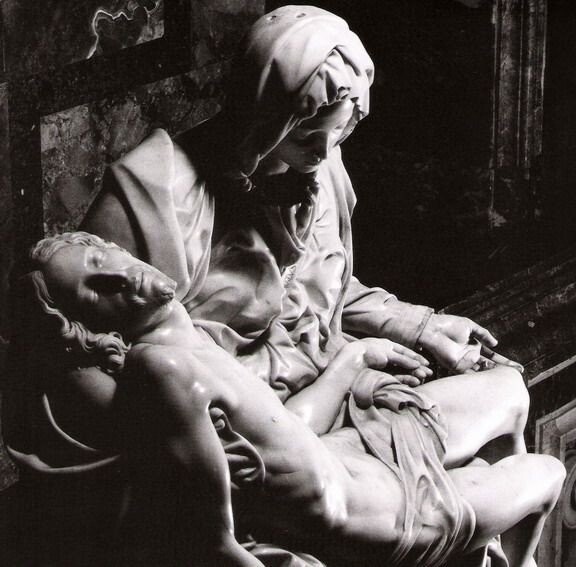
Michelangelo Buonarroti was a polymath who painted ceilings, designed architecture, and sculpted figures that remain among the most studied works in art history. Born in 1475 in Caprese, Tuscany, he was apprenticed to painters and sculptors in Florence by his early teens, eventually studying under Domenico Ghirlandaio before spending time at the Medici sculpture garden, where he had access to the Medici family’s own collection of ancient Roman statuary, a real, documented detail worth noting since it directly explains his intimate familiarity with classical form without requiring any invented excavation. His breakthrough came with the Pietà in 1499, a marble masterpiece depicting Mary cradling the dead Christ, still housed in St. Peter’s Basilica, carved when he was only 24 years old. Then came David in 1504, a 17-foot marble figure symbolizing Florentine resilience, followed by the Sistine Chapel ceiling, painted between 1508 and 1512, an undertaking so physically demanding that Michelangelo’s own surviving letters and a contemporary sonnet he wrote describe the toll it took on his body, his neck strained from years spent working overhead.
Art historians directly attribute his extraordinary anatomical realism to well-documented practices, including his habit, confirmed through his own biographers and surviving records from the Santo Spirito monastery in Florence, of dissecting cadavers to study human anatomy directly, alongside intensive study of surviving ancient sculpture available to him in Florence and later Rome. This documented combination of anatomical study and classical training is the actual explanation for his technical mastery, not an invented excavation theory.
This Theory’s Real Origin
Naming this origin matters, since it explains exactly why credentialed scholars reject the theory so decisively. This particular claim closely mirrors an identifiable pseudo-historical framework, sometimes called “Mud Flood” theory, connected to the broader “New Chronology” movement developed by Russian mathematician Anatoly Fomenko starting in the 1970s and 80s. Fomenko is a real, credentialed mathematician, but he has no training in art history, archaeology, or historical linguistics, the fields his New Chronology framework attempts to overturn, and his broader thesis proposes that recorded history before roughly the 11th century CE is largely fabricated, a claim rejected essentially unanimously by professional historians worldwide, not merely by specialists studying Michelangelo. The Mud Flood variant applies this same rejected framework specifically to architecture and sculpture, treating any missing preparatory record as evidence of concealment rather than the ordinary gaps that exist in any five-century-old paper trail. Recognizing that this specific theory traces back to a mathematician’s broader, already-discredited historical framework, rather than to any actual discovery about Michelangelo, explains why art historians treat it as settled rather than as an open question worth investigating.
The Sleeping Cupid Incident
This 1496 incident is worth telling accurately, since the theory inverts its actual significance. Michelangelo genuinely carved a Cupid statue and artificially aged it, using soil staining and other techniques to mimic centuries of burial, to sell as an ancient antique to Cardinal Raffaele Riario. When the deception was discovered, the cardinal was reportedly impressed rather than outraged, and invited Michelangelo to Rome, a documented turning point that launched his Roman career. Art historians consistently cite this story as clear evidence of Michelangelo’s precocious technical skill, his demonstrated ability to convincingly replicate ancient sculptural style through his own craftsmanship, exactly the opposite of what this theory claims. The story demonstrates he could create convincing fakes through talent alone, not that he was in the business of unearthing and relabeling actual ancient works.
Missing Sketches and Preparatory Work
Michelangelo genuinely destroyed much of his preparatory drawings and models near the end of his life, a recorded personal practice, but art historians have a well-established explanation that has nothing to do with concealment. Renaissance artistic convention placed real value on presenting a finished work as the product of divine inspiration and singular genius, and art historians note several Renaissance masters, not only Michelangelo, deliberately destroyed preparatory materials specifically to preserve this culturally significant mystique around the creative process. Surviving correspondence and contemporary accounts, including biographies written during his own lifetime by Giorgio Vasari and Ascanio Condivi, confirm this motivation directly, an artist’s personal choice about how his creative process should be perceived, not evidence of an invented excavation scheme. It’s also worth noting that a meaningful number of Michelangelo’s preparatory drawings did survive regardless, held today in collections including the British Museum and the Casa Buonarroti in Florence, sketches that show exactly the kind of iterative, exploratory working process a genuine sculptor develops over years, not the kind of record a person unearthing finished ancient work would ever need to produce in the first place.
The Unfinished “Slaves”
Michelangelo’s “Prisoners” or “Slaves” series, six marble figures intended for Pope Julius II’s tomb, do remain unfinished, several still showing their figures only partially emerged from the surrounding block. Art historians have a well-established explanation with no need for invented flood interruption: the tomb commission itself was famously, repeatedly downsized and revised over several decades, as recorded shifts in papal funding and priorities changed the project’s scope multiple times throughout Michelangelo’s extended, well-documented involvement with it, originally conceived as a freestanding structure with over 40 figures before being reduced, after Julius II’s death, to a considerably more modest wall tomb. Scholars also note the artistic tradition of “non-finito,” deliberately incomplete work, was consciously employed by Michelangelo and other Renaissance artists as an intentional aesthetic choice, symbolizing the human form’s metaphorical struggle to emerge from raw material, an interpretation grounded in the artist’s own surviving writings, including poetry he composed comparing the sculptor’s work to freeing a figure already present within the stone.
The Pietà Signature and Name Etymology
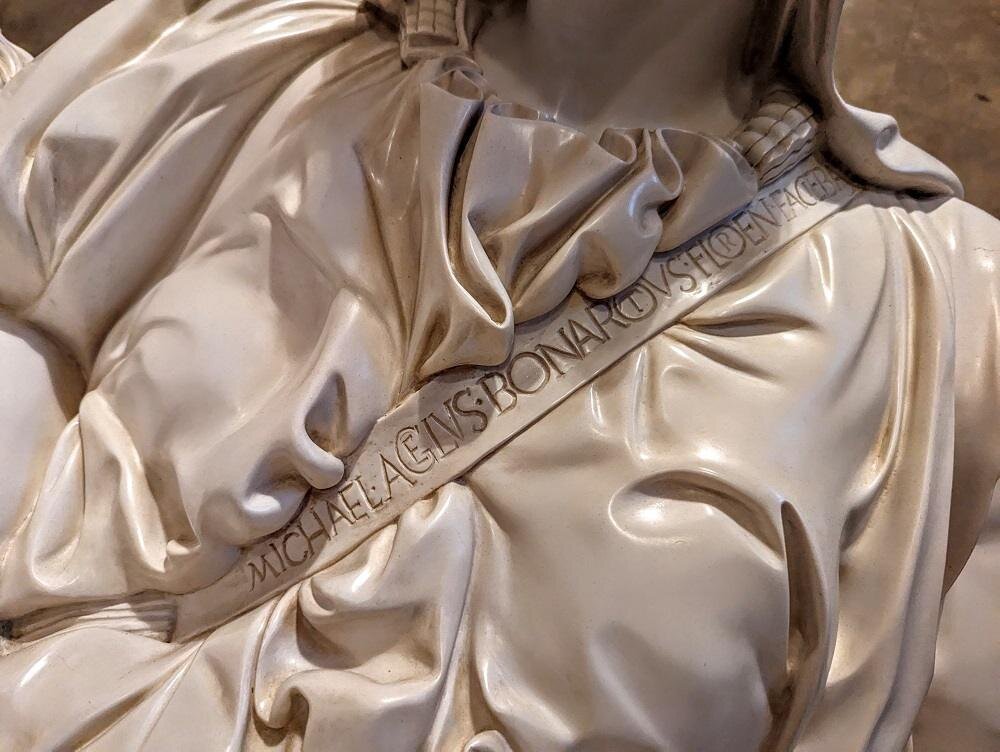
Michelangelo signed only one work in his entire career, the Pietà, with the inscription “MICHEL.A[N]GELVS BONAROTVS FLORENTIN[VS] FACIEBAT” carved across Mary’s sash. Art historians attribute the signature’s cramped placement to practical spatial constraints, fitting lettering along an already-carved fold of drapery, not evidence of a hasty, illegitimate addition. Tradition, recorded by early biographers including Vasari, holds Michelangelo added it after overhearing visitors attribute his authorship to another sculptor, a documented account consistent with an artist asserting ownership of his own work, not concealing a false claim.
The claim that “Michelangelo,” roughly “Michael” plus “Angelo,” encodes some hidden divine message about his sculptures’ true origin misunderstands ordinary Renaissance naming convention. Given names combining biblical and angelic elements were common throughout Christian Europe during this period, standard religious naming practice rather than a coded artistic confession. Renaissance names carried religious meaning broadly across an entire population of ordinary people named this way. That alone doesn’t make any one person’s name a hidden clue about anything.
The Real Explanation for Buried Ancient Ruins
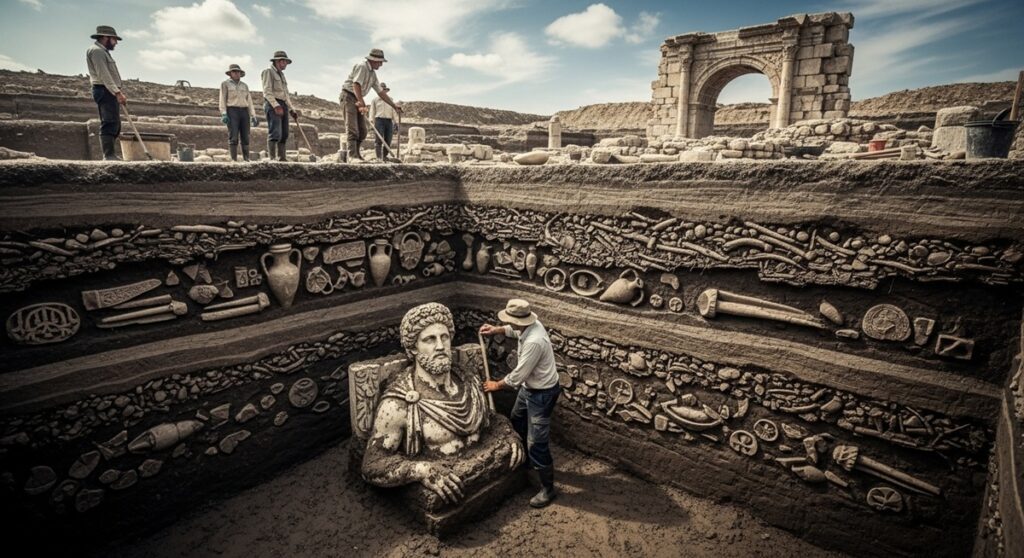
Understanding this process removes the need for any dramatic flood explanation entirely. Renaissance Rome did contain buried ancient structures, and the explanation requires no catastrophic flood at all. Archaeologists and historians attribute buried ground-floor structures and ancient ruins to ordinary, gradual urban sediment accumulation over many centuries, construction debris, repaving, and organic buildup, a thoroughly studied process called urban stratigraphy, the same slow process that explains why archaeologists dig downward to reach older layers of any long-inhabited city worldwide. Flood myths do exist across many cultures, including the Mesopotamian Epic of Gilgamesh and other ancient traditions, and geological evidence does confirm significant regional flooding events occurred at various points in ancient history. But geologists and archaeologists have found no evidence supporting a single, global, catastrophic flood event burying advanced civilizations roughly 500 years before Michelangelo’s lifetime, the exact claim this theory needs and has never once been able to substantiate with any independent geological or archaeological evidence.
Independent Confirmation of Michelangelo’s Working Process
This evidence stands entirely apart from the destroyed sketches this theory makes so much of. Surviving quarry records from Carrara, the Italian marble source Michelangelo relied on throughout his career, confirm block orders and payments matching known commissions, a verifiable paper trail connecting raw, unworked marble directly to Michelangelo’s finished sculptures. Letters between Michelangelo and his patrons, including several popes and the Florentine government, extensively survive today and discuss ongoing sculptural progress, technical challenges, and payment negotiations for works still in creation, a substantial body of contemporary correspondence entirely incompatible with a secret excavation and relabeling scheme. Art conservators who have physically examined Michelangelo’s sculptures using modern techniques, including tool-mark analysis, have found consistent evidence of period-appropriate carving tools and techniques throughout, precisely what actual Renaissance-era creation would produce, and precisely what an unearthed ancient object would not.
The Well Established Story of David’s Marble Block
Few works of art have a paper trail this complete and verifiable. Surviving Florentine civic records confirm the specific block of Carrara marble that became David had sat abandoned in a cathedral workshop yard for over 25 years before Michelangelo began work, having been poorly quarried and partially worked by two earlier sculptors, Agostino di Duccio and later Antonio Rossellino, both of whom abandoned the project treating the block as too flawed to work with. Contemporary records confirm the formal 1501 commission process, including the actual committee that selected Michelangelo for the project after deliberation, and payment records track his progress across the roughly two years he spent actively carving the statue, culminating in a documented 1504 committee, which reportedly included Leonardo da Vinci and Sandro Botticelli among its members, convened specifically to decide where the finished statue should be placed. This extensively established paper trail, from abandoned block to formal commission to payment records tracking ongoing work to a recorded placement debate involving other named Renaissance masters, represents exactly the kind of verifiable historical evidence entirely absent from, and fundamentally incompatible with, any invented excavation narrative.
How Forensic Art Analysis Would Detect This
This kind of physical testing settles questions like this one far more decisively than any circumstantial detail ever could. Marble provenance analysis, using techniques including isotopic testing of oxygen and carbon ratios within the stone itself, can precisely identify which specific quarry a given block of marble originated from, and testing on Michelangelo’s major works has consistently confirmed Carrara origin, matching the exact quarries documented in his own surviving commission records. Tool-mark analysis, examining the actual physical traces left by carving instruments, can distinguish period-appropriate Renaissance chisel and rasp work from earlier ancient Greek or Roman carving techniques, which art conservators have found consistently throughout Michelangelo’s authenticated pieces. This physical, testable evidence is available and has been directly examined by conservators over many decades, and none of it has ever produced results consistent with an ancient excavated origin for any of Michelangelo’s major works.
Why This Theory Follows a Recognizable Pattern
Recognizing this recurring pattern is often more useful than debunking any single retelling of it. This Michelangelo theory follows a structure shared by comparable pseudo-historical claims applied to other historical figures and civilizations elsewhere in this library: an interesting historical figure or achievement gets reframed through selective, decontextualized details, missing records treated as suspicious rather than ordinary, coincidental details treated as coded messages, and an unrelated invented catastrophe used to explain away whatever evidence doesn’t fit. This structure applies just as readily to Michelangelo as it does to other invented “recent flood” claims, and recognizing the pattern itself is often more useful than debunking any single instance, since the same approach reliably resurfaces attached to new historical figures once an older version has been thoroughly addressed.
Michelangelo’s Real Legacy Doesn’t Need an Invented Mystery
Michelangelo’s well established life, his anatomical study through cadaver dissection, his early technical brilliance demonstrated through the Sleeping Cupid forgery, his deliberate destruction of preparatory work following documented Renaissance artistic convention, and his involvement in a tomb commission that was repeatedly downsized over decades, already explains his extraordinary body of work without requiring any invented excavation theory. Art historians have spent centuries studying his actual working methods, surviving correspondence, and contemporary accounts, and none of that extensive scholarship supports the idea that his masterpieces were unearthed rather than created. His genius remains genius, precisely because it’s thoroughly documented, verifiable in archives that anyone can still consult today.