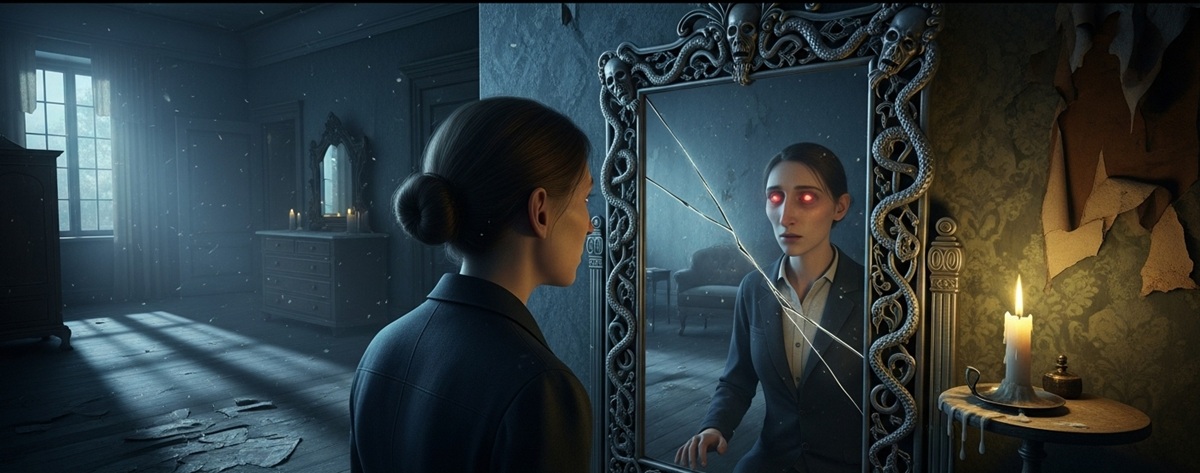
Sit close to a mirror in a dim room, fix your eyes on your own reflected gaze, and hold still for ten minutes. Don’t blink more than you have to. Somewhere around the one-minute mark, according to the largest controlled study ever run on this exact experience, your face will start to change. Not metaphorically. Sixty-six percent of the fifty healthy young adults who did exactly this, under laboratory conditions, in Italy in 2010, reported watching their own features warp into grotesque distortion.
Eighteen percent saw a parent’s face where their own should be, some of those parents long dead. Forty-eight percent watched something monstrous emerge. This isn’t folklore dressed up as science. It’s a published, peer-reviewed finding, and it happened to ordinary people with nothing wrong with them, staring at nothing more supernatural than glass and their own skin.
A Fear Older Than Glass Itself
Mirrors as we know them, mass-produced, silvered, hanging in every bathroom, are a relatively recent convenience. What people actually gazed into for most of human history was polished stone, hammered copper, or beaten bronze, imperfect surfaces that returned a wavering, imprecise version of the face looking into them, and across wildly separated cultures, that imprecise reflection got read the same way: not as an image, but as a threshold.
In ancient Egypt, mirrors of polished copper and bronze were bound up with Hathor, goddess of love, music, and the afterlife, and Egyptians believed the reflected surface could capture something of a person’s ka, their life force, holding it in the glass. In China, bronze mirrors etched with intricate designs were placed in burials specifically to guide the dead through the underworld and turn away spirits that might otherwise lead a soul astray. Among the Maya and Aztecs, obsidian, that dark volcanic glass, became the shaman’s scrying tool of choice, and the god Tezcatlipoca, whose name translates to Smoking Mirror, embodied the double edge of the whole practice: his mirror could reveal truth, but it could just as easily deceive. The Greeks told the story of Narcissus, who found his own reflection in a still pool and never looked away again, until it killed him. West African traditions held that a mirror gazed into too intently could trap a soul or drain the vitality straight out of a person, a belief that survives today on Vodou altars, where mirrors are placed deliberately to invite spirits while shielding the living from them. In parts of Latin America, particularly around the Day of the Dead, an uncovered mirror carries the specific risk of accidentally summoning an ancestor, or something less welcome wearing an ancestor’s face.

What holds these unconnected traditions together isn’t shared contact or a common source. It’s a shared intuition: that a mirror doesn’t just show you your face, it exposes something underneath it, something vulnerable.
The Rituals That Never Quite Went Away
Covering mirrors after a death in the household is a practice that spans Slavic, Caucasian, and Western European tradition, rooted in the fear that a departing soul could get caught in the glass, trapped between this world and whatever comes next, unable to move on, or that an uncovered mirror might instead swing open as an invitation for something else to cross the other way. The old superstition of seven years of bad luck for a broken mirror traces to Roman belief in a seven-year cycle of bodily renewal, shattered along with the glass. Jewish mourning practice during shiva calls for mirrors to be draped, turning attention inward and away from vanity during grief. In parts of Asia, gifting a mirror to newlyweds remains something you simply don’t do, the fear being a fractured reflection invites a fractured marriage. Victorian séance circles used mirrors deliberately to reach the dead, and the old Halloween game of gazing by candlelight to glimpse a future spouse always carried the same disclaimer: you might see a face you weren’t hoping for. None of this reads as ancient history exactly. Feng shui practitioners today still advise against a mirror facing the bed, on the theory that it drains energy or opens a relationship to outside interference, a belief with obvious roots in the same old intuition: whatever a mirror is doing, it’s not entirely passive.
Then a Psychologist Actually Tested It
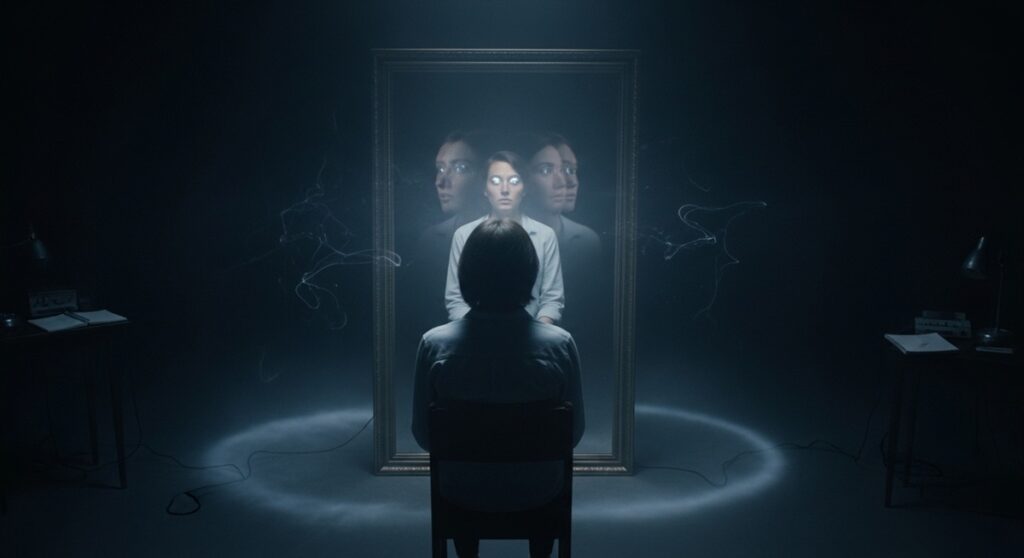
Giovanni Caputo, a psychologist at the University of Urbino in Italy, wasn’t trying to prove ghosts were real when he ran his first mirror-gazing study in 2010. He was investigating perception. His setup was almost aggressively mundane: a 5-by-5-meter room, lit only by a single dim 25-watt bulb positioned behind the participant so it never reflected directly into the glass, a large mirror positioned roughly 40 centimeters away, and fifty healthy adults with an average age of 23, instructed simply to look into their own eyes for ten minutes without letting their gaze wander.
The results, published in the journal Perception, were stranger than the setup suggested they’d be. Most participants began perceiving something unusual within the first minute. By the end of the ten-minute session, 66 percent reported major deformation of their own facial features. Forty-eight percent saw something monstrous, described variously as witches or skull-like faces. Twenty-eight percent saw the face of a complete stranger. Another 28 percent saw what Caputo’s later papers describe as archetypal faces, an old woman, a young androgynous figure, a shaman-like presence. Eighteen percent saw an animal, a cat or a pig recurring among the descriptions. And 18 percent saw the face of a parent, some living, but roughly 10 percent of the total sample specifically saw a parent who had died. Caputo followed this initial study with further research on inter-subjective gazing, pairs of strangers staring into each other’s eyes under the same dim conditions, and found the effect not only replicated but intensified, producing more varied strange-face experiences than mirror-gazing alone, along with measurable dissociative sensations, participants reporting a temporary loss of the ordinary sense of being fully present in their own body. A 2023 paper Caputo published in the Journal of Trauma and Dissociation examined the illusion’s specific relationship to derealization and depersonalization directly, treating the phenomenon as a genuine, replicable window into how ordinary perception can destabilize under very simple, controlled conditions.
What’s Actually Happening in the Brain
The mechanism Caputo and other perception researchers point to is the Troxler effect, first described in 1804 by Swiss physician Ignaz Paul Vital Troxler. Fix your gaze on one point for long enough, and the visual system starts to let go of everything around it, unchanging peripheral stimuli fade from conscious awareness because the brain, always trying to conserve processing effort, stops bothering to refresh input it isn’t changing. In dim light, that effect compounds with reduced overall visual information, and the brain, faced with a face it can’t fully resolve, does what it always does when input runs short: it fills the gaps in with pattern and memory, the same underlying tendency, pareidolia, that finds a face in a cloud or a slice of burnt toast, just turned inward on the one face it knows most intimately and expects to see least altered.
What determines which face shows up in the gap seems to depend heavily on what the viewer brings into the room. Emotional state acts as an amplifier: grief and anxiety, in particular, seem to increase both the frequency and the intensity of strange-face experiences, and researchers studying dissociative and psychotic-spectrum conditions have found related illusory patterns useful for understanding how hallucinations form more generally. Some clinicians have experimented cautiously with mirror gazing in grief counseling specifically, letting bereaved patients experience something resembling a final conversation with a lost parent or partner as part of processing loss, though the same researchers are careful to flag that this needs professional guidance rather than casual experimentation, since the line between a therapeutic encounter with grief and a genuinely destabilizing dissociative episode isn’t always obvious in the moment. Separate research on guided mirror gazing conducted with self-compassion framing, gazing at oneself with deliberate kindness rather than blank fixation, has shown measurable reductions in stress hormones, while individuals already experiencing depression have, in some studies, reported fewer overall illusions but a more negative emotional character to the ones they do experience. The same basic mechanism, in other words, can function as a mindfulness tool or a genuine risk, depending heavily on who’s sitting in front of the glass and what they carry in with them.
Bloody Mary and the Rest of the Bathroom-Mirror Canon
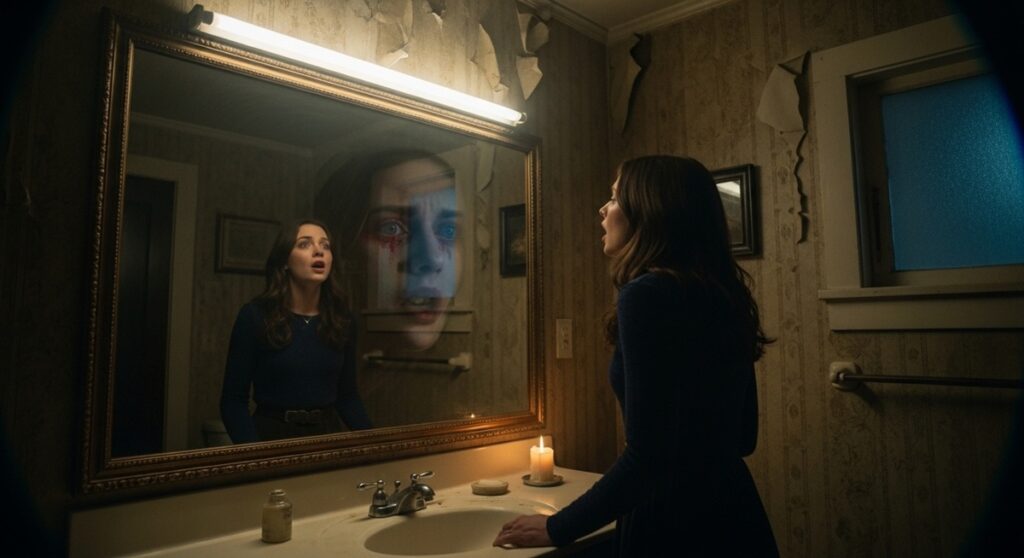
The childhood ritual of chanting a name three times into a darkened bathroom mirror traces back to 19th-century divination games, originally intended to conjure a vision of a future husband, which slid over the following century into straightforward horror, sometimes linked, without firm evidence, to the grim life of England’s Queen Mary I or to the era’s witch trials. The mechanism behind why it actually seems to work for the people who try it is the same Troxler effect and expectation bias driving Caputo’s laboratory results, just running in an unlit bathroom instead of a controlled 5-by-5-meter room. Japan has its own schoolyard version in Hanako-san, said to haunt the third stall of school bathrooms and summoned by a near-identical ritual, and Italian folklore carries its own witch-summoning variant. The pattern repeating across cultures that had no contact with one another is the real point: wherever humans gather in front of dim reflective glass and wait, something eventually seems to look back.
The Mirror as a Recurring Character in Fiction
Literature and film picked up the same unease and never let it go. Snow White’s stepmother interrogates a magic mirror about beauty and rank. Lewis Carroll sends Alice through the glass into an inverted world with its own logic. Shakespeare has Richard II shatter a mirror as his kingship collapses around him, and Tennyson’s Lady of Shalott dies specifically because she abandons the mediated safety of her mirror to look directly at the world. Orson Welles staged the climax of The Lady from Shanghai in a literal hall of mirrors, using fractured, multiplied reflection as a visual argument about how thoroughly its characters have been deceiving one another. Horror cinema returns to the mirror-as-portal premise constantly, Candyman, Oculus, and plenty of lesser-known entries all treat the reflective surface as a boundary that can be breached from either side. And the old detail that vampires cast no reflection, canonized by Bram Stoker’s Dracula, quietly encodes the same underlying anxiety in reverse: a reflection is supposed to prove you have a soul to lose, and its absence is meant to tell you something has already been lost.
Where the Science Ends and the Speculation Begins

It’s worth being direct about where this story shifts from established science into genuinely contested territory, since the two get blended together often enough online that the distinction matters. Some theorists have proposed that consciousness itself behaves like a quantum system, indeterminate until observed, and that awareness might arise from a kind of self-referential process not unlike a mirror reflecting itself back. The specific version of this that circulates most widely, the Penrose-Hameroff Orchestrated Objective Reduction theory, proposes that quantum effects inside neural microtubules give rise to consciousness. This is a real, published hypothesis from a real physicist and a real anesthesiologist, but it remains a minority position within neuroscience and physics alike, with credentialed critics arguing the brain is far too warm and biologically noisy for the kind of delicate quantum coherence the theory requires to survive intact for any meaningful duration. Treating it as an established explanation for why mirrors feel unsettling significantly overstates its actual standing. The strange-face illusion has a considerably more mundane, considerably better-evidenced explanation sitting right there in Troxler’s 1804 discovery and a century of subsequent perception research, no quantum mechanics required.
Who’s Actually Looking Back
Approached carelessly, prolonged mirror gazing can genuinely destabilize someone already prone to anxiety, dissociation, or body-image distress, and it’s worth treating the practice with the same caution any deliberately mind-altering activity deserves. Approached with intention, the same basic mechanism has shown real therapeutic promise for cultivating self-compassion and processing grief. Either way, what Caputo’s fifty participants in that dim Urbino laboratory actually demonstrated wasn’t a haunting. It was how quickly and how completely an ordinary, unchanging piece of glass can become a screen for whatever the mind sitting in front of it needs to project, deformation, a stranger, a dead parent, a monster, each one manufactured entirely from inside the skull doing the looking. The mirror never does anything. It just stops interrupting long enough for something else to.