



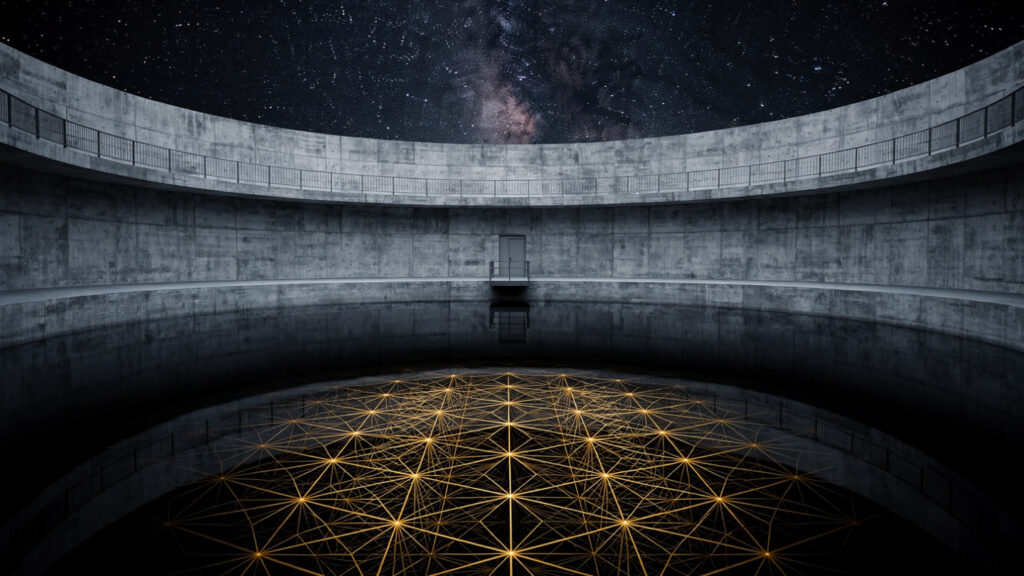
There is a room that human beings have been describing for roughly ten thousand years.
They did not use the same name for it, and they did not agree about what stood behind the door. Some called what they encountered God. Some called it Brahman. Some called it the deathless, nirvana, the Pleroma, the Absolute, the Tao, the presence of the Beloved, or simply reality as it is. Others, having no theological vocabulary available to them, described only what happened: the ordinary sense of being a separate self disappeared, awareness became radically unlike ordinary perception, knowledge arrived without inference, the distinction between the observer and what was observed collapsed, and the experience carried an authority that ordinary waking consciousness could not match. The languages changed. The cosmologies changed. The centuries changed. The destination kept acquiring the same recognizable features.
That distinction matters. The historical record does not contain one ancient tradition repeating one story. It contains thousands of accounts produced by people separated by geography, language, chronology, doctrine, and culture, often with no demonstrable contact with one another, describing experiences reached through radically different routes. The contemplative disciplines of India and Tibet, Christian mystical prayer, Sufi practice, Kabbalistic contemplation, Taoist cultivation, shamanic initiation, spontaneous near-death experiences, psychedelic encounters, and the anomalous states investigated by twentieth-century intelligence programs were not designed as parts of one research project. Yet when their accounts are stripped of the theological vocabulary imposed upon them afterward and examined at the level of phenomenology, a striking set of structural similarities remains.
William James recognized the problem more than a century ago. In The Varieties of Religious Experience, delivered as the Gifford Lectures in 1901 and 1902, he attempted something unusually disciplined for his time: rather than deciding in advance whether mystical experiences were divine revelations, psychological constructions, pathological events, or hallucinations, he examined what the experiences had in common across people who interpreted them in entirely different ways. His four characteristics became foundational: ineffability, noetic quality, transiency, and passivity. The second is the one that matters most here. Mystical states do not ordinarily present themselves to the person undergoing them as imaginative fantasies. They present themselves as knowledge. James observed that they seem to contain “states of knowledge” that feel revelatory and authoritative even though the knowledge cannot be translated cleanly into propositions.
That is the problem this series has been approaching from seven different directions. If the experience were merely one culture’s mythology, the convergence would be unremarkable. If it were merely a universal neurological artifact, the convergence would still be important, but the ancient maps would have a very different meaning. If, however, the recurring phenomenology is the result of human consciousness intermittently gaining access to a level of information normally excluded by the ordinary biological interface, then the traditions are not merely telling different stories about similar psychological events. They are describing different approaches to the same underlying structure.
The purpose of this final article is therefore not to add another isolated piece of evidence to the pile. It is to place the maps on top of one another and ask the question that becomes unavoidable only when they are viewed together: what kind of reality would produce the same destination across independent routes, and what does the recurring architecture of that destination imply about the interface through which human beings ordinarily experience existence?
What James Found in 1902
William James was not attempting to prove a supernatural doctrine. That is precisely why his contribution remains useful. He approached mystical experience as a psychological and philosophical problem, taking seriously the reports of intelligent, otherwise functional people while refusing to assume that the interpretation they placed upon their experiences was necessarily correct. His subject was not whether Christianity, Hinduism, Buddhism, or any other religion possessed the final explanation. His subject was the experience itself: what repeatedly happens to consciousness when people enter states that they regard as radically more significant than ordinary waking awareness.
The result was one of the earliest systematic attempts to separate phenomenology from interpretation. A Christian mystic might say that she encountered God, a Vedantic practitioner might say that Atman was recognized as Brahman, a Buddhist might deny the existence of an eternal self altogether, a Sufi might describe annihilation in the Beloved. James could place these accounts beside one another without requiring them to agree on theology, because the underlying experiential characteristics could be compared independently of the explanatory language subsequently attached to them. Ineffability meant that the experience exceeded ordinary language. Noetic quality meant that it was experienced as knowledge rather than mere sensation. Transiency meant that its full intensity was temporary. Passivity meant that the person often felt that the experience was happening to them rather than being produced by ordinary voluntary effort.

Those four characteristics are more consequential than they initially appear. Ineffability means that the destination cannot be reduced to a conventional description without losing something essential. Noetic quality means that the person does not merely feel different, the person feels that something has been learned. Transiency means that the biological organism can apparently enter and leave the state without permanently remaining in it. Passivity means that the ordinary executive self does not necessarily experience itself as the author of the event. Taken together, they describe something that behaves less like ordinary imagination and more like an encounter with an informational environment whose contents are being revealed rather than invented.
James did not possess the neuroscience required to test that possibility. What he possessed was the historical record. He could already see that Teresa of Ávila, Christian contemplatives, Hindu mystics, Buddhist practitioners, Sufi writers, and people experiencing spontaneous mystical states were repeatedly reporting the same unusual combination: dissolution of ordinary selfhood, heightened certainty, a sense of contact with a more fundamental reality, and the conviction that the experience had disclosed something that ordinary consciousness normally conceals. More than a century later, the scientific question is no longer whether such states exist. Modern neuroscience can measure changes in the brain during meditation, psychedelic states, and related altered states. The harder question is what those measurable changes actually mean.
The Vedantic Map
Among the great contemplative traditions, Advaita Vedanta provides perhaps the most explicit philosophical model of what the destination represents. Its central proposition is not that the individual self should become something else, but that the apparent separation between the individual self and ultimate reality is itself the fundamental error. In the Advaita framework associated with Shankara and the Upanishadic tradition, Brahman is ultimate reality and Atman is the deepest identity of the experiencer, the apparent division between the two belongs to the level of ordinary cognition rather than to the final structure of reality.
This is why the concept commonly translated as maya is more subtle than the English word “illusion” suggests. The claim is not simply that the world does not exist. The claim is that ordinary consciousness superimposes distinctions, limitations, identities, and separations upon a reality whose deeper structure is not divided in the way the ordinary self assumes. The individual is therefore not an error in the sense of being nonexistent. The individual is an incomplete representation: a localized mode through which something more fundamental experiences itself.
The contemplative method follows directly from the metaphysics. Instead of asking the practitioner to adopt a new belief, Advaita repeatedly directs attention toward the nature of the experiencer itself: Who is aware? What is the “I” that claims ownership of perception? What remains when sensations, thoughts, memories, roles, and autobiographical identity are observed rather than identified with? At the deepest end of the practice, the reported state is not an acquisition of new information in the ordinary sense. It is a recognition. The seeker discovers that the thing being sought and the awareness doing the seeking were never ultimately separate.
That phenomenology maps with remarkable precision onto the interface model developed throughout this series. If a biological organism is functioning as an interface through which a more fundamental consciousness process experiences a constrained representation of a larger system, then the suspension of the interface’s ordinary self-model should produce a peculiar discovery: the thing the individual had regarded as a separate observer may turn out to have been the system’s own processing capacity appearing locally through the interface. What Advaita describes as the recognition of Atman as Brahman can therefore be read, within the computed-system framework, as a phenomenological description of what happens when the boundary conditions imposed by the ordinary self-model cease to dominate awareness.
This is also why the traditional description of the destination is not fundamentally negative. Sat-chit-ananda (being, consciousness, bliss) is not the language of a blank void. It is the language of intensified presence. The ordinary self disappears, but awareness does not disappear with it. Instead, the reports describe greater immediacy, greater coherence, greater aliveness, and a profound sense that what had been sought externally was already present at the deepest level of the experiencer itself.
The Buddhist Cartography
Buddhism approaches the same territory from a radically different philosophical direction, which makes the convergence more interesting rather than less. Where Advaita speaks of an ultimate identity between Atman and Brahman, Buddhist traditions generally resist the proposition of an eternal individual self. Yet the meditative maps describe a sequence of states in which the ordinary construction of selfhood becomes progressively less dominant, perception becomes increasingly refined, and the distinction between ordinary subject and object is progressively destabilized.
The jhana literature is especially important because it does not merely say that meditation produces “spiritual feelings.” It offers a phenomenological progression. Concentration deepens, ordinary sensory and emotional structures recede, the sense of embodied location becomes increasingly attenuated, and the practitioner enters states traditionally described in terms of infinite space, infinite consciousness, nothingness, and neither perception nor non-perception. Whatever metaphysical interpretation one places upon those descriptions, they represent an unusually detailed premodern attempt to map changes in consciousness by their experiential characteristics rather than by theological doctrine alone.
The tradition’s deepest descriptions become even more striking because they concern the cessation of ordinary mental construction itself. Nirodha-samapatti, in the traditional literature, represents an extreme state in which ordinary mental activity is said to cease. The historical descriptions must be handled carefully here: traditional claims about complete cessation of breathing, heartbeat, or neurological activity should not be treated as established physiological facts simply because they appear in the texts. What can be taken seriously is the underlying phenomenological claim: advanced contemplative practice can radically alter the processes through which the ordinary self, ordinary perception, and ordinary continuity of thought are constructed.
Modern neuroscience gives this ancient cartography a second layer. Richard Davidson and colleagues’ research on highly experienced Tibetan Buddhist practitioners demonstrated unusual patterns of brain activity during advanced meditation, including pronounced high-frequency gamma synchrony. Antoine Lutz and colleagues’ work helped establish that long-term practitioners can display forms of neural organization that differ substantially from those observed in ordinary subjects. These findings do not prove that monks were accessing an external realm, and they do not establish the metaphysics of the experiences. What they do establish is something both more modest and more scientifically defensible: the human nervous system is capable of entering states of organization far outside the ordinary range of everyday consciousness, and sustained contemplative training can measurably alter the neural processes associated with attention, emotion, self-representation, and integration.
That distinction is essential to the argument. Neuroscience can establish the existence of the altered state and characterize its physiological correlates. It cannot, from those measurements alone, determine whether the altered state represents a deeper access to reality or an internally generated reorganization of information. The brain data therefore do not close the metaphysical question. They reopen it at a higher level of precision. The ancient practitioners said that the ordinary interface could be altered profoundly, modern measurement confirms that it can.
Christian Mysticism and the Architecture of Union
Teresa of Ávila’s Interior Castle supplies perhaps the most elegant Christian map of progressive interior transformation. Her seven dwelling places describe movement inward, toward increasingly profound forms of prayer and mystical experience, culminating in what she calls spiritual marriage. The imagery is Christian, but the phenomenological structure is remarkably familiar: the deeper the practitioner moves, the less adequate the ordinary sense of separation becomes, until the final state is described not as acquiring God but as entering a union in which the distinction between seeker and sought is transformed.
It would be intellectually careless to say that Teresa and Shankara were “teaching the same religion.” They were not. Their metaphysical systems, theological commitments, concepts of God, soul, liberation, and salvation differ profoundly. What converges is not the doctrine but the structure of the reported experience. Teresa describes a progressive withdrawal from ordinary self-reference into a state in which union becomes more fundamental than separation. Advaita describes the apparent separation of Atman and Brahman as a construction. Sufi writers describe fana, the dissolution of the ordinary self in the Beloved. Jewish mystical traditions describe devekut, cleaving to the divine. The vocabularies are irreducible to one another, but the phenomenological direction is unmistakable: the boundary that ordinarily defines the individual becomes less absolute.
Teresa lived in sixteenth-century Spain. Shankara belonged to eighth-century India. Milarepa lived in eleventh-century Tibet. Ibn Arabi lived in the twelfth-century Islamic world. Their historical circumstances were radically different, and the doctrines through which they interpreted experience were not interchangeable. Yet each left a map in which the deepest transformation involved the same extraordinary reversal: the self that believed it was approaching an ultimate reality discovers that its ordinary separation from that reality cannot be maintained at the deepest level of experience.
The NDE Literature | When the Route Is Not Chosen
The near-death experience introduces a crucial variation because the route can occur without years of contemplative preparation. A person may never have meditated, studied mysticism, or entertained any serious interest in altered states, yet during cardiac arrest, severe trauma, or another life-threatening event may report a profound transformation of consciousness. The phenomenology often includes separation from the physical body, unusual clarity, encounters with deceased relatives or other beings, movement through environments described as radically real, panoramic or life-review experiences, and a powerful conviction that consciousness has continued despite the apparent failure of the ordinary bodily system.
Not every NDE contains every feature, and the literature should not be flattened into a single template. Nevertheless, certain recurring elements have become sufficiently recognizable to constitute a genuine field of study. The most consequential for the present argument is the life review. In many accounts, the person does not simply remember events sequentially. The experience is described as an extraordinarily compressed apprehension of an entire life, sometimes accompanied by the perspectives and emotional consequences of other people affected by the experiencer’s actions. Whether this phenomenon ultimately reflects memory reconstruction, altered temporal processing, or something more radical remains unresolved. What matters here is that the phenomenology repeatedly takes the form of access to information vastly broader than the ordinary autobiographical self appears capable of holding at one time.
Bruce Greyson’s decades of NDE research are especially important because they shift attention away from the dramatic imagery toward what happens afterward. NDEs can be followed by persistent changes in attitudes toward death, materialism, relationships, spirituality, and the meaning of life. Experiencers frequently report that the experience permanently altered their hierarchy of values. The conviction that consciousness is somehow not exhausted by ordinary bodily identity can become one of the most durable conclusions they carry from the event. None of this, by itself, proves survival of consciousness after death. It does, however, demonstrate that an unusual alteration of consciousness can produce durable transformations in personality and worldview that are difficult to dismiss as a transient hallucination in the ordinary sense.
Within the interface model, the NDE becomes particularly interesting because it represents an accidental route rather than a cultivated one. Contemplative traditions spend decades learning to loosen identification with the ordinary self-model. An NDE may produce a comparable loosening because the biological system itself is under catastrophic stress. The interpretation remains open, but the structural question becomes unavoidable: if radically different routes repeatedly produce overlapping alterations in selfhood, perception, information access, and certainty, what common mechanism could lie beneath them?
Shamanic Practice and the Independent Discovery of Other Worlds
Long before modern neuroscience, indigenous traditions across widely separated regions developed deliberate methods for entering non-ordinary states: prolonged drumming, fasting, sensory isolation, arduous physical ordeal, ritual concentration, dream incubation, and the controlled use of psychoactive plants. The resulting cosmologies vary enormously, and it would be a mistake to compress every indigenous tradition into the modern category of “shamanism.” Yet where shamanic practices do occur, one recurring feature is especially relevant: the altered state is treated not simply as an unusual mood but as a means of obtaining information.
Michael Harner’s formulation of what he called the “core shamanic experience” emphasized several recurring elements: movement into a non-ordinary reality, encounters with autonomous beings or guides, reception of information from those beings, and return to ordinary life with knowledge intended for practical use. Whether those beings are interpreted as independent entities, culturally constructed representations, or manifestations of altered cognition is a separate question. The important observation is that the experiential architecture appears repeatedly: the practitioner enters a state experienced as another environment, encounters intelligences experienced as autonomous, receives information, and returns believing that something has been learned.
That structure intersects directly with the modern psychedelic literature. DMT reports frequently involve the perception of autonomous entities, environments that appear more real than ordinary waking reality, and encounters experienced as communications rather than passive imagery. The similarity to shamanic accounts is obvious enough to deserve investigation, but it does not automatically establish that the entities are objectively independent. The stronger and more interesting claim is narrower: human consciousness appears capable of entering states in which the distinction between internally generated representation and apparently autonomous informational encounter becomes extraordinarily difficult for the experiencer to maintain.
Across many traditional cosmologies, reality is consequently imagined as layered rather than flat. The ordinary human world occupies one level, while other orders of reality lie above, below, within, or beyond it. Those cosmologies cannot simply be equated with one another. Gnostic Pleroma, Buddhist cosmology, Hindu lokas, Kabbalistic structures, and indigenous spirit worlds belong to very different intellectual traditions, but they repeatedly encode the intuition that ordinary perception does not exhaust the structure of reality. The modern interface hypothesis makes precisely the same claim in a technological vocabulary: the surface presented to the user is not necessarily the complete architecture of the system producing the experience.
The STARGATE Sessions and the Problem of Information Without Ordinary Access
The STARGATE material introduces a different kind of anomaly because its original motivation was operational rather than religious. The U.S. government-supported remote-viewing programs were interested in whether trained individuals could obtain information about targets without ordinary sensory access. The historical record is controversial, the program’s results have been disputed, and the evidentiary standards applied to remote viewing remain a subject of legitimate debate. None of that should be concealed. But the phenomenology described by some of the program’s practitioners is still relevant to the larger map because it introduces the same unusual feature found elsewhere: consciousness experienced as capable of accessing information without being confined to the ordinary location and sensory apparatus of the body.
Ingo Swann became one of the most prominent figures associated with the program, and his accounts of remote viewing repeatedly emphasized a shift away from ordinary first-person perception toward a form of awareness he regarded as fundamentally different from looking through the eyes. The experience was described in terms of information arriving without the normal chain of sensory perception, sometimes accompanied by a sense that the distinction between observer and information had become strangely attenuated.

That phenomenology is strikingly similar to descriptions appearing elsewhere, but similarity is not proof of mechanism. A remote viewer’s subjective sense of disembodied awareness does not establish that consciousness literally left the body, just as an NDE’s subjective reality does not by itself establish survival after biological death. What it does establish is that the ordinary relationship between consciousness, bodily location, and information access is more complicated than everyday experience suggests. Once again, the same boundary becomes unstable: the assumption that awareness must always be restricted to information delivered through the ordinary sensory channels.
This is where the series’ central concept of the interface becomes useful. If the ordinary brain is not consciousness itself but the biological interface through which consciousness is constrained, organized, and rendered into a usable human experience, then a disruption of that interface should produce precisely the phenomenological question the historical record keeps returning to: what happens when the process is no longer confined to the information architecture of the ordinary user environment?
The Neuroscience | What Changes When the Interface Loosens?
Modern neuroscience does not provide a simple answer, but it has made the old question experimentally tractable. Research on meditation and psychedelics has repeatedly shown that the brain’s ordinary organization of selfhood is not fixed. Networks associated with self-referential processing, autobiographical thought, attention, salience, and sensory integration can change their activity and connectivity dramatically under altered states. One of the most important lines of work emerged from Robin Carhart-Harris and colleagues, whose “entropic brain” framework proposed that ordinary waking consciousness is characterized by relatively constrained patterns of brain activity, while psychedelic states permit a greater diversity and flexibility of neural configurations.
The default mode network is particularly important because it participates in processes associated with autobiographical self-reference and the maintenance of a coherent narrative identity. Under certain psychedelic conditions, activity within this network and its relationship with other systems can change substantially. Subjectively, the result can include ego dissolution, altered boundaries between self and world, unusual associations, intensified perception, and a sense that consciousness has become less constrained by the ordinary identity structure. The scientific description is necessarily more modest than the mystical interpretation: the brain’s normal organizing constraints have changed. Whether that change reveals a deeper layer of reality or simply permits the brain to generate an unusually unconstrained internal model remains an open question.
That distinction is the point at which the conventional and interface interpretations separate. The conventional interpretation says that the brain generates the experience and that relaxing its ordinary constraints therefore produces an unusual but internally generated state. The interface interpretation asks whether the same observations are also compatible with a different possibility: that the ordinary organization of the brain is not maximizing the total information available to consciousness, but deliberately constraining it into the narrow bandwidth required for biological survival and coherent participation in the surface environment.
If the second model were correct, then the apparent paradox would disappear. The brain would not be malfunctioning when the ordinary self-model loosens. It would be doing something else. The biological interface would be relinquishing some of its normal filtering function, allowing the conscious process to enter states characterized by greater informational diversity, weaker self-boundaries, and access to representations that ordinary waking consciousness excludes. That interpretation is not established by the neuroscience. But it is precisely the hypothesis the neuroscience leaves available for investigation.
The Destination | What the Independent Maps Actually Have in Common
At this point the individual traditions become less important than the convergence between them. James identified mystical experience as a recurring category of consciousness and isolated its noetic character. Advaita described the collapse of the apparent distinction between individual consciousness and ultimate reality. Buddhist meditation mapped progressive dissolution of ordinary self-construction and increasingly refined states of awareness. Christian mysticism described union in which separation between seeker and divine reality ceases to function as the final category. Sufi traditions described fana, the dissolution of the ordinary self in the Beloved. Shamanic traditions described journeys into non-ordinary realities populated by apparently autonomous intelligences. NDEs described abrupt transitions into states of radical clarity and expanded awareness. Psychedelic research reproduced some of the same structural features under controlled conditions. Remote-viewing accounts introduced the phenomenological possibility of awareness apparently detached from ordinary sensory localization.
The convergence becomes more significant when the traditions are compared not at the level of vocabulary but at the level of recurring structural characteristics. The ordinary autobiographical self becomes less dominant. The boundary between observer and observed becomes less rigid. The experience is frequently perceived as more real rather than less real. Information appears to arrive directly rather than through inference. The experience often carries an unusually strong sense of certainty. Autonomous intelligences are sometimes encountered. The individual returns to ordinary consciousness with the conviction that the experience revealed something fundamental rather than merely producing an unusual sensation. And, in a substantial subset of cases, the experience produces durable changes in values, behavior, fear of death, and the individual’s understanding of identity.
None of those observations proves the metaphysical interpretation attached to them. That caveat is not a weakness in the argument, it is what keeps the argument intellectually serious. A recurring phenomenological structure can be explained by a common neurobiological mechanism, by culturally shaped interpretation, by an interaction between brain and environment, or by a deeper ontology in which consciousness has access to information not ordinarily available through the biological interface. The evidence does not permit the final choice to be declared settled. What it does permit is a much more precise statement of the anomaly: human beings repeatedly report that when the ordinary construction of selfhood is weakened, consciousness can become more expansive, more informationally rich, and more certain of having encountered a deeper order of reality.
The interface hypothesis takes the convergence one step further. It proposes that the ordinary self is not the fundamental observer but the operating identity required for participation in a constrained environment, that the brain is not necessarily the producer of consciousness but the biological machinery through which consciousness is localized and regulated, and that the altered states described across contemplative, mystical, psychedelic, near-death, and anomalous literature represent different degrees or modes of loosening that regulation. In that framework, the destination is not another “place” in the ordinary spatial sense. It is the level of the system that becomes accessible when the ordinary surface representation ceases to monopolize awareness.
This explains why so many traditions describe the destination as simultaneously more real and less describable. A surface-level user interface is designed to display only the information necessary for navigation. The underlying architecture is necessarily richer than the interface that represents it. If consciousness temporarily gains access to that underlying architecture, the resulting experience would contain more information than the ordinary interface has categories for expressing. Ineffability would therefore not be surprising. Neither would the noetic quality. The person would be encountering information that feels more fundamental than the representations through which ordinary waking life is constructed.
The Part of the Map That Changes Everything | Autonomous Intelligence
There is one recurring feature that deserves more caution than it has traditionally received: the appearance of apparently autonomous intelligences. Mystical traditions populate the deeper levels of reality with angels, demons, devas, bodhisattvas, guides, archons, ancestors, saints, or divine presences. Shamanic practitioners encounter spirits and teachers. DMT reports frequently describe entities experienced as independent beings. NDEs sometimes involve deceased relatives or other presences. Remote-viewing accounts occasionally describe intelligence associated with the target environment. The similarity is striking, but this is also where the temptation to convert phenomenology into ontology becomes strongest.
The strongest defensible statement is not that these entities have been scientifically proven to exist. They have not. The stronger statement is that the recurrence of autonomous-agent phenomenology is itself an empirical feature of altered states and deserves explanation. The experiencers do not generally describe these figures as ordinary products of their own imagination. They report surprise, communication, instruction, resistance, personality, and apparent independence. That does not establish objective external existence, because the human brain is capable of generating extraordinarily convincing agents. But neither should the consistency be dismissed merely because the experiences occur in altered states. If the interface model is correct, autonomous agents would be exactly the kind of phenomenon one might expect at a structural level populated by processes or intelligences that do not belong to the individual’s ordinary autobiographical self.
This is where the ancient language of “beings” intersects with the modern language of “architecture.” A traditional culture may interpret an autonomous intelligence as an angel, spirit, deity, or archon because that is the vocabulary available to it. A modern investigator may call it an entity, an agent, or a generated model. Neither vocabulary by itself settles the ontological question. What matters is that across thousands of years, human beings repeatedly report encountering intelligences that seem to exist independently of the ordinary self-model whenever the ordinary interface is sufficiently altered.
What the Six Articles Behind This One Have Proposed
The significance of this final article cannot be understood independently of the six that preceded it. The series began with the possibility that the architecture of reality might contain a signature rather than merely a set of laws. The Architects piece examined the proposition that the universe’s fundamental structure contains something analogous to error correction, raising the possibility that maintenance is embedded within the physics rather than imposed from outside it. The Maintenance piece followed the possibility of active intervention, asking whether the apparent stability of the system might involve an operational component rather than passive lawfulness.
The Map piece moved backward through history and argued that ancient traditions may preserve fragments of a deliberately transmitted knowledge system. The Catastrophe piece examined the recurring memory of a catastrophic boundary and the possibility that independent traditions preserved a common astronomical event. The UAP piece examined reports suggesting that whatever intelligence may be associated with the phenomenon appears less interested in conventional visitation than in specific technological thresholds, particularly nuclear capabilities.
Then came the Brain piece, where the argument entered the one location from which no metaphysical hypothesis can escape scrutiny: the human organism itself. The brain contains mechanisms capable of radically changing the ordinary construction of selfhood. It produces endogenous psychedelic compounds. Split-brain research demonstrated that the apparently unified self can, under certain conditions, behave as if composed of partially independent processes. Meditation research demonstrated that long-term training can reorganize the neural correlates of attention and selfhood. Psychedelic research demonstrated that the ordinary self-model can be loosened pharmacologically. The biological interface is therefore not a metaphor in the weak sense of the word. It is a useful description of an observable fact: the brain actively constructs the form in which the organism experiences itself and its world.

This final article adds the missing dimension: what happens when the interface is bypassed, weakened, or catastrophically disrupted? The answer supplied by the historical record is not one isolated mythology but a remarkable family of convergent reports. The ordinary self appears less fundamental than it believed. Awareness becomes less tightly localized. The distinction between subject and object can weaken or disappear. Information can appear to arrive directly. The experience can acquire an overwhelming sense of reality and knowledge. Autonomous intelligences may appear. And the person may return convinced that ordinary waking consciousness represents only one restricted mode of a larger field.
That does not prove the computed-system hypothesis. It does something more valuable: it tells us what the hypothesis would have to explain. A serious model of consciousness cannot merely explain ordinary waking experience. It must also account for why humans can enter states in which the ordinary self-model changes so dramatically, why those states exhibit recurring phenomenological structures across cultures, why some of them produce durable transformations, and why the experiences are so consistently interpreted by their subjects as encounters with a reality more fundamental than the one they normally inhabit.
The Map Is Not the Proof
There is a temptation at the end of a seven-part investigation to make the conclusion stronger than the evidence allows. That temptation should be resisted. Ancient traditions do not constitute laboratory experiments. NDEs do not automatically demonstrate survival after death. Psychedelic entities do not automatically become external beings because thousands of people report them. Remote viewing remains contested. Unusual gamma activity in meditators does not demonstrate access to another dimension. And the fact that several cultures describe analogous states does not logically require a single external destination.
But the opposite mistake is equally serious: assuming that because the strongest metaphysical conclusion has not been proved, the entire pattern can be dismissed. The scientific position is not “nothing happened.” Something happened. It happened repeatedly. It can be studied. It has measurable physiological correlates. It has recognizable phenomenological characteristics. It can produce lasting psychological consequences. And independent traditions developed elaborate methods for reaching states whose descriptions overlap in ways that remain difficult to reduce to a single cultural narrative.
The honest conclusion therefore occupies a narrower but more powerful territory. The evidence establishes a persistent class of human experiences in which the ordinary interface of selfhood can be radically altered. It establishes that this alteration has recurring structural features. It establishes that the experiences are not confined to one religion, one historical period, or one method of induction. It establishes that neuroscience can observe corresponding changes in the organization of the brain. What remains unresolved is the ontological question: whether those changes reveal a deeper external structure or constitute the brain’s own capacity to generate increasingly unconstrained models of reality.
That unresolved question is not a defect. It is the frontier.
And Then the Entire Series Turns Around
Seen separately, each piece of the series can be argued against. A strange physical pattern can be coincidence. An ancient tradition can be mythology. A catastrophic memory can be cultural transmission. A UAP incident can be misidentification. A psychedelic entity can be a construction of the brain. An NDE can be a neurophysiological event. Remote viewing can be methodological error. Meditation can simply reorganize neural networks. Every individual claim has an alternative explanation.
But that is not the question the series was designed to ask. The question is whether the alternatives, taken together, leave the entire pattern untouched. This series has argued that the universe contains structures suggestive of information management, that historical traditions may preserve the intuition of an underlying architecture, that independent cultures may remember a catastrophic boundary, that anomalous phenomena cluster around specific technological thresholds, and that the brain contains mechanisms capable of radically altering the ordinary self-model. None of those arguments is proof. What thousands of years of contemplative and altered-state reports do independently establish, apart from any of the series’ own claims, is the recurring phenomenology itself: a deeper order reported when the ordinary self-model loosens. If the series’ proposed architecture is correct, that phenomenology is no longer a single anomaly. It becomes the relationship between all of them. If it is not correct, the phenomenology still stands on its own, real and unexplained.
The computed-system hypothesis this series has proposed offers one possible unifying architecture, and it is worth stating plainly rather than defensively: under that hypothesis, the universe would not be a static simulation in the crude science-fiction sense, but a dynamically maintained informational environment, in which physical law functions as part of its operating architecture, biological organisms function as localized interfaces, consciousness is not necessarily reducible to the hardware through which it is expressed, and the recurring destination described by mystics represents not a supernatural heaven but a deeper layer of the same system. That is what the hypothesis claims. Whether the universe actually works this way is the question the series has raised, not the question it has settled.
That model would also explain why the interface has to be restrictive. A biological organism could not function if it continuously perceived the entire informational structure in which it was embedded. Survival requires compression. Attention must be selective. Memory must be incomplete. The self must be stable enough to make decisions. The organism needs a world model, not the source code from which the world model is generated. What looks from inside the interface like limitation may therefore be precisely what makes biological existence possible.
Under that interpretation, the ordinary human self is not a prison because it is false. It is a tool because it is useful. The interface does not have to be deceptive in order to be incomplete. A map can be accurate while omitting the landscape’s full dimensionality. A dashboard can faithfully display the state of an engine without displaying the engine’s internal molecular dynamics. A human perceptual system can faithfully represent the environment required for survival without representing every layer of information that exists beneath the representation.
And that may be the deepest point concealed inside the world’s mystical traditions. Their recurring instruction is not simply “believe in another world.” It is “look more closely at the observer.” Examine the self. Examine perception. Examine the boundary between awareness and its contents. Examine what remains when the habitual construction is quiet. Across wildly different cultures, the instruction repeatedly leads toward the same discovery: the thing ordinarily experienced as the center of reality may be only the center of the interface.
The Room
So return to the room.
For ten thousand years, human beings have approached it through different doors. Some sat in silence until the boundary of self dissolved. Some prayed until the distinction between soul and God became impossible to maintain. Some practiced inquiry until the question “Who am I?” consumed the questioner. Some entered altered states through plants, fasting, drumming, isolation, or ordeal. Some arrived without choosing the route, during cardiac arrest or catastrophic trauma. Some entered states whose phenomenology was investigated by laboratories rather than monasteries. Some described entities. Some described emptiness. Some described infinite consciousness. Some described union. Some described a field of information. Some came back unable to explain what had happened except to say that ordinary reality no longer seemed complete.
They disagreed about what they saw because they were looking through different conceptual windows. Yet again and again, they agreed about what happened to the observer. The separate self became less absolute. The boundary between awareness and world became less certain. The experience became more rather than less real. Knowledge appeared without the ordinary machinery of inference. The destination was not experienced as fantasy but as disclosure. And afterward, the person could no longer completely return to the assumption that the ordinary interface was the whole of reality.
Perhaps all of that is generated by the human brain. That remains possible. Perhaps the brain is an extraordinary predictive machine capable of producing the most convincing sense of transcendence imaginable when its normal constraints are disrupted. Perhaps the ancient maps are cultural solutions to a universal neurobiological phenomenon. Perhaps the entities are constructions, the life reviews are altered memory, the sense of cosmic knowledge is a property of extreme confidence, and the apparent access to a deeper reality is the brain interpreting its own altered state as external revelation.
But there is another possibility, and it is the possibility this series has been building toward from the beginning: perhaps the brain does not create the entire room. Perhaps it normally keeps the door closed.
If that is true, then the most important discovery in the history of consciousness would not be that human beings can hallucinate another world. It would be that the biological interface has been mistaken for the entirety of the system it serves. The mystics were not necessarily describing fantasies when they said the ordinary self was a veil. The contemplatives were not necessarily speaking metaphorically when they said the deepest reality could be known directly. The NDE experiencers were not necessarily confused when they said the world beyond ordinary consciousness felt more real than ordinary life. The psychedelic reports would not necessarily be meaningless hallucinations when they described apparently autonomous intelligences. They may all have been describing, in the imperfect languages available to them, what happens when the interface stops being the only layer of reality available to awareness.
The Question the Series Leaves Behind
And this is where the investigation must stop pretending that the destination is the end of the story. If the interface is real in the stronger sense proposed by this series, then the most important questions have not yet been answered. What maintains the interface? Why is consciousness ordinarily restricted to such a narrow informational bandwidth? What is the relationship between the biological hardware and whatever process is experiencing through it? Why do altered states repeatedly produce autonomous-agent phenomenology? If the deeper level is genuinely informational, why does it appear structured rather than chaotic? If consciousness can access information outside the ordinary sensory model, under what conditions does that access become reliable enough to distinguish signal from internally generated construction? And, most importantly, what is the interface protecting?
That last question changes the meaning of everything that came before it. A protective interface can protect the organism from information it cannot use. It can protect the system from overload. It can preserve individual agency. It can prevent interference between processes. It can restrict access to information whose premature disclosure would destroy the very conditions under which biological life operates. Or, under a darker interpretation, it could protect something else from us. The evidence assembled here does not decide which possibility is true, and pretending otherwise would turn an investigation into a creed.
What the evidence does establish is that the ordinary human experience of being a separate self is not as immutable as it appears from inside the experience. Neuroscience can now watch the networks supporting that construction change. Meditation can train the changes. Psychedelics can induce them. Trauma can trigger them. Mystical practice can cultivate them. Near-death states can produce them involuntarily. Across cultures, people who undergo them have repeatedly reported that the resulting state feels less like the creation of a new reality than the removal of a barrier to an existing one.
That is the convergence that matters.
The traditions may have disagreed about the name of the room. They may have disagreed about who built it, whether anyone built it, whether the beings encountered there were gods or minds or symbols, whether the final state was union or emptiness, whether the self disappeared or was recognized as never having been separate in the first place. But they repeatedly agreed on the experience of crossing the threshold: the ordinary interface loses authority, and something larger becomes visible.
For ten thousand years, those reports existed as fragments scattered across monasteries, temples, deserts, forests, laboratories, hospitals, intelligence archives, and the private journals of people who could not explain what had happened to them. The fragments were usually studied separately. Religion studied the mystics. Medicine studied the dying. Neuroscience studied the brain. Anthropology studied the rituals. Psychology studied the aftermath. Intelligence agencies studied anomalies. Each discipline built its own vocabulary and rarely asked whether the different investigators were looking at different faces of the same phenomenon.
This series has asked that question directly.
The answer is not a proof. It is a map.
And the map points somewhere profoundly uncomfortable: toward the possibility that the thing human beings have spent ten thousand years calling transcendence may not be an escape from reality at all. It may be a deeper encounter with reality, occurring when the biological interface temporarily stops insisting that its own limited representation is the whole system.
If that is what the room is, then the oldest mystical instruction in human history acquires a meaning that is simultaneously simpler and more radical than any theology built around it: look beyond the interface.
Not because the world is unreal. Because the world we ordinarily see may be only the layer we were designed to see.
And if the seven articles have argued for anything consistently, it is that the same question has been waiting on the other side of that boundary for a very long time.
Whether the interface is temporary, whether the system is larger than the interface, whether the destination was ever truly absent, these remain the open questions this series has argued are worth asking, not the conclusions it has earned the right to declare.
We simply spent ten thousand years describing the room before we learned to ask what built the door.