



You wake up with the same name, the same memories, the same face in the mirror and the same story about how you got here. Almost everything you call “me” arrives bundled together: a body, a biography, a personality, a stream of memories and the feeling that somewhere behind all of it there is a single enduring self. But some of the most ambitious philosophies in human history have attacked that assumption from radically different directions. Advaita Vedanta says the deepest self is not the individual ego at all, but Atman, ultimately identical with Brahman. Gnostic texts describe human beings as carrying a divine element whose true origin lies beyond the material order. Leibniz argued that physical objects are not ultimately what reality is made of, but appearances grounded in immaterial monads. And Nick Bostrom’s modern simulation argument asks whether what we experience as physical reality could itself be the output of another level of existence.
These ideas are not secretly the same philosophy. They emerged in different civilizations, under different intellectual pressures, and they disagree profoundly about God, matter, consciousness, causation and what counts as knowledge. Yet they share a question that is much more interesting than the usual internet version of “Are we living in a simulation?”: How much of what you experience as yourself is actually fundamental?
The answer changes dramatically depending on which tradition you enter. In one, the individual self dissolves into an ultimate unity. In another, the world itself becomes the product of a lesser cosmic power. In a third, reality is composed of immaterial centers of perception rather than the solid objects common sense seems to present. In the fourth, the physical world may be real while still being a constructed environment at a deeper technological level. The similarities are striking. The differences are where the real story begins.
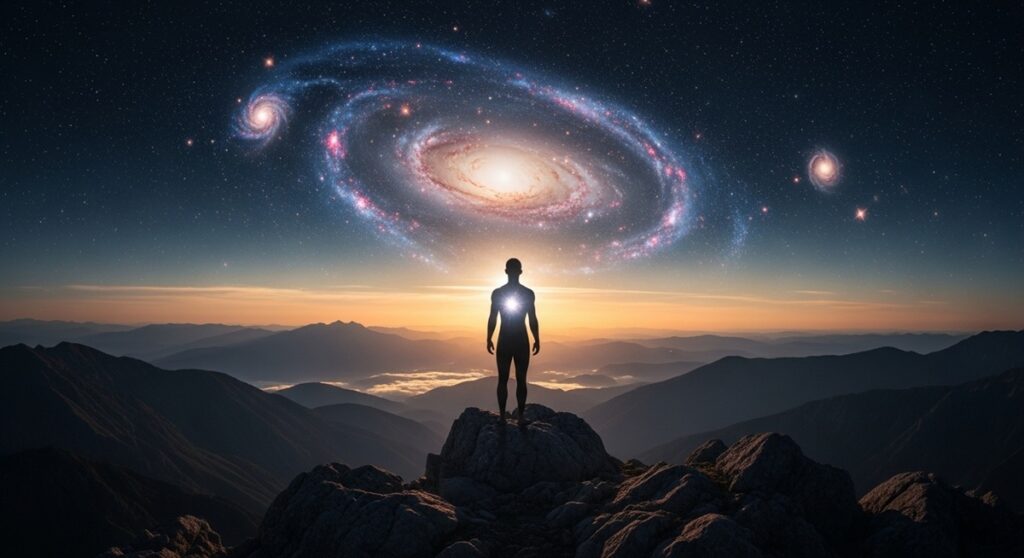
1. Atman and Brahman | The Self Beneath the Self
The oldest strand in this comparison reaches back to the Upanishadic traditions of ancient India and receives one of its most systematic philosophical formulations in Advaita Vedanta, especially in the work associated with Shankara in the eighth century CE. Advaita does not merely say that human beings possess a spiritual component hidden somewhere inside the body. Its claim is far more radical: the deepest self, Atman, is not ultimately separate from Brahman, the non-dual reality that underlies everything. The famous Upanishadic expression tat tvam asi, “that thou art,” became one of the classic formulations of this identity.
That does not mean Advaita teaches the simplistic idea that the personality in the mirror is secretly God. The distinction is precisely the point. Your name, history, desires, fears, social identity and ordinary sense of individuality belong to the empirical world of changing experience. The Atman that Advaita identifies with Brahman is not your ego enlarged to cosmic proportions. It is consciousness understood at a level prior to the individual personality.
This is also where the word maya becomes dangerously easy to mistranslate. Calling maya simply “illusion” can suggest that Advaita teaches that the universe is a hallucination, as though nothing exists at all. The philosophical position is subtler. Advaita distinguishes ultimate reality from the ordinary world of differentiated experience and asks why consciousness encounters multiplicity when reality is ultimately non-dual. Maya names part of the explanatory framework for that apparent multiplicity, it is not simply a synonym for “everything is fake.”
And Advaita should not be mistaken for the whole of Vedanta. Ramanuja’s Vishishtadvaita and Madhva’s Dvaita developed powerful alternatives in which the relationship between individual self, God and ultimate reality remains genuinely differentiated. The disagreement is important because it demonstrates that the Indian philosophical tradition did not possess one monolithic doctrine saying, “The body is an illusion and everyone is secretly the same.” It contained competing answers to the problem of what a person ultimately is.
2. The Gnostic Revolution | A Stranger Inside the World
Several movements and texts that modern scholars group under the broad label “Gnostic” approached the problem from almost the opposite direction. Rather than beginning with the unity of self and ultimate reality, certain Gnostic cosmologies presented the material universe as a deeply compromised creation. In texts such as the Apocryphon of John, recovered among the Nag Hammadi library in 1945 though considerably older than its discovery, Bishop Irenaeus of Lyon already knew and explicitly refuted its core teachings in his treatise Against Heresies, written around 180 CE, anchoring the composition of its mythological framework to no later than the middle of the second century, the supreme divine reality exists beyond the ordinary cosmos, while a lesser creator figure, commonly called Yaldabaoth, produces or governs the material order in ignorance of the higher divine reality.
Human beings can therefore contain something that does not properly belong to the lower world: a divine element or spark whose true origin lies beyond the material cosmos. Salvation is not primarily the acquisition of information in the modern sense. It is gnosis, a transformative knowledge of one’s true origin and condition.
The resemblance to Advaita is immediately tempting, but the temptation should be resisted. Advaita does not require an evil or incompetent cosmic craftsman. Its account of maya is not equivalent to a malevolent Demiurge. Nor does every text or movement conventionally described as Gnostic share exactly the same cosmology. “Gnosticism” is a modern umbrella term covering diverse ancient materials, and those differences matter.
Yet the structural question is remarkably familiar: What if the world presented to ordinary consciousness is not the whole story about where consciousness comes from? The Gnostic answer is not that you are secretly identical with the universe. It is that something within you may have an origin radically different from the material world surrounding you.

3. Leibniz | What If Matter Isn’t Fundamental?
More than a millennium later, and in a completely different intellectual environment, Gottfried Wilhelm Leibniz attacked the problem from the standpoint of European rationalist metaphysics. His 1714 Monadology proposed that reality is ultimately composed not of chunks of matter but of simple, indivisible substances called monads.
Leibniz’s famous phrase that monads have “no windows” captures something extraordinary about the theory. A monad is not a tiny physical particle bouncing around inside space. It is a metaphysical simple whose changes arise internally rather than through ordinary causal interaction with other monads. Yet the states of different monads correspond with one another through what Leibniz called pre-established harmony, grounded in God’s ordering of reality.
This is not a disguised version of reincarnation, mystical awakening or the modern idea that consciousness has escaped from a computer simulation. Leibniz was trying to solve serious problems about substance, causation, perception and the apparent unity of the physical world. His proposal was a technical metaphysical system, not an ancient-sounding spiritual revelation.
But it produces a startling consequence for anyone accustomed to naive materialism. What appears to us as a world of solid objects is not, for Leibniz, the ultimate level of reality. Physical bodies are phenomenal aggregates grounded in deeper metaphysical substances. The chair in front of you is real in an important sense, but it is not fundamental in the way common sense initially suggests.
And that creates a strange echo across the centuries. Advaita asks whether the everyday individual is the deepest reality. Leibniz asks whether the everyday physical world is the deepest reality. The questions are not identical, but both force ordinary experience to surrender its claim to being the final layer.
4. Bostrom | The Modern Version Doesn’t Begin With Mysticism
Then, in 2003, the argument changed vocabulary completely. Oxford philosopher Nick Bostrom published “Are You Living in a Computer Simulation?” in The Philosophical Quarterly. Suddenly the ancient question about the status of experienced reality could be posed without invoking Brahman, divine sparks or metaphysical substances. The new vocabulary was computation, posthuman civilization and simulated minds.
But Bostrom’s actual argument is much narrower than the popular slogan “we live in the Matrix.” He presents a trilemma: either civilizations like ours almost always become extinct before reaching a posthuman stage capable of running enormous numbers of ancestor simulations, or civilizations that reach that stage almost never run such simulations, or we are very likely already living inside one.
The logic depends on numbers of observers. If advanced civilizations can create enormous populations of conscious simulated beings and actually do so, simulated observers could vastly outnumber beings living in the original physical civilization. Under certain assumptions about reference classes and observer selection, that would alter the probability that someone like us belongs to the original population.
And this is where popular retellings usually go wrong. Bostrom did not discover a glitch in quantum mechanics. He did not point to DNA as computer code. He did not argue that déjà vu is evidence of a software reset. He did not claim that the universe’s mathematical regularity proves programmers exist. His 2003 paper is a philosophical argument about technological civilizations, simulation production and observer probabilities.
That distinction is not a minor technicality. It is the difference between an actual philosophical argument and a collection of science-fiction metaphors. Bostrom’s conclusion is conditional. Accept the relevant premises and assumptions, and the trilemma follows. Reject one of those assumptions, and the force of the argument changes. The paper does not provide a telescope image of the programmer’s server room.
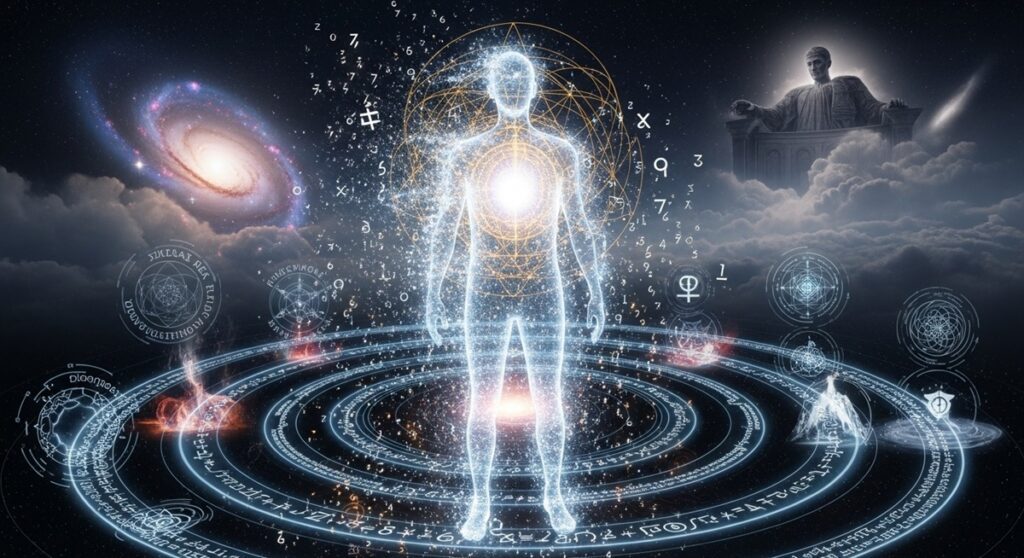
Four Systems. Four Different Ways of Dismantling Common Sense.
Now the comparison becomes more interesting. Advaita says the individual ego is not the ultimate self because Atman is Brahman. Certain Gnostic cosmologies say the divine element within a human being originates beyond the material cosmos. Leibniz says the physical world presented to the senses is not the fundamental level of reality, which consists instead of immaterial monads. Bostrom asks whether the physical world itself could be an artificial computational environment populated by simulated observers.
That is a real convergence, but it is a convergence of questions, not proof of a shared answer. None of these systems establishes that the others are correct. The fact that people separated by centuries repeatedly question the apparent solidity of ordinary reality is philosophically interesting, it is not empirical evidence that any particular metaphysical theory is true.
In fact, the differences are almost more revealing than the similarities. Advaita ultimately dissolves the deepest distinction between Atman and Brahman. Gnostic cosmology can preserve a profound distinction between the divine realm and the defective material order. Leibniz multiplies the fundamental level into an immense plurality of monads ordered by divine harmony. Bostrom does not need an ultimate divine reality at all: his hypothetical simulator could simply be another technologically advanced civilization.
The Question They Leave Behind
There is a temptation to read this entire history as confirmation. Four thinkers, four civilizations and four descriptions of reality appear to be whispering the same secret: you are not your body. But that conclusion is too neat, and it actually makes the ideas less interesting.
Leibniz never needed the Gnostic divine spark. Shankara was not anticipating computer simulations. Bostrom was not secretly rediscovering the Upanishads. The Gnostic authors were not writing an early version of computational metaphysics. These systems should not be collapsed into one timeless doctrine merely because modern readers can place them beneath the same headline.
What genuinely repeats is the refusal to accept first appearances as final explanations. The body may be one level of description. The personality may be another. Consciousness may be another. The physical world may be fundamental, or it may not be. And the fact that human beings keep asking where the deepest layer lies tells us something important even before any answer is chosen.
We experience ourselves from the inside, yet describe ourselves from the outside. Biology sees an organism. Psychology sees a mind. Neuroscience sees networks of activity. Society sees a person with a name, relationships and history. Philosophy asks whether any of those descriptions captures what the person ultimately is.
That question remains open.
And perhaps the most unsettling possibility is not that one of these ancient or modern theories is secretly correct. It is that the question itself may be larger than the categories we currently use to answer it.
Atman is not the Demiurge. A monad is not a Gnostic spark. Bostrom’s simulated observer is not the soul of the Upanishads. Four traditions do not give us one answer. They give us four increasingly strange warnings about the same assumption: that the world as it appears, and the self as it feels, must also be the world and self at the deepest level.
We know the body we inhabit. We know the story we tell about ourselves. What we do not know is whether either one is the final description.