



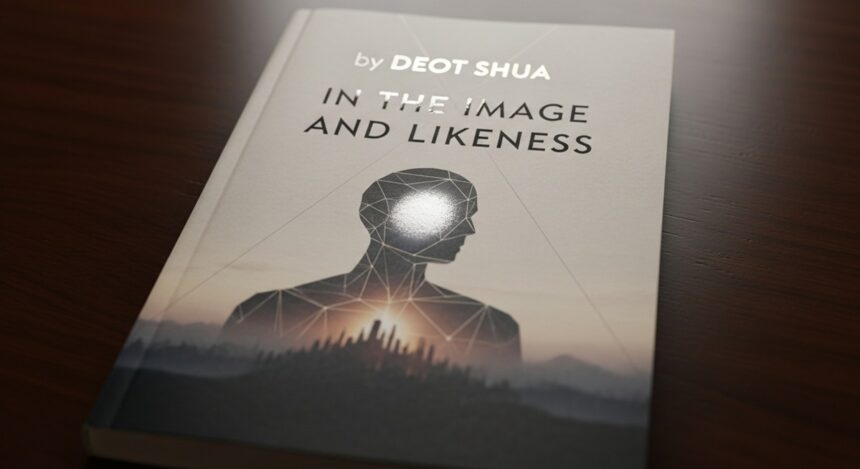
The alleged 1978 book called In the Image and Likeness cannot be traced to a verifiable author, publisher, edition, library record, contemporary report, court case, or documented suppression campaign. The story of its worldwide destruction therefore collapses at the point where a historical investigation should begin: the evidence.
But there is a much more interesting story hiding underneath it. The phrase “in our image, according to our likeness” is not a modern revelation, and it does not require a vanished manuscript to be mysterious. Genesis 1:26 belongs to a world in which gods, kings, statues, divine representation, human creation and political authority were already deeply intertwined. For more than a century, scholars have been comparing the biblical language with Egyptian and Mesopotamian evidence, and the resulting debate is considerably stranger, and considerably better documented, than the alleged 1978 conspiracy.
The real question is not who supposedly erased the book.
It is what the ancient text actually meant.

The 1978 Book Leaves a Remarkable Absence
The alleged story is unusually specific. A little-known author supposedly published a book called In the Image and Likeness in 1978, only for the work to attract the attention of religious authorities and governments. According to the circulating account, the book revealed a forbidden interpretation of Genesis, its author was persecuted or imprisoned in Israel, copies were destroyed, and an international suppression effort ensured that virtually no physical evidence survived.
That is exactly the sort of claim that should be testable. A book published in 1978 should ordinarily leave bibliographic traces: a publisher, an ISBN or catalog entry, library holdings, citations, reviews, advertisements, newspaper references, archival records, copyright information, or later references to the work. A genuine international campaign involving governments, churches and intelligence services would create still more opportunities for documentation. Yet no convincing bibliographic or documentary trail for the alleged book, its supposed author, or the coordinated suppression campaign described in the story has been located.
The name attached to the story is no more secure. No verifiable publication history establishes the identity of an author called “Deot Shua” or a comparable figure who published the alleged manuscript and was subsequently imprisoned for its contents. No identifiable court proceeding has emerged to substantiate the dramatic claim that the author was jailed specifically to silence the book.
That does not constitute a mathematical proof that no obscure private copy could ever have existed. History is full of lost books, unpublished manuscripts and poorly documented local publications. What it does mean is something much more precise: the extraordinary historical claims being made about this particular book currently lack the primary evidence that would allow them to be treated as history.
And that matters because the story has an unusual built-in escape hatch. If no copy can be found, the explanation is that the authorities destroyed it. If no publisher can be identified, the explanation is that the publication was underground. If no contemporary newspaper mentioned it, the explanation is that the suppression worked. If no official record survives, that absence itself becomes evidence of the conspiracy.
At that point, the claim becomes extraordinarily difficult to falsify. The missing evidence is no longer a problem for the story. It becomes part of the story.

But “Image and Likeness” Is Absolutely Real
The remarkable irony is that the conspiracy does not need to invent a mysterious phrase. Genesis already contains one. Genesis 1:26 describes God saying, “Let us make humanity in our image, according to our likeness,” followed by the creation of humankind in that image in the next verse. The Hebrew terms conventionally translated as “image” and “likeness,” ṣelem and demût, have generated centuries of interpretation and more than a century of modern philological and comparative scholarship.
And the ancient background is genuinely important. Biblical scholars have long compared Genesis’s language with Egyptian and Mesopotamian texts in which kings could be described as the image of a deity or as divine representatives on earth. An Assyrian text, for example, can describe a king as the image of the god Bel, Egyptian royal inscriptions likewise describe the pharaoh in terms of being a living image of a deity. These parallels do not prove that Genesis copied one particular text. They demonstrate that the language of divine image and representation belonged to a wider ancient Near Eastern conceptual world, one Genesis is participating in rather than simply borrowing from wholesale.
That is where one of the most influential interpretations begins. Biblical scholar J. Richard Middleton, whose 2005 study The Liberating Image remains a standard contemporary treatment, has argued that Genesis 1 uses royal imagery in a strikingly expansive way: in surrounding ancient cultures, divine-image language was strongly associated with kings and rulers, whereas Genesis applies the status to humanity as a whole. Phyllis A. Bird made a related argument in a 1981 Harvard Theological Review article, reading the “image of God” as a royal designation the text deliberately extends beyond kingship, in implicit contrast to rival Mesopotamian traditions, such as the Enuma Elish, in which humanity’s role is simply to relieve the gods of labor. The text then immediately connects that status with dominion over the earth and its creatures. On this reading, humanity is being presented as God’s authorized representative, not because every human is literally a divine being, but because human beings collectively receive a role associated elsewhere with kingship and representation.
That is a powerful idea. But it should not be turned into another oversimplification. The ancient evidence does not establish that “image of God” had one universally fixed meaning throughout Egypt and Mesopotamia, nor does every biblical scholar reduce Genesis 1 to royal ideology alone. Other interpretations emphasize divine-human kinship, representation, relationality, human vocation, or a combination of these dimensions. Catherine McDowell, for example, has argued that Genesis’s language can be illuminated not only by royal ideology but by the ancient rituals surrounding the creation and animation of divine images, while also emphasizing humanity’s relationship to God as a kind of divine kinship.
Genesis May Have Made a Royal Idea Everyone’s Problem
This is where the historical argument becomes genuinely provocative. In much of the ancient Near East, divine representation was deeply bound up with hierarchy. Gods ruled, kings represented them, statues could embody their presence and authority in particular places. Genesis 1 takes place inside that same conceptual universe but distributes the language far more broadly. “Image” is not restricted to a pharaoh or monarch. The text immediately moves from humanity as God’s image to “male and female” together.
That has led scholars to describe Genesis as democratizing or universalizing royal imagery. Middleton’s interpretation is particularly influential: humanity’s creation in God’s image is tied to a royal vocation in which human beings are authorized to exercise responsible dominion within creation. Other scholars have developed related interpretations in terms of representation, kinship and divine sonship. The precise formulation remains debated, but the underlying ancient comparison is not invented.
There is an even deeper comparison. Ancient Mesopotamian creation traditions sometimes describe humanity as being created in order to serve the gods. In the Atrahasis tradition, for example, humans are created to take over labor from the gods, a role spelled out even more starkly in the Enuma Elish, where the god Marduk announces that humanity will exist so that the gods “might be at ease.” Genesis is operating within a world where human creation and divine service were already connected, but its presentation of humanity’s status is strikingly different. Humanity is not introduced merely as a disposable workforce. It is created in God’s image and immediately assigned responsibility over the living world.
Scholars therefore debate whether Genesis is deliberately engaging and revising the anthropology of its ancient environment. Catherine McDowell, among others, has emphasized how Genesis should be read against ancient Mesopotamian ideas about divine images, human creation and sacred space. The important point is not that Genesis secretly encodes one forbidden historical event. It is that the biblical authors were participating in a sophisticated cultural conversation that can still be partially reconstructed from texts, inscriptions and archaeological evidence.

And No, Genesis Does Not Say Moses Wrote It
This is an important correction because it is easy to smuggle modern assumptions into an ancient text. The traditional association between Moses and the Pentateuch is enormously important in Jewish and Christian history, but Genesis itself does not present Moses as the narrator of its creation account. Modern biblical scholarship generally treats the Pentateuch as a collection of texts with a complex compositional history rather than simply a document written from beginning to end by Moses.
That makes the ancient context more interesting, not less. We do not need to imagine Moses sitting in an Egyptian classroom memorizing a secret royal vocabulary and later embedding it in Genesis. We can instead ask the historically meaningful question: what cultural ideas about gods, kings, images and humanity were available to the people and scribes who produced and transmitted the Genesis tradition?
That question can actually be investigated.
And unlike the alleged 1978 book, there are documents to investigate.
The Phrase Has a Two-Thousand-Year Interpretive Afterlife
The ancient problem did not disappear once Genesis was written. “Image of God” became one of the great questions of Jewish and Christian anthropology. What exactly is the image? Is it physical resemblance? Rationality? Moral capacity? Relationship? Dominion? Representation? Divine sonship? Some combination of these?
Philo of Alexandria was already wrestling with questions surrounding the image and likeness in the first century. Later Jewish interpreters developed their own approaches, sometimes resisting anthropomorphic readings and sometimes interpreting the language through philosophical categories. Medieval Jewish commentators continued the debate, demonstrating that the phrase was never simply a forgotten code waiting for a twentieth-century author to decode it.
Christian thinkers transformed the discussion again, frequently connecting the image of God with humanity’s rational, moral or spiritual nature and, later, with the restoration of that image. Modern biblical scholars then returned to the Hebrew vocabulary and the ancient Near Eastern evidence, asking whether earlier theological interpretations had overlooked the political and cultural world in which Genesis was composed.
There is therefore no single “secret meaning” that suddenly appeared in 1978. There is a documented chain of interpretation stretching across antiquity, medieval Jewish and Christian thought, early modern theology and modern biblical scholarship.
The Ancient Evidence Is Stranger Than the Conspiracy
Once the alleged manuscript disappears, the conspiracy story has nowhere else to go. But the ancient evidence keeps producing questions. Why does divine-image language overlap with royal representation? Why does Genesis connect God’s image with dominion? Why does the biblical creation account emerge from a world where humans were frequently described in terms of service to the gods? Why does Genesis give a status associated with rulers to humanity as a whole? And how much of that language reflects deliberate engagement with the religious and political assumptions of Israel’s neighbors?
Those questions have answers, competing answers, and arguments over the evidence. That is what makes them historical questions. A scholar can cite a royal inscription, challenge its relevance, propose another ancient parallel, test the Hebrew terminology, and argue over the interpretation. Another scholar can disagree. The evidence remains available for both sides.
That is the crucial difference between a historical mystery and a conspiracy narrative.
The “Lost Golden Age” Is Another Layer of the Same Problem
The wider story surrounding the alleged book often expands beyond Genesis into a familiar claim: that ancient cultures remembered a primordial age in which humanity possessed greater knowledge or lived closer to divine beings, only for that world to be destroyed or concealed. There really are ancient traditions about lost abundance, catastrophe, primordial harmony and decline, explored elsewhere in this site’s own coverage of separation myths. But their existence does not establish that all of them preserve memories of one literal prehistoric event.
Mesopotamian literature contains stories of primordial kingship, creation and catastrophe. Greek tradition contains the succession of human ages. Biblical literature contains Eden, the Flood and other narratives of loss and restoration. South Asian traditions developed their own elaborate accounts of cosmic ages and decline. These traditions are not interchangeable, and treating them as pieces of one ancient historical record erases the cultural differences that make each tradition interesting.
Comparative mythology can certainly investigate why human societies repeatedly tell stories about paradise lost, catastrophic transformation and a degraded present. But similarity is not identity. Two cultures telling stories about a lost golden age does not establish that both remembered the same event, just as two cultures telling flood stories does not by itself establish that one prehistoric flood is the source of every version.

What the Evidence Actually Gives Us
There is no reliable evidence presently establishing the alleged 1978 book, its supposed author, or the international campaign of coordinated suppression described in the story. The absence of a surviving copy alone cannot prove that no obscure manuscript ever existed, but the absence of the entire documentary footprint expected from the surrounding claims makes the narrative impossible to treat as established history.
Genesis 1:26, by contrast, is not missing. Its Hebrew wording is preserved. Its textual history can be studied. Its ancient Near Eastern parallels can be compared. Its vocabulary can be analyzed. Its reception history can be followed through Jewish and Christian interpretation. Its meaning can be argued over, and scholars have been arguing over it for centuries.
And that documented history produces a conclusion far more interesting than the alleged secret manuscript.
The phrase “image and likeness” was not waiting for a twentieth-century whistleblower to reveal it.
It was already sitting in one of the world’s oldest surviving traditions, surrounded by traces of the ancient political and religious world that produced it.
Maybe Genesis was describing humanity as God’s representatives. Maybe kinship and divine sonship are central. Maybe the imagery draws simultaneously on royal ideology and the ancient concept of the divine image. The scholarly debate remains open precisely because the evidence is rich enough to support competing interpretations.
What the evidence does not require is a vanished 1978 book.
The real secret is that the ancient text was never nearly as simple as the conspiracy made it sound, and unlike the alleged manuscript, the evidence is still here.