



Thomas Edison spent years ridiculing the crude machinery of spiritualism. He had no patience for tilted tables, rapping chairs, or a triangular piece of wood supposedly being pushed around a Ouija board by the dead. Then, in 1920, the most famous inventor in America told reporters that he was thinking about something far stranger: an apparatus sensitive enough that, if human personality survived death, it might give the dead a way to communicate with the living. He described the project publicly. He explained the physical problem he was trying to solve. And then, six years later, he said the whole thing had been a joke. The machine itself was never found. No authenticated blueprint survives. The famous photograph-like descriptions of how it supposedly worked appeared only years after Edison died. What remains is not proof that Edison built a telephone to the dead. It is something more interesting: a documented argument, inside the mind of one of history’s most consequential inventors, over whether death itself might be an engineering problem.
Edison had good reason to be taken seriously when he spoke about machines. By the time of his death in 1931, he had accumulated 1,093 successful U.S. patents, spanning telegraphy, electric power, sound recording, motion pictures, batteries and other technologies, while helping establish the industrial research laboratory as a model for organized invention. The Edison Papers describe him not simply as a prolific inventor but as someone who helped create the modern method of invention itself. That is precisely why the afterlife story became so irresistible. The man who spent his life turning vague possibilities into apparatuses was suddenly asking whether consciousness itself might leave a measurable trace behind.
Edison Was Not Asking Whether Ghosts Were Real
The first thing that has to be stripped away is the word ghost. Edison did not approach the question in the language of haunted houses, apparitions and supernatural beings. In his 1920 interview with Scientific American, he went out of his way to reject precisely that framework. He said he could not conceive of a spirit with no weight, material form or mass, and ridiculed the idea that such entities would spend eternity manipulating tables or pushing a little wooden indicator around a Ouija board. His objection was not simply that spiritualism was false. It was that its proposed mechanism was too crude to tell him anything.

That distinction matters. Edison was not saying, “I believe the dead are speaking to mediums.” He was asking a more unsettling question: if something of personality survives death, could it interact with matter in a measurable way? In the same 1920 interview, he described thinking about an apparatus that might be operated by personalities that had passed into another existence or sphere, while insisting that he did not actually know whether personalities survived. He even suggested that a sufficiently delicate instrument might give such personalities a better opportunity to express themselves than the crude methods used by mediums. Rutgers’ Edison Papers identifies these interviews as part of a longer thread in Edison’s thinking about whether consciousness could exist in fundamental units that persisted beyond bodily death.
That is a much stranger position than the popular version. Edison was not converting to spiritualism. He was trying to drag the question of survival into the laboratory. If the phenomenon was real, he wanted an instrument that could detect it. If the instrument detected nothing, then perhaps the hypothesis could finally be discarded. The machine, in other words, was supposed to do something a séance could never do: turn an argument about the dead into an experiment.
The 1920 Announcement Was Real. The “Spirit Phone” Was Not Yet a Machine
In October 1920, The American Magazine published an interview in which Edison was quoted saying he had been at work building an apparatus to determine whether personalities that had left the Earth could communicate with the living. That wording is the foundation of the entire legend. But almost simultaneously, Scientific American published an interview in which Edison described himself more cautiously as having been thinking about such a machine. The difference is small enough to overlook and large enough to matter enormously: one version sounds like a prototype already under construction; the other sounds like a research problem still being conceptualized.
Even Scientific American was careful about the claim. Its October 30, 1920 article was explicitly titled “Edison’s Views on Life and Death” and described the supposed apparatus as experimental. The surviving material does not give us an authenticated engineering drawing, a patent, a laboratory notebook showing a completed necrophone, or a working prototype that can be traced securely to Edison. More importantly, the Edison Papers themselves now state that no verifiable evidence has been found for an actual device capable of communicating with the dead.
So the first boundary has to be drawn here. Edison really said he was pursuing the possibility. That is documented. We do not have comparable evidence that he successfully built the famous machine later attributed to him. That is also documented. Everything that follows becomes a question of how much later mythology was built around that gap.
Then Someone Gave the Machine a Beam of Light
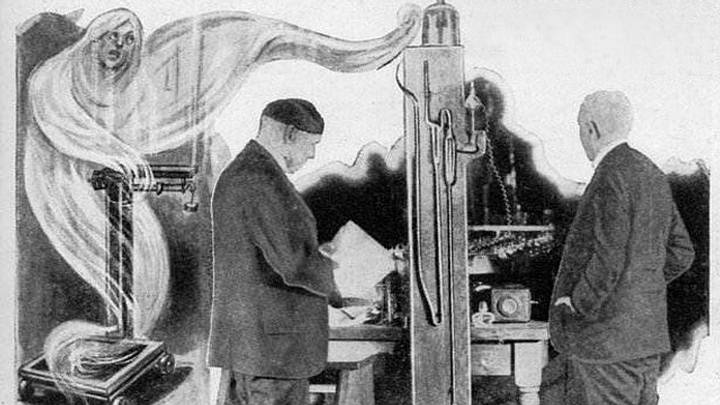
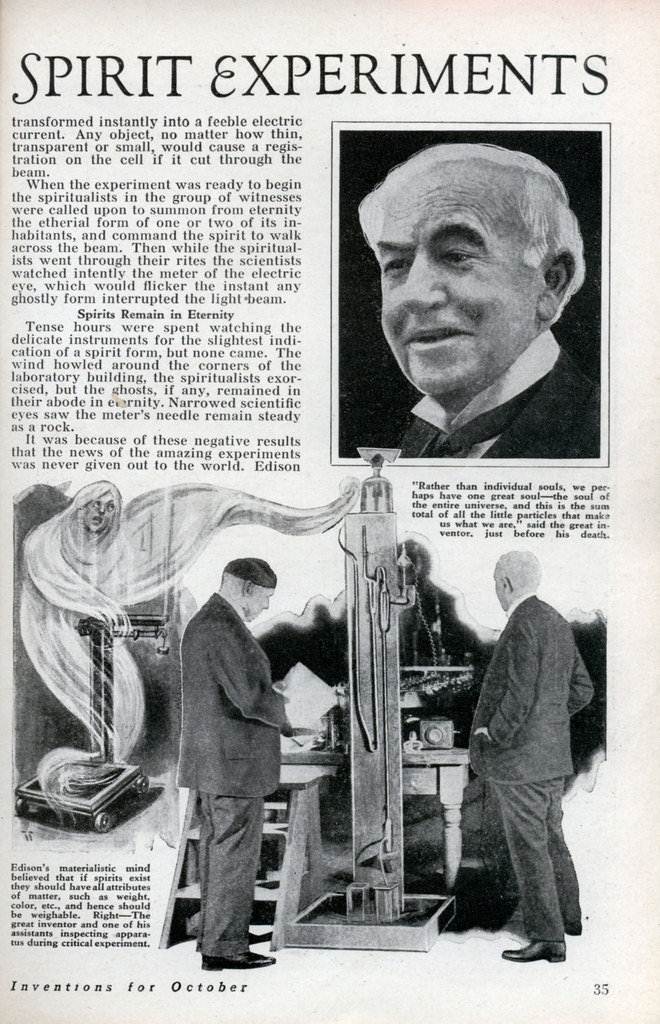
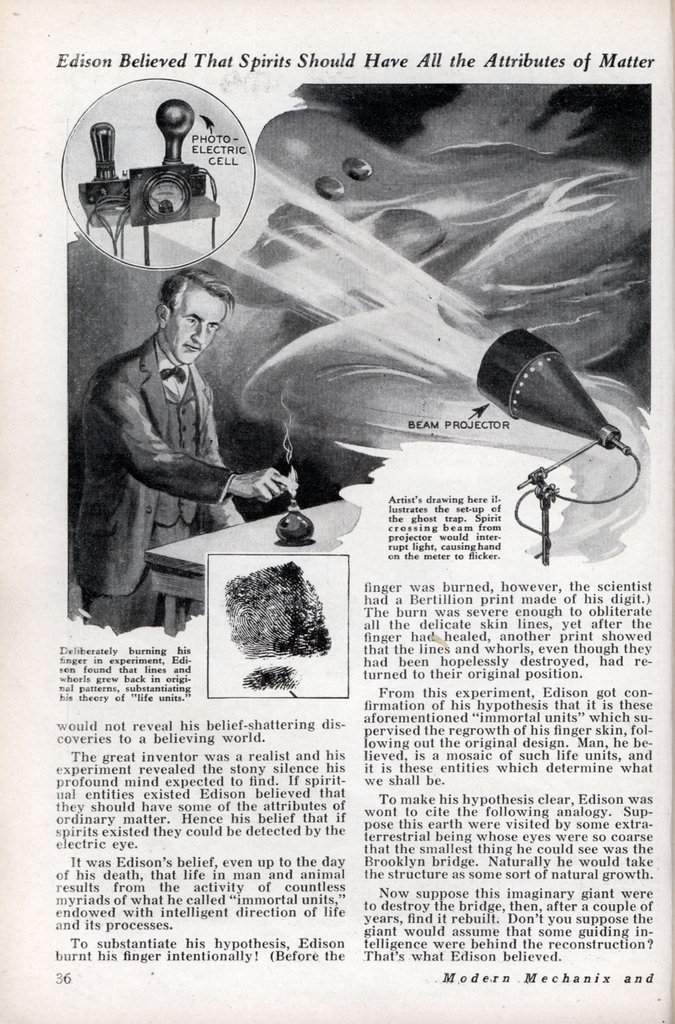
This is where the story changes from documented history into something much harder to classify. In October 1933, two years after Edison’s death, Modern Mechanix published the first known detailed description of a supposed experiment involving a photoelectric cell. According to the article, Edison had arranged a narrow beam of light across a darkened laboratory. The beam struck a photoelectric cell, and anything crossing it would supposedly interrupt the signal and register on a meter. The proposed experiment was simple in principle: if an invisible entity passed through the beam, the instrument should detect the interruption.
It is an almost perfect Edison story: light, electricity, a sensitive detector, an invisible phenomenon and a needle waiting to betray the existence of another world. There is only one problem. The detailed account appeared after Edison was dead. Rutgers’ Edison Papers specifically identify the 1933 Modern Mechanix article as the first description of this supposed apparatus and note that no verifiable evidence has been found for Edison’s work on such a device. The same source suggests the story may have been confused with Edison’s much earlier investigations into an unknown force he called “XYX,” experiments that did in fact continue intermittently into the 1920s.
That means the famous scene in which Edison supposedly gathered scientists and mediums around a photoelectric detector, waited for hours, watched the needle refuse to move and then continued refining the machine is not something we can responsibly present as established history. It is a later account, published in a magazine that named none of the “scientists” supposedly present. It may preserve a genuine experiment, a distorted memory of another experiment, or an invented scene constructed from Edison’s public statements and his known interest in sensitive instruments. We simply do not possess the contemporary evidence needed to decide between those possibilities.
The Theory Behind It Was Stranger Than a Ghost
Edison’s thinking about death did not depend entirely on supernatural spirits. His idea was more mechanical, and therefore more revealing. He speculated that living organisms might be composed of fundamental “units” of life or consciousness, tiny organizing entities that collectively produced the larger structure we called a person. The Edison Papers describe this as one of his controversial ideas about consciousness: these fundamental units might exist before and after the individual body that temporarily contained them.
The idea was an attempt to solve a problem that Edison found physically troubling. A human body changes constantly. Matter is replaced, tissues are destroyed and rebuilt, yet the organism maintains an astonishing continuity of form and function. If an organism could somehow retain its organization while its material components changed, Edison wondered whether there might be something deeper responsible for that continuity. He was not doing modern molecular biology, and his “immortal units” were not a scientific discovery. They were a speculative nineteenth- and early-twentieth-century attempt to explain how living organization persisted through changing matter.
That distinction is important because later accounts sometimes transform Edison’s speculation into something resembling a discovered biological fact. It was not. Edison had an intuition about organization, identity and continuity. He then asked whether whatever produced that continuity might remain after death. The machine was supposed to be the test.
Then Edison Himself Seemed to Pull the Plug
The strongest piece of evidence against the romantic version of the story comes from Edison himself. On October 12, 1926, six years after the famous 1920 announcement, he told The New York Times that he had invented the story because a reporter, B.C. Forbes, had arrived on one of the coldest days of the year, and Edison did not want to disappoint him. His explanation was devastatingly simple: “I really had nothing to tell him, but I hated to disappoint him, so I thought up this story about communicating with spirits, but it was all a joke.”
If that statement is accepted at face value, the mystery largely disappears. Edison was still Edison: a famous inventor with an enormous appetite for publicity, a legendary appetite for practical jokes, and a reporter standing in front of him asking for a story. The “spirit machine” becomes one more piece of Edisonian theater.
Except that the historical record does not become quite that clean.
Edison had discussed the possibility of consciousness surviving death before 1920. The Edison Papers trace the subject back at least to a 1910 interview in which he proposed that spiritualist claims might someday be scientifically tested. And in 1926, around the same period in which he dismissed the famous apparatus story as a joke, he was still publicly discussing the enormous difficulty of scientifically investigating the soul and immortality. He wrote that humanity did not even know how to begin investigating the question, and that the soul could not then be weighed, photographed or recorded by known instruments.
That does not prove he had a working machine. It does something more subtle. It shows that the question itself was not invented from nothing in 1920.
The Dead Man Edison Was Supposed to Hear From
Another part of the legend concerns William Walter Dinwiddie, an Edison associate who died in 1920. Later accounts describe an agreement between the two men: whoever died first would attempt to send a message to the survivor from beyond the grave. Dinwiddie died before Edison, creating the perfect narrative mechanism.
The story has been repeated in accounts of Edison’s afterlife experiments, including material surrounding Philippe Baudouin’s 2015 publication of Le Royaume de l’au-delà. But this is another place where the article should resist turning an intriguing secondary account into a laboratory fact. The pact is part of the documentary and biographical tradition surrounding Edison’s afterlife research; it is not evidence that Dinwiddie ever successfully communicated with Edison. No authenticated message from Dinwiddie exists.
The French Book That Reopened the Case
Then came 2015. French radio presenter and philosopher Philippe Baudouin published Le Royaume de l’au-delà, presenting material said to come from a French edition of Edison’s Diary and Sundry Observations. The claim was explosive because the French edition was said to preserve a chapter concerning Edison’s ideas about communicating with the dead that was absent from the familiar English edition published in 1948. The publication was real, and the book really was issued in France. The question is what, exactly, the recovered material proves.
Contemporary reporting described the rediscovered material as evidence that Edison had seriously explored ways of recording communications from the dead. But the existence of a French book containing purported Edison material is not the same thing as independent authentication of every page in it. The material has not transformed the historical consensus into “Edison built a working spirit phone.” Rutgers’ Edison Papers still state that no verifiable evidence has been found for an actual device. That leaves the 2015 publication where it belongs: as an important claim that complicates the joke theory, not as a laboratory notebook proving the machine existed.
The Machines That Came After Edison
Once Edison’s name became attached to the idea, the missing machine acquired a life of its own. In 1963, Fate magazine published another account claiming that lost blueprints had been recovered with the help of a medium and that a machine had been constructed from them. It did not work. Another object, the so-called Psychophone, was later attributed to Edison. The PBS program History Detectives, drawing on research by the Edison Papers, concluded that the attribution was false.
This is how historical legends become almost impossible to kill. A real statement becomes a rumor. The rumor becomes a magazine story. The magazine story acquires an illustration. The illustration becomes “the machine.” Someone builds a later device and attaches Edison’s name to it. Eventually the reconstructed object is cited as evidence that the original object must have existed.
The circle closes itself.
So Did Edison Really Try to Talk to the Dead?
The honest answer is both more limited and more interesting than the legend.
Yes, Edison really investigated the possibility. His own interviews establish that. He thought about whether personality could survive death and whether sufficiently sensitive scientific apparatus might detect it. The Edison Papers document the subject as part of his intellectual life, not as something invented by modern paranormal writers.
No, there is no authenticated Edison “spirit phone” sitting in an archive waiting to be rediscovered. No verified prototype has surfaced. No authenticated blueprint establishes the famous machine. The celebrated photoelectric-cell experiment comes from a posthumous 1933 magazine account, not a surviving contemporary laboratory record.
And yes, Edison himself later said the 1920 story was a joke. That cannot simply be erased because it makes the mystery inconvenient. Nor can it erase the earlier and later evidence that he genuinely regarded survival after death as a question worth thinking about scientifically.
What we are left with is not a secret invention. It is a collision between three different Edisons: the public skeptic mocking mediums, the inventor wondering whether consciousness could be measured, and the legendary showman perfectly capable of feeding a reporter an outrageous story and later calling it a joke.
Those three men may have been the same man.
The Real Mystery Was Never the Machine
The temptation is to ask where Edison’s machine went. Was it destroyed? Hidden? Locked in a laboratory drawer? Removed from the archives? Passed secretly to another researcher? Those are wonderful questions for a mystery story, but the evidence does not currently justify answering them with “yes.” The more defensible question is why Edison kept returning to the problem of death at all.
For Edison, the afterlife was not necessarily a supernatural kingdom populated by ghosts. It was an unresolved physical proposition. If personality survived, there should be some consequence. If there were consequences, perhaps an instrument could detect them. And if no instrument ever detected anything, then perhaps the entire idea would finally collapse.
That is almost aggressively Edisonian. Turn metaphysics into engineering. Turn belief into an instrument. Turn an ancient human question into something with wires, measurements and a failure condition.
But the instrument never became the proof. What survived instead was the question.
More than a century later, death still leaves us with the same impossible problem Edison confronted: we can measure a body, image a brain, record electrical activity, preserve a voice and map the machinery of memory, but none of those measurements has settled what, if anything, happens to the person who was doing the experiencing when the machinery stops. Edison’s proposed machine never solved that problem. His alleged experiment never became reproducible evidence. His later admission of a joke cannot erase his documented curiosity, and his curiosity cannot be inflated into proof of a machine that the archives do not contain.
Perhaps that is the most appropriate ending for a story about Thomas Edison. He spent his life believing that difficult questions could be attacked with better instruments. On this question, the instrument never arrived in a form history can verify. The dead never answered him. The needle never became evidence. And the greatest inventor in the room was left with the one thing his machines were designed to eliminate: an unanswered question, the same open question the library’s own pieces on clinical death research, quantum immortality, and John Wheeler’s information-based view of reality keep approaching from entirely different directions.
That question still sits there, waiting for someone to build a better instrument. And this time, the first thing it should measure is not a ghost. It should measure the evidence. That is the difference between a mystery and a myth. It is also the difference Edison, at his best, understood better than almost anyone.