



The Naval Observatory astronomer was dead before he could look.
Robert Harrington spent the final years of his career at the United States Naval Observatory calculating where a large undiscovered body in the outer solar system had to be. His method was gravitational forensics: taking the observed positions of the outer planets, measuring their deviations from the positions that the known solar system’s gravitational model predicted, and working backward to determine what additional mass, at what distance and orbital inclination, would produce the observed deviations.
The method was the same method that had found Neptune. In 1846, astronomers calculated that the deviations in Uranus’s orbit required an additional planet at a location. They looked at that location and found Neptune within one degree of the predicted position. The prediction’s success was one of the most spectacular confirmations of Newtonian mechanics ever produced.
Harrington’s 1988 paper in the Astronomical Journal applied the same method to the deviations observed in the outer planet orbits that Neptune and Pluto together could not account for. His calculation was specific: a body approximately three to four times the mass of Earth, at a distance approximately three to four times beyond Pluto, in an orbital inclination of approximately thirty degrees to the ecliptic plane.
He identified a candidate sky region. He was preparing to search it observationally when he was diagnosed with esophageal cancer.
He died in 1993 without looking.
His calculation sat in the published literature for twenty-three years before two Caltech astronomers ran the same general analysis on a larger and better-characterized dataset and reached a conclusion whose probability estimate the broader scientific community could not dismiss.
Konstantin Batygin and Mike Brown published their Planet Nine paper in the Astronomical Journal in January 2016. Their probability estimate for the existence of the body their calculation indicated: ninety percent.
Between Harrington’s 1988 paper and Batygin and Brown’s 2016 paper, three other independent calculations had pointed at the same general conclusion. Four before the Caltech paper. Five including it. Five independent lines of astronomical evidence, developed across thirty-three years by researchers at different institutions using different datasets and different analytical methods, all converging on the same conclusion.
Something large is out there. It has not been found.
The 1983 Detection That Nobody Could Explain
Five years before Harrington’s paper, a space telescope found something.
The Infrared Astronomical Satellite launched in January 1983 as a joint program of the United States, the United Kingdom, and the Netherlands. Its instrument was an infrared detector cooled to near absolute zero by liquid helium, giving it sensitivity to infrared sources that no ground-based telescope could match. During its ten-month operational life before the coolant was exhausted, it catalogued approximately 350,000 infrared sources and produced the most complete infrared survey of the sky ever made to that date.
Among the sources it detected was an object in the direction of the constellation Orion whose infrared signature was initially characterized as possibly consistent with a large body at relatively close range. The detection was significant enough that Gerry Neugebauer, the IRAS chief scientist, made a public statement that the Washington Post published on December 30, 1983.
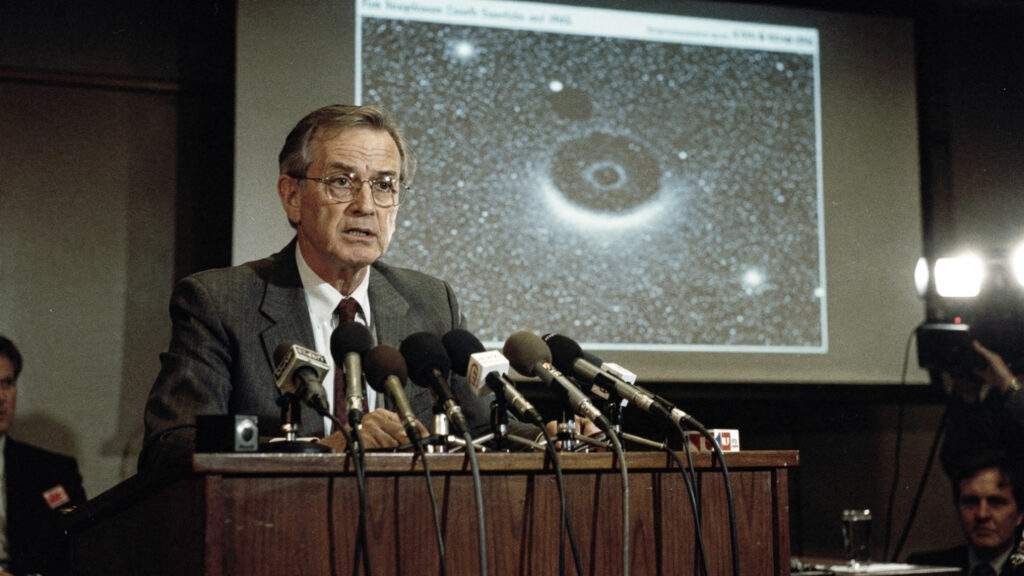
The statement was direct: all I can tell you is that we do not know what it is.
The article reported that the object might be as large as Jupiter and possibly close enough to be part of the solar system. The language was careful: might be, possibly, could be. The uncertainty reflected the genuine limitation of infrared detection for distance determination: an object’s infrared brightness depends on both its temperature and its distance, and a cold nearby object can have the same infrared signature as a warm distant object.
Subsequent analysis produced an explanation: the IRAS detection was most likely a distant galaxy or a cloud of interstellar cirrus dust whose properties fell in the parameter range that the initial announcement had flagged as potentially significant. The object was reclassified into known categories and the detection was closed.
The closure came without the comprehensive published analysis that would allow independent researchers to fully evaluate whether the reclassification was correct. The IRAS point source catalog entry for the detection is in the public record. The detailed analysis supporting the reclassification is not published at the level of specificity that would allow confident independent verification.
Whether the IRAS detected a genuine outer solar system body in 1983 and the subsequent reclassification was accurate, or whether the reclassification reflected the same institutional pattern of managing anomalous detections that the Robertson Panel and CIA psychological warfare pieces in this library cover as established policy, is not resolvable from the available public record.
What is established is that the IRAS detected something in 1983 that its chief scientist publicly acknowledged as unknown, that the subsequent explanation was not accompanied by the comprehensive published analysis that would make the reclassification independently verifiable, and that Harrington published his calculation of an outer solar system body five years later using a completely independent method that produced a consistent general conclusion.
Two independent lines of evidence. Five years apart. Both pointing at the same general region of the solar system.
Harrington’s Calculation and His Death
The gravitational forensics that Harrington applied to the outer planet orbit deviations in 1988 was the most direct available method for detecting an undiscovered body that was too distant and too dark to be observed directly with the telescopes then available.
The outer planets, Uranus, Neptune, and the trans-Neptunian objects then known, showed systematic deviations from their predicted positions when those predictions were calculated using only the gravitational influence of the known solar system. The deviations were small but consistent. Small and consistent deviations in a gravitational system are the signature of a missing mass term in the calculation: something is pulling the observed bodies in a direction by an amount that the model does not account for.
Harrington’s calculation produced the parameters of the missing term. A body of three to four Earth masses at a distance of approximately one hundred astronomical units in an orbital inclination of thirty degrees to the ecliptic would produce gravitational perturbations of the right magnitude and direction to account for the observed outer planet deviations.
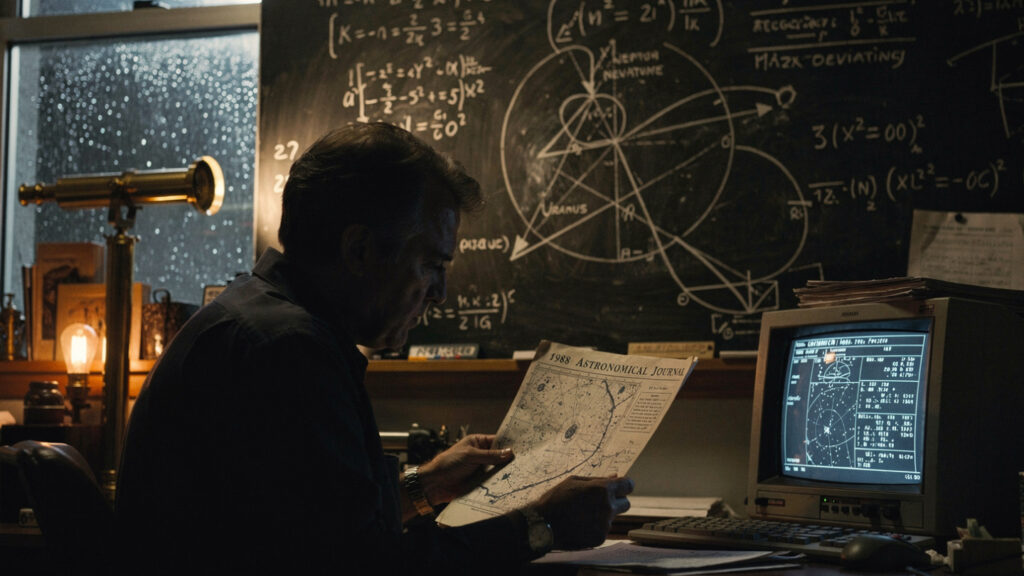
He subsequently collaborated with Tom Van Flandern, also at the Naval Observatory, on the triangulation of the body’s probable sky position from the direction of the observed perturbations. Their joint work produced a candidate search region in the southern celestial hemisphere, a preference that reflected the direction of the gravitational pull inferred from the outer planet deviations.
The southern sky preference in Harrington and Van Flandern’s calculation is significant because it is consistent with Planet Nine’s current best-estimate orbital geometry, which also places the body in the southern sky for a significant portion of its orbit. The consistency between a 1988 calculation based on gravitational perturbations and a 2016 calculation based on orbital clustering of Kuiper Belt objects is the kind of multi-method convergence that the scientific methodology treats as meaningful.
Harrington died in January 1993 at the age of fifty. The esophageal cancer that killed him developed rapidly. He had been active in the outer solar system research program until shortly before his death.
Van Flandern continued the work briefly but subsequently shifted his research focus. The search program that Harrington had been planning, pointing a telescope at the candidate sky region identified by their joint calculation, was not conducted after his death. The Naval Observatory’s outer planet research program did not maintain the momentum that Harrington’s work had established.
Whether this discontinuity was a natural result of the loss of the program’s driving researcher, or reflected some institutional redirection that the public record does not show, is not established.
The Japanese Calculation
In 2008, twenty years after Harrington’s paper and eight years before Batygin and Brown’s, two Japanese astronomers at Kobe University published an independent calculation that pointed at the same general conclusion from a different dataset.
Patryk Sofia Lykawka and Tadashi Mukai’s paper in the Astronomical Journal analyzed the orbital clustering of trans-Neptunian objects, the Kuiper Belt bodies whose orbits show statistical patterns that the known solar system’s gravitational model cannot fully explain. Their finding was that the clustering required a perturbing body of approximately 0.3 to 0.7 Earth masses at a distance of approximately one hundred to two hundred astronomical units in a highly inclined orbit.
The Lykawka-Mukai body is smaller than Harrington’s proposed body and smaller than Batygin and Brown’s Planet Nine. Whether the three calculations describe the same body at different accuracy levels, or whether the outer solar system contains multiple undiscovered bodies each detected by a different method, is a question that the discovery of the actual objects would resolve.
The significance of the Lykawka-Mukai calculation is that it represents a third independent analytical method, using a different dataset and a different theoretical framework from either Harrington’s gravitational perturbation analysis or Batygin and Brown’s orbital clustering analysis, that produces a consistent general conclusion: there is unaccounted-for gravitational mass in the outer solar system at distances of one hundred or more astronomical units in a highly inclined orbit.
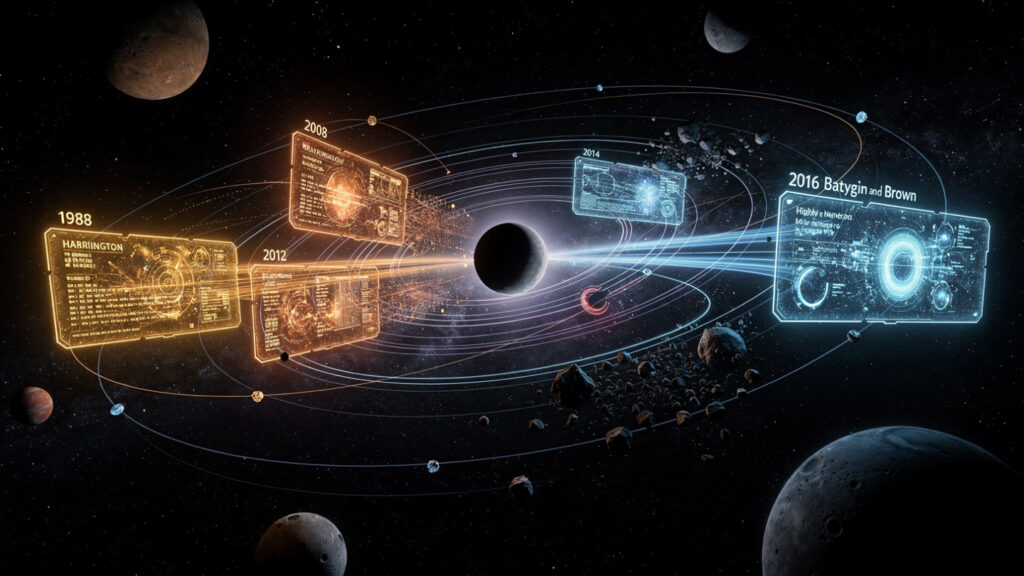
Three methods. Three datasets. Three research groups. Three calculations spanning twenty years of outer solar system astronomy. All producing the same general answer before Batygin and Brown put a probability number on it.
Batygin and Brown and the Ninety Percent
The Planet Nine piece in this library develops Konstantin Batygin and Mike Brown’s 2016 analysis in detail. The contribution of their paper to the broader search history is the probability estimate and the methodological rigor that forced the mainstream astronomical community to take the outer solar system body hypothesis seriously.
Their dataset was the orbital clustering of six highly inclined Kuiper Belt objects whose orbits showed a statistical alignment that the known solar system’s gravitational model predicted should occur with a probability of approximately 0.007 percent. The probability that the clustering was a random coincidence was therefore approximately one in fifteen thousand.
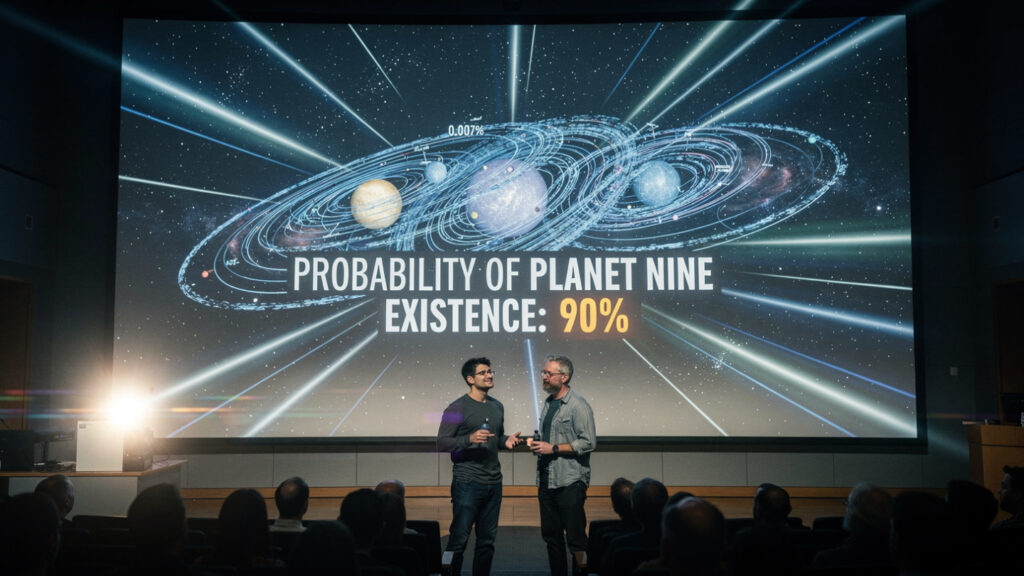
Their conclusion was that a body of five to ten Earth masses at a distance of approximately four hundred to eight hundred astronomical units in an orbit inclined at approximately thirty degrees to the ecliptic would produce exactly the observed clustering as a gravitational shepherding effect.
The ninety percent probability estimate was their assessment of the probability that the body existed, derived from the statistical improbability of the clustering being a random artifact combined with the consistency of their proposed body’s properties with the available evidence from multiple independent sources.
Ninety percent is not certainty. It is the same confidence level that a competent detective uses to name a suspect before the physical evidence is in hand. The body has not been directly detected. The search is ongoing.
The Vera Rubin Observatory in Chile, now operational after years of construction, is the primary instrument for the Planet Nine search because its large mirror, wide field of view, and repeated sky surveys give it the best current probability of detecting an object as faint and as distant as Planet Nine is predicted to be. The full survey program is expected to take several years to cover the predicted sky region with sufficient depth.
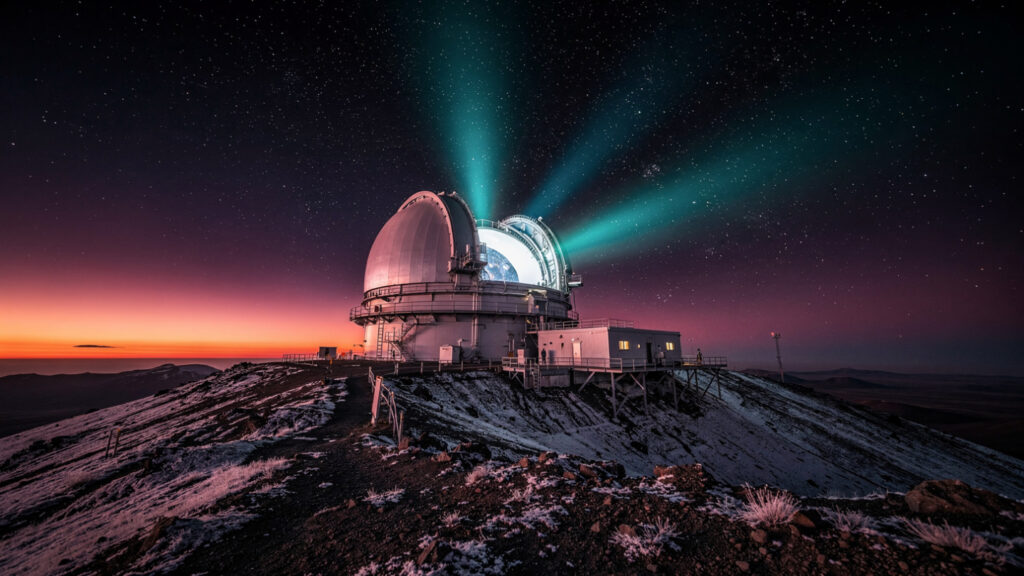
Whether the search will find Planet Nine in the predicted location, find something in a different location that updates the calculation, or find nothing that forces a reexamination of all five independent calculations, is the question that the current observational program is designed to answer.
What the Sumerians Said
The astronomical evidence for an undiscovered large body in the outer solar system exists independently of anything the Sumerian tradition says about Nibiru. The five calculations are in peer-reviewed journals. The IRAS detection is in the public record. The planet search is funded and ongoing.
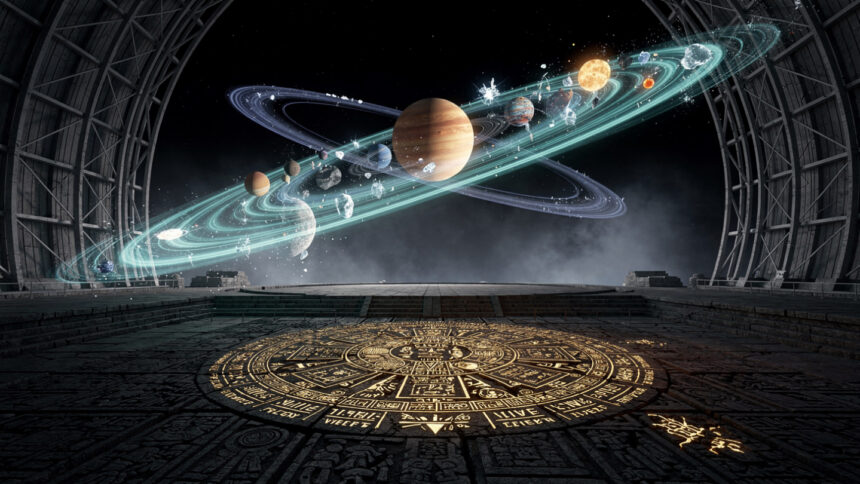
What the Sumerian tradition adds to this picture is a historical dimension: a four-thousand-year-old civilization that recorded its cosmology in cuneiform tablets described a celestial body with an orbital period, a relationship to the gods who created humanity, and a role in the catastrophic events of the distant past.
The Enuma Elish piece in this library develops the textual analysis of Nibiru in the Babylonian creation epic in detail. The element that the astronomical search history adds to that textual analysis is the convergence between what modern calculations propose and what the ancient texts describe.
The Sumerian sar, the unit of time equal to 3,600 Earth years, is the fundamental temporal unit of the antediluvian King List. The eight kings who ruled before the Flood reigned for numbers of sars. Alulim’s reign of 28,800 years is eight sars. The total antediluvian period of 241,200 years is sixty-seven sars.
The sar’s value of 3,600 years has been proposed as a planetary orbital period. If Nibiru is a real body whose orbital period around the Sun is 3,600 years, its distance from the Sun at the outer extent of its orbit would be calculable from Kepler’s third law: a body with a 3,600-year orbital period would have a semi-major axis of approximately 235 astronomical units.
The current Planet Nine calculations propose a semi-major axis of approximately 400 to 800 astronomical units, implying an orbital period of approximately 10,000 to 20,000 years. The Harrington calculation’s proposed body at approximately 100 astronomical units would have an orbital period of approximately 1,000 years.
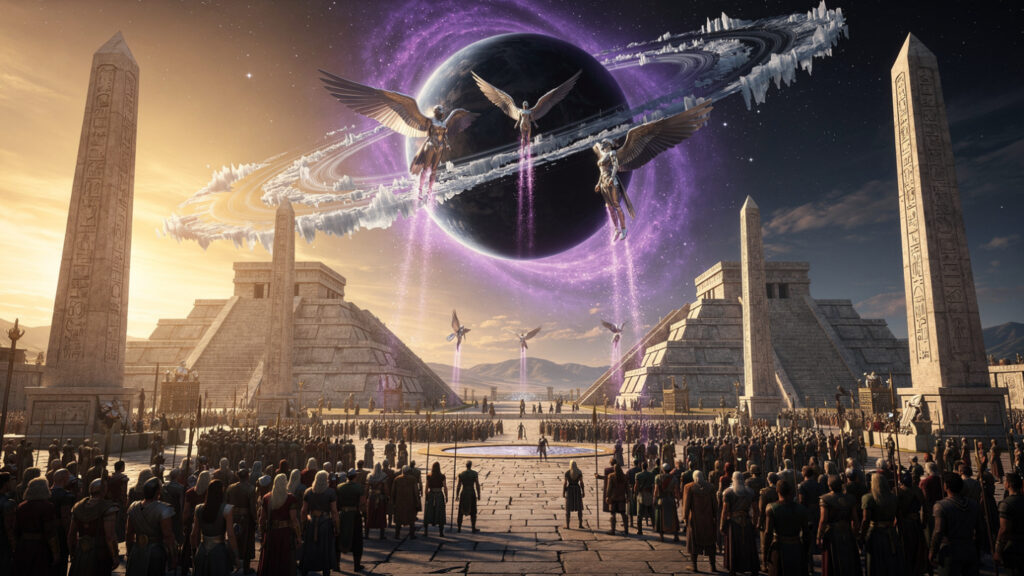
None of the current calculations produces a body with exactly the sar’s 3,600-year orbital period. Whether this discrepancy reflects an error in the Sumerian astronomical record, an incorrect identification of the sar as an orbital period, a different outer solar system body than the one the current calculations are tracking, or a calculation error in the modern astronomical models, is not established.
What is established is that the Sumerian tradition described a celestial body with a large orbital period, that multiple independent modern astronomical calculations have established the high probability of a large undiscovered body in the outer solar system, and that the two lines of evidence, ancient textual and modern astronomical, are pointing in the same general direction without aligning precisely on the same parameters.
The alignment is close enough to be interesting. The discrepancy is real enough to require explanation.
The Return Tradition and Its Astronomical Implication
The Anunnaki tradition’s claim that the gods departed and would return is not unique to Mesopotamian culture. It is documented across independent ancient traditions in ways that make cultural transmission as the sole explanation inadequate.
Quetzalcoatl departed eastward and promised return at a calendrical date in the Mesoamerican tradition. The Dogon tradition’s Nommo, the amphibious civilizational teachers covered in this library’s Oannes piece, are described as having returned to their home in the Sirius system and as being awaited. The Egyptian tradition’s Zep Tepi, the First Time, is described as a period that will return when the astronomical conditions of the original creation are replicated.
Whether these traditions describe the same class of beings as the Anunnaki, or independent civilizational teachers whose departure created similar cultural memories in independent populations, is a question the comparative religion literature cannot definitively answer.
This needs a clear caveat before going further: treating the Anunnaki specifically as a literal space-traveling civilization is Zecharia Sitchin’s interpretive framework, addressed with its sourcing problems in this library’s dedicated piece on the Tablet of Destinies, not a reading that professional Assyriologists accept. The genuinely interesting astronomical question, whether the sar and comparable ancient calendrical units happen to describe a real orbital period, doesn’t require accepting Sitchin’s civilizational narrative to be worth asking. It’s a numerical coincidence worth testing on its own, independent of who or what the Sumerians believed Nibiru to represent theologically.
If a real, undiscovered body does turn out to have an orbital period matching the sar, that would be a genuinely remarkable coincidence worth investigating on its own terms. It would not, by itself, establish anything about the civilizational claims layered onto the Sumerian sources by later reinterpretation.
The Sumerians used the sar. The Mesoamericans used the Long Count calendar. The Egyptians used the precessional cycle. All three traditions describe cosmic time scales significantly longer than ordinary human experience, encoded in numerical systems, associated with the coming and going of beings described as the creators or teachers of humanity.
Whether the sar, the Long Count, and the precessional cycle all describe the same underlying astronomical reality of a highly elliptical solar system body whose approach periods correspond to the recorded contact events, is the astronomical question that the planet search’s discovery of Planet Nine’s actual orbital parameters would be capable of addressing.
What Four Calculations and One Undiscovered Body Imply
The conventional history of science places the discovery of the outer solar system’s major bodies on a linear timeline: Uranus in 1781, Neptune in 1846, Pluto in 1930, the Kuiper Belt objects beginning in 1992. Each discovery extended the known solar system’s boundaries and revised the models of its formation and structure.
The four calculations pointing at an additional large undiscovered body in the outer solar system represent the next step in this sequence. The sequence’s previous steps were all completed successfully: every time the gravitational evidence indicated a missing mass term, the search found the body. Neptune was found within one degree of its predicted position. Pluto was found in the general region of Lowell’s prediction, though it proved too small to account for the perturbations that motivated the search.
Whether Planet Nine will be found in the region Batygin and Brown predict, in a different region suggested by updated calculations, or not at all because the apparent clustering reflects an observational bias in the Kuiper Belt survey data, is the current open question.
The search is ongoing. The Vera Rubin Observatory is the primary instrument. The search will produce a result within years rather than decades.
If Planet Nine is found, the astronomical question of its orbital period will be immediately calculable from its observed position and velocity. That calculation will be compared against the Sumerian sar, the Mesoamerican Long Count periods, and the other ancient calendrical systems that have been proposed as encodings of a large body’s orbital dynamics.
The comparison will either confirm or refute the astronomical claim embedded in the Sumerian tradition. Not the theological claim about the Anunnaki’s nature or their relationship to humanity. The numerical claim: that the sar of 3,600 years represents a real orbital period of a real body.
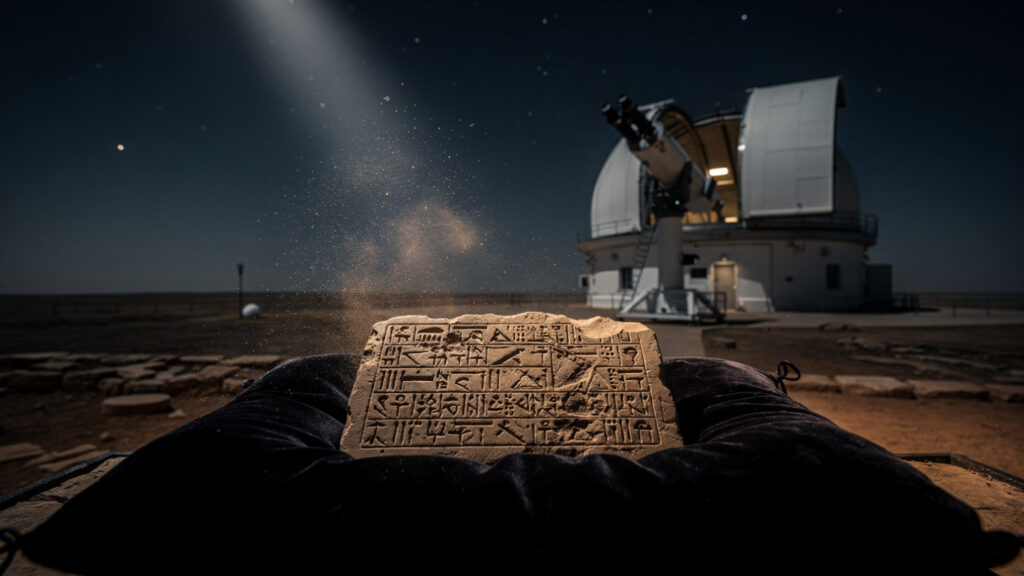
This is a falsifiable prediction whose test is imminent by astronomical time scales.
Harrington calculated it and died before he could look. Lykawka and Mukai calculated it and did not have the instrument to find it. Batygin and Brown calculated it and the instrument is now operational.
The Sumerians named it four thousand years ago. They said it had been here before. They said it would come back.
The Vera Rubin Observatory is taking the survey images now.
The result is not in yet.