
In the spring of 1901, a group of Greek sponge divers sheltering from a storm near the small island of Antikythera found something they had not been looking for. Diving the wreck of a Roman-era cargo ship, they surfaced with marble statues, bronze figures, glassware, and jewelry, the ordinary, extraordinary loot of a sunken ancient vessel. Among the crates hauled up and shipped to Athens was an unremarkable, corroded lump of bronze and wood, roughly the size of a large book, that nobody thought to examine closely for almost a year. When Greek archaeologist Valerios Stais finally looked at it in a museum workroom in 1902, he noticed something that should not have been there: a gear wheel, embedded in stone-hard corrosion, with triangular teeth cut into it with a precision that had no business existing in the ancient world.

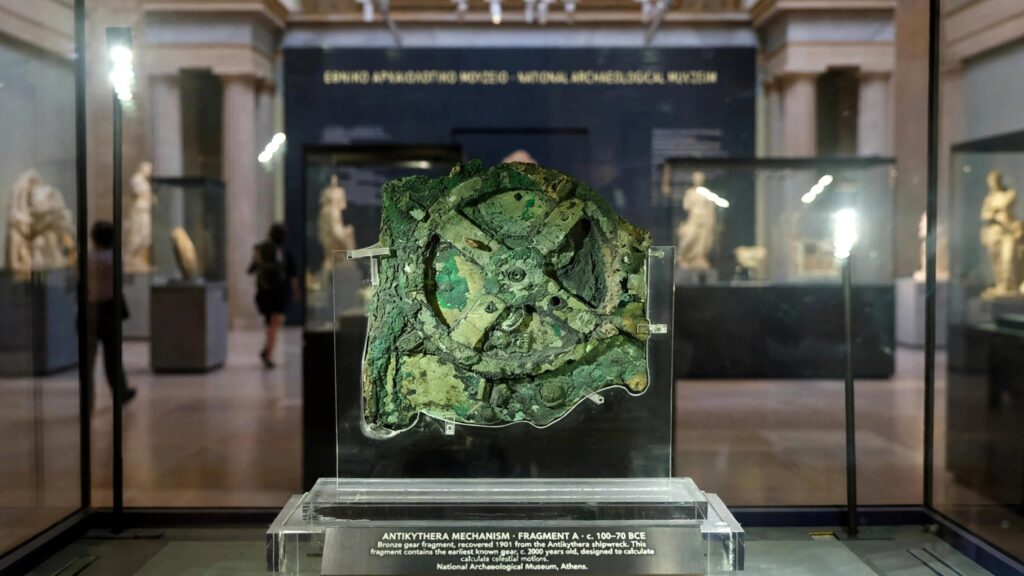
That lump of bronze is now known as the Antikythera Mechanism, and it would take more than a century, four generations of researchers, and technology the ancient world could not have imagined, X-ray computed tomography, surface imaging, particle physics, to even partially understand what it actually was. The device is real. It survives, in 82 corroded fragments, in a climate-controlled case at the National Archaeological Museum of Athens. Its full function, the complete mechanical logic of its front face, was not understood until 2021. And the more precisely researchers have come to understand it, the stranger a question it raises, not about the device itself, but about everything surrounding it that has vanished.
What the Fragments Actually Contain
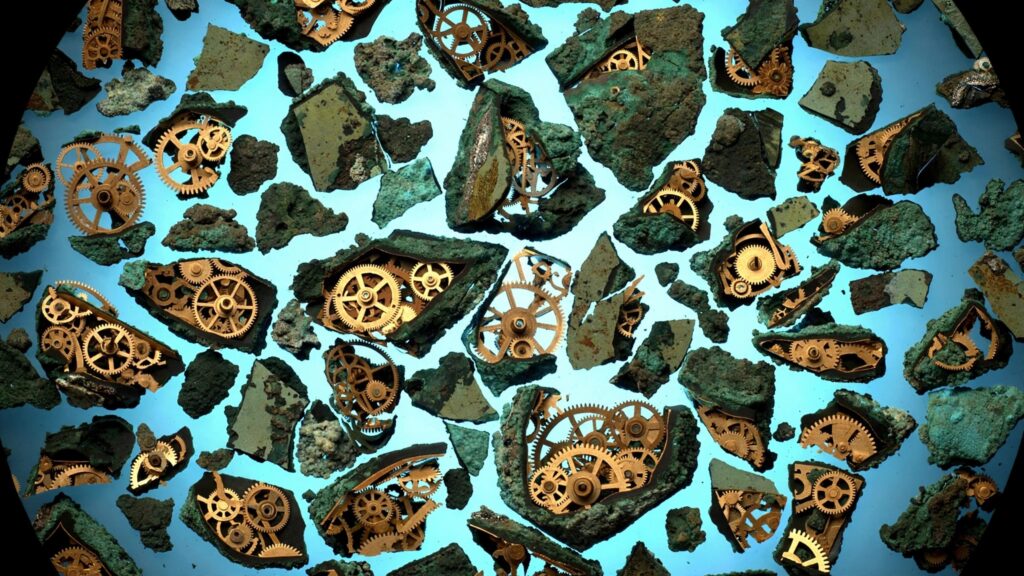
What survives of the Antikythera Mechanism is roughly a third of the original device, 82 fragments in total, of which only seven are large enough to contain significant gearing or inscriptions. Within them, researchers have identified 30 surviving bronze gears, ranging from the size of a coin down to a few millimeters across, some with teeth so fine they required a microscope to count accurately. The device was originally housed in a wooden case roughly the size of a large book or a small mantel clock, with dials on both the front and back faces, and it was operated by hand, using a small crank on the side.
The back of the device carries two spiral dials. One of these, the Metonic dial, tracks a real 19-year lunar-solar calendar cycle, allowing the user to reconcile the lunar calendar most Greek cities used with the solar year, correctly predicting when a leap month needed to be inserted to keep the calendar aligned with the seasons. The other, the Saros dial, is an eclipse predictor, tracking a real 223-month cycle known to Babylonian astronomers, and marked with small engraved glyphs indicating not just when a solar or lunar eclipse would occur, but at what hour of the day, and in some cases, what color the eclipsed moon would likely appear.
The front of the device is where the real mystery lived longest. Surface imaging in the early 2000s revealed a zodiac ring and an Egyptian calendar ring, along with faint traces of pointers, but the actual mechanism connecting them, the gear train responsible for actually calculating and displaying the positions of the sun, moon, and five planets known to antiquity, Mercury, Venus, Mars, Jupiter, and Saturn, was almost entirely missing from the surviving fragments. Researchers had the inscriptions describing what the front dial was supposed to show. They did not have enough physical gearing left to prove how it had done it.
The 2021 Breakthrough, Precisely Described
In March 2021, a team of researchers at University College London, working across mechanical engineering, civil and geomatic engineering, and archaeological science, published a paper in the journal Scientific Reports, part of the Nature Portfolio family of journals though distinct from the flagship Nature journal itself. The paper, led by Professor Tony Freeth of UCL’s Department of Mechanical Engineering, along with David Higgon, Aris Dacanalis, Lindsay MacDonald, Myrto Georgakopoulou, and Adam Wojcik, presented the first model of the front dial mechanism that satisfied every piece of physical evidence recovered from the fragments and matched every relevant word of the surviving inscriptions engraved on the device itself.
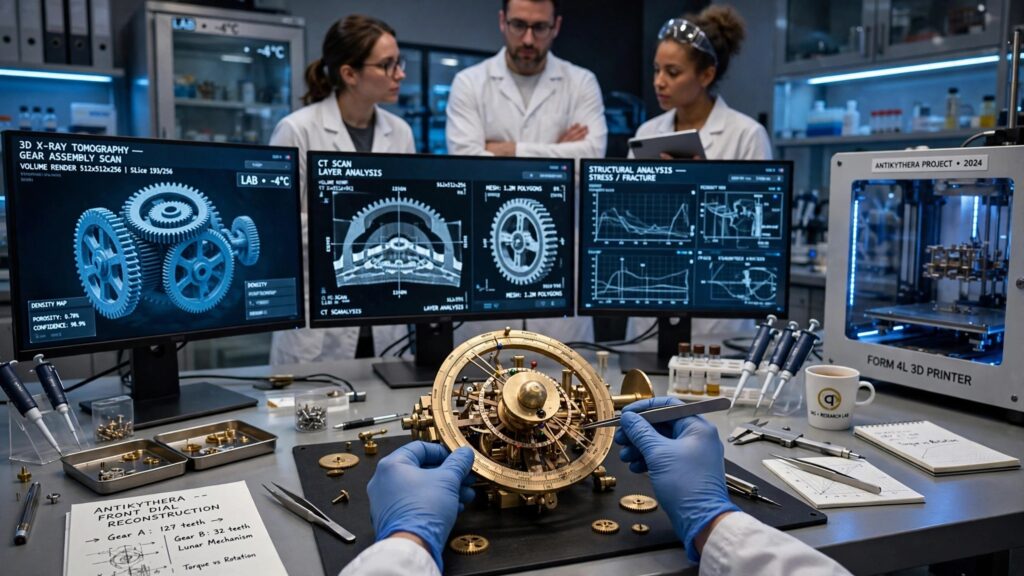
The breakthrough had been building for years. Microfocus X-ray computed tomography scans conducted in 2005 had already decoded much of the back of the mechanism, revealing the Metonic and Saros dials in detail. But that same scanning also revealed something researchers had not fully appreciated before: extensive inscriptions on the front cover and back cover of the device, packed with numbers describing the precise cycles of each visible planet relative to the sun. Two teams of epigraphers, working through 2016, painstakingly transcribed these inscriptions letter by letter from the X-ray data, and what they found was a set of extraordinarily specific planetary periods, numbers that did not match any previously known Greek astronomical text, but did align closely with older Babylonian observational astronomy.
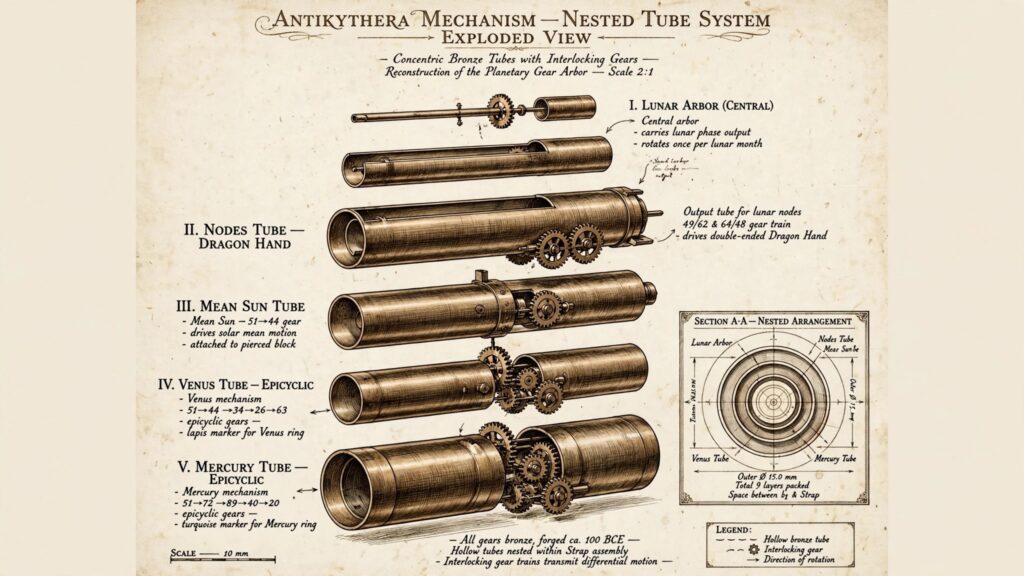
The UCL team’s real contribution was solving what Freeth has described as a complex three-dimensional puzzle, working out a gear train, hidden entirely within a mechanism a third of which no longer survives, that could take those Babylonian-derived numerical cycles and translate them into a working, physical display of an ancient Greek cosmos, the sun, moon, and five planets, moving across the front dial at their correct relative speeds using a nested system of concentric tubes and gears turning within gears.
As UCL co-author Adam Wojcik put it at the time of publication, the theoretical model was itself a major advance, but the team’s next challenge was to prove it was actually buildable using only the tools and techniques available in antiquity, a project the team pursued in the years that followed, physically constructing working models by hand to confirm the ancient design was not just mathematically elegant but mechanically real.
A Question of Dates, More Complicated Than It Looks
Ask when the Antikythera Mechanism was built, and the honest answer is that researchers are working with at least three overlapping dates, not one, and the gap between them is itself a clue.
The shipwreck that carried the device to the bottom of the Aegean has been dated, through the pottery, coins, and other datable cargo recovered alongside it, to roughly 60 BCE. That gives researchers a firm latest possible date, a terminus ante quem, for the mechanism’s construction. It had to exist by the time the ship went down.
Separately, paleographic analysis, the study of the actual letterforms used in the mechanism’s engraved inscriptions, along with the stylistic features of its gear-cutting, points to a construction window of roughly 150 to 100 BCE, a dating range that has stood for years as the working scholarly consensus.

Then there is a third, stranger date. A 2014 study published in the Archive for History of Exact Sciences, conducted by a science historian and a physicist working through the eclipse prediction calendar on the Saros dial, found that the mechanism’s astronomical calculations appear to begin counting from a real solar eclipse that occurred on May 12, 205 BCE. That does not necessarily mean the physical device itself was assembled in 205 BCE. It more likely means the underlying astronomical scheme the mechanism’s designer used, the mathematical starting point for the whole eclipse-prediction system, was rooted in an event nearly a century before the object itself was probably built. The device, in other words, may be a later physical instantiation of a mathematical astronomical tradition that was already old by the time this particular bronze machine was assembled.
That detail matters enormously for what comes next, because it points toward exactly the kind of deep, cumulative, and largely undocumented tradition the mechanism’s existence seems to demand.
The Real Question Isn’t the Device. It’s What It Implies.
Here is the actual puzzle the Antikythera Mechanism presents, and it is not the puzzle most popular retellings focus on. It is not really a mystery of who built it, or a case for lost ancient super-science, or a device out of time. It is a much more precise, and in some ways more unsettling, question: a machine of this computational sophistication does not appear out of nowhere. Cutting 30-plus bronze gears with the tooth-count precision this device requires, designing a nested gear train capable of correctly modeling five planets’ irregular apparent motion using an epicyclic system, and inscribing a user manual dense enough that modern epigraphers needed a decade to transcribe it, all of this implies not a single inspired craftsman working alone, but an established engineering tradition, with its own accumulated knowledge, its own trained specialists, its own prior attempts, failures, and refinements.
And that tradition has left almost no other physical trace at all.
This is not merely a modern inference drawn from the mechanism’s complexity. It is directly, explicitly confirmed by a real ancient source. The Roman statesman and philosopher Cicero, writing in the first century BCE, roughly contemporary with the Antikythera Mechanism’s likely construction window, describes not one but two separate bronze devices built to model the motions of the sun, moon, and five planets using internal gearing. The first, according to Cicero, was constructed by Archimedes of Syracuse, sometime before Syracuse fell to Rome in 212 BCE, a real historical event Archimedes himself died in during the city’s sack. Cicero describes this device as capable of reproducing the varying speeds of the sun, moon, and five planets through an internal mechanism, almost certainly toothed gearing, of the same general kind found in the Antikythera fragments.
Cicero describes a second device too, built later, by the Stoic philosopher Posidonius of Apamea, working in his own school on the island of Rhodes in the late second or early first century BCE, the same general place and period many researchers now believe the Antikythera Mechanism itself was built, based on an inscription referencing an athletic competition held in Rhodes. Separately, the fourth-century mathematician Pappus of Alexandria references a lost treatise attributed to Archimedes himself, titled On Sphere-Making, describing the construction of geared celestial models, further, independent literary confirmation that this kind of device was understood in antiquity as a distinct, describable, teachable body of mechanical knowledge.

None of these other devices survive. Not Archimedes’ planetarium. Not Posidonius’ orrery. Not whatever earlier prototypes must have existed to make either of them, or the Antikythera Mechanism itself, possible in the first place. What survives is one machine, corroded into 82 fragments, recovered by accident from the bottom of the sea, roughly a third complete.
Why Everything Else Is Gone
The honest answer to why no comparable device survives is not romantic, and it does not require inventing a lost civilization or an act of deliberate historical suppression. It requires understanding what bronze actually was in the ancient economy, and what tends to happen to complex machines once they stop working or fall out of fashion.
Bronze in the ancient Mediterranean was not simply a material. It was a stored, portable, endlessly reusable form of wealth, an alloy of tin and copper that had to be actively mined, traded, and smelted, and that could be melted down and recast into something new at essentially any point in its life, with minimal loss. Ancient bronze statues, tools, weapons, and mechanisms were, as a matter of ordinary economic practice, routinely melted down and repurposed once they were damaged, obsolete, or simply needed for their metal more urgently than for their original form. Archaeologists studying the ancient bronze economy broadly have long recognized this as a major reason so comparatively few ancient bronze artifacts survive at all, relative to ceramics or stone, regardless of how common or significant those bronze objects once were. A broken astronomical calculator, however marvelous, was still, to someone in later antiquity looking at scrap value, a lump of valuable metal.
The Antikythera Mechanism survived specifically and only because it escaped that fate by accident, sinking to the floor of the Aegean Sea inside a wrecked cargo ship, sealed away from the recycling economy that almost certainly consumed every comparable device built before or after it. It did not survive because it was uniquely valued or uniquely preserved. It survived because a ship sank, and the sea, unlike a foundry, does not melt bronze down for reuse.
This is the real, precise shape of the information gain problem the mechanism presents. It is not that ancient engineers possessed some singular, inexplicable burst of genius that vanished without explanation. It is that the ordinary, structural conditions of ancient material culture, the value of bronze as recyclable wealth, the total absence of any equivalent to a modern museum or archive dedicated to preserving obsolete technology, the simple fact that most objects from antiquity that were not stone, ceramic, or precious metal buried with the dead did not survive at all, meant that an entire tradition of precision mechanical engineering could exist, produce multiple sophisticated devices over at least a century, be directly referenced by name in surviving literary sources, and still leave behind exactly one physical example, recovered nearly two thousand years later purely by chance, from a shipwreck nobody was looking for it in.
The Astrolabe, and Why It Doesn’t Explain the Gap
It would be a mistake to leave the impression that the Antikythera Mechanism appeared in a world with no other precision astronomical instruments at all. It did not. The astrolabe, a handheld device used to tell time, track sunrise and sunset, and locate stars and planets in the sky, was almost certainly developed in the ancient Greek world around the same broad period, credited by later tradition to the astronomer Apollonius of Perga, working in the third century BCE, and possibly refined further by Hipparchus of Nicaea in the second century BCE. Real astrolabes, unlike the Antikythera Mechanism, did survive in meaningful numbers into later antiquity and the medieval period, particularly in the Islamic world, where astronomers preserved, refined, and manufactured them for centuries.
But the astrolabe’s survival actually sharpens the puzzle rather than resolving it. An astrolabe, for all its real elegance, is fundamentally a flat, engraved instrument, a kind of sophisticated star map combined with a sundial, with moving parts limited to a rotating disc or two. It requires no internal gearing at all. The Antikythera Mechanism is a categorically different kind of object: a genuine geared calculating machine, with a nested gear train doing real computational work, mechanically executing a mathematical model of planetary motion rather than simply displaying static astronomical positions the user has to calculate by hand. Nothing else from the ancient world does what it does. The astrolabe tells you it was plausible for the Hellenistic world to build precise scientific instruments and successfully pass that knowledge forward. It does not explain how a device with 30-plus internal gears, epicyclic planetary modeling, and an eclipse-prediction system accurate to the hour came to exist, or why, unlike the astrolabe, nothing comparable to it survived antiquity at all.
Hipparchus, Babylon, and the Math Underneath the Metal
Part of what makes the Antikythera Mechanism so revealing is not the bronze itself, but the mathematics encoded inside it, because that mathematics has its own real, traceable history, and it did not originate in Greece.
The 2021 UCL research confirmed that with the exception of the specific periods used for Venus and Saturn, essentially all of the planetary cycles encoded in the mechanism’s front cover inscription were already known to Babylonian astronomy, a tradition of careful, long-term naked-eye observation and arithmetic prediction that had been accumulating in Mesopotamia for centuries before the Antikythera Mechanism was built. What the Greek tradition contributed was not the raw astronomical data, but a different mathematical approach to modeling it: geometry. Where Babylonian astronomers predicted planetary positions through arithmetic progressions and observed periodicities, Greek astronomers, working in a tradition shaped by figures like Apollonius, Hipparchus, and eventually Ptolemy, began modeling the same celestial motions geometrically, using systems of circles moving on circles, epicycles riding on larger deferent circles, to explain why planets appeared to speed up, slow down, and even briefly reverse direction against the background stars.
Hipparchus of Nicaea, working on the island of Rhodes in the second century BCE, sits at almost exactly the intersection of everything the Antikythera Mechanism represents. He is real, and credentialed historians of astronomy widely credit him with being among the first Greek astronomers to systematically absorb and rework Babylonian observational data using Greek geometric methods, producing far more accurate lunar and solar models than Greek astronomy had achieved before him. He worked in the same city, during the same broad period, that many researchers now believe produced the Antikythera Mechanism itself, based on the device’s own inscriptions. Real historians of science have long speculated, carefully and without claiming certainty, that Hipparchus’ own astronomical work, or the work of students and successors trained in his tradition, may be the direct theoretical source underlying the mechanism’s design, though no surviving text explicitly names him as its designer. What the mechanism demonstrates, regardless of exactly whose hands built it, is that this fusion of Babylonian arithmetic and Greek geometry had, by this point, already been successfully translated out of pure theory and into working bronze.
The Long Road From Corroded Lump to Understood Machine
It is worth walking through exactly how long, and how technologically dependent, the process of actually understanding this device turned out to be, because the timeline itself says something real about how difficult a problem it presented.
For decades after its 1902 identification by Valerios Stais, the mechanism remained largely an object of speculation, its corroded fragments too dense and too fragile to examine in real detail using the tools available at the time. Real progress began in earnest in the 1970s, when British historian of science Derek de Solla Price, working with Greek nuclear physicist Charalampos Karakalos, used gamma-ray and early X-ray imaging to peer inside the corroded fragments for the first time, producing the first real, detailed gear counts and the first serious scholarly reconstruction attempts, published in Price’s influential 1974 study. Price’s work established, for the first time, that the device was almost certainly an astronomical calculator rather than a simple clock or navigational tool, and it set the research agenda for the next generation.

The real next leap came in 2005, when a research consortium including Cardiff University, the National Archaeological Museum of Athens, and Hewlett-Packard brought a purpose-built microfocus X-ray computed tomography system, along with advanced polynomial texture mapping for surface imaging, to examine the fragments with a level of precision far beyond what Price had access to three decades earlier. That 2005 imaging campaign is what finally allowed researchers to fully decode the back of the mechanism, resolving the Metonic and Saros dials in detail, and, critically, it is also what first revealed the dense, previously unreadable inscriptions on the front and back covers that would eventually prove essential to solving the front dial puzzle. It took another sixteen years, two separate teams of epigraphers transcribing thousands of ancient Greek characters letter by letter from that X-ray data, and a dedicated engineering research team applying real mechanical design principles to that transcribed text, before the 2021 UCL paper could finally present a complete, evidence-satisfying model of the front dial. From accidental discovery to full mechanical understanding: 120 years.
Building It Again, By Hand
Solving the theoretical puzzle of how the front dial worked was not, for the UCL team, the end of the project. A mathematically consistent model is not the same as a proof that ancient craftsmen, working without electricity, without modern metallurgy, and without computer-aided design, could actually have built the thing.

Following the 2021 paper, members of the UCL team pursued exactly that question directly, working to physically reconstruct the front dial gear system using materials and methods that would have been genuinely available in the ancient Mediterranean world, hand tools, bronze casting and filing, no modern precision machining. That practical reconstruction work directly tested the real feasibility of the nested tube system the mechanism’s back cover inscription describes, the concentric, hollow bronze tubes that would have had to rotate independently of one another at different speeds, carrying the sun, moon, and each of the five visible planets around the front dial without their mechanisms binding or interfering with each other. Successfully building a working version using only ancient methods stands as real, physical confirmation that the UCL team’s theoretical model was not just mathematically elegant on paper, but genuinely, mechanically achievable by ancient hands, closing the loop between inscription, theory, and object in a way that pure digital modeling alone never could have.
The Ship It Was Found On
The mechanism did not travel alone, and the company it kept on that ship is its own kind of evidence. The Antikythera wreck, discovered by the sponge divers in 1900 and excavated intermittently across more than a century since, including major modern underwater archaeological campaigns beginning in 2012, has yielded an extraordinary cargo: bronze and marble statues of exceptional quality, luxury glassware, gold jewelry, and fine furniture fittings, the unmistakable profile of a ship carrying high-value Greek art and craftsmanship, likely looted or purchased Greek treasure, toward Rome. That context matters. The Antikythera Mechanism was not cargo shipped as scrap metal or industrial equipment. It was found among the finest luxury goods of its era, suggesting it was itself regarded, by whoever packed that ship, as an object of comparable value and prestige, a scientific instrument sophisticated and precious enough to travel in the same hold as museum-quality statuary bound for the wealthiest buyers in the Roman world.
What Comes After the Fragments We Have
The 2021 paper did not end the research. It changed the shape of the questions researchers are now asking. With the front dial’s core mechanical logic finally established, the UCL team and other researchers working on the mechanism have shifted attention toward remaining unresolved details, including the precise design of a pin-and-slot mechanism believed to have modeled the moon’s real, variable orbital speed, a genuinely sophisticated piece of ancient engineering that itself accounts for lunar motion appearing to speed up and slow down across its monthly cycle, a real astronomical effect Hipparchus’s own theoretical work is credited with correctly describing.
Researchers are also continuing to study whether any additional inscriptions remain to be recovered from the existing 82 fragments using ever-improving imaging techniques, since even decades after the major 2005 scanning campaign, careful reexamination using refined methods has continued to yield new, previously unreadable text.
And a real, standing hope among researchers in this field, rarely stated as an expectation but never entirely abandoned, is that further underwater archaeological work at the wreck site itself, an area of seafloor that has still not been completely excavated, might someday recover additional fragments of the mechanism, or conceivably even evidence of other, similar devices that went down with the same ship. Major underwater campaigns at the wreck have continued intermittently since 2012, using modern diving and robotic survey technology unavailable to the original 1900 sponge divers, and each new campaign has continued to recover new material from the site.
A Fraction of a Fraction, and What That Actually Means
The Antikythera Mechanism is not evidence that ancient civilization possessed technology equivalent to the modern world, and no credentialed researcher studying it makes that claim. Nothing about the device implies electricity, powered machinery, or any capability beyond precisely cut hand-cranked bronze gearing applied to astronomical mathematics that Hellenistic Greek astronomers, drawing heavily on centuries of prior Babylonian observational data, had already worked out. What it demonstrates is something narrower and, in its own way, more interesting: that the theoretical astronomical knowledge of the Hellenistic world, the eclipse cycles, the planetary periods, the lunar-solar calendar reconciliation, had already been successfully translated into working mechanical form, by real engineers, using real toothed gearing, at a level of applied precision that the historical record, absent this one surviving object, would have given almost no indication of.
That has real, direct implications for how confidently historians can speak about the technological limits of any period defined mostly by what happens to survive rather than by what was actually built. The Antikythera Mechanism is not an anomaly that breaks the historical record. It is a reminder of how much of the actual historical record was never going to survive at all, and how easily an entire craft tradition, real, skilled, and referenced by name in texts we still have, can leave behind a physical footprint of exactly one object, recovered by accident, understood only in fragments, and fully decoded only in 2021, more than a century after it was first pulled out of the sea by divers who were looking for sponges, not for the most sophisticated surviving machine of the ancient world.
Somewhere in the workshops of Hellenistic Rhodes, or Syracuse, or wherever else this tradition was actually practiced, there were almost certainly other machines like this one. Apprentices who trained on earlier, cruder versions. Failed attempts, melted back down into raw bronze and recast into something else entirely. A body of practical, transmitted engineering knowledge that never made it into the surviving philosophical and mathematical texts historians rely on, because it lived in workshops, in hands, in metal, not in scrolls. All of it is gone now, except for the one object a storm, a shipwreck, and two thousand years of cold seawater happened to preserve. The Antikythera Mechanism is not a message from a lost civilization. It is what is left of a real one, the surviving fraction of a surviving fraction, and it is worth sitting with exactly how much that implies about everything from that world we will simply never get to see.