
Forty-two is not a secret code. It is something more interesting: a number with enough genuine appearances to make the human brain very good at turning coincidence into conspiracy. It appears in ancient Egyptian funerary texts, in the Book of Revelation, in the mathematics of six, in the geometry of the primary rainbow, and, most famously, as Douglas Adams’s deliberately arbitrary answer to the meaning of life, the universe and everything. Put those facts on the same page and a strange feeling arrives almost automatically. Surely they cannot all be unrelated. Surely somebody, somewhere, knew something. Surely the number is trying to tell us something.
That feeling has a name. Apophenia describes the tendency to perceive meaningful connections in unrelated or random information, while the more specific phenomenon known as frequency illusion makes a newly noticed word, object, or number suddenly seem to appear everywhere. The important distinction is that the appearances can be completely real while the connection between them is not. Forty-two really does occur in all of these places. What has not been demonstrated is the invisible line connecting them. And that distinction is where the story becomes much more interesting than numerology.
The First Trap | Once You Notice 42, You Start Hunting for 42
Imagine that you have never thought about the number 42 in any serious way. You encounter thousands of numbers every day: prices, dates, page numbers, addresses, percentages, temperatures, scores, timestamps, measurements and random strings of digits. Almost all of them disappear from consciousness immediately. Then somebody tells you that 42 is important. The next morning you see 42 on a receipt. Later it appears in a video timestamp. That evening you notice a product containing 42 units. By the end of the week, the number seems to be stalking you. The extraordinary part is not that you found several examples. The extraordinary part is how invisible the other numbers suddenly became.
Psychologists have studied this kind of pattern perception for decades. Apophenia is not itself a diagnosis or proof that somebody is irrational, pattern detection is a normal feature of human cognition, and research has measured meaningful-pattern perception even in non-clinical populations. The same machinery that allows a person to detect a genuine pattern can also generate a false one when unrelated events happen to line up. In other words, the brain does not first ask whether a connection is true and then notice it. Very often, it notices the possible connection first and only afterward has to decide whether the connection deserves to survive.

Forty-Two Really Is Ancient
The fact that 42 is psychologically easy to overinterpret does not mean every appearance is meaningless. One of the oldest and most substantial examples comes from ancient Egypt. Spell 125 of the Book of the Dead describes the deceased standing before forty-two assessors in the Hall of Two Truths and declaring innocence of a series of offenses. The individual declarations correspond to the assessors, and surviving manuscripts preserve variations in names, ordering and formulation, so the tradition should not be treated as though one perfectly uniform list existed across every period and papyrus. But the central fact is solid: forty-two has a genuine and important place in Egyptian funerary religion.
That is already enough to make the number historically interesting without importing anything supernatural into it. The Egyptians were not secretly predicting Douglas Adams, and there is no evidence that a modern literary joke was somehow encoded in a New Kingdom funerary tradition. They were using a number inside their own religious and ethical system. The mistake comes when two independent uses are placed beside each other and the human mind quietly upgrades similarity into relationship.
Then Revelation Uses It Again
The number appears again, thousands of years later, in a completely different literary environment. Revelation 13:5 gives the beast authority for forty-two months. The figure belongs to the symbolic numerical language of Jewish and early Christian apocalyptic writing, where periods of persecution, judgment and divine intervention are frequently expressed through highly charged numerical periods. It is therefore a genuine biblical occurrence of 42, but it is not evidence that Revelation was participating in a secret numerical tradition shared with ancient Egypt.
This is an important rule for numerical mysteries: the fact that two traditions use the same number does not tell us whether they inherited the number from one another. To establish historical transmission, we would need evidence of transmission: texts, dates, borrowing, linguistic links, cultural contact, or some other demonstrable mechanism. Without that, identical numbers are simply identical numbers. Human cultures have generated enormous quantities of numerical symbolism over thousands of years. Some overlaps are inevitable.
And Then Douglas Adams Made It Famous
Modern culture supplied the most famous 42 of all. In Douglas Adams’s The Hitchhiker’s Guide to the Galaxy, the supercomputer Deep Thought eventually announces that the answer to the ultimate question of life, the universe and everything is 42. The joke works because the answer is simultaneously precise and useless. The characters have spent enormous effort seeking the answer without actually knowing the question, and the universe hands them a perfectly ordinary integer.
Adams later gave the explanation that destroys most attempts to turn the number into a hidden cipher. He said he chose it as an ordinary, smallish number because it was a joke. The elaborate mathematical, binary and mystical explanations attached to it afterward were, in his words, nonsense. The joke was never that 42 contained a secret cosmic message. The joke was that human beings desperately wanted a profound answer and were delighted to receive a number.
The Mathematics Looks Impressive Because Mathematics Is Flexible
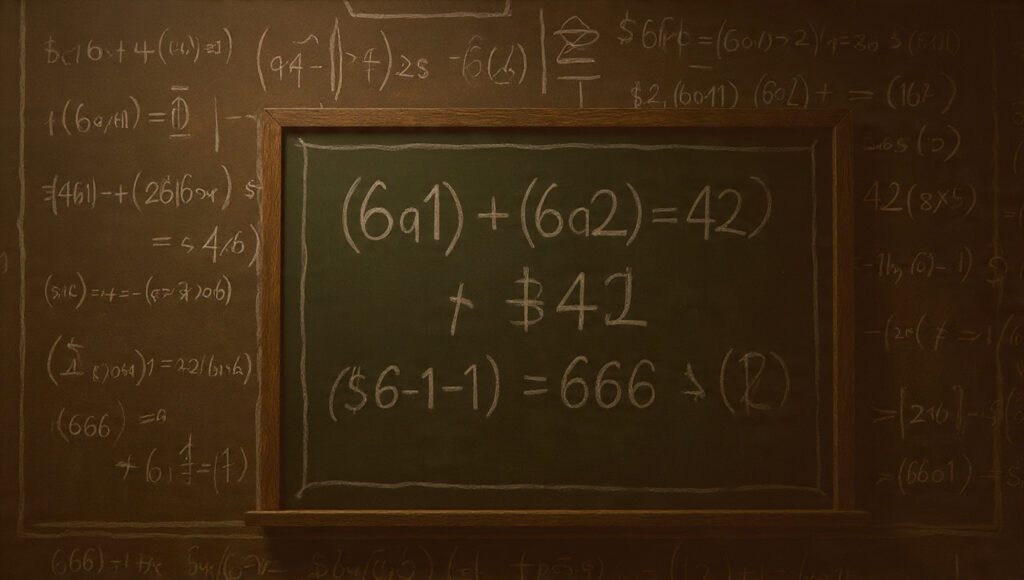
There is another reason 42 is so easy to mythologize: mathematics can make almost any sufficiently interesting number look suspiciously special. Six plus thirty-six equals 42, or, written in the more theatrical form often circulated online, 61 + 62 = 42. The arithmetic is completely correct. What does not follow is that the equation reveals something about the universe.
Given enough numbers and enough permitted operations, there are countless ways to manufacture relationships after the fact, the same kind of retroactive pattern-hunting that turns unrelated coincidences into an illusion of design. You can use powers, roots, sums, products, factorials, digit manipulations, bases and other mathematical transformations until a desired relationship appears. Once the relationship has been found, it can look astonishingly deliberate because the search process that produced it has disappeared from view. That is one of the central problems with numerology: it usually shows you the successful coincidence while hiding the enormous number of possible combinations that produced nothing interesting.
The Rainbow Really Is About 42 Degrees
And here the number acquires another genuinely beautiful association. The primary rainbow has an angular radius of approximately 42 degrees. That is real optics, not numerology. Sunlight enters water droplets, is refracted, reflected inside the droplet and refracted again as it exits. The geometry and refractive properties of water produce the characteristic angular position of the primary bow. The rainbow is not secretly aware of the number. The number is simply what the physics produces.
This is almost a perfect demonstration of the difference between pattern and meaning. The 42-degree geometry is not arbitrary. It follows from physical laws that can be measured, calculated and reproduced. If every human being vanished tomorrow, the rainbow would still form at approximately the same angular radius. The number does not become significant because we noticed it. We noticed it because the world happened to contain it.

The Missing Professor Problem
Then there is the supposed authority behind some versions of the 42 story: a “Doctor of Divinity William Frederick” who is presented as having recognized the number’s hidden importance. No independently traceable scholarly source has been established for this person or for the alleged research attributed to him. That matters because a mysterious expert cannot function as evidence merely because the title sounds impressive. A real scholarly claim should leave a trail: a publication, institution, archive, lecture, book, manuscript, interview, or at minimum a source that can be independently located.
This is one of the easiest tricks in the mythology of numbers. Give an unsupported observation a professor. Give the professor a prestigious-sounding discipline. Then repeat the claim often enough that the name itself begins to feel like a citation. But a citation is not a decoration. It is a route back to evidence. When the route ends at a name nobody can independently locate, the authority has disappeared and only the costume remains.
Why 42 Appearing on Packaging Doesn’t Prove Anything
Packaging provides an especially fertile environment for numerical coincidence because commercial products are full of numbers to begin with. Manufacturers have to work with container dimensions, shipping cartons, pallet geometry, pricing, standardized units, inventory systems and historical packaging conventions. A package containing 42 items can therefore have an entirely mundane logistical explanation without requiring a hidden numerical program.
The important point is not that every appearance of 42 on a package has been individually explained. It is that the evidentiary burden runs in the opposite direction from the conspiracy claim. If somebody argues that 42-unit packaging is a deliberate signal, the relevant question is not “Can you find more examples?” It is “Can you demonstrate that 42 was selected for the alleged reason, and that the same decision-making process connects otherwise unrelated manufacturers?” Without that evidence, counting examples only amplifies the illusion.
A Number Cannot Make Food Dangerous
Some versions of numerical conspiracy stories go further and imply that a particular unit count, label or numerical pattern reveals something about the safety or composition of a food product. That leap has no evidentiary basis. A number printed on a package does not establish what is inside it, and the presence of 42 units cannot substitute for laboratory analysis, ingredient declarations, manufacturing records or regulatory inspection.
That distinction becomes especially important when numerical folklore drifts into health claims. Pattern recognition can be entertaining. It becomes irresponsible when a coincidence is promoted into evidence about contamination, disease, treatment or deliberate poisoning. At that point the question is no longer whether the pattern is fascinating. It is whether the claim has evidence capable of surviving independent testing.
The Psychology Behind the Feeling That 42 Is Following You
The most useful concept here is the frequency illusion. Once something enters your attention, you become more likely to notice it. Arnold Zwicky popularized the term in 2005, building on the experience commonly described as the Baader-Meinhof phenomenon, itself named after a 1994 letter reader Terry Mullen sent to the St. Paul Pioneer Press describing exactly this feeling after hearing the name of a German militant group twice in quick succession. The effect does not require the world to change. Your sampling of the world changes. You remember the moments when 42 appears because 42 has become relevant, while the hundreds or thousands of moments in which 17, 31, 58 or 93 appeared leave almost no psychological trace.
Apophenia goes one step deeper. It concerns the perception of meaningful relationships among events or stimuli that are objectively unrelated. Research has experimentally examined this tendency and found that meaningful-pattern perception exists across the general population, while stronger tendencies toward perceiving connections in random material can be associated with particular cognitive and personality characteristics. None of this means that every person who notices coincidences is irrational. It means that the machinery required to discover genuine structure is also capable of generating structure that is not actually there.
The Number Is Real. The Conspiracy Is the Extra Step.
There is something almost poetic about 42 accumulating so many unrelated lives. Ancient Egyptians used it in a funerary judgment tradition. Revelation used forty-two months within an apocalyptic vision. Douglas Adams turned it into one of the most famous jokes in modern science fiction. Optics places the primary rainbow at roughly 42 degrees. Mathematics can generate elegant identities involving it. Modern commerce can produce packages containing it. None of those facts needs to be erased to reject the conclusion that they form one hidden system.
In fact, the coincidences become less interesting when we force them into a conspiracy. Their real fascination is that a single human mind can place them beside one another and instantly experience coherence. Ancient religion, modern fiction, physics, mathematics and logistics suddenly feel like chapters of one book. But the book may exist only because we bound the pages together.
Now Watch What Happens to You
After reading this article, you are probably going to notice 42 more often. That is not a prediction of hidden forces. It is the experiment.
You may see it on a receipt, in a timestamp, on a page, in a product listing, in a sports score or somewhere on a screen. When you do, something remarkable will happen: the number will feel different from the numbers around it. It will seem to announce itself. It may even feel as though the world has quietly started repeating a message.
But the world probably did not change. Your attention did.
That is the deeper lesson of 42. The number is real. The Egyptian text is real. The biblical passage is real. Adams really did choose the number as a joke, and the rainbow really does form at approximately that angular radius. The extraordinary part is what the human mind does next: it takes separate truths, draws invisible lines between them, and experiences the resulting shape as though it had been waiting there all along.
Sometimes those lines reveal a genuine pattern. Sometimes they reveal a useful idea. And sometimes they reveal nothing except the person holding the pencil.