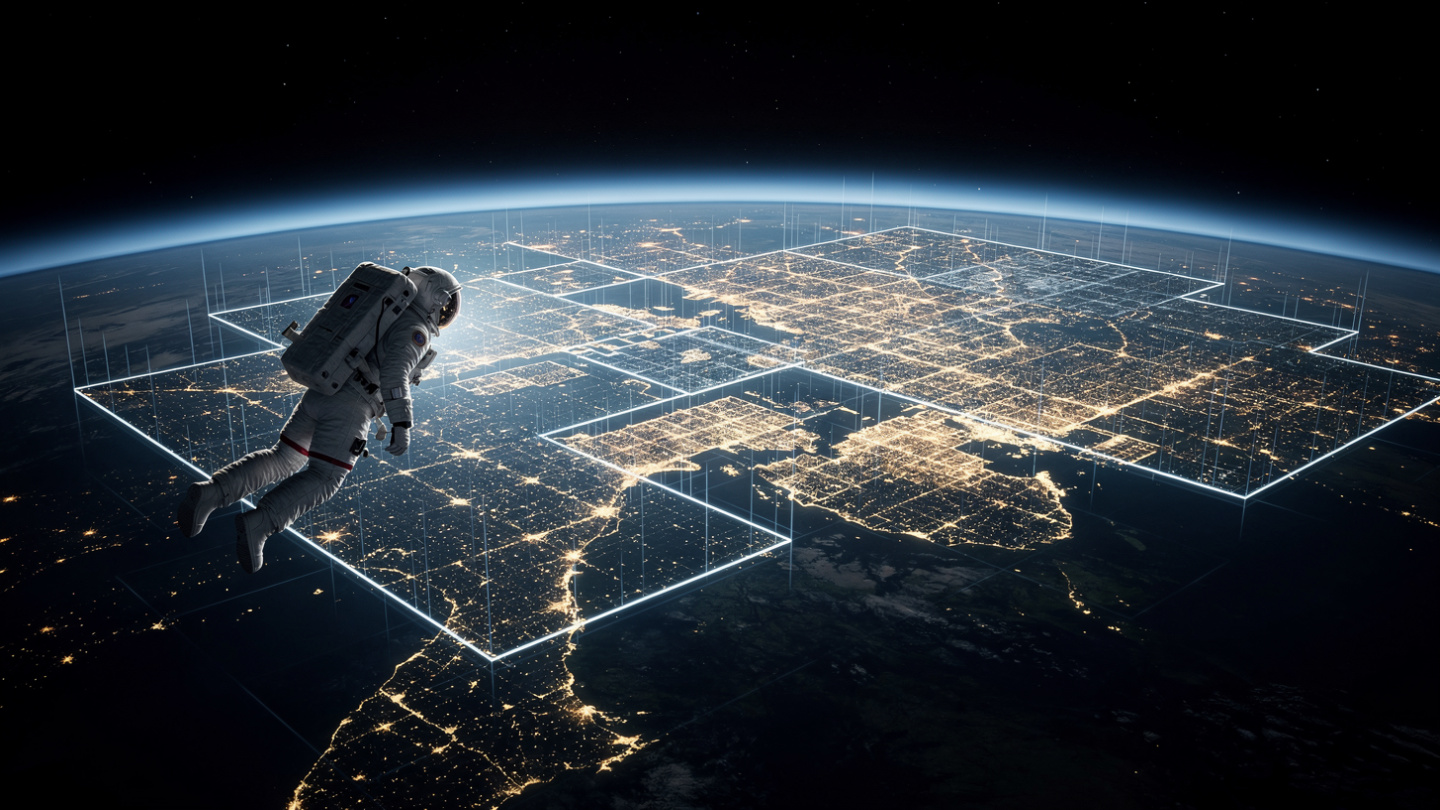
When Ron Garan looked down at Earth from the International Space Station, he expected to see the planet. What he did not expect was how much of human civilization would seem to disappear. There were no borders, no stock markets, no national economies, no political divisions visible from the cupola. There was only a thin, luminous biosphere suspended against an almost incomprehensibly dark background. “I didn’t see the economy,” Garan later said.
The experience became part of a phenomenon now known as the Overview Effect, a documented psychological response reported by astronauts and studied by researchers interested in awe, self-transcendence, and changes in how people perceive humanity’s place within the larger planetary system.
What Garan Saw From Orbit
Ron Garan launched aboard Soyuz TMA-21 on April 4, 2011, beginning what NASA records as a 164-day mission during Expeditions 27 and 28, with 2,624 orbits of Earth. Retrospective accounts in which Garan described his broader spaceflight experience have sometimes given different totals, including approximately 178 days and nearly 3,000 orbits. The discrepancy is minor and appears to reflect differences in how the periods of his spaceflight career are being counted, but it is worth leaving visible rather than manufacturing a false precision. What matters for the experience itself is beyond dispute: Garan spent an extended period living in orbit, repeatedly observing Earth as a single physical object rather than as the collection of nations and institutions familiar from its surface.
Garan had already flown in space once before the 2011 mission. His first flight, aboard space shuttle Discovery in 2008, delivered the Japanese Kibo laboratory module to the International Space Station. He was therefore not encountering spaceflight for the first time when the experience he later described became central to his thinking. From the cupola, he saw something much harder to perceive from the ground: the entire human environment compressed into a thin atmospheric layer surrounding one small world.
His description has become one of the most frequently repeated accounts of the Overview Effect. “I saw an iridescent biosphere teeming with life,” Garan wrote. “I didn’t see the economy.” He went on to argue that the contrast was disturbing: humanity’s institutions organize life through economic, political, and national categories, while the physical planet itself presents no such divisions. From orbit, the atmosphere appears as a fragile boundary around a single interconnected system.

Garan eventually expressed the conclusion in unusually direct terms. If the systems that sustain human life are treated as components of an economy rather than as prerequisites for the economy itself, then the priorities may be backwards. His proposed reversal was simple: instead of organizing thinking as “economy, society, planet,” he argued for “planet, society, economy.” That is an argument about civilization and policy, not a scientific conclusion demonstrated by looking through an ISS window. The distinction matters. The observation is one thing. The philosophy Garan built from it is another.
The Overview Effect Was Named Before Garan Experienced It
The experience Garan described did not begin with him. Frank White coined the term Overview Effect in his 1987 book The Overview Effect: Space Exploration and Human Evolution, drawing on interviews with astronauts and cosmonauts who had described profound changes in perspective after seeing Earth from space. Long before the term existed, astronauts were already reporting reactions that sounded remarkably similar: the disappearance of visible national borders, an intensified awareness of planetary unity, and an unusual combination of awe and vulnerability.
That makes the phenomenon more interesting than a single astronaut’s inspirational anecdote. Across decades of human spaceflight, people exposed to the same extraordinary visual experience have sometimes described overlapping psychological responses. Researchers have subsequently examined those responses in connection with awe, self-transcendent emotions, connectedness, and changes in how individuals understand themselves in relation to humanity and the natural world. The scientific literature is still developing, and it does not establish that every astronaut experiences the same transformation, but there is a genuine research subject here: what happens to human perception when the planet that normally functions as an invisible background suddenly becomes an object in the field of view?
Garan gave his own version of the phenomenon a further name: the Orbital Perspective. In his 2015 book of the same name, he argued that the experience should not remain a temporary emotional high that disappears when an astronaut returns to Earth. The challenge, as he framed it, was to preserve the planetary perspective after returning to a world where borders, institutions, markets, and competing interests once again dominate ordinary perception.
The Strange Power of Seeing a Whole Planet
There is something almost paradoxical about the experience. Spaceflight dramatically increases the physical distance between the observer and Earth while simultaneously making Earth appear more intimate. From the surface, the planet is effectively too large to perceive as a whole. Continents disappear beyond horizons. Oceans become abstractions. Atmospheric systems are experienced as weather. Borders are represented by maps rather than visible geography. From orbit, those distinctions collapse into a single object.
The psychological significance of that change in scale is precisely what makes the Overview Effect worth studying. It does not require a supernatural explanation, nor does it establish that astronauts acquire privileged knowledge about economics or politics. The striking feature is simpler: a dramatic change in physical perspective can alter the psychological frame through which the observer interprets familiar human problems.

Garan’s “I didn’t see the economy” line captures that transformation unusually well. The economy is everywhere when viewed from inside human civilization. It determines prices, employment, investment, production, and political debate. Yet none of those structures is physically visible from orbit. What is visible is the biosphere on which every one of them ultimately depends.
Vernadsky Had Already Imagined a Planetary Layer of Mind
More than half a century before Garan entered orbit, the Russian and Soviet biogeochemist Vladimir Vernadsky was developing a radically different way of thinking about the relationship between life, Earth, and human activity. Vernadsky’s concept of the Noosphere described a proposed planetary sphere shaped increasingly by human thought, knowledge, technology, and collective activity. The idea emerged in the 1920s and 1930s alongside intellectual work associated with Pierre Teilhard de Chardin and Édouard Le Roy, building on the older distinction between the geosphere and biosphere.
Vernadsky was not describing the Overview Effect, and Garan’s experience does not experimentally validate the Noosphere. The connection is conceptual rather than evidentiary. Both perspectives become interested in the same unusual scale of perception: humanity ceases to look like a collection of isolated individuals and begins to look like a planetary process. Vernadsky approached that problem through biogeochemistry and Earth-system thinking. Garan encountered it through a window in orbit.

That distinction actually makes the comparison more valuable. Vernadsky did not need astronauts to establish that human activity had become a planetary force, while Garan did not need Vernadsky to recognize the emotional shock of seeing Earth without the artificial divisions that normally organize human consciousness. Separated by decades and working in entirely different intellectual environments, both arrived at a question that becomes difficult to avoid once the planet is viewed at sufficient scale: what does humanity look like when it is considered as part of one planetary system?
The Experience Became a Philosophy
Garan did not leave NASA in 2013 and simply abandon the experience as an interesting memory from space. He continued building organizations and projects around the idea that the planetary perspective should influence how people approach problems on Earth, including the Fragile Oasis initiative, the Manna Energy Foundation, and Impact CoLab. His public work subsequently treated the Overview Effect not as an isolated psychological curiosity but as a possible starting point for rethinking cooperation, sustainability, and the relationship between human institutions and the environment that supports them.

That is where the subject becomes more complicated. The Overview Effect can provide evidence about an experience: astronauts can undergo powerful shifts in perspective after seeing Earth from space. It cannot, by itself, determine which economic system humanity should adopt, how governments should regulate resources, or what balance should exist between economic growth and ecological protection. Those are normative questions. Garan’s conclusions may be persuasive, but they remain conclusions.
Where the Evidence Ends
The most interesting version of the Overview Effect does not require turning it into something it is not. There is no need to claim that astronauts acquire mystical knowledge, that orbital photographs reveal a hidden planetary consciousness, or that a few minutes looking through the cupola can settle centuries of political and economic argument. The documented phenomenon is already remarkable enough.
What the evidence supports is that viewing Earth from space can produce a profound change in perspective for some astronauts, a response serious researchers have begun to study through the psychology of awe, self-transcendence, connectedness, and planetary identity. Garan’s testimony gives that experience a particularly memorable expression: an astronaut looking at the entire living planet and realizing that some of the structures that dominate human life are completely invisible from the outside.

And perhaps that is the enduring power of the image. The Overview Effect does not prove that humanity is one mind, that the Earth possesses a consciousness of its own, or that any particular political philosophy is correct. It reveals something more modest and perhaps more consequential: perspective is not neutral. Change the physical scale from which a human being sees the world, and the categories that once seemed permanent can suddenly look temporary, artificial, and surprisingly small.