Nine knights. Nine years. A gap in the record most popular accounts either ignore or fill with treasure. The history of the Knights Templar’s founding decade, 1119 to 1129, is one of the strangest stories in medieval Europe, and it doesn’t need an invented excavation to earn that description. What actually happened is a story about poverty, patience, a monk who nearly wrecked his own reputation vouching for men nobody trusted, and one of the most consequential pieces of paper the Catholic Church ever issued.
This piece tells that story accurately, addresses the popular “Temple Mount excavation” legend directly and fairly, and explains what historians and archaeology actually say happened underneath Jerusalem’s most contested hill.
Nine Knights and a City That Didn’t Want Them
In 1119, a French knight named Hugues de Payens, alongside a small circle of companions traditionally numbered at nine, approached King Baldwin II of Jerusalem with an unusual proposal. The roads to the holy city were dangerous. Pilgrims arriving by the thousands after the First Crusade’s success two decades earlier were being robbed, kidnapped, and killed on the routes between the coast and the shrines they’d crossed a continent to reach. Hugues and his companions wanted to form a permanent order of warrior-monks, men who would take religious vows like any monastery’s brothers, but who would carry swords instead of illuminated manuscripts, and whose cloister would be the open road.
This is well established history, recorded in the chronicle of William of Tyre, the Latin Kingdom’s most important contemporary historian, writing several decades later but drawing on institutional memory and earlier sources still available to him. Baldwin II said yes. He gave the fledgling order quarters in his own palace, a building constructed on the southern end of the Temple Mount platform, on the site of, and incorporating parts of, the Al-Aqsa Mosque. Because medieval Christians believed this site had once housed the Temple of Solomon, the order took its name from the location: the Poor Fellow-Soldiers of Christ and of the Temple of Solomon. Knights Templar, for short.
And then, for a decade, almost nothing happened. That’s not a gap in the historical record. That’s the historical record.
What “Nothing Happened” Actually Looked Like
It’s worth being precise about what the sources actually describe during these nine years, because “nothing happened” undersells a difficult, unglamorous, and revealing period. The order had no formal Rule, no papal recognition, no reliable income, and, according to several medieval accounts, so little money in its early years that its seal depicted two knights riding a single horse, a deliberately chosen symbol of the order’s founding poverty that the Templars kept using even after they became staggeringly wealthy, apparently as a point of institutional pride.
Membership grew at a glacial pace. Historians studying the order’s earliest surviving records count perhaps thirty members by the end of the first decade, a genuinely tiny fraction of the thousands the order would eventually command. Without formal Church sanction, the Templars existed in an uncomfortable legal and spiritual limbo: not quite monks, not quite ordinary knights, answerable to no clearly defined authority, dependent entirely on Baldwin II’s personal goodwill and whatever charity individual pilgrims and local nobility chose to offer. Medieval sources describe the order surviving during this period largely on alms and donated equipment, hardly the picture of an institution flush with newly unearthed treasure.
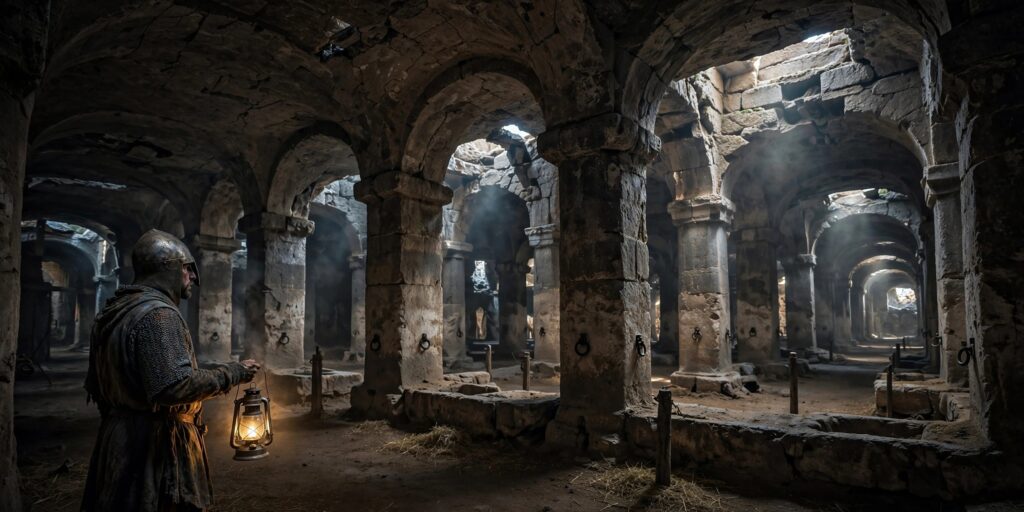
What the order did have, during these quiet years, was a headquarters with an extraordinary amount of underground space. The Temple Mount’s southern end sits atop an extensive warren of vaulted substructures, massive underground halls now commonly called Solomon’s Stables, dating from Herod’s first-century expansion of the platform, not from Solomon’s actual, much earlier and much smaller original Temple. These vaults were physically enormous, capable of stabling hundreds of horses, and the Templars, a mounted order, appear to have used at least part of this space for exactly that purpose, mundane military logistics rather than any recorded exploration project.
The Legend, Told Fairly
This is the point where the popular version of this story usually takes a sharp turn, and it deserves to be presented honestly rather than dismissed with a wave. The theory holds that during these nine quiet years, the Templars weren’t simply stabling horses in Herodian vaults. They were digging. Beneath the Temple Mount, the theory proposes, lay something the Templars had come specifically to find, whether through prior knowledge passed down through obscure channels, through connection to the Copper Scroll, a Dead Sea Scroll discovered in 1952 that does actually describe, in cryptic terms, locations of buried Temple treasure, or through some other unspecified source of insider knowledge. Having found it, in this version, the Templars used their discovery, whether literal treasure, sacred relics, or suppressed religious documents, as leverage: financial capital, blackmail material against the Church, or both, explaining how nine impoverished knights became, within a generation, the wealthiest and most powerful institution in Christendom.
This theory has cultural staying power, and it’s worth understanding why. It was popularized most influentially by the 1996 book The Hiram Key, by Christopher Knight and Robert Lomas, and echoed in various forms by earlier works including 1982’s Holy Blood, Holy Grail. Both books connect the Templars to Freemasonry’s own founding mythology, and both have sold substantially and shaped decades of popular imagination about the order. Neither book’s authors are trained medieval historians or professional archaeologists, and neither book’s central claims about a Temple Mount excavation and treasure discovery have been accepted by the actual academic field that studies the Templars, medieval military orders, and Crusader-era Jerusalem.
What the Real Excavations Actually Found
Here is where the story gets considerably more interesting, because archaeology did eventually go underneath the Temple Mount, and the record of what happened is worth knowing in detail rather than either dismissed or exaggerated.
In 1867, the British Royal Engineers officer Charles Warren, working for the newly established Palestine Exploration Fund, arrived in Jerusalem to conduct the first systematic modern archaeological survey of the city. Ottoman authorities strictly forbade excavation within the sacred platform itself, so Warren’s team worked from the outside in, sinking narrow vertical shafts, some reinforced only by improvised wooden framing, down along the Temple Mount’s massive retaining walls, and tunneling laterally wherever they safely could. It was dangerous, claustrophobic work. Local laborers, Warren recorded, sometimes refused to enter the shafts at all, fearing collapse. Warren himself was laid up for days at a time with fever.
Over three years, Warren’s team mapped an astonishing underground world: more than thirty cisterns cut into the bedrock beneath the platform, ancient water channels, the shaft that today bears Warren’s own name, and, running beneath the southeastern section of the Mount, tunnels and passages, some Herodian, some clearly medieval, added or modified centuries after the original construction. This was rigorous, professionally conducted, foundational work in the history of biblical archaeology, and it remains cited by scholars today, published in Warren’s own 1876 account Underground Jerusalem and in the Palestine Exploration Fund’s official 1884 survey volumes.
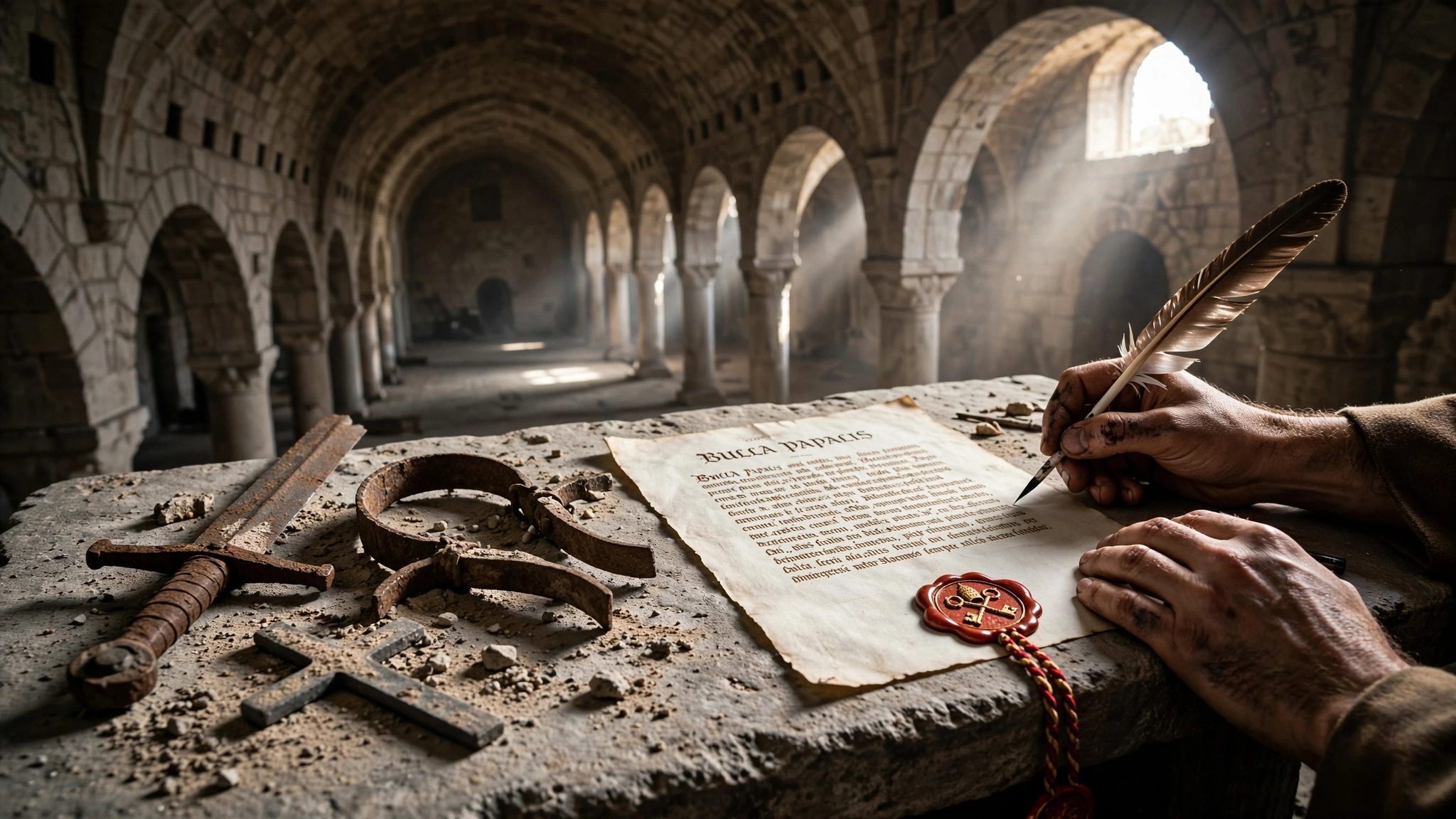
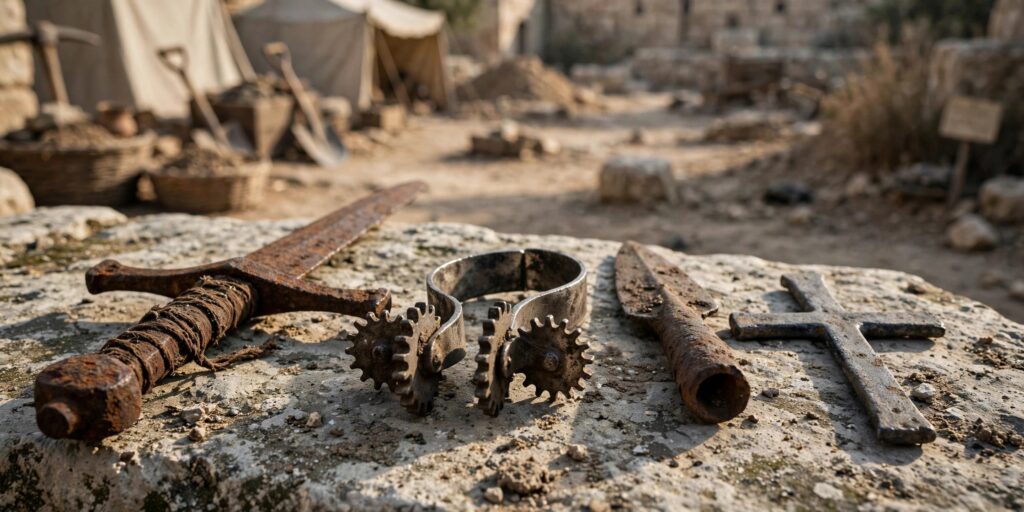
And in the course of that work, Warren’s colleague on the same expedition, Charles Wilson, a fellow Royal Engineers officer, recovered a small group of physical objects from within one of the tunnels beneath the Mount: a sword hilt, a pair of spurs, a spear tip, and a leaden cross. These artifacts have been described by later historians, including medieval historian Gordon Napier, as being “of possible Templar origin,” items consistent in style with the equipment of a 12th-century mounted knight.
This is a striking find, and it deserves to be reported as exactly what it is, no more and no less. It is not treasure. It is not a scroll, a relic, or a document. It is a sword hilt, a pair of spurs, a spear tip, and a cross, the kind of ordinary personal equipment a knight might lose, discard, or leave behind while stabling horses in an underground vault for a decade. “Of possible Templar origin” is itself a careful, provisional phrase, historians attaching uncertainty to an attribution based on stylistic resemblance rather than confirmed written proof. No inscription identifies these objects as Templar property. No accompanying find, chest, cache, or hoard, accompanies them. They are consistent with the Templars having spent time in that space, which nobody disputes, not with the Templars having found something there.
Why Professional Historians Don’t Accept the Treasure Theory
It’s worth being direct about the actual evidentiary gap between the popular legend and the established academic record, because the gap is total rather than partial. No medieval chronicle, no Crusader-era document, no papal correspondence, no entry in the Templar Rule itself, and no artifact beyond the four items described above has ever surfaced connecting the order’s founding decade to any excavation, discovery, or recovered treasure. The Copper Scroll, real and fascinating in its own right, was found in 1952 in a cave near Qumran, roughly a day’s journey from Jerusalem, sealed inside a cave that shows no evidence of medieval disturbance, let alone a recorded visit by 12th-century French knights. No credible chain of transmission connects that scroll’s contents to Hugues de Payens and his companions in 1119, a full 850 years after the scroll itself was likely hidden.
This absence of evidence matters because the treasure theory isn’t simply unconfirmed, it’s actively unnecessary. Trained historians studying the Templars’ financial rise have a considerably better established explanation available, one built on paper trails, papal bulls, and land deeds rather than speculation about buried scrolls. And that explanation is, if anything, a more interesting story than the invented one.
Bernard of Clairvaux Bets His Reputation
The turning point in the Templars’ fortunes has a name, a date, and a specific, recorded human decision behind it: Bernard of Clairvaux, the most influential churchman in Western Christendom, choosing to publicly and repeatedly stake his own considerable reputation on an obscure, unproven order of soldier-monks nobody outside the Holy Land had ever heard of.
Bernard had a personal connection to the order. His own uncle, André de Montbard, was reportedly among Hugues de Payens’s original companions, and Bernard, already by the 1120s one of the most sought-after religious voices in Europe, founder of the reforming Cistercian monastic movement, advisor to popes and kings, took up the Templars’ cause directly. He lobbied for the order’s formal recognition. He personally helped draft what would become the Templar Rule. And when recognition finally came, at the Council of Troyes in January 1129, convened specifically to resolve the order’s uncertain status, Bernard’s influence in the room was, by every contemporary account, decisive.
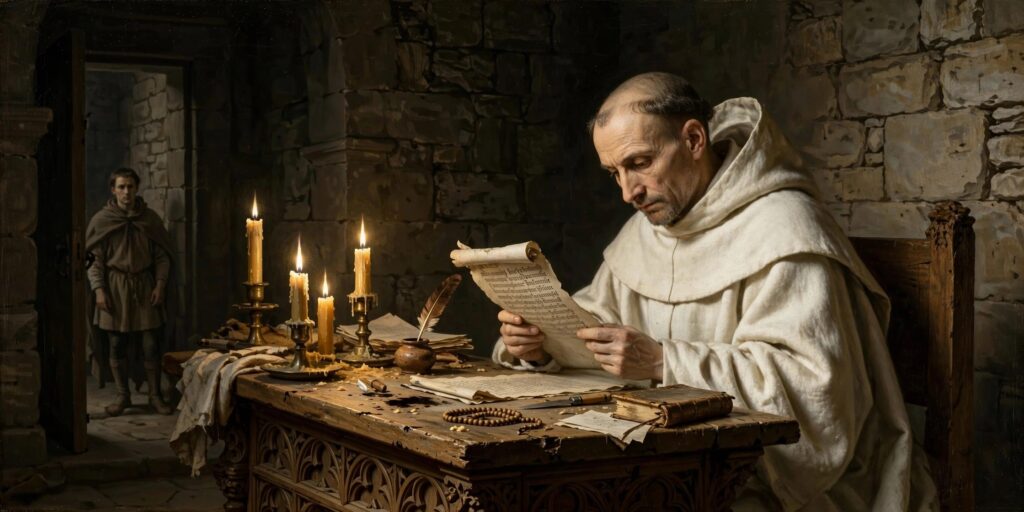
The council granted the Templars an official Latin Rule, seventy-two clauses long, governing everything from prayer schedules to permitted clothing to battlefield conduct. It was a formal, ecclesiastical stamp of legitimacy, the thing the order had lacked for nine years. And Bernard didn’t stop there. Around 1130, he wrote and circulated De Laude Novae Militiae, “In Praise of the New Knighthood,” a widely read treatise explicitly marketing the Templars to European nobility as something without real precedent: a “new kind of knighthood,” fusing the discipline of the cloister with the sword, fighting what Bernard called a double war, against flesh-and-blood enemies and against the spiritual forces of evil simultaneously. To an European aristocracy raised on both crusading fervor and inherited guilt over lives spent in ordinary, sinful warfare, this was an extraordinarily compelling pitch, a way to be a warrior and a saint at once.
The Paper Trail That Actually Explains the Wealth
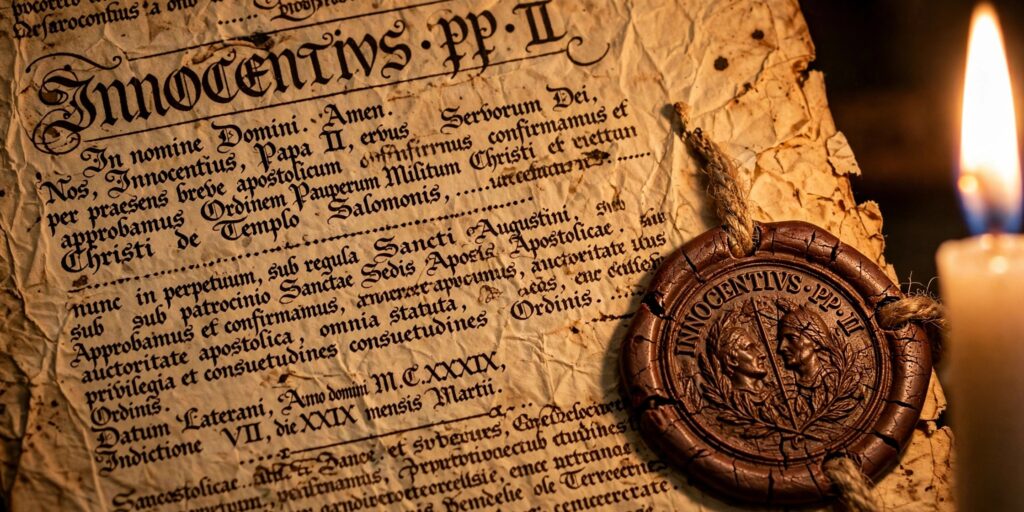
Council recognition in 1129 was real and significant. But the text that actually transformed the Templars’ finances arrived a decade later, on March 29, 1139, when Pope Innocent II issued the papal bull Omne Datum Optimum, “Every Perfect Gift,” addressed directly to the order’s Grand Master.
This surviving document rewards close reading, because its actual clauses explain the Templars’ rise far more directly than any invented excavation could. The bull placed the order and all its possessions under direct papal protection, meaning no local bishop, count, or king could interfere with Templar property or activities without answering to Rome itself. It exempted the Templars from paying tithes, an extraordinary privilege at the time, previously granted to only one other order, Bernard’s own Cistercians. It permitted the Templars to keep all spoils captured in battle against non-Christian forces, without the customary obligation to share such spoils with local rulers or the Church hierarchy. And it authorized the order to build its own churches and maintain its own priests, freeing it entirely from dependence on local clergy.
Two further bulls followed within six years, Pope Celestine II’s Milites Templi in 1144 and Pope Eugene III’s Militia Dei in 1145, each adding further privileges, including the right to collect an annual tax on Templar-affiliated churches and properties. Together, these three papal bulls did something no buried treasure could have accomplished on its own: they made the Templars legally, financially, and spiritually independent of every secular authority in Europe except the Pope. Historians studying medieval land records have traced the consequence directly. Freed from local jurisdiction and taxation, and marketed across Europe through Bernard’s writing and the Templars’ own growing crusading reputation, the order began attracting an extraordinary wave of recorded land donations, from French petty nobility who couldn’t aspire to a count’s title but held castles and vassals, from the crowned rulers of Aragon and Portugal facing their own ongoing wars against Muslim territory nearby, and eventually from donors as far afield as England, Germany, and Dalmatia.
By the close of the thirteenth century, property records indicate the order controlled somewhere in the range of 870 castles, commanderies, and subsidiary houses spread across Latin Christendom, an almost unimaginable expansion from nine knights and a borrowed corner of a king’s palace, achieved not through a single dramatic discovery but through a deliberate, decades-long institutional strategy: secure legal independence first, then let established privilege and effective marketing do the rest.
The Banking System Nobody Needed a Treasure to Build
The final piece of the explanation is, if anything, the most genuinely remarkable, and it required no hidden gold at all: the Templars built one of medieval Europe’s first functioning international financial networks, essentially by accident of their own operational needs.
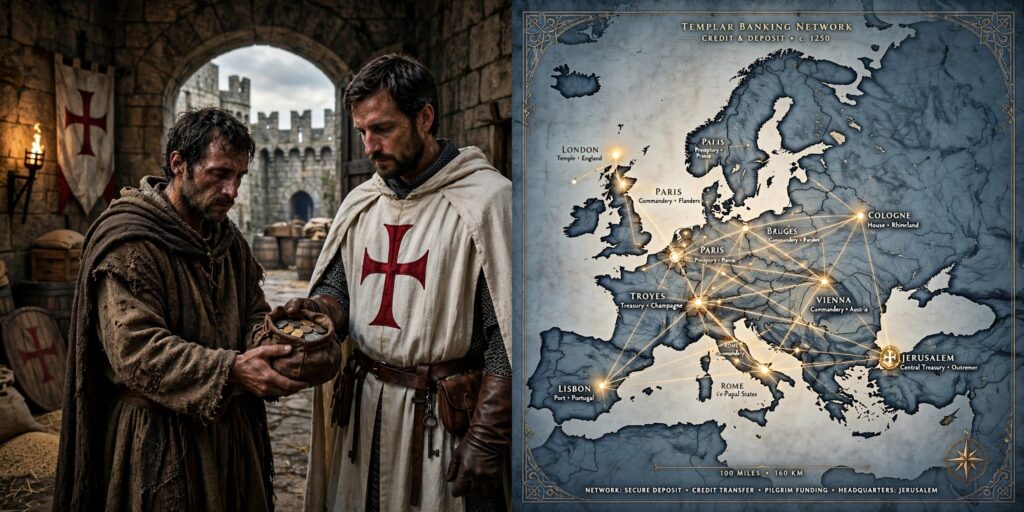
A pilgrim traveling from, say, England to Jerusalem faced a serious problem: carrying enough coin for a months-long journey made you an obvious target for robbery at every stage of the route. The Templars, with fortified houses strung across Europe and the Levant precisely because of their expanding land holdings, began offering a genuine solution. A pilgrim could deposit funds at a Templar house in London, receive a sealed letter of credit recording the deposit, and present that letter at a Templar house in Jerusalem to withdraw the equivalent sum, minus a transaction fee that functioned, in effect, as interest income for the order, carefully structured to avoid the Church’s own prohibitions on usury.
This system, well documented in surviving Templar financial records, was well ahead of its time, a functioning precursor to modern international banking instruments, centuries before formal European banking houses would develop comparable systems. The order didn’t need buried treasure to fund this network. The network itself, combined with its enormous, tax-exempt landed wealth, generated ongoing revenue on its own, revenue substantial enough that by the thirteenth century, kings, including France’s own Philip IV, borrowed directly from Templar coffers to fund their governments, a financial dependency that historians studying Philip’s eventual, brutal suppression of the order in 1307 consider one of several plausible motives behind his actions, a king erasing his own creditor.
Why the Real Story Is the Better One
It’s worth closing with what the actual, established record offers that the treasure legend can’t. The story has named characters making high-stakes decisions with consequences historians can trace: Bernard of Clairvaux choosing to spend his considerable moral authority on an unproven order of soldiers, a choice that could easily have failed and damaged his own standing. A Roman pope drafting extraordinarily specific legal language that anticipated, and prevented, exactly the kinds of local interference that had strangled other religious ventures. Nine knights turning a real problem, pilgrims dying on dangerous roads, into an institution that would eventually loan money to kings.
None of this required a hidden excavation, and treating the richly sourced explanation as somehow less satisfying than an unverified one gets the actual story backward. The nine-year gap between 1119 and 1129 wasn’t a cover for secret digging. It was nine years of an impoverished, uncertain order slowly building the reputation and relationships that would let a single piece of paper, a papal bull four sentences into its opening line quoting the Epistle of James, “Every good gift and every perfect gift is from above,” transform them permanently. The Temple Mount vaults the Templars stabled their horses in are still there today, still called Solomon’s Stables by visitors, still genuinely impressive feats of Herodian engineering. What was found beneath them, as far as the actual historical and archaeological record shows, was a sword hilt, a pair of spurs, a spear tip, and a cross. What was found in Rome and in Troyes, in the form of ink on parchment, changed the course of medieval European history far more thoroughly than any legend has managed to improve upon.