Roberto Calvi was found hanging beneath Blackfriars Bridge in London on June 18, 1982. His pockets contained five pounds of stones and the equivalent of approximately fifteen thousand dollars in various currencies. He had been the chairman of Banco Ambrosiano, Italy’s largest private bank, which had just collapsed in the largest bank failure in Italian history to that date, leaving a hole of approximately one and a quarter billion dollars that investigators traced to a series of shell companies in Luxembourg, Panama, and the Bahamas.
The beneficial owner of many of those shell companies was the Vatican Bank.
The official name of the Vatican Bank is the Instituto per le Opere di Religione, the Institute for Religious Works. It was established in 1942 under Pope Pius XII. It operates outside Italian jurisdiction on the grounds that the Vatican is a sovereign state. Its accounts are secret. Its transactions are not subject to Italian financial regulation. Its beneficial ownership of financial instruments is protected by the same sovereign immunity that protects the Vatican’s diplomatic communications.
Calvi was known as God’s Banker because of his close relationship with Archbishop Paul Marcinkus, the American-born head of the Vatican Bank from 1971 to 1989. Marcinkus was the individual through whom the Banco Ambrosiano-Vatican Bank relationship operated. When Italian prosecutors issued arrest warrants for Marcinkus following the Banco Ambrosiano collapse, the Vatican refused to surrender him. The Vatican’s position, upheld by the Italian courts after a prolonged legal battle, was that Marcinkus enjoyed sovereign immunity as a head of a Vatican department.
Marcinkus was never tried for his role in the Banco Ambrosiano collapse. He retired to Arizona in 1990 and died in 2006.
Calvi’s death was originally ruled a suicide. It was subsequently reclassified as murder after a British inquest in 2003. Italian prosecutors charged five individuals with his murder in 2005. All five were acquitted in 2007. The murder of Roberto Calvi has not been prosecuted successfully. The Vatican’s role in the financial transactions that preceded his death has not been adjudicated in any court.
These are not conspiracy theories. They appear in the Italian parliamentary record, in the Bank of Italy’s official investigations, and in the public accounts of the court proceedings.
The P2 Lodge
The Propaganda Due lodge, known as P2, was a Masonic lodge operating under the jurisdiction of the Grande Oriente d’Italia, the principal Masonic body in Italy, whose membership list was discovered by Italian police in 1981 at the home of Licio Gelli, the lodge’s Venerable Master.
The membership list contained approximately nine hundred and sixty names, including the heads of the three Italian intelligence services, military commanders, industrialists, politicians, and journalists. The discovery of the list produced a parliamentary crisis in Italy, the resignation of the government, and a formal parliamentary investigation that produced a report identifying P2 as a state within the state operating to subvert Italian democracy.
Licio Gelli’s connection to the Vatican Bank appears in the parliamentary investigation. Gelli had relationships with Vatican Bank officials and with Roberto Calvi, who was himself a P2 member. The financial transactions involving P2-connected entities and the Vatican Bank appear in the Banco Ambrosiano investigation.
The P2 connection to the Vatican is not a Vatican-is-secretly-Masonic conspiracy claim. It is the recorded overlap between a Masonic lodge that was conducting illegal intelligence and financial operations and the Vatican Bank that was processing financial transactions connected to those operations.
The Italian parliament investigated this. The investigation produced published findings. The findings are in the public record.
The Ratlines
Operation Paperclip, the American program that brought Nazi scientists to the United States following World War II, appears in the declassified record. The parallel escape networks that helped Nazi war criminals reach South America and other destinations through Austria, Switzerland, and Italy appear in declassified American intelligence records and in the academic historical literature.
Aarons and Loftus’s Unholy Trinity, published in 1991 and based on declassified American, German, and Australian intelligence documents, describes the involvement of Vatican officials in facilitating the escape of Nazi war criminals through what became known as the Ratlines. The individuals named include Bishop Alois Hudal, a rector of a German national church in Rome, who used his position and connections to provide identity documents, travel papers, and passage to Nazi criminals including Franz Stangl, the commandant of Treblinka, and Eduard Roschmann, the Butcher of Riga.
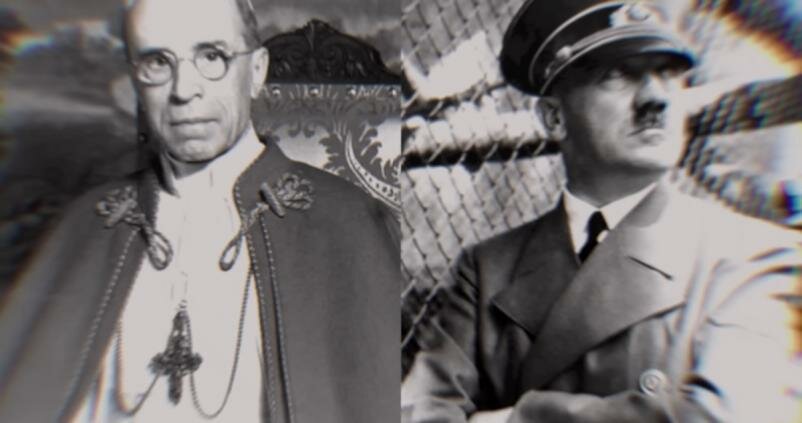
The historical consensus on the Ratlines does not attribute the Vatican’s involvement to a deliberate policy of protecting Nazism for ideological reasons. The better supported explanation involves a combination of anti-Communism, which made some Vatican officials willing to protect former Nazis as potential assets against Soviet expansion, the network of individual clerics acting independently of official Vatican policy, and the institutional failure to monitor what individual clerics with access to Vatican resources were doing.
Whether the institutional failure was genuine or whether it reflects deliberate policy at higher levels is a question that the declassified record leaves unresolved. The involvement of Vatican officials in escape operations is well established.
The LUCIFER Telescope
The Large Binocular Telescope Near-infrared Utility with Camera and Integral Field Unit for Extragalactic Research, LUCIFER, is a near-infrared instrument mounted on the Large Binocular Telescope at the Mount Graham International Observatory in Arizona, which is jointly operated by several institutions including the Vatican Observatory.
The Vatican Observatory is a legitimate astronomical research institution with a history extending to the nineteenth century. Its researchers publish peer-reviewed astronomical papers. The LUCIFER instrument’s name was chosen before the Vatican joined the observatory’s operating consortium, and it is an acronym rather than a theological statement.
The Vatican Observatory’s director, Guy Consolmagno, has given multiple public interviews addressing the LUCIFER naming and the broader question of the Catholic Church’s relationship to astronomy. His public statements reflect a genuinely sophisticated position on the relationship between science and theology that is more interesting than either the conspiracy interpretation or the dismissive conventional response.
What is genuinely interesting about the Vatican Observatory’s intellectual position is the question it has raised publicly about the theological implications of extraterrestrial intelligence. Vatican Observatory researchers and consultants have published academic papers and given public statements exploring how the Catholic Church’s theological framework would accommodate the discovery of intelligent life elsewhere in the universe.
Pope Francis’s 2014 statement that he would baptize extraterrestrials if they came to the Vatican is a matter of public record. It is consistent with a broader Vatican intellectual tradition that has engaged with the extraterrestrial intelligence question more seriously than its public image suggests.
The connection between the Vatican’s own preparatory theological work on extraterrestrial intelligence and the UAP disclosure timeline covered in this library’s OES and congressional hearing pieces is the element that deserves serious treatment rather than the Satanic conspiracy framing.
The Concordat and the Historical Record
The Vatican’s relationship with the Nazi and Fascist regimes during the Second World War appears in the historical record in ways that are more complex and more disturbing than the conspiracy framing captures.
The Reichskonkordat, signed between the Vatican and Nazi Germany in July 1933, was a treaty establishing the legal status of the Catholic Church in Germany in exchange for the Church’s agreement to withdraw from political activity. The treaty was signed by Cardinal Eugenio Pacelli, later Pope Pius XII, who had been the Vatican’s Secretary of State.
Whether the treaty represented a pragmatic attempt to protect Catholic institutions in Germany, as the Vatican’s defenders argue, or a legitimization of the Nazi regime at a critical moment in its consolidation of power, as its critics argue, is a historical debate whose resolution requires engaging with the recorded sequence of events rather than with a predetermined framework.

Pius XII’s silence during the Holocaust is the most extensively recorded and most extensively debated question in twentieth-century Vatican history. The debate between historians including Rolf Hochhuth, whose 1963 play The Deputy accused Pius XII of complicity through silence, and historians including Margherita Marchione, who argued that Pius XII took actions to protect Jews, has produced a substantial literature that the Vatican’s partial opening of the Pius XII archives in 2020 continues to inform.
Whether Pius XII’s silence reflected moral cowardice, pragmatic calculation about what public protest would accomplish, or information management that protected Jews through quiet channels rather than public condemnation, the historical evidence does not support a simple verdict in either direction.
What the historical record does support is that the Vatican, as an institution operating within the political constraints of wartime Europe, made decisions whose consequences included both protection of some individuals and failure to prevent the murder of millions. The institution’s claim to moral authority exists in tension with this historical record in ways that serious historical engagement acknowledges without resolving through either the conspiracy or the apologetic framework.
The Financial Architecture
The Vatican Bank’s current status, following decades of scandal and partial reform, appears in the institutional record.
Pope Francis established the Secretariat for the Economy in 2014 and appointed Australian Cardinal George Pell as its head with a mandate to bring financial transparency to Vatican accounts. Pell’s reform program was resisted by entrenched financial interests within the Vatican administration, a resistance that appears in the accounts of his tenure and in the subsequent trials of Vatican officials for financial crimes.
In 2019, the Vatican’s own financial watchdog raided the Vatican’s Secretariat of State and confiscated documents and computer hardware as part of an investigation into a 200-million-euro real estate investment in London that involved fees and commissions whose beneficiaries were not fully disclosed. The raid of a Vatican ministry by Vatican investigators is itself a remarkable institutional event that received less international coverage than its significance warranted.
The subsequent trial of Vatican officials, including Cardinal Angelo Becciu, produced in 2023 the first criminal conviction of a cardinal in Vatican history, with Becciu convicted of embezzlement and sentenced to five and a half years. The trial exposed financial transactions involving Vatican funds that were used for purposes unconnected to the Church’s charitable mission.
The recorded financial history of the Vatican Bank, from its establishment in 1942 through the Banco Ambrosiano scandal, the P2 lodge connections, the Ratlines funding questions, and the current reform-and-resistance dynamic, describes an institution whose financial operations have consistently prioritized opacity over accountability and whose transactions have repeatedly connected to organized crime, intelligence operations, and political corruption.
This is not the Vatican as the servant of Satan. It is the Vatican as an institution with extraordinary accumulated wealth, extraordinary institutional opacity, and a well established history of deploying both in ways that are inconsistent with its stated spiritual mission.
The distinction matters for the site’s credibility. The established institutional behavior is disturbing enough. Attributing it to Satanic conspiracy rather than to the well understood dynamics of institutional power, financial opacity, and the historical choices made by individuals, replaces a traceable and well established history with an untraceable and unfalsifiable one.

The Banco Ambrosiano investigation is in the Italian parliamentary record. The Ratlines record is in the declassified American intelligence archive. The P2 membership list is in the public record. The Vatican trial records are in the Italian judicial system.
The historical record is available. The conspiracy framing makes it less accessible rather than more by replacing documented events with an unfalsifiable framework that cannot be proven or disproven.