




There is a strange thing that happens when an old mystery becomes fashionable again. The original sources become less interesting than the versions built on top of them. Names change. Hierarchies acquire new terminology. Ancient theology gets translated into the language of computers, dimensions, energy systems and extraterrestrial civilizations. Before long, the modern vocabulary can sound more authoritative than the tradition it claims to decode.
But the actual Christian angelic hierarchy is already strange enough.
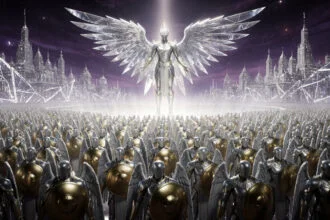
In the fifth or sixth century, an anonymous Christian theologian writing under the name Dionysius the Areopagite produced On the Celestial Hierarchy, one of the most influential works ever written about the architecture of the invisible world. He organized the celestial beings into nine orders arranged across three hierarchies. The names are not speculative. They are not modern reconstructions. They are Seraphim, Cherubim, Thrones. Dominions, Virtues, Powers. Principalities, Archangels, Angels.
Thomas Aquinas later adopted this structure into his own angelology, devoting an extended section of the Summa Theologiae to the hierarchies, their names, their functions and their ordering. That matters because the real tradition is considerably more sophisticated than many of its modern descendants.
And once the actual sources are read, something else becomes clear. The nine ranks were never presented as nine classes of extraterrestrial beings, nine technological civilizations, or nine grades of biological intelligence. They were an attempt to answer a much older question: if reality contains intelligences beyond humanity, what would their relationship to God, to one another and to the material world actually look like? That is a far more interesting question than simply renaming them.

The Nine Ranks Are Real, and the Order Matters
Pseudo-Dionysius does not merely produce a list. He builds a system. The celestial beings are divided into three groups of three, with the first hierarchy closest to God, the second concerned with divine governance, and the third increasingly concerned with the manifestation of that order toward the created world. His sixth chapter explicitly establishes the threefold arrangement, while the following chapters examine each hierarchy in turn.
At the summit are the Seraphim, Cherubim and Thrones. The Seraphim are associated with burning or fiery ardor. The Cherubim are associated with fullness of knowledge and wisdom. The Thrones represent stability and receptivity to the divine presence. Then comes the middle hierarchy: Dominions, Virtues and Powers. Their names concern authority, strength and ordered activity. Finally comes the lowest of the three celestial hierarchies: Principalities, Archangels and Angels. Here the system becomes increasingly outward-facing. Pseudo-Dionysius describes this final hierarchy as more directly concerned with the manifested world and with communication to humanity.
There is an important detail hidden inside that last point. For Pseudo-Dionysius, “angel” is both a general term and the name of the lowest order. All celestial beings can be called angels in the broad sense because they communicate or manifest divine illumination. But within the hierarchy itself, the Angels occupy the final rank. They are closest to the human sphere and therefore most directly involved with things manifested to the world.
That is not a minor terminological distinction. It is the logic of the entire system. The hierarchy moves from the most immediate contemplation of God toward increasingly direct participation in the created order.
Aquinas Did Not Replace the Hierarchy. He Asked How It Worked
Centuries later, Thomas Aquinas inherited this architecture and subjected it to the characteristic machinery of medieval scholasticism. His question was not simply whether angels existed. He wanted to know what kind of beings they would have to be if they existed. In Summa Theologiae I, question 108, Aquinas explicitly discusses the three angelic hierarchies and their nine orders. He follows Dionysius in placing the Seraphim, Cherubim and Thrones first, the Dominions, Virtues and Powers second, and the Principalities, Archangels and Angels third.
But Aquinas adds an important qualification that is often lost when the hierarchy is presented as a fixed ancient chart. There was already disagreement about the precise ordering. Pope Gregory the Great, writing in his Homilies on the Gospels, agreed with Dionysius on most of the nine names but placed the Principalities directly above the Powers rather than below the Virtues, a genuine difference in where two of the nine ranks sit relative to each other. Aquinas discusses both systems directly in Question 108, Article 6, calls Gregory’s alternative ordering “also reasonable,” and explains the internal logic each writer used before ultimately siding with the Dionysian arrangement.
That small detail makes the history more interesting. The hierarchy was not handed down as a celestial spreadsheet. It was theology being constructed, compared, argued over and refined.
And Aquinas’s reasoning is remarkably systematic. For Dionysius, the highest hierarchy concerns the relationship of the celestial beings to God himself. The middle hierarchy concerns divine government and disposition. The lowest concerns the execution and communication of that order. Aquinas takes this structure seriously enough to connect each level to a different stage of action: contemplation of the divine end, ordering of what is to be done, and finally carrying that order into its effects. The hierarchy is therefore not merely vertical. It is functional.

What Does an Angel Look Like?
This is where the medieval tradition becomes stranger than the modern one. Aquinas does not imagine angels as biological organisms with wings. He argues that angels are incorporeal beings and do not possess bodies naturally united to them. At the same time, he accepts the scriptural accounts in which angels appear visibly to human beings and therefore asks how such appearances could occur.
His answer is precise. An angel can assume a body. And Aquinas goes further than the vague phrase suggests. He argues that such a body can be formed from air, with the air condensed and shaped sufficiently to produce a visible form. The body is not the angel’s natural body. It is an instrument of manifestation.
That distinction is essential. A modern retelling might describe this as an angel constructing an “avatar,” generating a temporary biological shell, or materializing a physical interface. Aquinas does not. His framework is theological rather than technological. The assumed body exists so that a spiritual intelligence can become perceptible to embodied human beings. It is not a machine. It is not an alien biological suit. It is not evidence for an ancient technology program. It belongs to a completely different conceptual world. And that world is worth encountering on its own terms.
Even the Fallen Angels Complicate the Picture
Aquinas’s treatment of the fall introduces another layer. He considers the possibility that the angel who became Satan belonged to the highest orders. In discussing the motive for angelic sin, he argues that the pride involved would have been particularly fitting to a spirit possessing exceptional excellence, and cites the traditional view that the one who fell was among the highest.
This is not quite the same thing as the later popular image of “Lucifer, the Seraphim” presented as though the detail were a simple biblical fact. The distinction matters. Christian scripture, patristic interpretation, Dionysian hierarchy and medieval scholastic speculation are not identical layers of tradition. Aquinas is reasoning within that accumulated tradition. He is not reporting an interview with a celestial hierarchy. That distinction is precisely what makes the history worth studying.
Where the Modern Reinterpretation Goes Wrong
The temptation is obvious. The ancient hierarchy contains ranks. The modern world contains networks. The ancient texts speak about intelligences beyond ordinary humanity. The modern world speaks about artificial intelligence, information processing and non-human cognition. The ancient theologians describe beings capable of appearing in physical form. Modern technology creates virtual and physical interfaces.
The parallels can be provocative. They are not, by themselves, evidence of identity. A resemblance between two conceptual systems does not establish that they describe the same underlying phenomenon. That is one of the most persistent errors in the interpretation of ancient mysteries: a metaphor becomes a mechanism, a mechanism becomes a hypothesis, and the hypothesis eventually gets repeated as though it were something the original source actually said. The distance between “this sounds strangely similar” and “this is what the ancient authors were describing” is enormous.

The Silicon Problem
There is a second claim that sometimes enters this territory: that the complexity of modern computing and telecommunications is so extraordinary that human beings could not plausibly have developed it themselves. That claim deserves a straightforward historical answer. They did. The history is not mysterious because it happened all at once. It is remarkable because it happened incrementally.
In 1947, John Bardeen and Walter Brattain produced a semiconductor amplifier at Bell Laboratories, with William Shockley subsequently developing the device. The three were awarded the 1956 Nobel Prize in Physics for their work on semiconductors and the discovery of the transistor effect. Then came another enormous transition. In 1959, Jack Kilby and Robert Noyce independently demonstrated approaches to putting multiple electronic components onto a single semiconductor structure, establishing the foundation of the integrated circuit. Kilby later received the 2000 Nobel Prize in Physics for his part in the invention of the integrated circuit.
From there, the history becomes one of accumulation. Smaller transistors. Better materials. Improved lithography. More reliable fabrication. Higher transistor densities. New memory architectures. Microprocessors. Fiber optics. Satellites. Undersea cables. Wireless networks. The internet.
None of this means technological development was simple. It means the opposite. It was distributed across generations of human work. The transistor did not appear as a finished computer. The integrated circuit did not appear as the internet. The internet did not appear as the smartphone. Each achievement became infrastructure for the next. That is what technological history actually looks like.
The More Interesting Mystery Is the One the Sources Actually Contain
None of this requires dismissing the ancient hierarchy. Quite the opposite. The real tradition is more interesting than the invented one. Pseudo-Dionysius was trying to construct an ordered account of intelligences existing between God and humanity. Aquinas then subjected that account to rigorous philosophical analysis, asking what such beings would be, how they could act, how they could appear, and how their different orders could be understood.
The result is not primitive science waiting to be translated into computer terminology. It is a sophisticated metaphysical model of reality. And that model raises questions that modern technology has not made obsolete. If consciousness exists in forms other than human consciousness, what would distinguish one kind from another? If intelligence does not require a biological body, what exactly is a mind? If an intelligence can interact with matter without being identical to matter, what does that imply about the boundary between physical and non-physical reality? And if human beings have repeatedly imagined hierarchies of intelligence above themselves, are those hierarchies merely projections of social order, or are they attempts to reason toward something humanity cannot directly perceive?
The historical sources do not settle those questions. They were never designed to. But they show that humanity has been asking versions of them for a very long time.

The Nine Names Are Enough
There is therefore no need to improve the celestial hierarchy by giving it names that Pseudo-Dionysius and Aquinas never used. No “Altars.” No “Forces.” No hidden computational architecture. No reconstructed technological vocabulary presented as though it were ancient testimony.
The actual names are already extraordinary: Seraphim. Cherubim. Thrones. Dominions. Virtues. Powers. Principalities. Archangels. Angels. They survived from late-antique theology into medieval philosophy and into living Christian traditions today. Aquinas’s treatment remains one of the clearest examples of how seriously medieval thinkers could take the problem of non-human intelligence, while still distinguishing theological reasoning from empirical observation.
And that distinction is precisely where the modern conversation should begin. The ancient texts do not tell humanity that angels were extraterrestrial engineers. The engineering record does not tell humanity that silicon came from heaven. Neither conclusion follows. But neither subject becomes less fascinating when the unsupported bridge between them is removed. Sometimes the more extraordinary story is the one that survives without it.
The hierarchy was a real theological idea. The nine names are real. Aquinas really did develop the system. Humans really did build the transistor and the integrated circuit. And the gap between those two histories, the invisible intelligences imagined by medieval theology and the physical intelligence built by modern engineering, is still wide enough to contain some of the oldest questions humanity has.
What is intelligence? What is matter? What is a mind? And what, exactly, would have to be true for an intelligence to exist beyond the human one?
Those questions are stranger than any invented rank.