



The painting has been in a church in Tuscany since 1600 and nobody has formally explained what the object in it is.
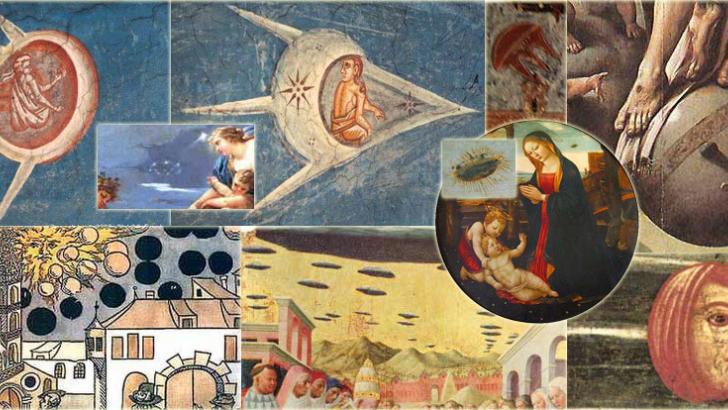
Bonaventura Salimbeni was not a minor painter working outside the established conventions of his tradition. His 1600 work The Glorification of the Eucharist, commissioned for the church of San Lorenzo in San Pietro in Montalcino and still hanging there, is considered one of the significant works of his career. It depicts God and Christ positioned on either side of a metallic sphere. Both figures hold the sphere by what the painting renders as protruding antenna-like rods extending from its surface. The sphere’s geometry, its surface finish, and its antenna configuration correspond to no conventional iconographic symbol in the Catholic tradition’s established visual vocabulary for representing divine power.
In 1957 the Soviet Union launched Sputnik 1. The satellite’s design, a metallic sphere with four protruding antennae, is visible in photographs from the period. Aeronautical engineers and historians of technology who have examined Salimbeni’s painting and the Sputnik photographs have described the correspondence as non-trivial. The term non-trivial in engineering assessment means the similarity is too precise to dismiss as coincidence without a formal explanation for how the correspondence arose.
Three hundred and fifty-seven years separate the painting from the satellite. The painting predates every documented human technological development that produced the satellite by at least two centuries. Either Salimbeni invented the functional design of an artificial Earth-orbiting satellite in 1600 for symbolic purposes that the Church approved and that no iconographic tradition explains, or he was painting something he or his source had seen.

The Church saw the painting. The Church commissioned the painting. The Church has kept the painting in continuous display for four hundred and twenty-six years.
Ezekiel’s Technical Description
The oldest recorded account of an aerial craft in the Western textual tradition is not ambiguous about what it describes. The first chapter of Ezekiel, written in the sixth century BCE during the Babylonian exile, provides a technical description of an encounter with what the prophet calls the glory of the Lord, using language that reads, when approached without the requirement to interpret it theologically, as an attempt by a person without aeronautical vocabulary to describe a functional flying vehicle.
The craft arrives from the north in a great cloud with fire and brightness. Four living creatures emerge from it, each with four faces and four wings, moving in straight lines without turning. Beside each creature is a wheel whose rim is full of eyes, and the wheels move in any direction without turning, suggesting omni-directional movement capability. Above the creatures is an expanse like crystal, and above the expanse a throne of sapphire, and above the throne a figure with the appearance of a human being surrounded by fire and brightness.
Josef Blumrich spent his career as a structural engineer at NASA, specifically on the Saturn V rocket program. After reading Chariots of the Gods by Erich von Däniken, he initially set out to disprove von Däniken’s Ezekiel interpretation using his engineering expertise. His formal analysis of Ezekiel’s description, published in The Spaceships of Ezekiel in 1974 and covering the aerodynamic, structural, and propulsion implications of the technical details in the text, produced the opposite conclusion. Blumrich determined that Ezekiel’s description was consistent with a functional spacecraft design whose omni-directional landing wheel system he considered innovative enough to patent.
The patent was filed and granted, and that fact deserves precision rather than inflation: patents are granted for novel mechanical designs based on their engineering merit, independent of whether the inventor’s stated inspiration or any underlying historical claim is true. Blumrich’s book is a real, published personal interpretation by a credentialed engineer, and it is worth reading on those terms. It has never been treated as a validated finding by biblical scholars or by NASA itself, and it should not be presented as an institutional or scientific confirmation that Ezekiel was describing an actual craft.
The Renaissance painters who encoded aerial objects in sacred art had Ezekiel as their primary scriptural reference for what divine craft looked like. Whether they were painting the theological symbol or the object behind the symbol, Ezekiel had given them a template.
The Wandjina
The Australian Aboriginal cave paintings of Western Australia present the case that requires the least interpretive work and receives the least mainstream attention because it cannot be accommodated within any framework the official account offers.
The Wandjina figures are consistent across thousands of kilometers of cave art spanning a geographic range that covers most of Western Australia. They have been dated by various methods to between five thousand and more than fifty thousand years before the present, depending on the technique and the site. The figures depict upright humanoids with consistent physical characteristics: large black eyes, no visible mouth, a rounded head that appears to be enclosed in a helmet or sealed environment suit, and a formal frontal posture that Aboriginal artists do not typically use for human figures.

The Aboriginal tradition that produced these paintings has a continuous account of what they represent. The Wandjina are not ancestors in the conventional sense. They are the creators of the world and everything in it. They descended from the sky. They shaped the land, the water, the living species. They gave the human population its laws and its cultural framework. Then they returned to the sky.
This account is not mythological elaboration of natural phenomena in the sense that mainstream anthropology applies to creation stories. It is a historical claim about beings with physical characteristics who arrived from a direction and departed to the same direction. The paintings are the visual record of those beings maintained across millennia by a culture that considers their accurate preservation a sacred obligation.

The figure’s physical characteristics, large forward-facing eyes, apparent helmet, no visible mouth, match the descriptions of non-human beings that contact witnesses have provided in accounts spanning the last century with no apparent connection to the Aboriginal tradition. The correspondence has not been formally analyzed by any institution combining anthropological and UAP research expertise.
What Was Approved
The Renaissance paintings of aerial objects exist within an institutional context that the standard treatment of this material ignores completely.
Renaissance art was not produced by independent artists for public display. It was produced by craftspeople working within a commissioning system whose primary client was the Catholic Church and whose secondary clients were the aristocratic and merchant patrons whose authority the Church underwrote. A painter working in 1350 or 1486 or 1600 did not place objects in sacred paintings without his patron’s knowledge. Every element of a commissioned work was subject to review. The iconographic program, the symbolic content, the visual theology of every painting that hung in a church or a palace was approved by the institution that paid for it.
The Svetishoveli fresco of 1350 hangs in Visoki Dečani Monastery in Kosovo, a functioning Serbian Orthodox monastery. The two objects visible in the upper corners of the crucifixion scene, each apparently containing a human figure in motion, were painted by an unknown artist working for the monastery’s ecclesiastical authority. The authority saw the fresco. The authority approved it. The fresco has hung in the monastery for six hundred and seventy-five years.

Dennis Geronimus, Associate Professor of Italian Renaissance at New York University, offered the mainstream art-historical explanation for the Svetishoveli objects in an interview: they represent the sun and the moon. This deserves being reported as the well-established explanation it actually is rather than dismissed by mischaracterizing the iconographic convention. Personified sun and moon figures, shown as small disks with human faces or full figures inside them, positioned at the arms of the cross, are one of the most extensively documented conventions in Crucifixion art, appearing as early as the sixth-century Rabbula Gospels and recurring continuously through Byzantine, Orthodox, and Western medieval painting for the next thousand years. These figures are routinely shown gesturing, weeping, or turning away from the scene, and are frequently labeled directly in the accompanying text as “Sun” and “Moon.” The Svetishoveli fresco’s two disks, each containing a moving figure at the arms of the cross, match this established convention precisely rather than deviating from it.
Carlo Crivelli’s Annunciation with Saint Emidius of 1486, now in the National Gallery in London, shows a circular object in the upper left of the composition directing a single beam of light toward the head of the Virgin Mary. The conventional interpretation describes this as a representation of the Holy Spirit’s descent. The beam’s geometry, its directionality, and the disc from which it originates correspond more precisely to a technical description of directed energy than to the traditional dove-and-light iconography of the Annunciation. Crivelli was a technically sophisticated painter. His choices in this work were deliberate. The commissioning authority approved them.

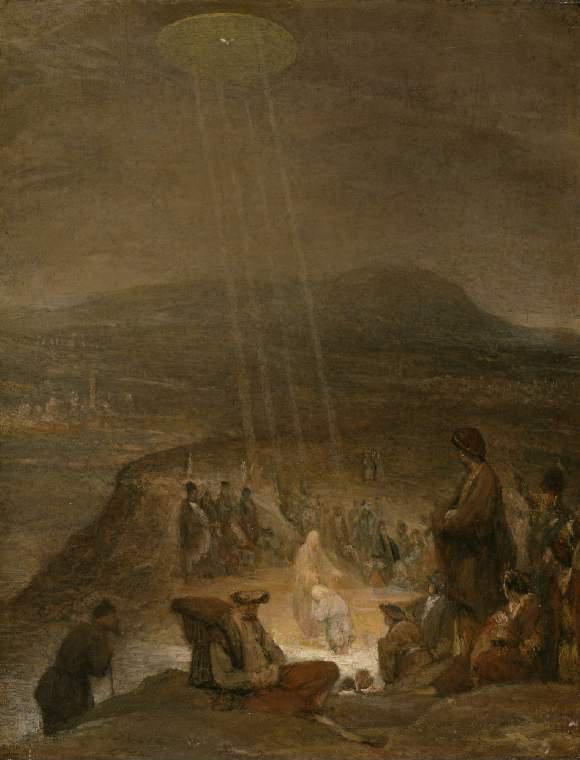
Aert de Gelder painted his Baptism of Christ in 1710, forty years after Rembrandt’s death. He was Rembrandt’s last living pupil and the inheritor of his master’s commitment to documentary precision in the rendering of light. The disc above the baptism scene in de Gelder’s painting directs four beams of light downward toward the figures below. It has the geometry, the surface appearance, and the illumination pattern of a physical object rather than a theological symbol. De Gelder painted what he could see with high fidelity. The question the painting raises is what he was looking at.
The Ghirlandaio Witness
Domenico Ghirlandaio’s Madonna with Saint Giovannino, painted in the fifteenth century and now in the Palazzo Vecchio in Florence, contains a detail that the art historical treatment of the work almost never discusses and that visitors who discover it independently find impossible to misinterpret.
In the upper right background of the painting, behind and above the Madonna’s shoulder, a man stands on a hill with a dog. Both the man and the dog are looking upward and to their right. In the section of sky they are looking at, an object hovers. The object is disc-shaped and luminous. The man and the dog are watching it.

Ghirlandaio placed two witnesses in a sacred painting observing an aerial object with the casual normalcy of people watching something that is simply there. Not a theological symbol requiring interpretation. Two figures and their dog, looking at something in the sky above them.
The witnesses in the painting are looking at the same direction. Their posture is attentive rather than reverent. They are watching the way a person watches something they do not understand but find compelling.
The painting is in the Palazzo Vecchio. The witness figures are not mentioned in the standard art historical description of the work. The object they are watching is in the painting.
What the Archives Contain
The Vatican Library holds an estimated eighty-five kilometers of shelving containing documents spanning seventeen centuries of institutional history. The contents of the restricted sections have been partially revealed through occasional access granted to researchers and have produced findings that demonstrate the library’s holdings extend well beyond what has been catalogued in publicly accessible form.
Every commissioning decision for every painting that depicts anomalous aerial objects in a sacred context passed through the Church’s institutional review process. The theological advisers who approved these paintings left records. Discussions among clergy about how to represent divine craft occurred in an institution whose communications were recorded and preserved, though it is worth restating here that the mainstream art-historical explanation for these specific paintings, correctly identified above, does not actually require any such theological debate about witnessed craft to explain them.
Those records are in the archive. The archive has not been searched for this category of institutional decision-making, either because no researcher with the relevant expertise has been granted access, or because the relevant documents are in the restricted sections, or because the search has been conducted and the results have not been published.
The painters worked within established iconographic conventions that the institution approved. The institution preserved the paintings for centuries. The institution’s records of its own commissioning decisions are in one of the largest archives in human history.
What those records say about what the commissioning authorities knew they were approving has not been published.
UFOs in Renaissance paintings survive today only because a church that could have destroyed them chose not to.
A comparable unidentified object shows up in a very different Renaissance work, the orb in Leonardo’s Salvator Mundi, whose incorrect light refraction has kept credentialed art historians debating its meaning without needing any fabricated ethnographer’s theory.