



The river was the Cape Fear.
On January 8, 2007, Chris Bledsoe Sr., a North Carolina building contractor with no background in astronomy, astrophysics, or intelligence work, went to the riverbank near Fayetteville with his son and three colleagues. What he reported experiencing there over the following hours initiated a sequence of events whose institutional trajectory is the most specifically anomalous element of his case: within months of the encounter, Bledsoe was sitting in rooms at NASA and meeting with personnel from multiple American intelligence agencies who wanted to know what he had seen.
The standard UAP encounter does not produce this outcome. Most UAP witnesses never speak to anyone with institutional credentials. The ones who do speak to researchers rarely receive invitations into the institutional infrastructure of American aerospace and intelligence. The gap between a riverbank in Fayetteville and a briefing room at NASA is not a gap that contactee testimony normally crosses.
Bledsoe crossed it. The question of why is the most significant single fact about his case and the one whose answer the available documentation most directly motivates examining.
What He Reported
Bledsoe described luminous spherical objects moving over the river in ways inconsistent with any known aerial vehicle. The encounter lasted hours. He returned to his companions in a state of visible physical and psychological distress. The subsequent weeks produced what he and his family recorded as a continuous series of anomalous encounters: the objects returning, communications occurring, and a developing relationship with whatever was producing the phenomena that bore no resemblance to the standard abduction framework of involuntary clinical examination.
The character of what Bledsoe reported receiving during these encounters is the element that separates his case from the standard contactee tradition. He described being shown information: specifically, astronomical information whose precision he had no known means of generating independently. The information concerned a star, a alignment, and a relationship between that alignment and a structure on the Giza plateau that has been there for approximately four thousand five hundred years.
He was shown that the star Regulus, at a position on the horizon before dawn, in direct alignment with the Sphinx’s eastward gaze, marked a threshold in a precessional cycle whose significance the entities communicating with him considered important enough to deliver as the central content of his encounter.
A North Carolina building contractor reported receiving precise astronomical data about precessional cycles, stellar alignments, and the Sphinx’s orientation. He reported it to researchers who verified the astronomy. The astronomy checked out. NASA performed the calculations. The calculations confirmed the alignment.
This is the recorded sequence.
The NASA and Intelligence Community Engagement
The institutional response to Bledsoe’s testimony is recorded across multiple sources in the UAP research literature including the work of researcher Ryan Bledsoe, the contactee’s son, and the broader documentation accumulated by researchers who have investigated the case over the subsequent decade and a half.
Bledsoe’s institutional engagements included meetings with NASA personnel, reported interactions with researchers connected to the intelligence community’s UAP investigation programs, and a level of sustained institutional attention whose character distinguishes his case from the hundreds of contactee claims that receive no institutional engagement whatsoever.
The intelligence community’s known interest in contactee testimony has an institutional history that the library’s Robertson Panel piece and the Stargate viewers piece develop in parallel contexts. The Robertson Panel’s 1953 recommendations included the systematic monitoring of civilian organizations discussing anomalous phenomena because those organizations might receive genuine leaked information presented in alternative framing. The CIA’s well known SCANATE and STARGATE remote viewing programs, whose non-terrestrial targeting appears in the library’s dedicated piece, established an institutional framework in which anomalous human perception of non-ordinary information was treated as a legitimate intelligence collection methodology rather than as a psychological curiosity.

Whether Bledsoe’s case was evaluated within this institutional framework, whether the intelligence community’s interest in his testimony reflected the methodology of treating contactee reports as potential information sources about non-human intelligence activity rather than as evidence of psychological disturbance, is the question that the recurring pattern of his institutional engagements raises.
What the pattern establishes is that the people who spent careers evaluating anomalous human experiences for intelligence value considered Bledsoe’s account worth sustained attention. Their professional assessment of what warranted their time and institutional resources is the form of institutional endorsement whose meaning the conventional dismissal of contactee testimony does not account for.
Regulus | What the Star Actually Is
The astronomical content of Bledsoe’s encounter deserves development independent of its prophetic framing, because the star he was shown is genuinely extraordinary by any standard of stellar physics.
Regulus, designated Alpha Leonis, is the brightest star in the constellation Leo and one of the twenty brightest stars in the night sky. At approximately seventy-nine light years from Earth, it is close enough by stellar standards that its light reaches us within a human lifetime. Its position at the heart of Leo, the lion constellation, has made it one of the most consistently significant stars in the recorded astronomical traditions of multiple ancient cultures: Babylonian, Persian, Hindu, Greek, and Roman astronomers all assigned it calendrical and astrological significance, and it was one of the four Royal Stars of ancient Persian astronomy whose rising and setting marked the cardinal points of the year.

What makes Regulus physically remarkable is its rotation. Regulus A, the primary component of a multiple star system, completes a full axial rotation approximately every fifteen and a half hours. For comparison, the Sun completes one rotation in approximately twenty-five days. The consequence of Regulus A’s extreme rotation rate is a stellar body that is not spherical: the centrifugal force at its equator has flattened the star into an oblate spheroid whose equatorial diameter is approximately thirty-two percent larger than its polar diameter. The equatorial surface of Regulus A is moving at approximately eighty-six percent of the velocity required to tear the star apart.
The consequence of this rotation for the star’s appearance is directionally dependent: viewed from the poles, Regulus A appears as a hot blue-white star. Viewed from the equatorial plane, the cooler, expanded equatorial region produces a different apparent color. Whether any observational geometry from Earth’s position in the stellar neighborhood would produce a reddish apparent color from Regulus is the astronomical question that the encounter’s red star description motivates examining rather than dismissing.
The star system also includes known companion stars, designated B, C, and D, at varying distances from the primary. The light travel time of seventy-nine years means that any event occurring in the Regulus system is observed from Earth seventy-nine years after it happened. Whether any of the companion stars have undergone changes in the recent astronomical past whose light has not yet reached Earth is a question the current observational record cannot answer because the light carrying that information may still be in transit.
These are established physical facts about a real star, not prophetic embellishment. The astronomy of the Bledsoe encounter, whatever produced the encounter, is grounded in genuine stellar physics whose character is more interesting than most contactee communications manage to be.
The Sphinx and Precession | The Clock That Was Already Running
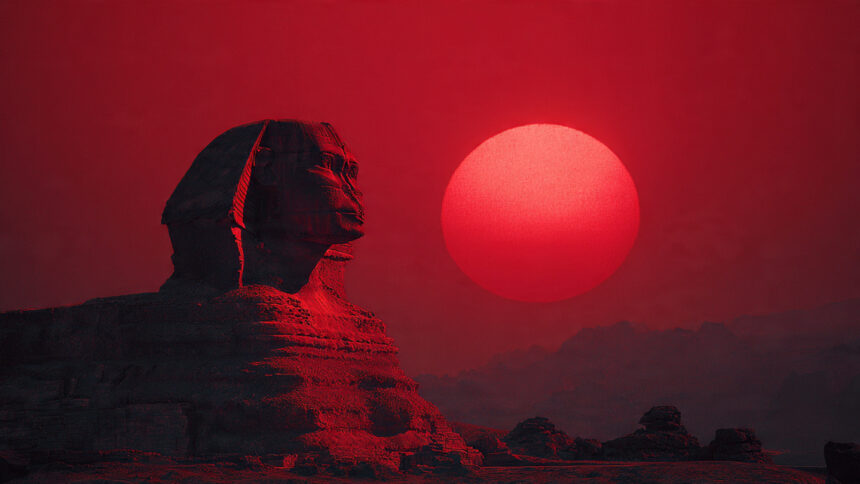
The Sphinx sits on the Giza plateau facing due east, its gaze fixed at the horizon where the sun rises at the equinoxes. This orientation is well established and uncontroversial. What is less universally acknowledged is the astronomical implication of that orientation across the timescales that precession introduces.
The Earth’s axial precession, the slow wobble of the planet’s rotational axis that takes approximately twenty-five thousand nine hundred years to complete a full cycle, causes the positions of stars relative to the horizon to shift measurably over centuries and dramatically over millennia. The Sphinx’s eastward gaze intersects different constellations at different points in the precessional cycle. In the current epoch, the Sphinx gazes toward Taurus and, depending on the date and the horizon calculation, toward the boundary region where Leo and Virgo meet.
At approximately ten thousand five hundred to nine thousand BCE, the precessional position of the Earth placed Leo directly on the eastern horizon at the spring equinox, meaning that at dawn on the equinox, a viewer standing at the Sphinx and looking in the direction of its gaze would have seen the constellation Leo rising, with the Sphinx itself, a lion, facing its celestial counterpart.
This precessional alignment is the basis of Robert Bauval and Graham Hancock’s proposal that the Sphinx preserves an astronomical timestamp whose value, approximately ten thousand five hundred BCE, represents its true date of construction or its intended astronomical reference point. Whether this proposal is correct is a question the library’s existing Sphinx and geological dating pieces address. Whether the Sphinx’s known orientation toward the eastern horizon is intentional astronomical encoding or coincidental architectural decision is the interpretive question that the precessional mathematics motivates without definitively resolving.
What Bledsoe’s communicated information added to this established framework is a stellar focus within the Leo constellation: not Leo as a whole, but Regulus specifically, whose position as the heart of the lion makes it the most astronomically precise reference point within the constellation for calculating the exact moment of the precessional alignment.
Whether this specificity represents a genuine astronomical insight transmitted in the encounter, the kind of precision that distinguishes genuine astronomical knowledge from vague mystical symbolism, or reflects Bledsoe’s subsequent exposure to the Bauval and Hancock precessional research tradition whose details he may have absorbed before or after the encounter, is the question that the timing and character of his reported communications raises.
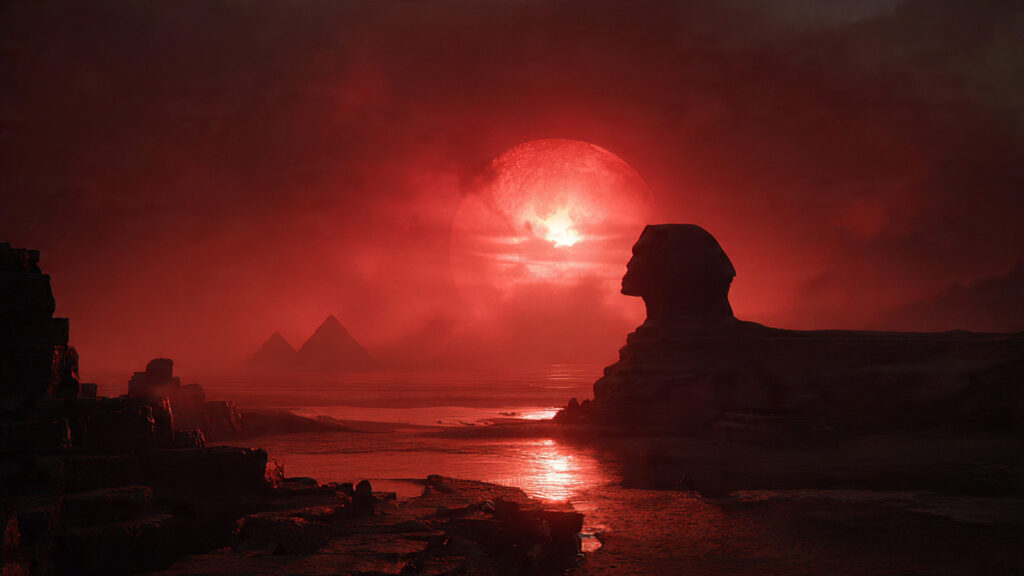
What can be said with certainty is that he reported the Regulus-Sphinx alignment, and that, on his account, NASA personnel verified the astronomical calculation and confirmed the alignment is astronomically real and precessionally significant.
The Contactee as Intelligence Asset
The institutional history of the intelligence community’s engagement with anomalous human experiencers is the recorded context whose development gives the Bledsoe case its most significance within the library’s UAP framework.
The STARGATE program, whose remote viewing sessions targeting non-terrestrial locations are covered in the library’s dedicated piece, established a well known precedent: the American intelligence community funded, administered, and took seriously a program in which individuals with anomalous perceptual capabilities were used to collect information about locations and objects that conventional intelligence methods could not access. The program ran for over two decades, involved confirmed institutional participation from the CIA, DIA, and military intelligence branches, and produced results that the program’s own evaluations described as statistically significant.
Whether the intelligence community’s reported interest in Bledsoe represents a continuation of this same institutional logic, treating his anomalous perceptual experiences as a potential source of information about non-human intelligence activity rather than as a psychological phenomenon requiring treatment, is the question that the recurring pattern of engagements raises.

The institutional context of Fayetteville, North Carolina, where Bledsoe lives and where the initial encounter occurred, is relevant: Fayetteville is the location of Fort Bragg, now Fort Liberty, one of the largest and most significant military installations in the United States, whose known activities include Special Operations Command whose relationship to classified UAP research programs has been a subject of ongoing investigation in the UAP research community.
Whether the proximity of the initial encounter to a major special operations installation is coincidental or reflects the recurring pattern of UAP activity clustering around military installations is the question that the geographic context raises without the available evidence resolving.
The Ancient Royal Star
The ancient astronomical significance of Regulus across multiple independent cultures is the element of the Bledsoe encounter whose connection to the library’s broader ancient knowledge framework is most direct.
In Babylonian astronomy, Regulus was known as Sharru, the King, one of four stars that marked the cardinal points of the ecliptic in the Babylonian astronomical system. In Persian astronomical tradition, it was Venant or Vega, one of the four Royal Stars whose rising governed the astronomical calendar. In Vedic astronomy, it was Magha, the Mighty, associated with the ancestors and the ancestral realm. In Greek tradition, it was the heart of Leo, whose association with solar power and royal authority was maintained across the entire span of classical civilization.
The consistent ancient attribution of royal authority and cyclical significance to this star across multiple independent astronomical traditions is the cross-cultural pattern whose character connects to the library’s broader framework of ancient astronomical knowledge preserved across independent civilizations. Whether the ancient world’s consistent identification of Regulus as a marker of cycles, power, and thresholds reflects genuine astronomical knowledge whose content was transmitted across the ancient world through known trade and communication networks, or reflects independent convergence on the same star’s genuinely significant astronomical properties by multiple independent cultures, is the question that the pattern raises.
The convergence of this ancient astronomical tradition with Bledsoe’s reported encounter, in which the content transmitted to him concerned Regulus and its relationship to the Sphinx’s precessional orientation, is the element whose analytical significance the library’s existing treatment of ancient astronomical knowledge makes most directly assessable.
A 2007 encounter on a North Carolina riverbank produced astronomical information consistent with a cross-cultural ancient tradition spanning Babylon, Persia, India, and Greece. The man who reported receiving it had no known background in ancient astronomy. The institutions that evaluated it found the astronomy sound.
Whatever produced the encounter, it knew about Regulus.
What the Intelligence Agencies Were Actually Doing
The recorded history of intelligence community engagement with UAP contactee testimony is more institutionally coherent than the public discourse about it suggests.
The Robertson Panel’s conclusion, covered in the library’s dedicated piece, was that UAP phenomena should be managed through systematic public ridicule while being investigated seriously through classified channels. This two-track approach, public dismissal combined with private investigation, is the institutional context that explains why serious intelligence professionals would meet with a North Carolina contractor about his river encounter while the official public posture of every relevant government agency was that such encounters do not occur.
The recurring pattern of high-credibility UAP witnesses receiving institutional attention while the public record showed no acknowledgment of their cases is not unique to Bledsoe. It is the recorded operational signature of the Robertson Panel’s recommended approach applied consistently across the seven decades following its adoption.

Whether the intelligence community’s interest in Bledsoe was specifically about the Regulus-Sphinx astronomical information, about his ongoing relationship with whatever was producing the phenomena, or about something in the encounter’s content that is not fully represented in the publicly available accounts of his testimony, is a question the reported institutional engagement raises without the available record resolving.
What the engagement establishes is that the people whose professional function is to evaluate the significance of anomalous information considered Bledsoe’s testimony significant enough to pursue through institutional channels rather than dismiss.
The Precessional Framework and What It Implies
The Sphinx as a precessional clock is the interpretive framework that the Bledsoe encounter activates most directly, and its implications for the library’s broader ancient civilization thesis are worth developing explicitly.
If the Sphinx’s known eastward orientation encodes an astronomical reference point in the precessional cycle, then the structure’s builders possessed a genuine understanding of precession, a phenomenon requiring centuries of continuous astronomical observation to detect and millennia of observation to quantify with the precision that accurate precessional clock design requires. The conventional dating of the Sphinx to approximately 2500 BCE places its construction within the dynastic Egyptian period whose known astronomical knowledge does not obviously include precessional calculation of the precision required.
The geological water erosion evidence recorded in the library’s existing Sphinx piece, whose analysis by Robert Schoch suggests a construction date significantly earlier than the conventional Egyptological dating, is the physical evidence whose implications connect to the precessional clock hypothesis: if the Sphinx is older than the conventional dating, the civilization that built it had more time in which to develop the astronomical knowledge its orientation implies.
Whether the Sphinx encodes the precessional position of approximately 10,500 BCE as Bauval and Hancock proposed, or a different precessional position whose calculation the Bledsoe encounter’s Regulus focus refines, is a question that the established astronomical framework motivates examining with greater precision than either the conventional Egyptological or the alternative research communities have yet applied.
What is established is that the Sphinx faces east. What is established is that precession changes which star rises on the eastern horizon at the equinox over a twenty-five-thousand-year cycle. What is established is that Regulus, the heart of Leo, is one of the most astronomically and culturally significant stars in the recorded history of human astronomy. What is established is that a 2007 encounter produced information connecting these three established facts in a way that, on Bledsoe’s account, NASA personnel considered worth verifying.
The clock has been running since before the first dynasty. The star whose rising it was built to track is still there. The gaze has not moved.
Whatever the builders encoded in the Sphinx’s orientation, they built it to last long enough for the message to be received.
The Sphinx points at Regulus in the sky tonight the same way it did the night construction finished.