



The bear isn’t in the sky. Neither is the hunter, the swan, the plough, the scorpion, or any of the other figures humanity has drawn between distant points of light. The stars themselves do not form the shapes we see. They sit at wildly different distances, move through space on different trajectories, and only appear connected because a human observer looks at them from one particular position on one particular planet. The pattern is ours.
That sounds like a small psychological curiosity until you notice how often the same operation runs through human civilization. We compress thousands of separate observations into a constellation. We compress landscapes into maps, events into stories, strangers into categories, and complicated institutions into theories about who is secretly controlling them. Sometimes the compression is extraordinarily useful. Polynesian navigators could cross an ocean by remembering stable relationships between stars even though those stars had no physical relationship to one another. Astronomers turn enormous quantities of measurements into models that predict eclipses and planetary motion. Archaeologists reconstruct vanished societies from fragments. And sometimes the same machinery draws connections that are not there at all.
The Brain Does Not Store Reality Whole
One of the most important insights in twentieth-century psychology began with a deceptively simple problem: there is far more information in the world than a human nervous system can retain in raw form. George A. Miller’s famous 1956 paper, “The Magical Number Seven, Plus or Minus Two: Some Limits on Our Capacity for Processing Information,” examined limits in immediate memory, absolute judgment, and information processing. Miller’s important observation was not simply that people could remember around seven things. It was that recoding could reorganize information into larger meaningful units, allowing the mind to handle material that would overwhelm it if every element had to be treated separately. Later research substantially revised the simple “seven” rule, with estimates of working-memory capacity often falling closer to three or four chunks under controlled conditions. The deeper principle survived the numerical revision: the mind becomes vastly more effective when separate pieces can be organized into meaningful structures.
That is why a sequence of unrelated letters can become effortless once it is reorganized into familiar abbreviations. It is why an experienced chess player does not experience a board simply as thirty-two isolated objects. Expertise allows recurring configurations to become recognizable units, dramatically changing what the player can perceive and remember. The mind is not merely storing more information. It is changing the representation of the information. What looks like an enormous collection of independent details to a novice can become a handful of meaningful structures to someone who has learned the underlying regularities.
Calling this a “compression algorithm” is a useful metaphor, provided we remember that it is a metaphor. The brain is not literally running a ZIP file on reality. It is selecting, grouping, categorizing, predicting, and discarding information according to what experience has taught it is important. That ability is one of the foundations of intelligence. It is also one of the reasons intelligence can fool itself.
Pareidolia Is What Happens When the Pattern Arrives Before the Explanation
This is where pareidolia enters the story. Pareidolia is the tendency to perceive a recognizable object, face, animal, or meaningful structure in an ambiguous or otherwise non-specific stimulus: a face in a cloud, a figure in a rock formation, an animal in a patch of shadow. It is not simply “seeing patterns.” Pattern recognition is essential to ordinary perception. Pareidolia is better understood as a case in which the perceptual system settles on a meaningful interpretation when the underlying stimulus does not uniquely specify one.
That distinction matters because not every pattern humans perceive is imaginary. A face in a cloud is not evidence that a person is hiding inside the cloud. But a human face is a real biological pattern, and the visual system has very good reasons to be sensitive to it. The same machinery that helps us recognize a friend across a crowded room can make a face appear in three dark patches on a wall. The system is not malfunctioning in some absolute sense. It is operating under uncertainty, making a rapid best guess from incomplete information.
The Constellations Are Real Patterns We Invented
A constellation reveals the same principle on a cosmic scale, but with an important qualification: constellations are not simply optical hallucinations. They are cultural constructions imposed on genuine astronomical observations. The stars are real. Their positions in the sky are measurable. The apparent arrangement is stable enough from Earth’s perspective to become extraordinarily useful. What is invented is the figure connecting them, the bear, hunter, twins, scorpion, ship, serpent, or whatever a particular culture chooses to see.
That distinction is almost the entire article in miniature. The stars are evidence. The lines are interpretation. The interpretation can be useful without being a physical property of the stars themselves. A navigator does not need the Big Dipper to be a literal bear for its stars to help establish direction. A culture does not need Orion to be an actual hunter wandering through space for the constellation to become part of a mythology. A useful representation does not have to resemble the thing it represents in every respect. It only has to preserve the information that matters for the task.
Stonehenge Is the Important Counterexample
This is also why Stonehenge deserves more caution than the usual “humans see patterns everywhere” argument allows. Some of the astronomical relationships at the monument are not projections of modern imagination onto random stones. The architecture contains a genuine solstitial axis. The central stone settings frame the approximate positions of the summer-solstice sunrise and winter-solstice sunset, and archaeological research shows that those relationships were incorporated into the monument’s design. The British Museum and Historic England both describe the solstitial alignment as an intentional feature of the monument.
But even here, the evidence has to be handled at the resolution it actually supports. Stonehenge demonstrates that prehistoric people deliberately observed the sky and incorporated solar cycles into architecture. It does not automatically demonstrate every proposed astronomical alignment ever attributed to the site, nor does an astronomical orientation tell us precisely what every builder believed about the cosmos. Archaeology becomes interesting precisely because it has to separate the alignment that can be demonstrated from the interpretation layered on top of it.

This Is Where Conspiracy Thinking Gets Its Power
The dangerous version of constellation-making begins when the objects being connected are not ambiguous stars but genuine events. One institution really did conduct a secret program. Another government really did classify documents. A corporation really did lobby regulators. An intelligence agency really did investigate an extraordinary claim. A monument really does have an astronomical alignment. A historical text really does contain a strange passage. None of those facts has to be fabricated for the resulting story to become false.
The crucial move is what happens between the facts. A documented event becomes connected to another documented event. A third detail appears. A date seems significant. Two people once attended the same conference. A symbol appears in both places. The separate facts are then compressed into a single explanatory structure: therefore they are parts of one operation. The individual stars remain real. The constellation is invented.
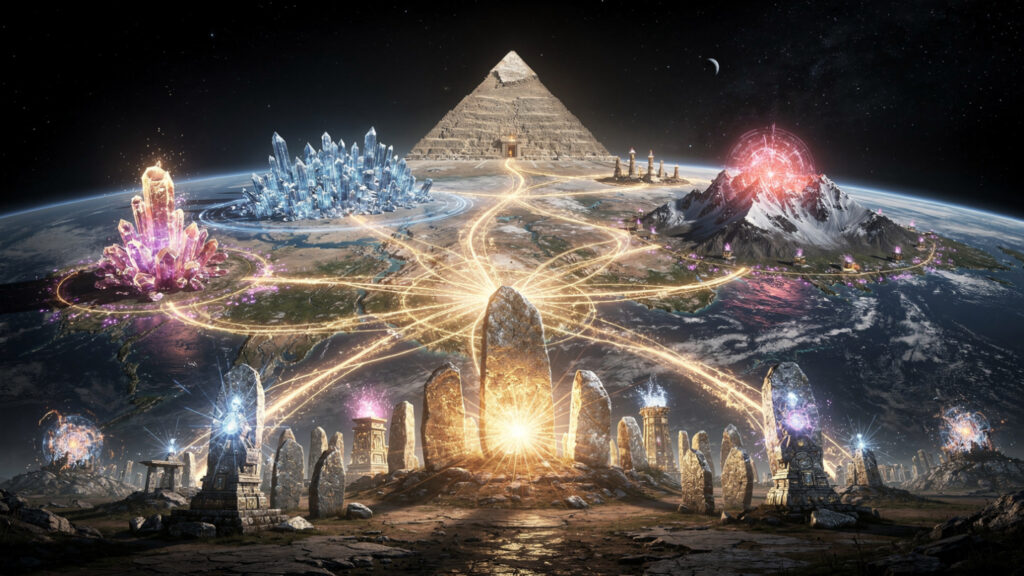
This is why conspiracy narratives can be unusually persuasive. They often contain real information. The problem is not necessarily the existence of the dots. It is the line drawn between them. A secret government program can be real without proving every paranormal story attached to it. Astronomical precession can be real without proving that the Earth is entering a physically transformative “Age of Aquarius.” Ancient monuments can encode observations of the sky without proving that their builders possessed technology from a vanished civilization. The leap from these things happened to therefore these things form one hidden system is where the evidentiary burden changes.
Science Does Not Stop at Finding the Pattern
Science is often described as a method for finding patterns, but that is only half the story. Human beings are already extremely good at finding patterns. Science becomes powerful because it adds a second operation: trying to determine whether the pattern survives attempts to break it.
Measurements can test a proposed relationship. Independent observations can ask whether the same effect appears elsewhere. Replication can reveal whether a striking result survives outside the original experiment. Predictions can force a theory to risk being wrong. Statistical methods can estimate how surprising a pattern would be under chance. Peer criticism can expose an attractive explanation that quietly depended on selecting only the evidence that supported it. None of these tools makes scientists immune to pattern-seeking. Scientists are human beings too. What the scientific system attempts to do is make the cost of being wrong visible.
That is why falsifiability matters, even though real scientific practice is more complicated than the slogan sometimes suggests. A compelling pattern becomes scientifically interesting when it generates consequences that could distinguish it from competing explanations. The question changes from “Can I make these facts fit together?” to “What observation would force me to admit that this connection is wrong?”
The Same Brain Builds Maps, Myths, and Models
There is something almost beautiful about the fact that the same cognitive ability sits underneath such different human achievements. A navigator learns a pattern among stars. A child learns that certain sounds belong together as a word. A chess player recognizes a position. An engineer sees a failure mode hidden inside thousands of measurements. An archaeologist notices that a series of structures share an orientation. A storyteller turns generations of experience into a character and a plot. In every case, the mind is refusing to treat reality as an undifferentiated pile of disconnected information.
The danger begins only when the representation becomes more convincing than the evidence beneath it. A map can become outdated. A myth can be mistaken for history. A model can be mistaken for reality. A correlation can be mistaken for a cause. A collection of coincidences can become a hidden architecture. The human talent that allows us to discover genuine structure is inseparable from the vulnerability that allows us to manufacture structure where none exists.
The Question Is Not Whether We Connect the Dots
The bear was never in the stars. But the stars were never meaningless either. They were real points of light, and human beings turned them into something memorable enough to navigate by, tell stories about, teach to children, and carry across oceans. The same mind that invented the bear can discover a genuine orbital pattern, recognize a face, decode a language, reconstruct an archaeological site, or formulate a scientific law. Pattern recognition is not the enemy of truth. It is one of the instruments truth is found with.
The difficult part comes afterward. Once the mind has drawn the lines, it has to be willing to erase them. That is the discipline civilization has spent centuries building: not a machine that stops us from seeing patterns, but a method that asks whether the pattern remains when someone else looks, when the data change, when the prediction fails, and when the most beautiful explanation turns out not to be true. The stars do not tell us whether the bear exists. They give us the raw material from which a mind can draw one. Wisdom begins at the moment we become curious enough to ask how patterns form in the mind, not just whether the shapes in the sky are real.