


Marco Rubio really did say it. On camera, he said that the United States had experienced “repeated instances of something operating in the airspace over restricted nuclear facilities,” and that “it’s not ours.” The sentence is genuine. The mystery begins with everything that came before it, and everything Rubio later said about what he actually meant.
When the quote resurfaced in The Age of Disclosure, Rubio was no longer a senator. He was the Secretary of State. The documentary identified him by that current title, and the trailer gave viewers no obvious indication that the interview had actually been recorded years earlier. That matters because Rubio subsequently explained the missing context himself: the interview had been conducted roughly three or four years earlier, while he was still in the Senate, and he was describing allegations brought to him by military personnel and other officials, not claiming firsthand knowledge that non-human craft were operating over nuclear facilities. He did not retract the underlying concern. In fact, he said unidentified objects had genuinely been reported over restricted airspace and that the possibility of an adversary possessing an asymmetric surveillance capability was itself a serious national-security problem. But that is a very different statement from a sitting Secretary of State personally confirming extraterrestrial technology.

The Quote Is Real. The Impression Is More Complicated.
The documentary itself is real. The Age of Disclosure, directed and produced by Dan Farah, premiered at SXSW in March 2025 and was presented as an investigation built around testimony from 34 senior figures from government, the military and intelligence. Its official festival description made an extraordinary claim of its own: that the film would reveal an 80-year cover-up involving non-human intelligent life and reverse-engineered technology. Rubio was one of the people featured.
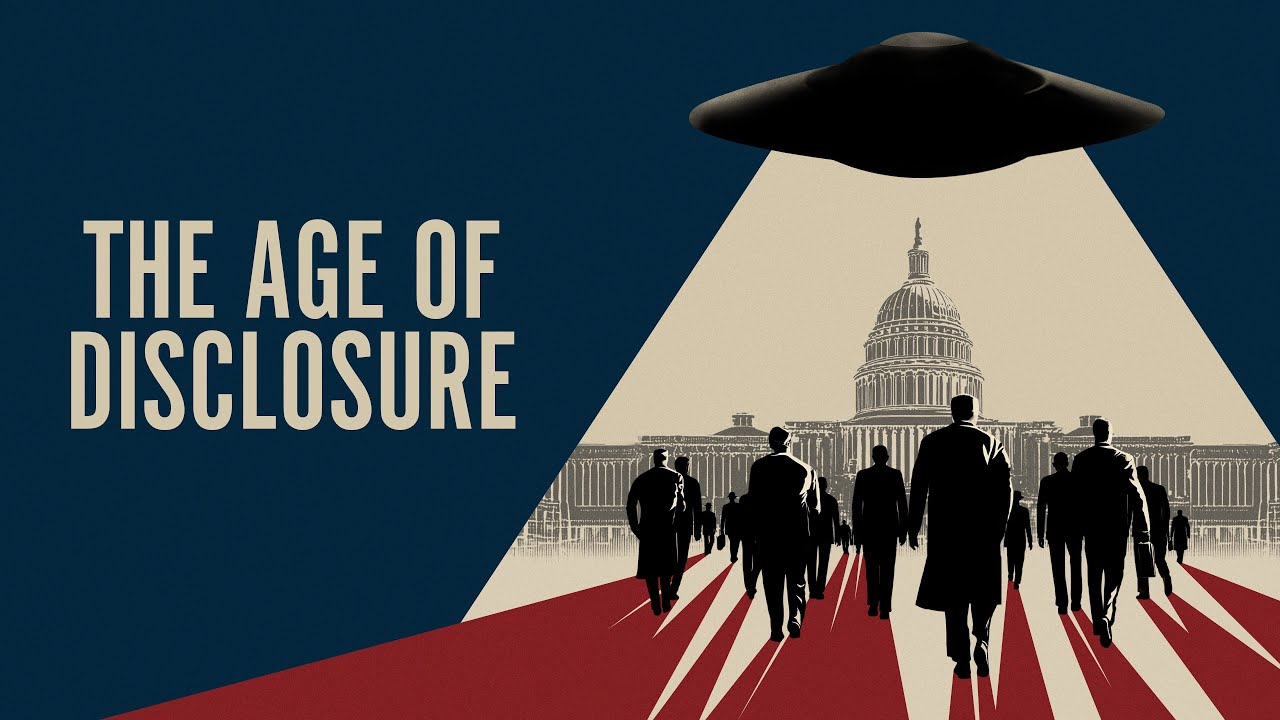
That distinction between the film’s claim and Rubio’s claim is essential. The film can argue that a vast body of classified evidence exists. Rubio can say that military personnel have brought allegations to him. Neither statement independently establishes that the United States possesses extraterrestrial craft, that non-human beings have visited Earth, or that the objects reported over nuclear facilities are alien. What Rubio actually provides is something narrower and more interesting: confirmation that senior political figures have been told extraordinary things by people they considered sufficiently credible to bring the allegations forward.
That is evidence of a claim. It is not yet evidence of the claim’s underlying reality.
Then Rubio Explained What the Trailer Did Not
When Sean Hannity later asked Rubio about his appearance in the documentary, Rubio did something unusually useful for anyone trying to establish what the clip actually means: he supplied the missing chronology.
“I’m not disavowing that,” Rubio said, before explaining that the interview had been conducted “almost, like, maybe three or four years ago” while he was still in the Senate. He then clarified the more important point. He had been describing allegations made by people who came forward to him, including Navy pilots, admirals and generals, and claims that programs existed within the government of which even presidents were allegedly unaware. “I was describing what people had said to me,” Rubio explained, “not things that I have firsthand knowledge of in that regard.”
That sentence should sit directly beside the original quote whenever the clip is presented. Without it, the viewer naturally performs a simple mental substitution: Secretary of State Rubio says unknown craft are over nuclear facilities. With it, the actual proposition becomes: Senator Rubio said that people had reported such incidents to him, and he did not personally possess independent confirmation of their most extraordinary claims.
The difference is not cosmetic. It is the difference between firsthand evidence and testimony about someone else’s testimony.
But Rubio Did Not Simply Walk Everything Back
There is another detail that gets lost when the story is reduced to “Rubio debunked his own UFO quote.” He didn’t.
Rubio said the fundamental point remained true: objects have been reported operating in restricted airspace, including around sensitive military facilities, and officials have sometimes said they were not American. He also said he did not have an independent way to verify everything witnesses had told him. His own concern was less cinematic than an extraterrestrial invasion. He specifically raised the possibility that an adversarial nation could possess an asymmetric surveillance capability that the United States had not yet identified or countered.
That is a genuine national-security question. An unidentified object over a nuclear installation does not become extraterrestrial merely because nobody has identified it. It could be a drone, an aircraft, an intelligence platform, a sensor artifact, a misidentified conventional object, or something genuinely unexplained. “Unknown” is a description of the evidence, not a statement about its origin.
Rubio’s position has also stayed remarkably consistent since. In August 2026, now well into his tenure as Secretary of State, he made a nearly identical statement through an official State Department channel and in a separate podcast interview: “I don’t know who it is. I don’t know what it is. But there are things flying over our military installations, and they’re not ours, and we should look into this, be serious about it.” That’s not the same interview resurfacing again, it’s Rubio independently repeating the same basic concern more than a year into his current role, which suggests the underlying position, unresolved objects over sensitive sites warrant investigation, reflects something more durable than a single recontextualized soundbite.
And Then There Is Jay Stratton
The documentary contains a much more explicit statement, and it belongs to someone else.
Jay Stratton, a former senior intelligence official and former director of the Pentagon’s Unidentified Aerial Phenomena Task Force, says in the film: “I have seen with my own eyes non-human craft and non-human beings.” That is an extraordinary firsthand claim. It should be attributed to Stratton, not Rubio. Contemporary reporting confirms that Stratton’s statement is one of the film’s central moments, while also noting that the documentary does not publicly provide the underlying photographs, physical evidence or detailed circumstances that would allow outsiders to independently evaluate what he says he witnessed.
Combining Stratton’s statement with Rubio’s therefore creates a composite quotation that neither man actually made. Rubio described allegations reported to him. Stratton claimed personal observation. Those are two different categories of testimony, and collapsing them into one “government official confirms aliens” narrative makes the evidence sound stronger than it is.
Where Project Blue Beam Actually Came From
This is where the story takes another turn, because the phrase “Project Blue Beam” did not originate inside the modern UAP disclosure movement.
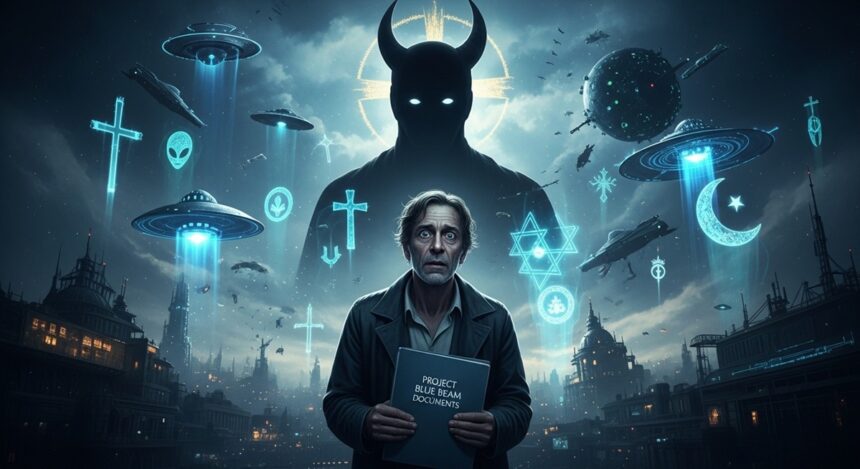
The theory traces back to Serge Monast, a Quebec journalist and conspiracy writer who developed the idea in the 1990s and published his Project Blue Beam material in 1994. The theory imagined NASA, the United Nations and other powerful institutions using advanced technology to manufacture a spectacular global religious or extraterrestrial event, ultimately helping impose a new world order. The theory subsequently mutated online, absorbing holograms, artificial intelligence, staged alien invasions, mass psychological manipulation and eventually almost any unexplained aerial phenomenon that could be fitted into its framework.
There is an important methodological problem here. Blue Beam begins with a theory and then treats later events as potential evidence that the theory was correct. That reverses the normal evidentiary sequence. A real document showing a government program to manufacture a fake extraterrestrial event would be evidence for Blue Beam. A politician discussing unidentified objects is not. A documentary about UFO disclosure is not. A military official alleging hidden programs is not. Each may be interesting, but none supplies the missing documentary bridge to Monast’s specific 1994 scenario.
Monast’s Death Did Not Supply the Missing Evidence
Monast died in December 1996, reportedly from a heart attack, at the age of 51. His death later became part of the mythology surrounding Blue Beam, with believers suggesting that he had been silenced because of what he knew. But suspicion surrounding a death is not documentation of an assassination, and the Blue Beam literature itself does not produce the independent evidence necessary to establish that claim. His death therefore cannot retroactively authenticate the theory he had published.
This is a recurring pattern in conspiracy culture: the disappearance, death or misfortune of the original theorist becomes another piece of supposed evidence. The theory generates the prediction, the prediction generates the interpretation, and the interpretation eventually becomes evidence for the original theory. At that point the system becomes almost impossible to falsify because every possible outcome can be absorbed into it.
What Steven Greer Actually Brings to the Story
Steven Greer is not an invented character either. The physician and UFO activist founded the Disclosure Project in 1993 and has spent decades arguing that governments possess suppressed evidence of extraterrestrial contact. His work is therefore part of the documented history of modern UFO disclosure culture. But his interpretation of contemporary disclosure as a possible psychological operation designed to manufacture a false extraterrestrial threat remains his claim, rather than an established conclusion independently demonstrated by government records.
One of the clearest examples of why individual cases need to be separated from the larger theory is the so-called Atacama skeleton, a tiny and unusually formed set of human remains that became one of the most famous “alien body” stories of the modern UFO era. Greer’s own 2013 documentary Sirius presented the specimen as potentially non-human, and he provided a bone marrow sample to Stanford geneticist Garry Nolan. Subsequent genomic research, however, established that Ata was human and female. The 2018 whole-genome study, published in the peer-reviewed journal Genome Research, identified mutations associated with skeletal and developmental abnormalities, while a separate critique led by University of Otago bioarchaeologist Siân Halcrow later challenged aspects of the study’s interpretation of the skeletal abnormalities specifically. That dispute is scientifically interesting, but it does not resurrect the extraterrestrial hypothesis: both sides were examining unusual human remains.
The episode is useful for a reason that has nothing to do with ridicule. It demonstrates how extraordinary appearance can create an extraordinary hypothesis before the underlying biological identity has been established. Once the identity was resolved, the mystery did not disappear, it changed categories.
The Evidence Gets Weaker When the Claims Get Bigger
There is a hierarchy here that the modern disclosure debate often blurs.
Level one: unidentified objects have been reported in restricted airspace. That is not controversial.
Level two: military personnel and government officials have made claims about objects they could not identify. Also documented.
Level three: some officials say they personally witnessed extraordinary craft or beings, a claim echoed by other named military figures elsewhere in UAP culture. That is a documented claim, but it remains testimony requiring corroboration.
Level four: the objects are non-human technology.
Level five: governments are secretly preparing a manufactured extraterrestrial event under a program corresponding to Project Blue Beam.
The higher the claim goes, the more independent evidence it requires. Rubio’s quote gets you somewhere on the first two levels. It does not leapfrog automatically to the fifth.
The Strange Part Is That Rubio’s Real Statement Is Enough
There is no need to turn Rubio into something he did not claim to be.
A former senator and current Secretary of State publicly acknowledged that military and government personnel had brought him reports of unidentified objects operating around restricted facilities, including nuclear sites. He said some of those people alleged the existence of programs hidden even from presidents. He also said he could not independently verify everything he had been told. Those statements are already consequential. They raise legitimate questions about classification, chain of command, intelligence collection, airspace security and the government’s ability to identify objects operating around its most sensitive installations.
The mistake is thinking that an unresolved question becomes more credible when an unsupported answer is attached to it.
What We Actually Know
We know Rubio made the “it’s not ours” statement. We know the interview predates his tenure as Secretary of State by several years. We know he later said he was describing allegations reported to him rather than firsthand knowledge. We know he nevertheless considers unidentified activity over restricted airspace a legitimate national-security concern, and that he repeated that same basic concern in his own words as recently as August 2026. We know Jay Stratton separately claims to have personally seen non-human craft and beings. We know The Age of Disclosure deliberately presents those claims as part of a much larger disclosure narrative. And we know Project Blue Beam predates all of this by decades, originating in Serge Monast’s 1990s conspiracy literature rather than in a newly uncovered government document.
What we do not have is the final piece that would transform the story: publicly verifiable physical evidence demonstrating that the unidentified objects are extraterrestrial, or an authenticated government document demonstrating that a Blue Beam-style operation exists.
And that is where the story should stop, for now.
Marco Rubio really said, “It’s not ours.” He did not say, “It’s extraterrestrial.”
Rubio’s it’s not ours quote is genuine, but the seven missing words are where the entire investigation actually lives. The genuinely unresolved question is not whether Rubio secretly confirmed Project Blue Beam. He didn’t. The better question is what, exactly, American military personnel have been reporting over restricted and nuclear-related facilities, and why, after years of hearings, investigations and classified claims, so much of the underlying evidence remains inaccessible to the public. That question does not require a holographic alien invasion. It only requires the one thing every serious investigation begins with: evidence.