


There is an ancestral tremor that runs through the human nervous system whenever the night sky fills with that perfect, unnerving orb of light. It is the Full Moon, a celestial spotlight that has, for millennia, been blamed for every sleepless night, every surge of irrational passion, and every moment of inexplicable despair.
What does rigorous biology actually say about this influence? Some of it holds up remarkably well. Some of it, on close inspection, doesn’t.
Lunar Sympathy and the Genesis of Lunacy
The link between the lunar cycle and human instability is older than recorded history, crystallized in the very word “lunacy,” a state of madness attributed directly to the Moon’s dominion. Shakespeare captured this in Othello, where the Moor, having just committed an act of fatal, irrational passion, seeks cosmic absolution: it was not his fault, but the Moon’s. This was not poetry so much as a reflection of widespread 17th-century belief. Science, ironically, initially tried to fight this ancient astrology with its own flawed logic. Galileo Galilei dismissed the idea of the Moon generating ocean tides, finding the notion too astrologically tinged for his taste. He was famously, utterly wrong. It is the Moon’s gravity, in combination with the Sun’s, that pulls the massive water bodies of Earth into their tidal rhythm.
The scientific correction ironically rehabilitated the ancient fear. If the Moon can lift the entire Pacific Ocean, surely it exerts some pull on the fluids within the human body. This logic provided a foundation for generations of doctors who, well into the 18th and 19th centuries, prescribed medicines and advised surgical timing based on the waxing and waning phases. That specific belief hasn’t survived contact with modern data. Multiple large-scale studies, including one analyzing over 18,000 surgical patients and another covering nearly 17,000 cataract operations, have found no statistically significant relationship between lunar phase and surgical complications, blood loss, or recovery outcomes. The overwhelming medical consensus is that the old logic, tides pull the body’s fluids, therefore surgery timing matters, doesn’t hold up, however durable the belief itself has proven to be among patients.
Biological Entrainment | The Deep Code in Water and Soil
To move beyond superstition, it helps to analyze the two undeniable vectors of lunar influence: light and gravity. For millennia, living organisms have navigated, grown, and reproduced based on subtle shifts in both.
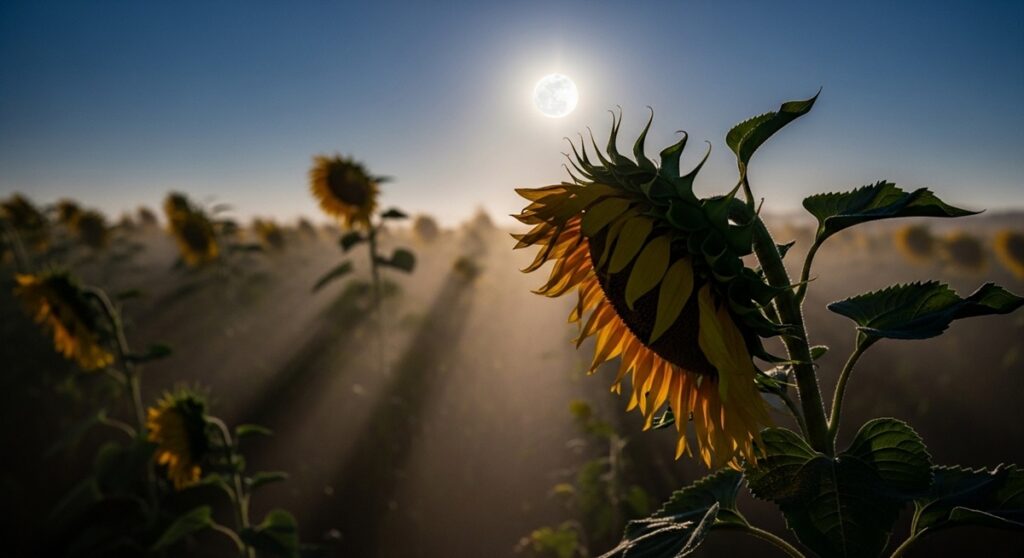
Gardening’s adherence to the lunar calendar, where the phases dictate the timing of planting or harvest, may seem like pure agrarian superstition. Yet the underlying mechanism of moonlight is real, purely optical, and well documented by biologists who study photoperiodism. Plants possess an intricate light-sensing system tied directly to their growth cycles. In complete darkness, the total blackness of a clouded new moon night, a plant’s growth accelerates. The moment the plant senses even faint light, that acceleration slows. On a clear, moonlit night, shoots grow more slowly than during the darkness of a new moon, because the plant perceives moonlight as an interruption of its night cycle. Species that require a long, uninterrupted dark period for flowering may see that process slowed or arrested by a bright Moon. This is pure physics of light intensity, not astrology.
This same mechanism explains a common gardening frustration: the seeds of many aggressive weeds require only minimal light exposure to germinate. If soil gets disturbed on a cloudless, moonlit night, bringing seeds to the surface, faint moonlight can be enough to trigger sprouting, while the same disturbance on a dark, overcast night often won’t. The sunflower offers a telling contrast: it tracks the Sun relentlessly from east to west but entirely ignores the Moon, whose light is too dim to matter for its purposes. The biological truth here is straightforward: the Sun is the brighter, more literal driver of plant behavior, but the Moon still shapes the subtle rhythms of the night for species tuned to detect it.
Tidal Crucible | Evolution and Aquatic Genesis
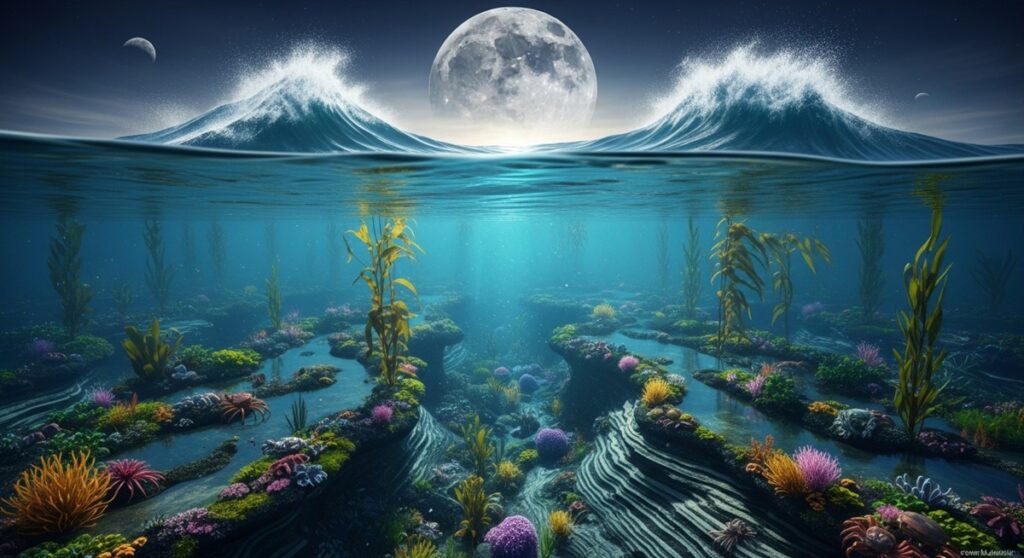
The Moon’s clearest, most undeniable influence sits in the ocean, the birthplace of animal life. The Moon generates tides roughly twice daily, creating tidal bulges that reshape coastlines and act as a gradual brake on Earth’s rotation, slowing the planet’s spin by fractions of a second each century. This tidal force created the intertidal zone, a harsh, constantly alternating environment of flooding and exposure that hosts a striking share of shallow-water species diversity. Biologists broadly agree that without these tidal cycles, life on Earth would look radically different, since the rhythmic pressure of the tides forced organisms in that zone to adapt rapidly. Traces of this ancient tidal history are preserved in rock formations called tidalites, thin sediment layers deposited by the ebb and flow of ancient waters, and some researchers have connected the powerful tidal reach of the early Atlantic to the emergence of vertebrates capable of surviving on land.
The Pulse of the Body | Circadian Rhythms and the Genuinely Contested Evidence
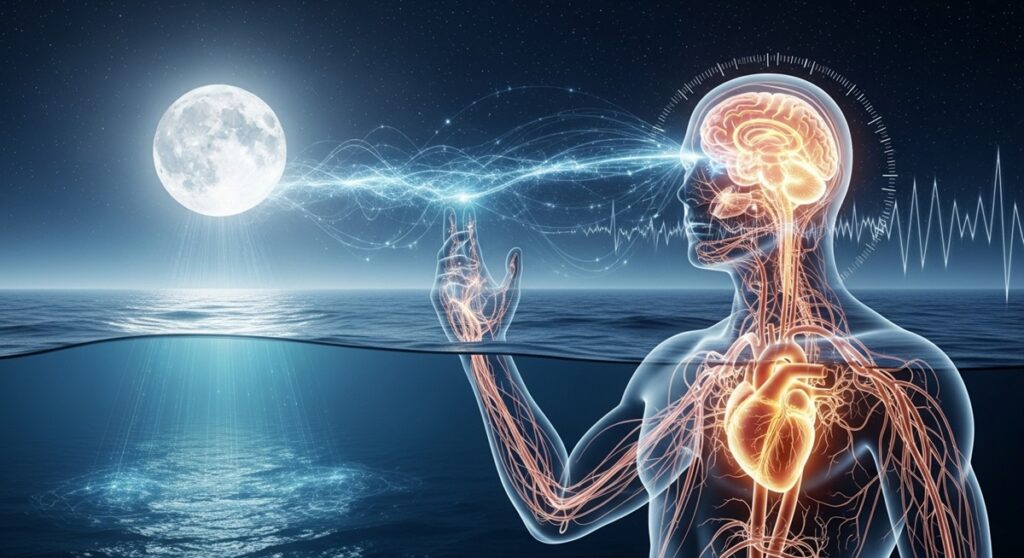
Human blood shares a broad compositional resemblance to ancient seawater, and our bodies are mostly water, which gives the old belief in the Moon’s pull on our internal fluids a certain symbolic resonance, even where the science doesn’t fully back it. The most genuinely interesting evidence involves circadian rhythms. A 2021 study published in Science Advances, led by chronobiologist Charlotte Helfrich-Förster, analyzed decades of individual menstrual records and found intermittent synchronization with lunar light and gravity cycles for a subset of women, a pattern that appeared to weaken after 2010, coinciding with widespread LED and smartphone screen adoption, though it persisted more strongly around January when the Moon’s and Sun’s gravitational pulls align most closely. That finding remains genuinely debated rather than settled: a much larger 2019 analysis of 1.5 million cycles logged through a period-tracking app found no meaningful lunar correlation at the population level, and independent chronobiologists reviewing Helfrich-Förster’s work have noted the synchronization she found was intermittent and inconsistent across individuals, not a reliable, universal pattern. The honest summary is that lunar-menstrual synchronization remains a live, unresolved research question, not the settled biological fact it’s often presented as.
Separately, it’s worth being precise about the tides themselves undercutting the oldest version of this belief. The Moon’s pull on ocean water is time-dependent, occurring twice every 24 hours, not phase-dependent. That means the old logic blaming Othello’s full-moon murder on lunar gravity was flawed on its own terms: his bodily fluids, if the theory held, would have been tugged just as hard during a quarter moon at the equivalent point in the tidal cycle. What actually varies by phase is light, not gravity, and modern researchers increasingly suspect that reported “full moon madness,” increased sleep disturbance, altered nighttime behavior, is substantially a matter of moonlight itself affecting sleep architecture, a real and separately documented effect, rather than any gravitational pull on the body.
Navigational Servitude | Deceived Night Insects
Even in the animal kingdom, the Moon’s influence is primarily light-based and non-mystical, yet genuinely vital. The chaotic flight of moths circling a lantern illustrates this well: the insects aren’t drawn to light out of attraction so much as using the distant, reliably fixed Moon as a navigational beacon to fly in a straight line. An artificial, nearby light source breaks that navigation system, causing the moth to circle endlessly trying to keep the light at a constant angle, sometimes until exhaustion. Dung beetles similarly use the Moon, or failing that, the brightest visible stars, to roll their dung balls in a straight line away from competitors, a finding confirmed experimentally in planetarium settings. In the insect world, the Moon functions as a fixed overhead reference point, a genuinely useful survival tool, not a mystical force.
Where the Speculation Outruns the Physics
This is worth addressing directly, since it’s the kind of claim that circulates as if it were real physics rather than a garbled version of it: there is no legitimate research proposing that the Moon “focuses” exotic particles to create new elements like potassium in soil. What’s real is considerably more mundane and, in its own way, more interesting: potassium-40, a naturally occurring radioactive isotope already present in soil since Earth’s formation, emits its own neutrinos as a byproduct of ordinary radioactive decay, a phenomenon physicists study as “geoneutrinos” to map the Earth’s interior composition. The Moon doesn’t generate or focus these particles, and no genuine physics research proposes it does. That detail is worth correcting plainly rather than treated as a tantalizing possibility, since it inverts a real, well-understood nuclear physics process into something it isn’t.
What’s Measurable and What Isn’t
The measurable effects of the Moon, light and gravitational tides, are substantial and genuinely foundational to life on Earth, from the intertidal zone that likely shaped vertebrate evolution to the photoperiodism that governs plant growth to the navigational systems of moths and dung beetles. Where the evidence gets more honestly uncertain is in human physiology specifically: menstrual-lunar synchronization remains a real, actively studied, and unresolved question, not settled fact in either direction, and the old belief in lunar-timed surgery has been tested repeatedly and found unsupported. The gap between what’s solidly established and what remains genuinely open is itself worth sitting with, rather than filling in with claims about particle physics that don’t exist in any published research. The Moon’s real influence on life turns out to be extensive enough without needing embellishment.