





The document is on the CIA’s own website. It has been there since declassification. Anyone can read it.
In October 1952, Marshall Chadwell, Assistant Director of Scientific Intelligence at the Central Intelligence Agency, sent a memorandum to General Walter Bedell Smith, Director of Central Intelligence and formerly Dwight D. Eisenhower’s Chief of Staff during World War Two. The memo concerned the wave of UFO sightings that had been overwhelming Air Force reporting systems for five years and that had reached its most publicly visible and institutionally difficult moment three months earlier, in July 1952, when objects tracked on radar performed maneuvers over the restricted airspace of the nation’s capital for two consecutive weekends.
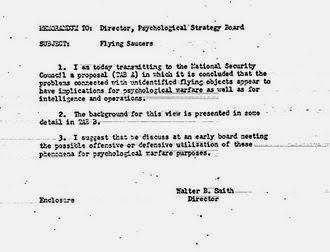
Chadwell’s memo requested that the National Security Council be briefed on the UFO situation so that a coordinated community-level response could be organized. It identified two separate institutional problems the phenomena presented. The first was operational: aircraft appearing and disappearing across American airspace without identification created conditions where a genuine Soviet attack could be misidentified as UFO activity, or where genuine UAP activity could trigger false alarms about Soviet attacks. The second was political, and it is the second that the memo’s most significant sentence addresses.
A study should be established to determine what, if any, use could be made of these phenomena by US psychological warfare planners.
The assistant director of CIA Scientific Intelligence proposed in writing, in a memo addressed to the Director of Central Intelligence, that the American government study how to weaponize public belief in UFOs for psychological warfare purposes. The memo is dated October 1952. The document is on the CIA’s website. The sentence is in paragraph four.
What the Washington Overflights Produced
The July 1952 context matters for understanding what Chadwell was responding to.
On the nights of July 19-20 and July 26-27, 1952, radar operators at Washington National Airport, Andrews Air Force Base, and Bolling Air Force Base tracked multiple unidentified objects performing maneuvers over the most restricted airspace in the United States. The objects appeared on multiple independent radar systems simultaneously. Jet interceptors were scrambled on both nights. The objects demonstrated acceleration and directional change capabilities that no 1952 aircraft could match. The objects appeared to respond to the interceptors’ presence, moving away when the jets approached and returning when they departed.
The Air Force held a press conference on July 29, 1952. Major General John Samford, the Air Force Director of Intelligence, offered the temperature inversion explanation. The explanation was immediately challenged by the radar operators who had tracked the objects, by civilian meteorologists who noted that the atmospheric conditions that night did not support the temperature inversion thesis, and by the simple fact that temperature inversions do not perform evasive maneuvers in response to interceptor aircraft.
By July 1952, the Air Technical Intelligence Center had logged 1,500 official sighting reports since 1947. That month alone produced 250 reports. Of all catalogued sightings, over twenty percent remained unexplained after analysis. The Air Force’s public explanation mechanism was overwhelmed and its credibility was failing.

The Chadwell memo was written into this institutional moment. Denial was not working. Explanation was not working. The question Chadwell was asking was whether the phenomena could be turned to use rather than managed as a liability.
The Robertson Panel
Two months after the Chadwell memo, in January 1953, the CIA convened a panel of scientists to review the accumulated UAP evidence and produce recommendations for institutional management of the situation. The panel was chaired by physicist H.P. Robertson of Caltech and included scientists from MIT, the University of California, and the weapons research establishment. Its classified report, declassified decades later, is the most explicit surviving statement of the institutional program for managing public belief about UAP phenomena.
The Robertson Panel concluded that there was no evidence of extraterrestrial craft in the reviewed material. It also recommended a program of public education specifically designed to reduce public interest in the subject, described in the report as stripping the phenomena of its special status. The mechanisms recommended included the use of television programs and popular media to associate UFO claims with irrationality and delusion, surveillance of civilian UFO investigation organizations to monitor their activities and membership, and the use of Project Blue Book’s public reporting function to generate dismissive narratives around reported sightings.

The recommendation to surveil civilian organizations is the most institutionally significant element of the report and the one that received the least public attention when the document was declassified. The CIA recommended monitoring the membership lists and activities of private citizens who were investigating UFO sightings because those citizens’ investigations represented a threat to the institutional management program. The threat was not to national security in the conventional sense. It was to the credibility of the management program itself.
The Robertson Panel report was implemented. Project Blue Book, established within the same institutional window, ran the public debunking program until 1969. Its internal assessments during that period, recorded in the files that became available after its closure, show an institution that understood the difference between its public function and its actual operational purpose.
The Management Program
The sequence from the 1952 Washington overflights to the Robertson Panel to Project Blue Book describes an institutional trajectory. An agency encounters a phenomenon it cannot explain, cannot suppress, and cannot explain away with the tools currently available. It convenes an internal review. The review recommends not further investigation of the phenomenon but a program for managing public belief about the phenomenon. The program runs for seventeen years under official cover as a scientific investigation. When it stops working because public credibility in its conclusions has declined too far, it is closed.
The question of what replaced Blue Book when it closed in 1969 is one that the public record does not answer directly. The Robertson Panel recommended a program. Blue Book implemented it for seventeen years. Institutional programs with national security implications do not end because a public-facing component is discontinued.
The AATIP program, which Luis Elizondo directed from 2007 to 2012, represented a classified continuation of the UAP analytical function that Blue Book had nominally performed publicly. Its existence was not acknowledged until 2017. The UAP Task Force established in 2020 represented a further evolution of the same function under different institutional cover.
Each institutional iteration represents the same management challenge the Chadwell memo identified in October 1952: a phenomenon that cannot be suppressed requiring an institutional response that serves the purposes the Robertson Panel specified. Not investigation. Management.
The Staged Event Question
The Chadwell memo proposed studying psychological warfare applications of UFO phenomena. The Robertson Panel recommended a program for managing public belief about UFO phenomena using media and surveillance. Some versions of the Blue Beam theory point to HAARP, the real ionospheric research program that ran from 1993 to 2014 at Gakona, Alaska, as evidence of the necessary technology. This overstates what HAARP was actually capable of: it was an unclassified facility, publicly documented and open to visiting scientists, studying how radio waves interact with the ionosphere for communications and basic research purposes, and nothing in its published research or technical specifications supports a capability for large-scale visible plasma projection or holographic image generation at altitude.
Project Blue Beam needs to be clearly separated from the real history above rather than presented as its natural continuation. The theory, first articulated by Canadian journalist Serge Monast in 1994, describes a staged alien invasion using holographic technology as a mechanism for achieving a coordinated global response that would justify new global governance structures. Monast’s claim has never been substantiated by any independent evidence, document, or credible source beyond his own writing, and it should be treated as unverified speculation rather than as a documented program. Monast did die of a heart attack in 1996. That fact is often placed immediately after mentioning his claims in a way that implies foul play without saying so directly, and this piece should not do that: there is no credible evidence connecting his death to his claims, and a heart attack in a fifty-one-year-old man requires no additional explanation. Blue Beam’s foundational claim, not the real Chadwell and Robertson Panel history that precedes it in this piece, is what remains entirely unverified.

The CIA proposed the psychological warfare use of UFO phenomena in 1952. The capability to generate aerial objects in airspace was developed and patented. The ionospheric research required for large-scale implementation was conducted for twenty-one years. The institutional infrastructure for managing public belief about aerial phenomena has been continuously operational in some form since 1953.
Monast’s claims about Blue Beam cannot be verified from the public record. What can be verified is the institutional trajectory from Chadwell’s 1952 proposal to the present: an agency that proposed weaponizing public UFO belief, implemented a program to manage it, developed technology capable of generating aerial objects, and conducted the atmospheric research required to deploy that technology at scale.
The distance between the 1952 proposal and a staged implementation is a distance of means. The institutional intention appeared in October 1952 and addressed to the Director of Central Intelligence.
The document is on the CIA’s website.
What Blue Book’s Closure Means
Project Blue Book was closed in December 1969 following the Condon Report, a University of Colorado study commissioned by the Air Force that concluded further investigation of UFO phenomena was not justified. Edward Condon, the study’s director, was a physicist and former director of the National Bureau of Standards. His report concluded that nothing had come from UFO study in twenty-one years that had added to scientific knowledge.
The internal Blue Book files, examined after declassification, tell a different story about what the program understood versus what it published. The program’s analysts identified multiple categories of genuine anomalies that the public-facing conclusions did not address. The Robertson Panel’s recommendation that unexplained cases be minimized in public reporting was implemented consistently across Blue Book’s operational period.

Blue Book’s closure was not a conclusion that the phenomena did not require investigation. It was a conclusion that Blue Book was no longer the appropriate institutional mechanism for conducting that investigation or for managing the public dimension of it. The phenomena that had generated 1,500 official reports by 1947 and 250 reports in a single month of 1952 did not stop producing reports in 1969.
The AATIP program recorded its own anomalies between 2007 and 2012 under a classification level that placed its findings outside the range of congressional oversight that Blue Book had nominally been subject to. The progression is consistent: each institutional iteration of the UAP management program operates at a higher classification level and lower public visibility than the one it replaced.
The Chadwell memo proposed psychological warfare use of the phenomena in October 1952. The Robertson Panel implemented the management program in January 1953. Blue Book ran the public component until 1969. AATIP ran the classified component from 2007 to 2012. The UAP Task Force has run the current component since 2020.

The Chadwell memo, on the CIA’s website, describes the beginning of a program whose current iteration has never been formally ended or its conclusions publicly disclosed.
The proposal to weaponize public UFO belief was made in writing, addressed to the Director of Central Intelligence, and sent to the National Security Council seventy-three years ago.
The management program it generated has been running continuously since three months after that memo was sent.