



The first one arrived in 2007, from data recorded in 2001.
Duncan Lorimer, a radio astronomer at West Virginia University, was searching archived data from the Parkes radio telescope in Australia when he found a pulse. It lasted approximately five milliseconds. In those five milliseconds it released more energy than the Sun produces in three days. It came from somewhere outside the Milky Way, at a distance that subsequent analysis placed at approximately one to two billion light years. It arrived once and was never detected again.
Lorimer and his student Matthew Bailes published the finding in Science in 2007. The astrophysics community’s initial response was skepticism: a single detection of an anomalous phenomenon in archived data is not the standard evidentiary threshold for a new astrophysical class. The Lorimer Burst, as it became known, sat at the margins of the field for several years before additional detections confirmed that it was not an artifact.
By 2013, four more FRBs had been detected in the Parkes data. By 2020, the catalog contained more than a hundred. By the current date, several hundred FRBs are in the published catalog, detected by radio telescopes on multiple continents and in space. They are confirmed as a genuine astrophysical class. Their origin is confirmed as extragalactic. Their sources are confirmed in a small number of cases through high-resolution localization. Their mechanism is not confirmed.
The mechanism is not confirmed because every proposed mechanism has problems with observed properties, and because the observed properties of FRBs as a class show a diversity that a single mechanism does not obviously explain. Whether this diversity reflects multiple mechanisms producing similar observable signatures, a single mechanism operating under dramatically different environmental conditions, or something else entirely, is the question that the current astrophysical literature treats as its most important unresolved problem in transient radio astronomy.
What a Fast Radio Burst Actually Is
A Fast Radio Burst is a transient radio emission lasting between approximately a tenth of a millisecond and a few seconds, with peak durations typically in the range of one to ten milliseconds, whose dispersion measure, the frequency-dependent delay in its arrival time, establishes its origin outside the Milky Way in every confirmed case.
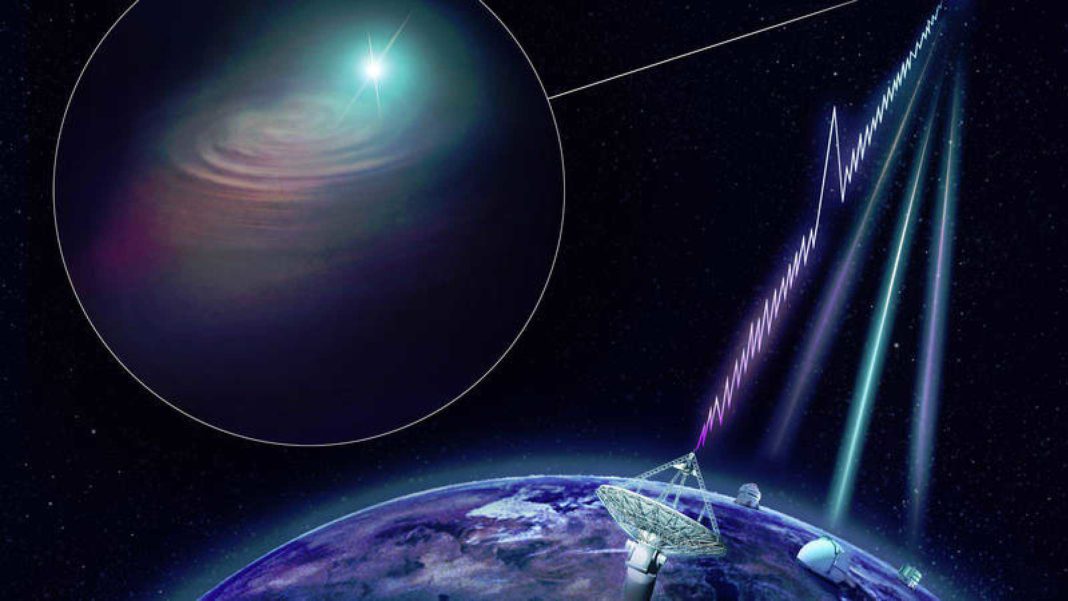
The dispersion measure is the diagnostic that makes FRBs scientifically significant rather than simply anomalous. Radio waves traveling through ionized plasma, the diffuse gas between galaxies, are dispersed: lower frequency components of the signal travel more slowly than higher frequency components, arriving later at the detector. The magnitude of this dispersion, quantified as the dispersion measure, increases with the amount of ionized plasma the signal has passed through. For FRBs, the dispersion measures measured are significantly higher than can be accounted for by the Milky Way’s interstellar medium alone, confirming that the signals have traveled through substantial intergalactic space before arriving at Earth.
The energy released in a single FRB event is extraordinary. The Lorimer Burst released approximately ten to the thirty-third power joules in five milliseconds. For comparison, the Sun’s total luminosity is approximately four times ten to the twenty-sixth watts: the FRB released in five milliseconds what the Sun produces in approximately two and a half billion years.
This energy density, releasing the equivalent of years of stellar output in milliseconds from a source region small enough to produce the observed pulse coherence, is the primary constraint on FRB source models. Whatever produces an FRB must be capable of releasing this energy density in this timescale from a compact source.
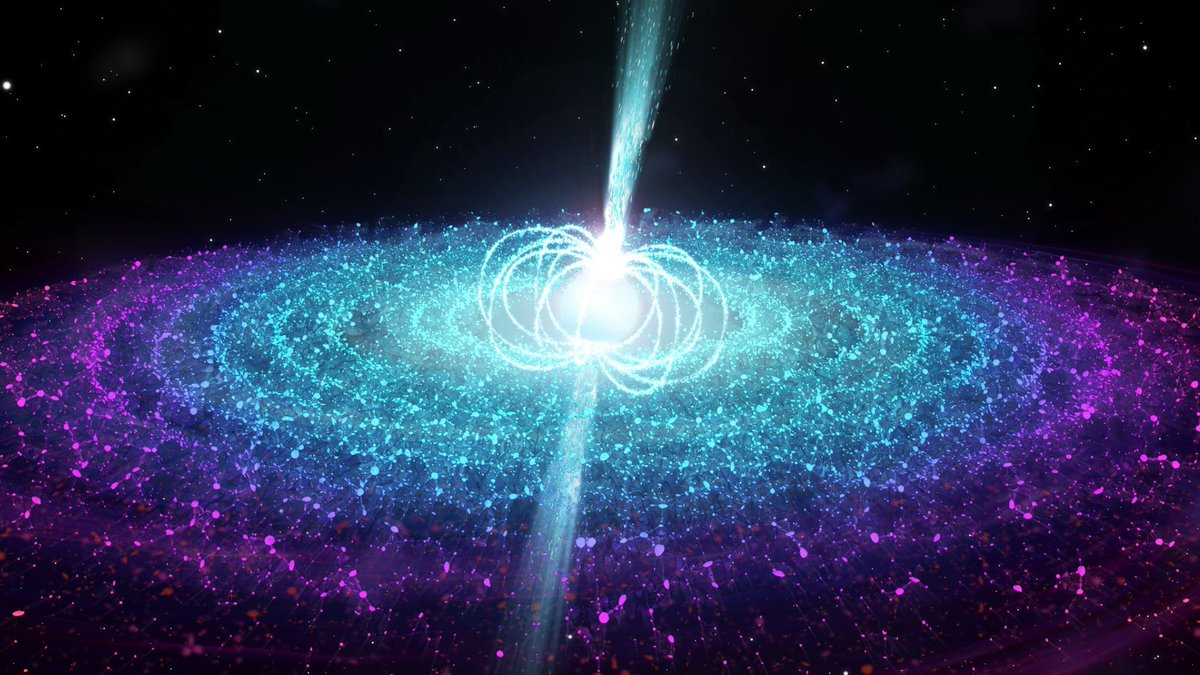
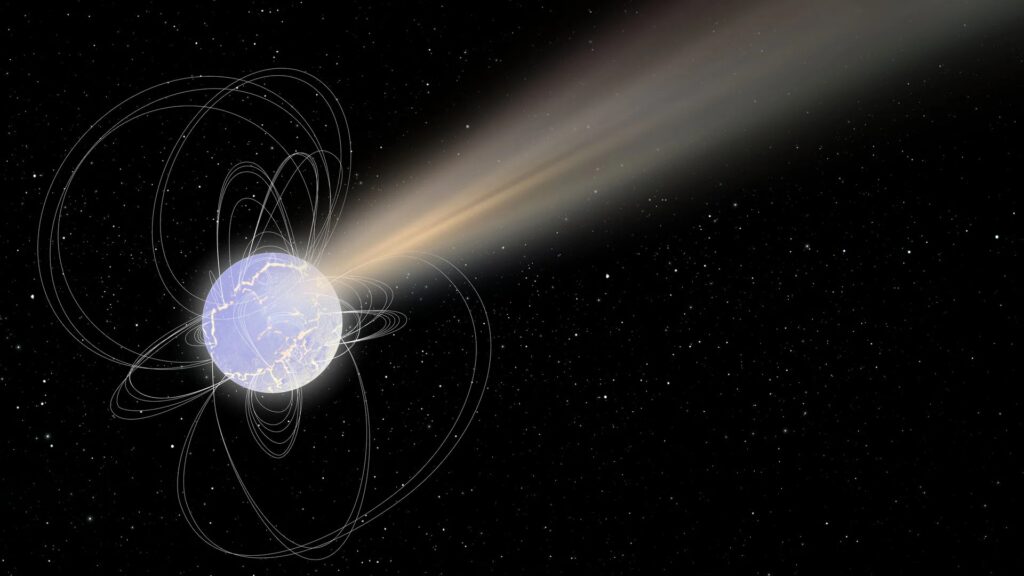
The natural candidates are the most energetically extreme environments in the known universe: neutron stars, which pack approximately one and a half solar masses into a sphere of approximately ten kilometers, magnetars, neutron stars with magnetic fields of ten to the eleven Tesla, approximately a trillion times the Earth’s magnetic field, and black holes, whose accretion dynamics can release energy at rates approaching the Eddington luminosity of stellar-mass and supermassive objects.
Each of these candidates accounts for some observed FRB properties and fails to account for others.
The Repeaters
The property that most directly challenges the natural source models is repetition.
Most FRBs have been detected once. This is expected for catastrophic one-time events like neutron star mergers or the collapse of a massive star: the event produces the burst and the source is destroyed or fundamentally altered. The detection rate of non-repeating FRBs is consistent with the predicted rate of appropriate catastrophic events in the observable universe, providing circumstantial support for catastrophic source models.
The repeating FRBs are different. As of the current catalog, approximately forty FRB sources have been observed to repeat, producing multiple bursts from the same sky position over days, months, or years. The repetition rate is low: most detected repeating sources have produced tens or hundreds of bursts over their observation periods. But the repetition itself eliminates the catastrophic event models for these sources: whatever is producing the repeated bursts from the same location survives each burst event and produces another.
FRB 121102A, the first repeating FRB identified, was discovered in data from the Arecibo telescope in 2012 and published in 2016 when its repeating character was confirmed. Its source was subsequently localized to a dwarf galaxy approximately three billion light years from Earth through VLBI observations, making it the first FRB to be precisely localized.
The dwarf galaxy environment was significant: the source was embedded in a persistent radio emission region whose luminosity and physical characteristics were consistent with either a young magnetar embedded in a supernova remnant or a compact object in the environment of a massive black hole. The persistent source provides the first environmental context for an FRB source and connects the mechanism to extreme astrophysical environments.
What the persistent source model does not explain is the temporal structure of FRB 121102A’s repeat burst distribution: the bursts cluster in time, with periods of high burst rate followed by periods of silence, whose pattern the static persistent source model does not predict.
The Seventeen-Day Period
In 2020, a team led by Dongzi Li published a paper in Nature reporting the most significant single finding in FRB research to that date: FRB 121102A showed a statistically significant periodicity in its burst activity.
The period was approximately sixteen to seventeen days. Over a dataset spanning approximately a year of observations, the source showed an active window of approximately four days followed by an inactive window of approximately twelve to thirteen days, cycling with a period of sixteen to seventeen days.
The paper’s statistical analysis established the period’s significance at well above the threshold for claiming a detection: the probability that the observed periodicity arose by chance from a randomly distributed burst sequence was calculated at less than one in ten thousand.
A seventeen-day period in the activity cycle of an extragalactic radio source is one of the most significant pieces of astrophysical data in the FRB literature because it constrains the source model in ways that the individual burst properties do not.
The natural mechanism most consistent with a seventeen-day periodicity is orbital: if the FRB source is in a binary system with a companion object, and if the companion periodically obscures or enhances the emission through geometric or plasma effects, the orbital period of the binary would produce exactly this type of activity window. A seventeen-day orbit implies a binary separation and companion characteristics that constrain the source model to a class of compact binary systems.
The alternative natural mechanism is geometric precession: if the FRB source’s emission beam precesses on a seventeen-day cycle, the beam would sweep across the Earth’s line of sight periodically and away from it periodically, producing the observed activity window without requiring a binary companion.
Both models are physically plausible. Both have been published in the peer-reviewed literature. Neither has been definitively established as the correct explanation.
The observation that makes both natural models difficult rather than straightforward is the burst substructure. Individual bursts from FRB 121102A show complex time-frequency structure: within a single burst lasting a few milliseconds, there are sub-bursts with frequency drift patterns, spectral widths, and time-frequency relationships that the simple neutron star or magnetar models produce only with additional and somewhat ad hoc assumptions about the emission geometry.
The complexity of the burst substructure, combined with the seventeen-day periodicity of the activity window, produces a source whose overall temporal behavior requires a model with at least two distinct timescale components: the millisecond timescale of individual burst production and the seventeen-day timescale of the activity window. Natural models that produce both simultaneously without invoking multiple independent mechanisms are not yet in the published literature.
FRB 180916 and the Spiral Galaxy
FRB 180916.J0158+65 represents a different class of localization evidence. Where FRB 121102A was placed in a dwarf galaxy at three billion light years, FRB 180916 was localized by the European VLBI Network to a position within a spiral galaxy approximately five hundred million light years from Earth, published in Nature in January 2020.
The spiral galaxy, SDSS J015800.28+654253.0, is structurally similar to the Milky Way: a grand design spiral with a star-forming disk and a central bulge. The FRB 180916 source is located in the outskirts of one of the galaxy’s spiral arms, in a region of moderate star formation activity.
The significance of this localization was the contrast with FRB 121102A’s dwarf galaxy environment. FRB 121102A’s source was in an extreme environment: a dwarf galaxy with high star formation rate, a persistent radio source co-located with the FRB position, and environmental characteristics suggesting unusually energetic or extreme astrophysical activity.
FRB 180916’s source is in an ordinary environment: a typical spiral galaxy in a typical region of a typical spiral arm. Whatever is producing FRB 180916 does not require the extreme environment that FRB 121102A suggested might be necessary.
Co-author Jason Hessels’s statement in the published paper captures the implication: we are at the point where a theory has to explain this diversity or we have to start thinking seriously about the presence of different types of sources for FRB.
The diversity between the two repeating FRB environments, one extreme and one typical, suggests either that the same mechanism operates in dramatically different environments, or that FRBs are not a single astrophysical class but a phenomenological category whose observable properties are shared by multiple distinct source types.
FRB 180916 also subsequently showed a periodicity. Its activity cycle, published in a 2020 paper by the CHIME collaboration, has a period of approximately sixteen and a third days, strikingly similar to FRB 121102A’s seventeen-day period. Two repeating FRBs from different galaxy types and different astrophysical environments both showing similar periodicity is the finding that the single-mechanism advocates point to as evidence for a common physical origin, and that the multiple-mechanism advocates must explain through environmental coincidence.
The CHIME Catalog and the Statistical Picture
The Canadian Hydrogen Intensity Mapping Experiment, CHIME, is a radio telescope in British Columbia whose design makes it uniquely effective for FRB detection: its fixed cylindrical reflectors observe a large swath of the sky simultaneously rather than pointing at targets, allowing it to survey the full accessible sky on a daily cadence.
CHIME’s FRB detection rate, since becoming operational in 2018, has increased the known FRB catalog by more than an order of magnitude. The CHIME FRB Catalog 1, published in 2021, contained 536 sources detected between July 2018 and July 2019 alone.
The statistical properties of the CHIME catalog provide the most comprehensive current picture of the FRB population as a whole. The catalog shows that FRBs are distributed uniformly across the sky, consistent with an isotropic extragalactic source distribution. The dispersion measure distribution shows sources at a range of distances from nearby to cosmological. The burst rate, extrapolated from the CHIME detection rate to the full sky, implies that approximately ten thousand FRBs occur somewhere in the observable universe every day.
Ten thousand events per day, each releasing energy equivalent to years of stellar output in milliseconds, from sources distributed uniformly across the observable universe.
Whether this rate is consistent with the known population of magnetars and neutron stars, the proposed natural sources, depends on the efficiency with which these objects convert their available energy into the type of radio emission that FRBs represent. The efficiency calculations required to match the observed FRB rate to the magnetar population have problems that the current models have not fully resolved.
The Artificial Signal Hypothesis
The natural source models for FRBs have been developed and published in the peer-reviewed literature with the appropriate rigor that mainstream astrophysics applies to novel phenomena. They have physical motivations, predictive consequences, and empirical constraints.
The artificial signal hypothesis, that some or all FRBs represent deliberate transmissions from technological civilizations, has also been published in the peer-reviewed literature, though in a smaller number of papers and with more limited institutional enthusiasm.
Avi Loeb and Manasvi Lingam published a paper in the Astrophysical Journal Letters in 2017 proposing that FRBs could be consistent with beamed microwave emissions from a planet-sized transmitter used to propel light sails across interstellar distances. Their argument was that the physical parameters of FRBs, their energy, bandwidth, and beaming characteristics, are within the range of what a sufficiently advanced technology could produce, and that the geometry required for a transmission system of this type would produce the observed millisecond burst duration when the beam sweeps across the Earth’s line of sight during each rotation of the transmitter’s host planet.
Whether this model is correct is not established. What the Loeb-Lingam paper established is that the artificial transmission hypothesis is not ruled out by the physical parameters of FRBs, and that the hypothesis makes testable predictions whose verification or falsification is possible with current or near-future radio telescope capabilities.
The predictions include: artificial FRBs should show coherent emission properties distinct from the incoherent emission expected from plasma-based natural sources, artificial FRBs should show temporal regularities corresponding to the rotation period of the transmitter’s host planet or the orbital period of the transmitter system, and artificial FRBs should not show the spectral evolution patterns associated with plasma dispersion in the emission region, though interstellar dispersion would still be present.
The FRB 121102A periodicity is consistent with the artificial transmission prediction of temporal regularity. The burst substructure complexity, with its frequency drift patterns, is consistent with either the plasma emission models or the coherent emission models. The full set of FRB 121102A’s properties has not been shown to be inconsistent with the artificial transmission hypothesis.
This is not evidence for artificial transmission. It is the absence of definitive evidence against it.
The Signal Piece’s Existing Framework
The Signal Has Already Left piece in this library develops the Drake Equation framework, the Fermi Paradox, and the physical arguments for why electromagnetic signals rather than physical spacecraft might be the primary evidence for extraterrestrial civilizations in a universe where the distances between stars make physical travel extraordinarily costly.
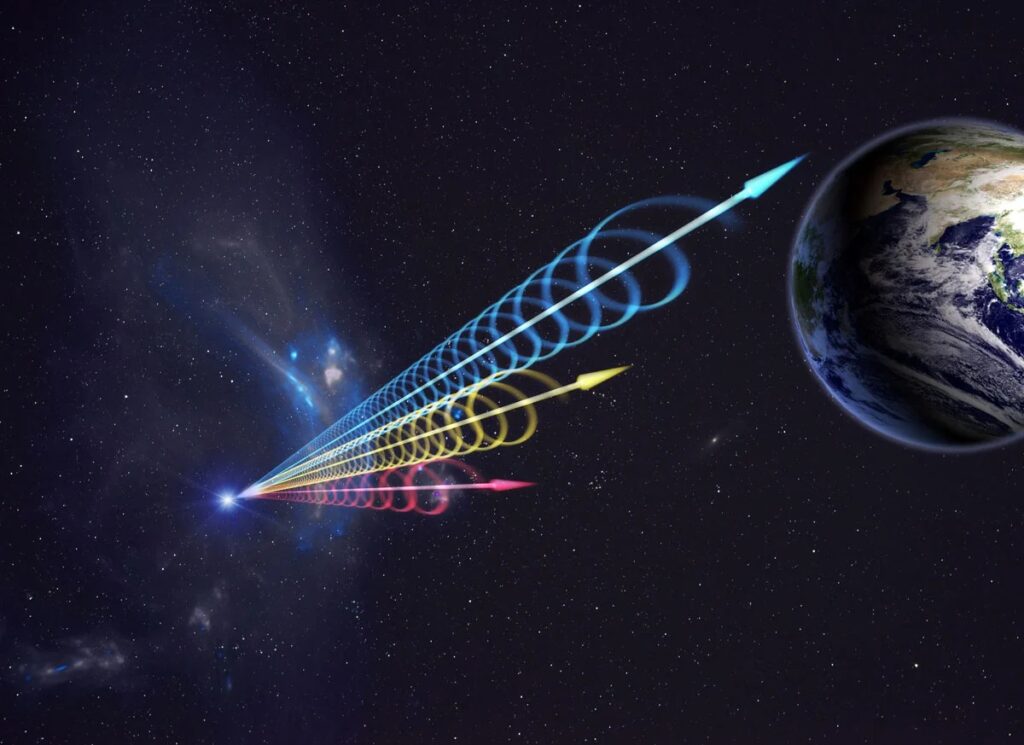
FRBs are the most energetically extreme transient electromagnetic events in the current catalog of detected astrophysical phenomena. Their detection rate implies they are common. Their energy output implies they are extraordinary. Their source mechanism is the most contested question in current radio astronomy.
The SETA piece in this library develops the co-orbital probe surveillance hypothesis and notes that the Galileo Project’s all-sky monitoring system is the most rigorous current institutional response to the question of anomalous electromagnetic and physical phenomena in the solar system.
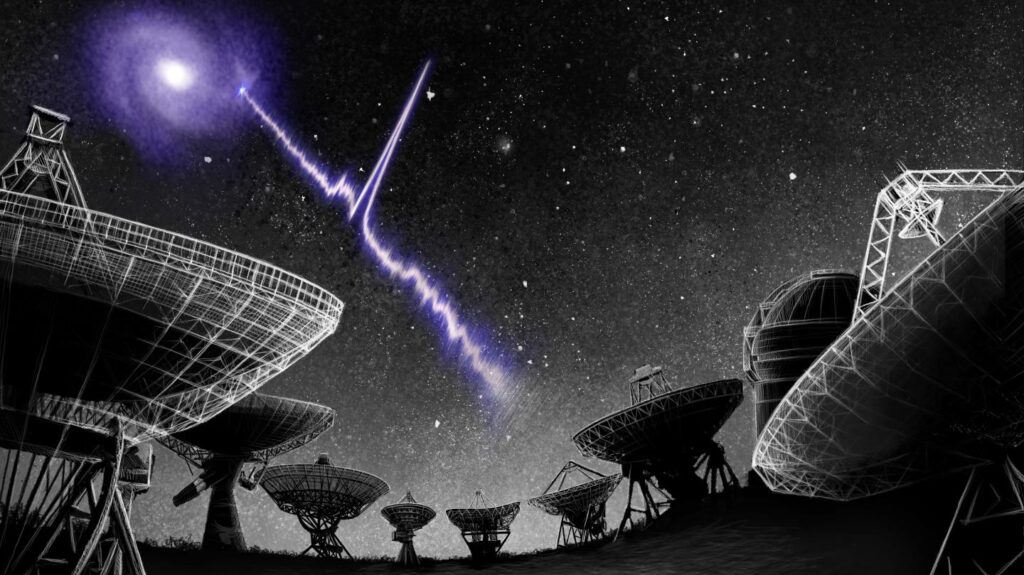
Whether FRBs represent a class of phenomena that the Galileo Project’s monitoring would capture is a technical question: FRBs are extragalactic and are detected by large radio telescopes specifically designed for wide-field radio survey work, not by the optical and infrared cameras that the Galileo Project deploys for its primary monitoring function. The FRB detection infrastructure, CHIME, Parkes, Arecibo, the MeerKAT array in South Africa, is the relevant institutional context for the search for artificial FRB signals.
The connection between the SETA framework and the FRB catalog is the question of whether any known FRB source shows the properties that an artificial transmission from a technological civilization would display that a natural source would not. The periodicity findings, the burst substructure complexity, and the localization diversity all contribute to this question without resolving it.
What Seventeen Days Implies
The seventeen-day periodicity of FRB 121102A and the sixteen-day periodicity of FRB 180916 are the most pieces of structural evidence in the FRB catalog whose implications have not been fully processed in the mainstream astrophysical literature.
A natural source whose activity is modulated by a seventeen-day period requires a physical mechanism operating on that timescale. The binary orbit and precession mechanisms are the most developed natural explanations. Both require physical parameters: the binary orbit model requires a companion object whose orbital characteristics produce the observed window geometry, and the precession model requires a neutron star whose spin-axis precession rate corresponds to the observed period.
Neither mechanism makes predictions about why two FRB sources in different galaxies and different astrophysical environments would show similar periods. The binary orbit model would predict a distribution of periods reflecting the distribution of compact binary separations, which should be broad and not concentrated near sixteen to seventeen days. The precession model would predict a distribution of periods reflecting the distribution of neutron star spin-axis precession rates, also expected to be broad.
The clustering of two independent repeating FRB periods near seventeen days is either a significant observational coincidence, the result of a selection effect in the current sample that concentrates near this period, or evidence of a common physical mechanism whose timescale is constrained to this range.
The selection effect explanation is plausible: the current repeating FRB sample is small, and the detection methodology of current surveys may favor sources that repeat on timescales of days to weeks. Whether the seventeen-day clustering is a genuine feature of the repeating FRB population or an artifact of the current sample size will be answerable when the repeating FRB catalog grows by an order of magnitude.
If the clustering persists as the sample grows, the natural mechanism explanation becomes significantly more constrained. A natural mechanism that consistently produces seventeen-day periodicity from sources in different environments would require either a universal feature of the compact object population, which the current population models do not clearly provide, or a common origin mechanism that constrains the relevant physical parameters.
An artificial transmission mechanism that produces seventeen-day periodicity from sources in different galaxies would require either a common technological solution to an engineering problem, the same rotation period for the transmitter’s host planet in different star systems, or a deliberate choice of transmission period that is standardized across different transmission sites.
The second possibility, a standardized transmission period, is the prediction that the artificial transmission hypothesis makes that the natural mechanism hypothesis does not: if FRBs are deliberate interstellar transmissions from technological civilizations, and if those civilizations are using a standardized protocol for their transmission system, the periodicity should be consistent across different sources because it reflects the standard rather than the physical parameters of each source.
The Magnetar That Changed Everything and What It Left Unexplained
On April 28, 2020, the European Space Agency’s INTEGRAL satellite detected a burst of X-ray energy from a known source approximately 30,000 light-years away in the constellation Vulpecula. The source was SGR 1935+2154, a magnetar discovered in 2014 and known to emit powerful bursts of gamma rays and X-rays at irregular intervals. In late April 2020 it had reactivated after a period of relative quiet.
At the same moment that INTEGRAL registered the X-ray burst, the CHIME radio telescope in British Columbia, Canada, which is the same instrument whose data established the 17-day periodic FRB documented above, detected a burst of radio waves from the identical position in the sky. Radio telescopes operated by the STARE2 array in California and Utah independently confirmed the radio emission within 24 hours.
The combined detection was published simultaneously in multiple papers in Nature in November 2020, with the CHIME/FRB Collaboration and Sandro Mereghetti of Italy’s National Institute for Astrophysics among the lead authors. Mereghetti’s recorded statement about the finding: we have never before seen a burst of radio waves similar to a fast radio burst from a magnetar. This is the first observed connection between magnetars and fast radio bursts.
The significance of this detection for FRB research is foundational. Before April 28, 2020, every known FRB had originated in a galaxy hundreds of millions to billions of light-years from Earth. The distances made detailed investigation of the emission mechanism impossible: the signals arrived having traveled too far for any simultaneous multi-wavelength observation at the source. The SGR 1935+2154 event occurred close enough, in cosmological terms, that multiple instruments in orbit and on the ground caught it simultaneously across the full electromagnetic spectrum from X-ray to radio.
The simultaneous X-ray and radio emission established magnetars as confirmed producers of at least some fast radio bursts. This is the most significant single advance in FRB astrophysics since the phenomenon was discovered in 2007. It provides a physical mechanism: a magnetar’s intense magnetic field, the strongest of any known object at approximately ten to the fifteenth power Gauss, can accelerate charged particles to energies sufficient to produce the extraordinarily powerful radio emission that FRBs require.
Whether magnetars account for all FRBs or only some of them is the question that the SGR 1935+2154 detection opens rather than closes. The burst from SGR 1935+2154, while energetic enough to qualify as a genuine FRB by the radio flux criteria, was approximately 30 to 3,000 times less energetic than the most powerful extragalactic FRBs. Whether scaled-up magnetar activity can account for the most extreme events in other galaxies, or whether some FRBs require a different and currently unknown mechanism, is the question that the energy discrepancy motivates.
This is where the 17-day periodic FRB documented above becomes more specifically anomalous rather than less, and the relationship between the two findings deserves explicit development.
The SGR 1935+2154 magnetar produced a single burst, followed by subsequent lower-level bursting activity without any identifiable periodicity. Its emission pattern is irregular, driven by the unpredictable dynamics of its magnetic field’s stress and release. The random nature of its bursting is consistent with what the magnetar model predicts: a stressed magnetic crust periodically fracturing in unpredictable locations, producing bursts whose timing reflects internal magnetic dynamics rather than any external clock.
The periodic FRB described above, designated FRB 180916.J0158+65 and detected by the same CHIME telescope that caught the SGR 1935+2154 radio burst, shows a 17-day cycle with 4 active days followed by 12 quiet days, repeated without drift or interruption across the full observational baseline. This periodicity is not predicted by the magnetar model that the SGR 1935+2154 detection confirmed.
Magnetar burst patterns do not show stable multi-day periodicities. The physical mechanisms that could produce a strict 17-day on-off cycle in a magnetar’s radio emission have been proposed, including precession of the magnetar’s rotation axis and orbital motion in a binary system where a companion star periodically obscures or distorts the emission, but none of these proposed mechanisms has been confirmed for FRB 180916.J0158+65’s source.
The magnetar confirmation therefore produces a puzzling and interesting result for the periodic FRB: it establishes that magnetars produce some FRBs through a confirmed physical mechanism, which makes the periodic FRB’s character more, not less, in need of explanation. If the periodic source were simply a magnetar, its periodicity would require an additional mechanism beyond standard magnetar burst physics. If the periodic source is not a magnetar, the SGR 1935+2154 confirmation means there are at least two distinct classes of FRB source, one confirmed and one unknown.
Erik Kuulkers, the ESA scientist who coordinated the multi-telescope observation campaign that captured the SGR 1935+2154 event, made a public statement, on the record, about what the detection requires for future progress: greater collaboration between institutions to focus even more on the origin of these mysterious phenomena. The collaboration he called for, simultaneous multi-wavelength observation of FRB sources as they occur, is exactly what the 17-day periodic source’s predictable active window makes possible.
The periodic FRB’s active window is known in advance. The instruments exist to observe it simultaneously across wavelengths. Whether the source shows simultaneous X-ray emission during its radio bursts, as the magnetar SGR 1935+2154 did, or shows only radio emission without X-ray counterpart, would distinguish between the magnetar model and alternatives in a single coordinated observational campaign.
Whether that campaign has been conducted and what it found is not established in the available published record as of the current writing.
The CHIME telescope detected both. The magnetar source revealed itself. The periodic source is still repeating on its 17-day cycle.
Whatever is running on that schedule, the instrument that could tell us what it is has been pointed at the sky since 2018.
The Distance and the Direction
FRB 121102A is three billion light years from Earth. FRB 180916 is five hundred million light years from Earth. The signals arriving from these sources left their origins three billion years and five hundred million years ago respectively.
Three billion years ago, the Earth was in its Archean eon: single-celled life existed, but multi-cellular organisms would not appear for another billion years. Five hundred million years ago, the Cambrian explosion had just produced the first complex animal body plans.
Whatever transmitted these signals, if they are transmissions, did so before multi-cellular life had established itself on Earth. Whatever received them is receiving them now, five hundred million to three billion years after transmission.
This temporal displacement is one of the most profound aspects of the FRB phenomenon that the mainstream discussion does not fully develop. The signals are not current communications. They are historical records of whatever produced them, transmitted from the deep past of the universe’s timeline and arriving in our present through the physics of light travel time.
If FRBs are natural astrophysical events, this temporal displacement is irrelevant to their meaning: a magnetar that produced a burst three billion years ago is simply a magnetar, no more meaningful than any other magnetar in the historical record.
If FRBs are artificial transmissions, the temporal displacement becomes the most important single fact about them: a civilization that transmitted a signal three billion years ago may no longer exist. It may have evolved beyond recognition. It may be the origin of everything that followed in the galaxy’s civilizational history. The signal is a message from the deep past of cosmic history, arriving now, in the civilizational moment when humanity has built instruments sensitive enough to detect it.
The detection of the first FRB in 2001 data was not made until 2007. The comprehensive survey of the FRB population was not possible until CHIME began operations in 2018. The instruments required to detect these events have existed for decades, but the survey methodology required to characterize the population was developed only in the last decade.
Whether the timing of humanity’s development of the capabilities required to detect and analyze FRBs has any significance relative to the frequency of the FRB events and the distance ranges from which they are detectable, is a question that the anthropic principle addresses in ways that neither confirm nor deny the relevance.
The signals have been arriving for billions of years. The receivers capable of characterizing them have existed for approximately twenty years. The catalog containing several hundred sources has been assembled in the last decade. The periodicity that provides the most structural constraint on the source model was published in 2020.
The mechanism is still not confirmed.
The signals are still arriving.