



In December 1945, a farmer named Muhammad Ali al-Samman was digging near the cliffs of Jabal al-Tarif, outside the Egyptian town of Nag Hammadi, when his mattock struck something buried in the earth. It was a large sealed earthenware jar. Inside were thirteen leather-bound codices containing fifty-two texts written in Coptic on papyrus, preserved in the dry Egyptian climate for roughly sixteen centuries.
The discovery was extraordinary for a simple reason. Many of the texts contained ideas that had survived antiquity largely through the descriptions and criticisms of their opponents. Here, suddenly, were manuscripts produced by communities whose voices had been partially submerged by the victory of emerging Christian orthodoxy.
What those manuscripts contain is stranger than the circumstances of their discovery. They describe a universe in which the visible world is not the highest reality, in which the creator of the material order may itself be ignorant of the reality above it, in which human beings contain something that does not entirely belong to the material world, and in which liberation comes not primarily through obedience to an institution but through gnosis: a direct recognition of what one actually is.
Nearly two thousand years later, philosophers began asking whether reality itself might be constructed. Computer scientists began describing information as fundamental to physical description. Physicists found unexpected mathematical correspondences between areas of mathematics developed for completely different purposes.
None of that proves the Gnostics were right.
But the resemblance is difficult to ignore once the ancient system is understood on its own terms.
Why Were These Texts Buried?
The history needs to be handled carefully because one of the most persistent stories surrounding Nag Hammadi is also one of the easiest to oversimplify.
The texts were not discovered because a fourth-century church official wrote “destroy these particular thirteen codices” and someone secretly rescued them. We do not possess a document identifying the person who buried the collection, nor do we know precisely why that person chose this location. What we know is more limited and, in some ways, more interesting.
The codices were produced in a period when competing Christian traditions were increasingly being defined as heretical. Irenaeus of Lyon’s Against Heresies, written around 180 CE, attacked several movements that modern scholars associate with what is broadly called Gnosticism. The irony is that Irenaeus preserved descriptions of traditions whose own literature would later become extraordinarily difficult to recover.
Then, in 367 CE, Athanasius of Alexandria issued his famous Easter Letter listing the books he regarded as canonical and distinguishing them from other texts. The letter is not an order specifically naming the Nag Hammadi codices, and it would be misleading to present it as one. But it belongs to the same historical process: Christianity was becoming increasingly organized around an accepted textual and theological boundary, while competing traditions were losing institutional ground.
The Nag Hammadi codices appear to have been buried sometime in the late fourth century. The chronological proximity is suggestive. The precise motive is unknown.
That distinction matters. There is a fascinating historical story here without needing to manufacture a missing document of persecution.
The texts survived anyway. Some of the manuscripts later suffered damage after their discovery, and parts of the collection were dispersed before scholars understood what had been found. But enough survived for an entire intellectual tradition, once known largely through hostile descriptions, to speak again in its own voice.
What the Library Actually Contains
“The Gnostic texts” sounds like a single body of teaching. It wasn’t. The Nag Hammadi collection contains works from different communities, periods and theological traditions. Some are recognizably Christian. Some are heavily mythological. Some are philosophical. Some draw on Jewish, Platonic, Hermetic and other intellectual currents. The manuscripts do not present one clean doctrine.
That diversity is important because later writers often speak of “Gnosticism” as though it were an organized religion with a single creed. It is better understood as a family of related movements and texts whose common features include an unusually strong emphasis on hidden knowledge, the distinction between the highest divine reality and the material cosmos, and the possibility that human beings possess a deeper identity than the one ordinarily recognized.
The Gospel of Thomas, for example, contains 114 sayings attributed to Jesus. Some resemble sayings preserved in the canonical Gospels. Others have no direct canonical parallel. Its central concern is not the construction of a cosmic bureaucracy but the discovery of hidden meaning through direct recognition.
The Gospel of Philip takes the reader somewhere stranger still. One damaged passage describes Mary Magdalene as a companion of Jesus and says that he loved her more than the other disciples. The manuscript is damaged at precisely the point where the text describes where he kissed her. The missing word has generated centuries of speculation compressed into a single lacuna.
What the missing word means cannot be recovered with certainty. The responsible conclusion is therefore not that the passage proves a secret relationship, nor that it proves a suppressed alternative Christianity, but that the manuscript leaves a genuine historical question unresolved.
The Cosmology of the Apocryphon of John
The text that matters most to the modern comparison is the Apocryphon of John.
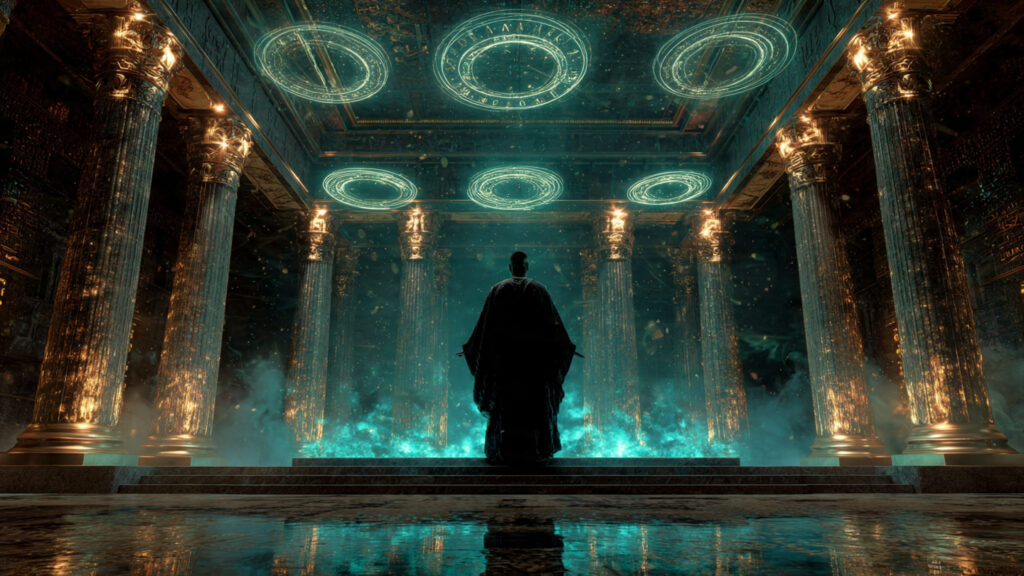
Its cosmology begins above the ordinary universe. At the highest level is the unknowable divine source, the Invisible Spirit. From this source emerges the Pleroma, a fullness of divine reality expressed through emanations.
Then something goes wrong.
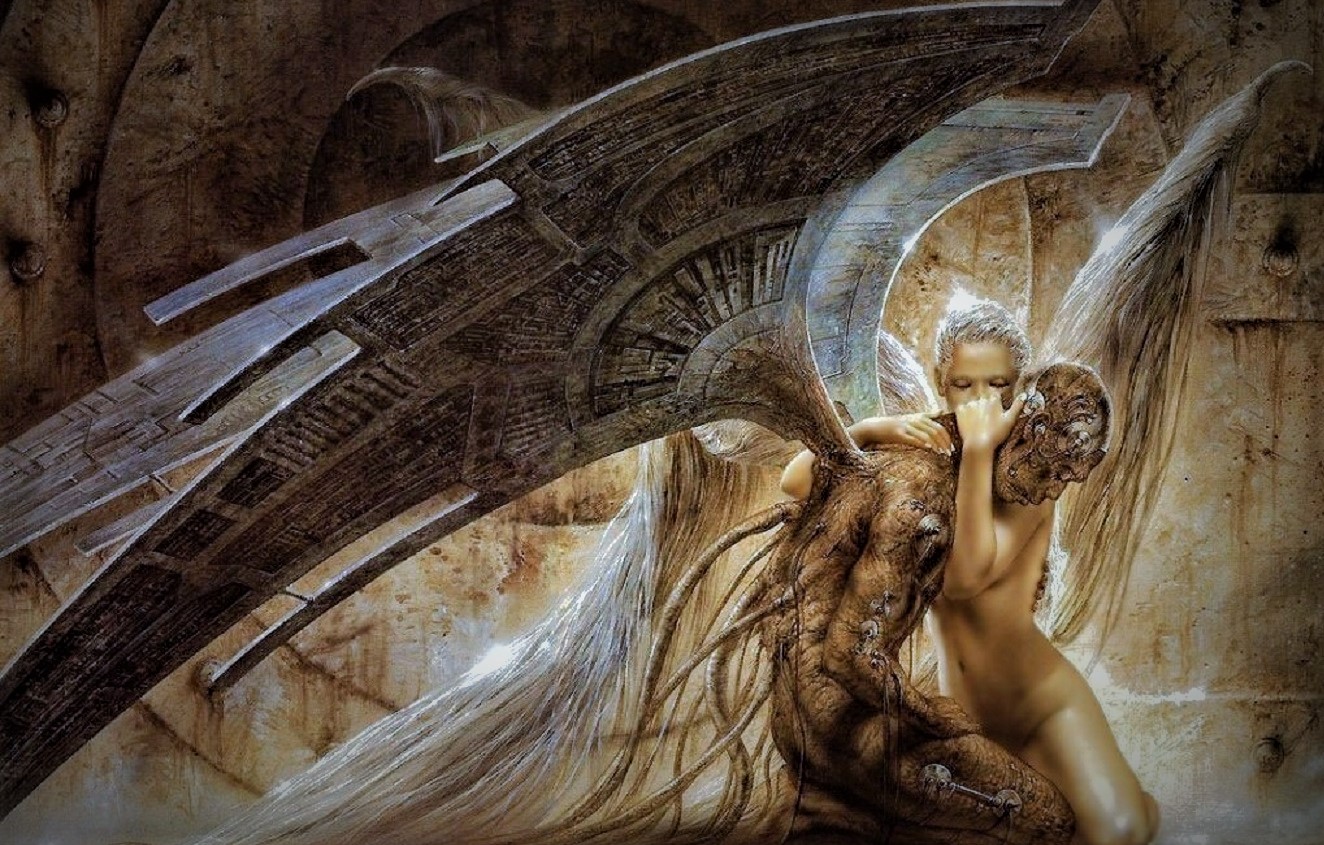
Sophia, one of the divine emanations, acts without her counterpart and produces an imperfect being. This being, Yaldabaoth, does not understand his own origins. He believes himself to be the highest divine authority and proceeds to construct the material cosmos.
The result is one of the most remarkable cosmological ideas in the ancient religious world: a creator who is powerful enough to construct a universe but ignorant of the reality above him.
The Archons serve within this lower order. Human beings, meanwhile, contain a divine element, a spark that originates in the higher reality but has become entangled in the material world.
Gnosis is the escape route.
But “knowledge” is an imperfect translation because the word suggests information. The Gnostic idea is closer to recognition: the sudden apprehension of one’s actual origin and identity. The problem is not merely that human beings lack facts. The problem is that they have forgotten what they are.
The Ancient World as a Constructed World
This is where the Nag Hammadi material begins to acquire an unexpected modern resonance.
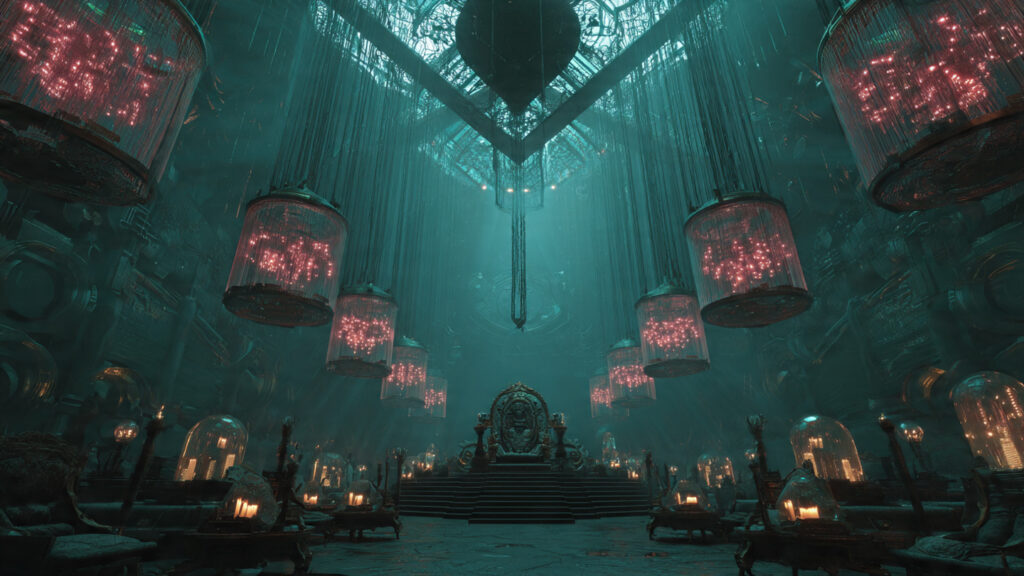
The Apocryphon of John describes a world that is real to the beings living inside it but is not ultimate reality. Its creator is not the highest intelligence. Its administrators maintain the structure. Its inhabitants do not ordinarily understand their own position within it. Liberation requires discovering something about the nature of the system and, more importantly, about oneself.
That is not a description of a computer simulation. The Gnostics were not secretly anticipating modern computing. Their universe was theological, metaphysical and mythological, not digital.
But the architecture is recognizable.
Modern simulation arguments ask whether conscious beings could exist inside an artificial reality whose inhabitants mistake their environment for fundamental reality. The ancient Gnostic texts ask whether conscious beings could exist inside a constructed material order whose inhabitants mistake that order for the whole of reality.
The questions overlap. The explanations do not.
Bostrom’s Simulation Argument
In 2003, philosopher Nick Bostrom published his famous simulation argument. Its actual structure is considerably more careful than the popular version usually presented online.
Bostrom did not claim to have demonstrated that we live inside a computer simulation. Instead, he presented a trilemma: either civilizations like ours almost always become extinct before reaching a posthuman technological stage, or advanced civilizations rarely choose to run vast numbers of ancestor simulations, or simulated observers could vastly outnumber observers living in the original biological reality.
If the third possibility were true, then under the argument’s assumptions a randomly selected observer might be more likely to be simulated than not.
That is philosophy, not detection. No hidden processor has been found. No experiment has demonstrated that spacetime is running on external hardware.
And that makes the comparison with Nag Hammadi more interesting, not less.
Gates and the Mathematics of Information
Physicist S. James Gates became associated with the simulation conversation for a very different reason.
Gates and five co-authors, Charles Doran, Michael Faux, Tristan Hübsch, Kevin Iga, and Gregory Landweber, published a real, peer-reviewed finding in 2008: classifying mathematical objects called adinkras, used to represent supersymmetric structures, is mathematically equivalent to classifying certain doubly-even error-correcting codes, the same broad class of mathematical structures used in information theory and digital communication. The discovery is real, six-authored, and mathematically interesting.
What it does not show is that someone has written computer code underneath physical reality.
That distinction became especially clear at a real 2016 event, the Isaac Asimov Memorial Debate at the American Museum of Natural History, where five panelists were asked to estimate the probability that reality is a simulation. Cosmologist Max Tegmark said 17 percent. Philosopher David Chalmers said 42 percent. Physicist Lisa Randall said effectively zero. Physicist Zohreh Davoudi declined to give a figure. And Gates, the physicist whose own research much of the modern conversation is built around, said 1 percent, the second-lowest estimate on the panel.
His mathematics therefore belongs in this article for a precise reason: it demonstrates that structures associated with information and structures arising in fundamental physics can unexpectedly converge. It does not demonstrate that the universe is artificial, and the physicist who found the correspondence rates its metaphysical implication lower than almost anyone else who has publicly weighed in on it.
A Resemblance Is Not a Proof
Put the three frameworks beside each other and the resemblance is striking.
The Apocryphon of John describes a constructed material order whose inhabitants do not understand its deeper origin. Bostrom considers the possibility that conscious observers might inhabit an artificial reality. Gates’s work demonstrates an unexpected mathematical correspondence between structures in supersymmetry and information theory.
But these are not three pieces of evidence for the same proposition.
One is an ancient theological cosmology. One is a philosophical probability argument. One is a mathematical result concerning the structure of physical theories.
Their resemblance is therefore a phenomenon in the history of ideas before it is evidence about the nature of reality.
That distinction is central to what Monkey & Elf is trying to do with anomalous material. A pattern can be meaningful without being proof. An ancient myth can anticipate a modern question without predicting modern science. Two theories can share a structure without describing the same underlying object.

What the Church Actually Suppressed
The historical question deserves the same discipline.
It is true that emerging Christian orthodoxy rejected and marginalized theological systems that differed from the developing consensus. It is true that texts associated with those traditions became increasingly difficult to preserve. It is true that the Nag Hammadi collection represents an extraordinary survival of literature that might otherwise have been known principally through the writings of its opponents.
But “the church buried the Nag Hammadi library” is not an established historical fact.
We don’t know who buried the codices. We don’t know precisely what prompted the burial. We cannot reconstruct the motives of the person or community that placed them in the jar.
What we can reconstruct is the larger historical environment. Christian institutions were defining acceptable doctrine. Competing traditions were increasingly described as heretical. Imperial patronage changed the political position of Christianity. Bishops acquired greater institutional authority. Texts outside the emerging canon became progressively harder to transmit.
The disappearance of alternative Christian literature was therefore not imaginary. But the surviving evidence does not justify turning every buried manuscript into evidence of a centrally coordinated suppression operation.
Mary Magdalene and the Problem of the Missing Word
The Mary Magdalene material provides an unusually clear example of why uncertainty is not the enemy of a good historical story.
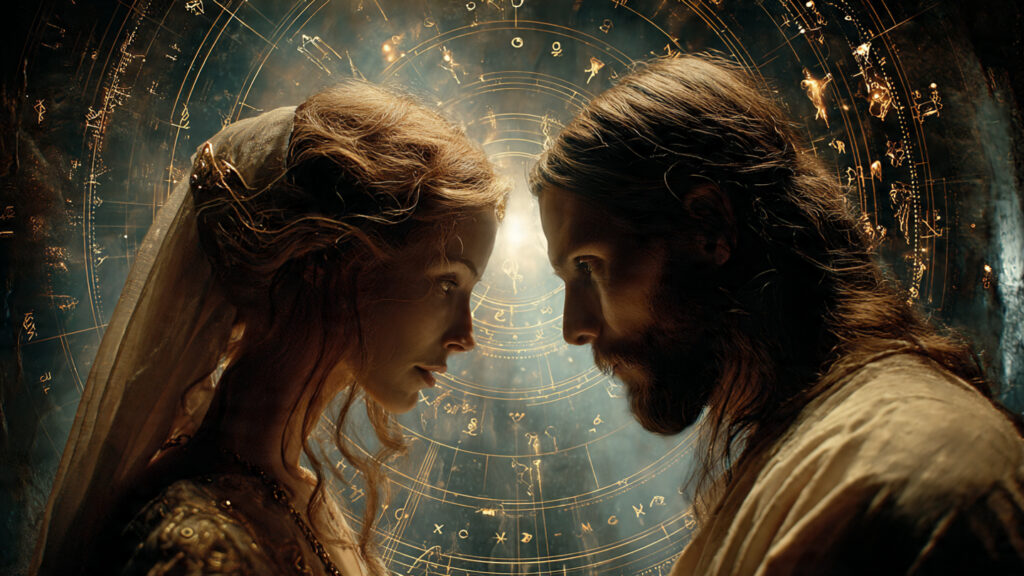
The Gospel of Philip gives Mary Magdalene an unusually prominent position. It describes her as a companion of Jesus and associates her with forms of spiritual knowledge and transmission that are central to the text.
Then the manuscript breaks.
The famous passage concerning Jesus kissing Mary contains a missing word. Scholars can debate what the lost word may have been, but the manuscript itself cannot tell us.
That makes it a perfect example of the difference between evidence and imagination. The gap is real. The possibilities are real. The certainty is not.
The later Western identification of Mary Magdalene with a repentant prostitute is also historically significant, particularly because Pope Gregory I made that identification explicitly in 591 CE despite the canonical Gospels never identifying her as such. But that historical development should not be turned into proof that the Gnostic account was secretly correct. It is evidence of a later interpretive tradition changing the way one of Christianity’s most important women was remembered.
The Strange Case of the Sacred Vowels
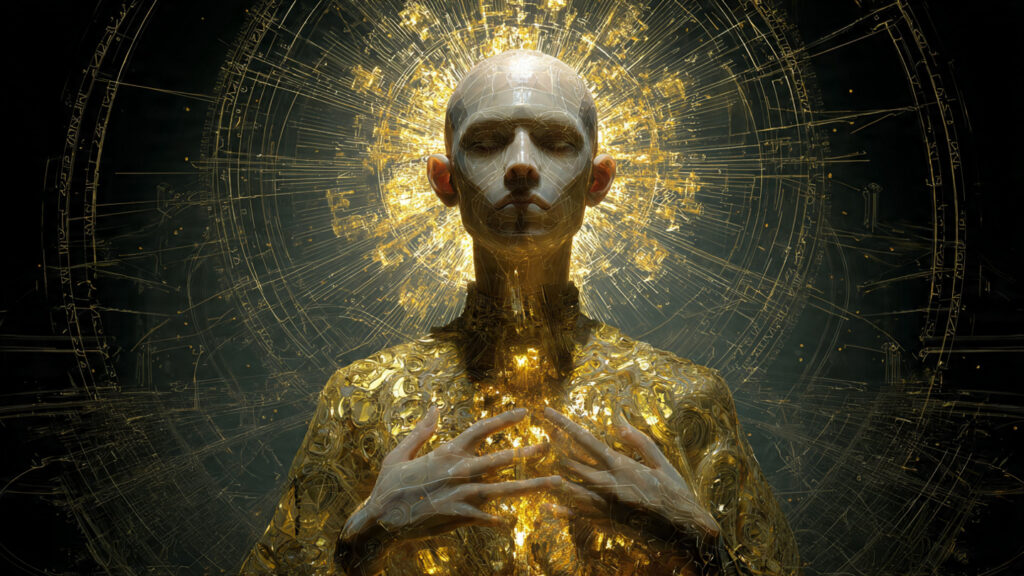
Several texts in the Nag Hammadi collection preserve sequences of vowels and other vocal elements associated with divine names, praise, ascent and ritual contexts. Similar ideas appear elsewhere in late-antique religious traditions, where sacred sounds were sometimes treated as more than ordinary language.
Later traditions associated the seven Greek vowels with the seven planetary spheres and with the soul’s ascent through the cosmos. Whether such practices were understood as producing an objective effect on consciousness or functioned primarily as ritual language is much harder to establish.
That uncertainty is worth preserving because it points toward one of the deeper features of the Gnostic world: knowledge was not always conceived as something that could simply be read in a book. It could be something enacted, remembered, spoken, experienced or recognized.
What Survived
The Nag Hammadi codices were probably buried in the late fourth century. They were hidden for centuries and eventually recovered in 1945. Their preservation transformed what scholars could say about several currents of early Christianity because the traditions could finally be studied through their own texts rather than exclusively through the descriptions of their critics.
That alone would make Nag Hammadi one of the great manuscript discoveries of the modern era.
But the collection has acquired another life because its cosmology keeps producing modern echoes.
A world that is not ultimate reality. A creator who is not the highest intelligence. Administrators operating inside a larger structure. Human beings who do not understand their own condition. A hidden origin. Liberation through recognition.
Those ideas now sound surprisingly familiar.
They sound familiar because modern philosophy and science have independently developed questions that sometimes occupy similar conceptual territory. But similarity is not transmission, and similarity is not proof.
The Gnostics did not need to have predicted the simulation hypothesis for their cosmology to remain extraordinary. They constructed, in the language available to them, one of the most radical alternatives to ordinary reality ever produced by the ancient religious imagination.
Marcion and the broader second-century Gnostic revolt is covered separately and in more depth elsewhere in this library.

The Question the Jar Leaves Behind
There are two very different ways to read Nag Hammadi.
The first is to dismiss the texts as ancient mythology and move on. The second is to treat them as evidence that an ancient civilization somehow discovered the true architecture of reality and encoded it in theological language.
Neither response is justified by the evidence.
The more interesting position lies between them.
The texts are real. Their cosmologies are real historical artifacts. Their authors were asking serious questions about consciousness, creation, ignorance, identity and liberation. Modern thinkers are asking some of the same questions, sometimes using radically different intellectual tools.
Whether the resemblance tells us something profound about reality, something profound about the structure of human imagination, or both, remains unresolved.
And perhaps that is the most appropriate conclusion for a library whose central concept was gnosis.
The important question was never simply whether information had been hidden.
It was whether knowing something changes what the knower is.
The jar was buried for sixteen centuries. The texts survived. The questions survived with them.
We still don’t know whether the universe is constructed, whether consciousness originates somewhere beyond the material world, or whether the ancient Gnostic cosmology was anything more than a remarkably elaborate answer to those questions.
But the fact that human beings were asking them nearly two thousand years ago is itself part of the story.