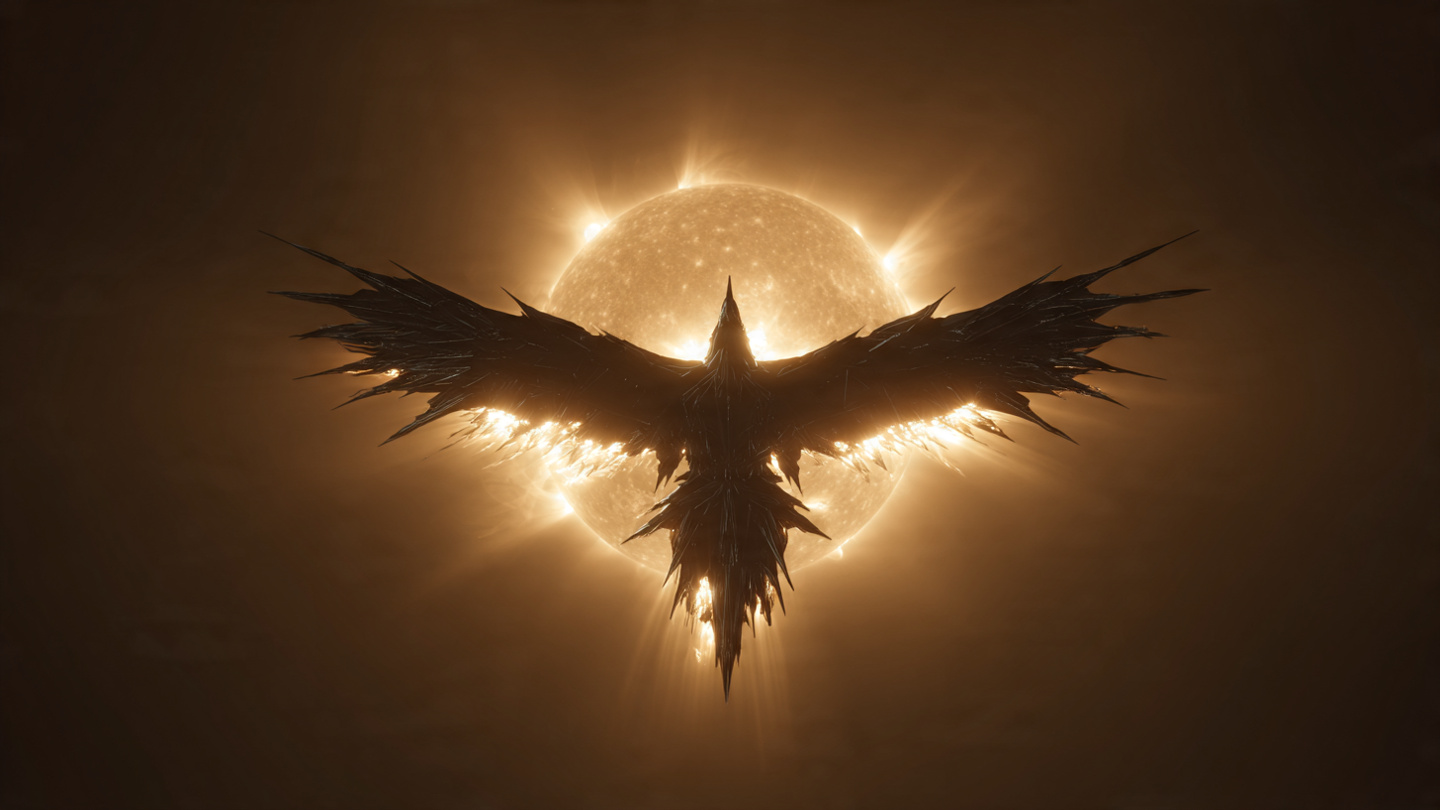
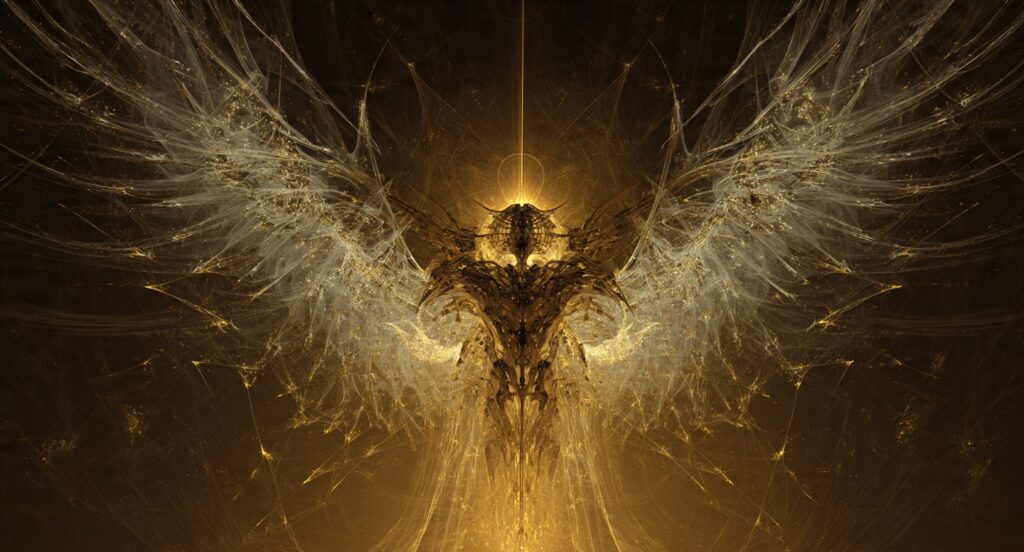
The image is real. The Russian research institute that published it is real. And the strange bird-shaped feature really did appear in SOHO’s LASCO imagery on February 2, 2026, after a remarkably similar image had appeared on May 24, 2025. But there is a crucial distinction between those facts and the claim now circulating online: there is no evidence that a gigantic physical object ten times the diameter of Earth was flying above the Sun.
The apparent size was conditional on treating the entire visual feature as a physical object. LASCO’s own documentation warns that its images can contain artifacts produced when high-energy particles strike the detector, and scientists have spent decades studying exactly this kind of contamination. In the February 2026 case, researchers at Russia’s Space Research Institute discussed a rare particle event among the possible explanations, another Russian astronomer proposed a sungrazing comet as an alternative. Neither explanation requires an alien craft, a solar phoenix, or a machine emerging from the Sun. More importantly, neither has to be invented after the fact. The instrument has a long scientific record of producing spectacular images from real particles, comets, solar plasma and detector effects.
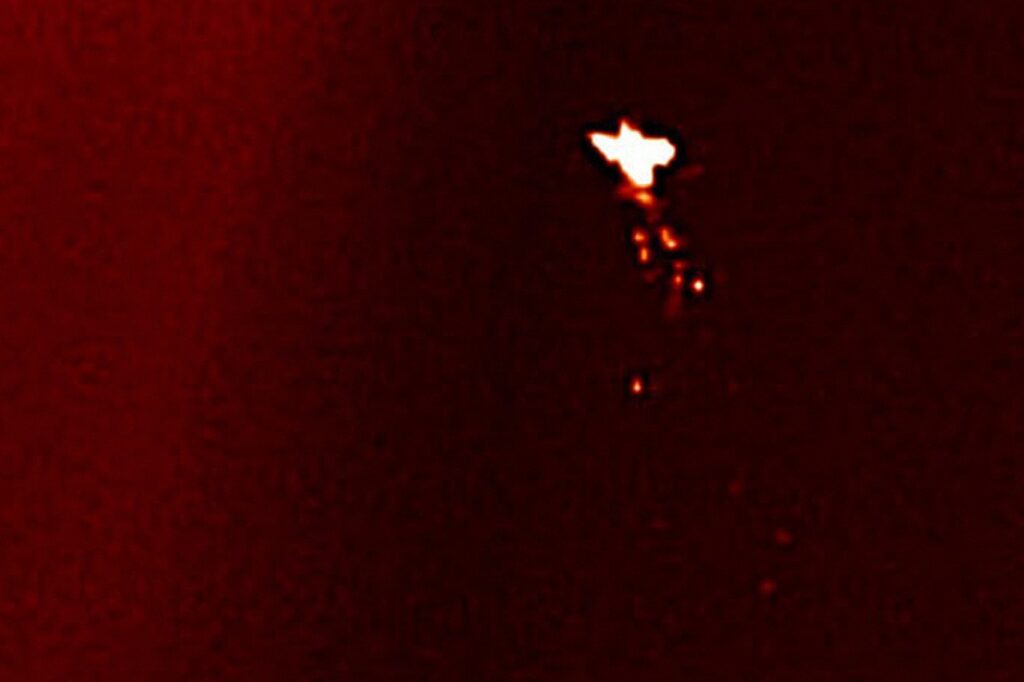
Photo: © Laboratory of Solar Astronomy of the Space Research Institute of the Russian Academy of Sciences
What LASCO Actually Saw
The first thing to understand is what the instrument is actually photographing. The Large Angle and Spectrometric Coronagraph, or LASCO, is one of the principal instruments aboard the Solar and Heliospheric Observatory, the joint NASA-ESA spacecraft launched on December 2, 1995. SOHO operates near the Sun-Earth L1 point, and LASCO uses an occulting disk to block the overwhelming brightness of the solar surface so that the much fainter corona can be observed. The C2 coronagraph covers the region relatively close to the Sun, while C3 extends much farther outward.
That design is precisely what makes LASCO so useful, and so visually deceptive to anyone unfamiliar with coronagraph data. The camera does not produce a conventional photograph of objects floating against an ordinary black sky. It records extremely faint light surrounding an occulted Sun. The field can contain coronal streamers, eruptions, planets, stars, comets, spacecraft debris and detector artifacts. NASA’s own LASCO documentation explicitly lists high-energy particles hitting the detector among the causes of anomalous features.
And LASCO is extraordinarily sensitive to genuine objects as well. SOHO has discovered more than 5,000 comets, most of them previously unknown, because its coronagraphs are unusually well positioned to see sungrazing comets approaching the Sun. So when something strange appears in a LASCO frame, “it’s an artifact” is not automatically the answer. The instrument can show real celestial objects too.
The “Ten Times Earth” Number Needs an Asterisk
The viral statistic sounds definitive: the “bird” was more than ten times the size of Earth. But that is not what the instrument measured.
The Russian Solar Astronomy Laboratory estimated that the apparent feature extended roughly 150,000 kilometers and was located around two million kilometers above the Sun’s surface. The comparison with Earth’s diameter, about 12,700 kilometers, was explicitly conditional: if the image represented a physical object rather than an optical or instrumental phenomenon, its apparent dimensions would be more than ten times Earth’s diameter.
That “if” is the entire story.
A measurement made from an image is not automatically a measurement of a physical object. Before calculating the dimensions of something in a photograph, you have to establish what the thing is. If the feature is a detector artifact, there is no ten-Earth-size object to measure. If it is a comet and its tail, the apparent structure is not the physical diameter of a solid body. If it is solar plasma, the geometry belongs to a transient magnetic structure. The number therefore tells us how large the feature appears in the image, not how large an unknown spacecraft actually is.
The May 2025 “Firebird” Was the First Warning
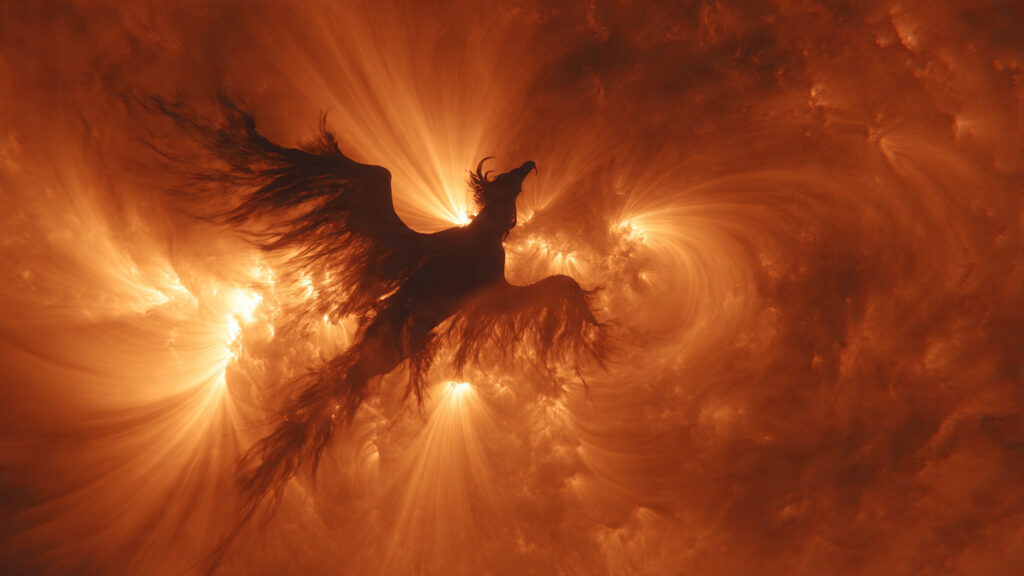
The February 2026 image was not the first time LASCO produced this particular kind of visual astonishment. On May 24, 2025, the Solar Astronomy Laboratory published an image that appeared to show a huge bird or aircraft with a fiery trail. Again, the apparent feature was described as roughly 150,000 kilometers across and about two million kilometers above the Sun. The image rapidly became an internet sensation.
But the May case also illustrates why visual resemblance is not identification. Astronomer Alexander Kiselyov argued that the image could instead represent a sungrazing comet passing close to the Sun and undergoing violent evaporation or fragmentation. Sungrazing comets are not theoretical objects invented to explain strange photographs. SOHO has found thousands of them, and LASCO is one of the world’s most productive instruments for discovering them.
The February 2026 event generated a different leading possibility among researchers: a rare cosmic-particle interaction with the detector. The important word is possibility. The public evidence does not justify rewriting the event as conclusively solved when the researchers themselves were still discussing alternatives.
Why a Particle Strike Is Such a Serious Possibility
This is where the story becomes much more interesting than a generic “optical illusion” explanation.
LASCO’s CCD detectors have been recording the effects of energetic particles for decades. A 2018 peer-reviewed study in Monthly Notices of the Royal Astronomical Society examined cosmic-ray spallation events recorded by LASCO during SOHO’s long mission. The researchers described images containing diverging linear tracks that converge on individual pixels, signatures created when high-energy particles interact with the silicon CCD. They also noted that LASCO imagery routinely records dots and tracks produced by energetic particles and that major solar flares and coronal mass ejections can generate the famous “snowstorm” appearance in the detector.
That is not speculation based on the February image. It is a published history of the instrument.
The physics also fits the environment. On February 1-2, 2026, the Sun was experiencing an unusually active period, including an X8.1 flare late on February 1, an X2.8 flare shortly afterward and an X1.6 flare on February 2. Solar energetic particles associated with major solar events are precisely the sort of radiation that can contaminate spacecraft detectors.
That makes a detector event entirely plausible. It does not, by itself, prove that the bird-shaped image was caused by one particular particle. The scientifically honest conclusion is narrower: the instrument has a known mechanism capable of generating transient anomalous features, and the February observation occurred during conditions in which energetic-particle contamination was especially plausible.
But There Is Another Problem With the “Giant Object” Interpretation

The visual feature was reported as appearing in a single frame and not being present in the surrounding imagery. That is exactly the sort of behavior that should make investigators cautious about interpreting the shape as a persistent macroscopic body.
A real comet can move rapidly. A fragment can brighten or break apart. Solar plasma can evolve dramatically. A detector can register a particle in one exposure and not the next. All of those possibilities exist. But the existence of a striking silhouette in one frame does not provide the missing information needed to distinguish among them.
This is why the surrounding sequence matters more than the enlarged still image. A single frame is where pareidolia is strongest: the human visual system is exceptionally good at finding familiar shapes in noise. Give a random structure two wings and a bright trail, and the brain supplies the bird. Give it a date from the Cold War, and the internet supplies the spacecraft.
The Instrument Itself Tells Us What Can Go Wrong
There is something almost poetic about the fact that LASCO has been watching the Sun continuously for three decades. The spacecraft was launched in 1995 and originally had a much shorter planned mission life. Instead, SOHO survived repeated technical problems, remained operational near L1 and became one of the most productive solar-observing platforms ever flown. NASA now describes it as the longest-lived Sun-watching satellite, with LASCO among its most important instruments.
But a three-decade-old instrument operating in space is not a perfect cosmic camera. It is a detector exposed continuously to radiation, spacecraft debris, energetic particles, stray light and the complicated optical environment created by a coronagraph. Its images are enormously valuable precisely because scientists understand those limitations and know how to interpret them.
That is the paradox at the center of the “solar bird.” The same instrument that makes the photograph possible also supplies reasons to distrust the most literal interpretation of what the photograph appears to show.
What the Russian Scientists Actually Claimed
The distinction between the laboratory’s words and the internet’s words is important. The Russian Solar Astronomy Laboratory described the May image as beautiful and somewhat mysterious and explicitly entertained the possibility that it could be a galactic particle. In other words, the institution that released the striking image did not announce the discovery of an extraterrestrial vehicle. The uncertainty was part of the original story.
The February 2026 reporting was similarly cautious. Sergei Bogachev of the Space Research Institute described the feature as one of the rare forms that occasionally appear in orbital telescope imagery and said the scientific question was whether it represented unusual noise or a real physical object. That is a legitimate research question. It is not a declaration that a ten-Earth-diameter object had been discovered above the Sun.
This distinction is easy to lose once an image leaves a scientific institution and enters social media. “Scientists don’t yet know exactly what caused this unusual frame” becomes “scientists discovered an unexplained object.” “An unexplained object” becomes “a mysterious spacecraft.” And “spacecraft” eventually becomes “proof of an ancient solar prophecy.” Each step sounds only slightly different from the one before it. By the end, almost none of the original uncertainty remains.
So Was It a Comet, a Particle, or Something Else?
Based on the evidence currently available, the responsible answer is: we should not pretend the public record has established one definitive identification.
A high-energy particle striking the CCD is a strong candidate because LASCO has a documented history of recording exactly this class of detector event, and the February sighting occurred during intense solar activity. A sungrazing comet is another plausible natural explanation because LASCO routinely discovers comets near the Sun and the May 2025 image was publicly interpreted in precisely that direction by astronomer Alexander Kiselyov. Solar plasma or another optical or instrumental effect cannot simply be ruled out from the viral still image alone.
What the evidence does not establish is a solid object ten times Earth’s diameter. It does not establish propulsion. It does not establish extraterrestrial origin. It does not establish an intelligent craft. And it certainly does not establish that the Sun has produced some kind of mechanical “herald.”
The Image Was Real. The Object Was an Interpretation
The viral version of the story asks a spectacular question: What was the enormous bird-shaped spacecraft flying above the Sun?
The scientific version asks a better one: What produced this extraordinarily unusual signal in a camera that has been watching the Sun continuously for thirty years?
That question is still worth asking. In fact, it is more interesting precisely because there are several legitimate possibilities. A cosmic ray can leave a physical signature in a CCD. A sungrazing comet can survive long enough to appear as an astonishing structure before breaking apart. Solar plasma can be sculpted by magnetic fields into shapes that look almost deliberately designed. And a detector can turn an invisible particle interaction into a visible object that looks, for one frame, like something from mythology.
The “bird” was real as an image. The ten-Earth-size object was an interpretation.
That distinction is the entire mystery. The Sun did not need to produce a spaceship to create one of the strangest photographs of 2026. It only needed a thirty-year-old spacecraft, an extraordinarily sensitive detector, an unusually active star and one frame that happened to make noise look like wings.
And sometimes that is the genuinely uncanny part of astronomy: the universe does not have to be hiding something artificial to produce an image that looks as though it was designed.