



The Solar and Heliospheric Observatory has been watching the Sun continuously since 1996. The Solar Dynamics Observatory has been watching it in high resolution since 2010. Between them, the two instruments have produced the most comprehensive continuous record of solar activity ever compiled, covering every wavelength from extreme ultraviolet to visible light, at resolutions and frame rates that reveal detail invisible to ground-based observation.
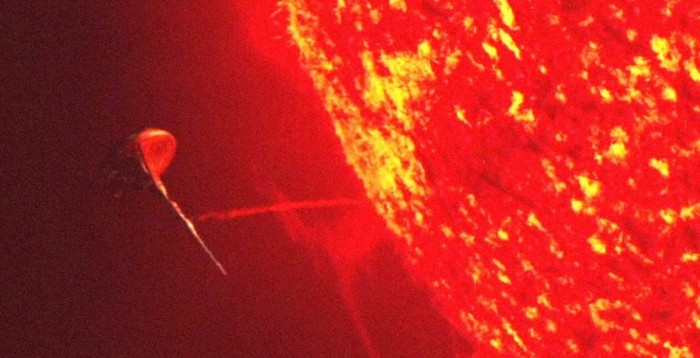
In the course of producing this record, both instruments have documented objects near the Sun that do not correspond to any category in the standard solar observation taxonomy.
The standard categories are well established. Sungrazing comets, particularly the Kreutz group family derived from the break-up of a large progenitor comet over thousands of years, fall into the Sun on predictable orbital trajectories. SOHO has discovered more than three thousand of them. Their behavior is consistent: they accelerate as they approach under the Sun’s gravity, they brighten as their volatiles sublimate in the increasing heat, and they either disintegrate before impact or collide with the solar surface in a predictable final arc. Solar prominences are arcs of magnetized plasma extending from the solar surface, following magnetic field lines and falling back to the surface on predictable timescales. Solar flares are explosive releases of energy from magnetic reconnection events in the corona. Each of these phenomena has a characteristic signature in the imaging data that trained analysts identify reliably.
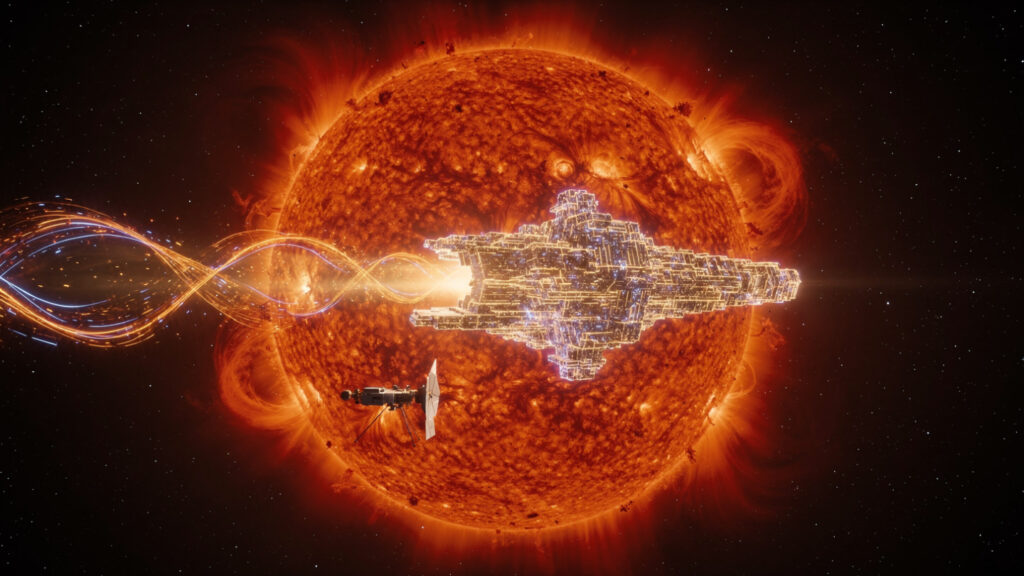
The anomalous objects are those that do not follow these signatures. Objects that maintain consistent velocity in the solar environment rather than accelerating under the Sun’s gravity. Objects that appear to exit the solar corona rather than entering it on a terminal trajectory. Objects that appear at positions inconsistent with any known comet family orbit. Objects that produce no brightening response to the increasing solar proximity that destroys comets.
These objects exist in the SOHO and SDO record. The institutional response to them has been consistent: attribution to instrumental artifacts, camera effects, cosmic ray hits on the detector, or misidentified known phenomena. Some of these attributions are accurate. The ones that have been attributed to instrumental artifacts without instrumental analysis identifying which artifact mechanism produced the observed signature are in a different category.
What SOHO Has Actually Found
The Kreutz group comets are the baseline against which the genuinely anomalous objects need to be distinguished. SOHO’s discovery of more than three thousand Kreutz comets has established the most comprehensive catalog of sungrazing objects in the history of astronomy. The catalog is one of SOHO’s most significant scientific contributions: before continuous solar monitoring, most Kreutz comets fell into the Sun unseen.
The catalog also establishes what a known cometary object looks like in SOHO’s coronagraph imagery. The angular velocity increases as the object approaches. The brightness increases dramatically as the ice and volatile compounds sublimate. The object follows a smooth curve consistent with a gravitationally determined orbit. The tail points away from the Sun at all points in the trajectory. The object does not decelerate. It does not change direction. It does not exit the corona.
The anomalous objects in the SOHO record do not show these characteristics. The most frequently documented category shows objects near the Sun that maintain consistent apparent velocity over multiple frames rather than showing the gravitational acceleration of a sungrazer on a terminal trajectory. Others show objects that appear on one side of the solar disk and exit on the other side, following a path that passes through the corona in a transit pattern rather than a fall pattern.
The transit pattern is the most significant anomaly because its implications are the most specific. A transit pattern implies that the object enters the corona from outside, passes through it, and exits on the other side. This is not what comets do. This is not what solar prominences do. This is not what any known solar phenomenon does. A transit pattern implies an object that is moving independently through the solar environment rather than being controlled by the Sun’s gravity.
The formal analysis that would determine whether the transit pattern objects represent genuine anomalies or systematic instrumental artifacts has not been published by any institution with access to the full resolution, multi-wavelength data that both SOHO and SDO collect.

The Parker Probe’s Findings
The Parker Solar Probe was launched in August 2018 with the primary mission of studying the solar corona in situ for the first time in the history of space exploration. It reached a perihelion distance of approximately 6.9 million kilometers from the Sun’s surface in 2021, well within the outer corona, and has continued setting proximity records on each successive orbit.
The probe’s findings have produced several results that were unexpected in the context of the existing solar physics model.
The switchbacks. The probe documented magnetic field reversals in the solar wind that occur at a frequency and in a configuration that the pre-mission models did not predict. These switchbacks, as the researchers called them, are brief reversals of the magnetic field direction in the solar wind stream, associated with localized increases in solar wind velocity. Their origin remains a topic of active research. The proposed mechanisms include magnetic field reconnection in the corona and Kelvin-Helmholtz instabilities at the boundary between different solar wind streams. The frequency at which they occur in the probe’s data suggests that the corona is more magnetically complex and more energetically active than the model predicted.
The coronal heating problem. The Sun’s surface temperature is approximately 5,500 degrees Celsius. The corona, the outer atmosphere extending millions of kilometers above the surface, is between one million and three million degrees Celsius. The mechanism by which the corona is heated to temperatures hundreds of times higher than the surface below it is one of the most significant unresolved problems in solar physics. The Parker Probe’s close-in measurements have confirmed the temperature discrepancy and have provided new data on the thermal structures within the corona, but have not resolved the fundamental mechanism question.
The significance of the coronal heating problem for the anomalous object discussion is specific: an environment whose energetic properties are not fully characterized by the current model is an environment in which anomalous observations may reflect genuine physical phenomena rather than instrumental artifacts. The corona’s unexplained energetics establish that the solar environment contains processes that the current model does not fully describe.
Nassim Haramein’s Framework
Nassim Haramein is a Swiss-American physicist whose work on the application of black hole physics to all scales of physical structure, from subatomic particles to galactic superclusters, was published in the peer-reviewed journal Physics of Particles and Nuclei Letters in 2013. The paper presents a unified field model in which the proton’s size and mass are accurately calculated using a black hole framework rather than the standard model’s quark structure approach.
The paper’s contribution, that the measured charge radius of the proton is accurately predicted by treating it as a black hole, has been verified against experimental measurements and produces a match that the standard model’s approach had not achieved. The paper has been cited by subsequent researchers and represents Haramein’s strongest case for the physical validity of his broader framework.
His broader framework extends this black hole model upward through all scales: atoms, cells, planets, stars, galaxies, and the universe itself all contain black holes at their organizational center that drive their rotation, their energy output, and their structural coherence. In this framework, the Sun’s core is not a nuclear fusion reactor in the conventional sense. It is a black hole whose rotational dynamics drive the fusion processes occurring at the boundaries between the core and the surrounding plasma.
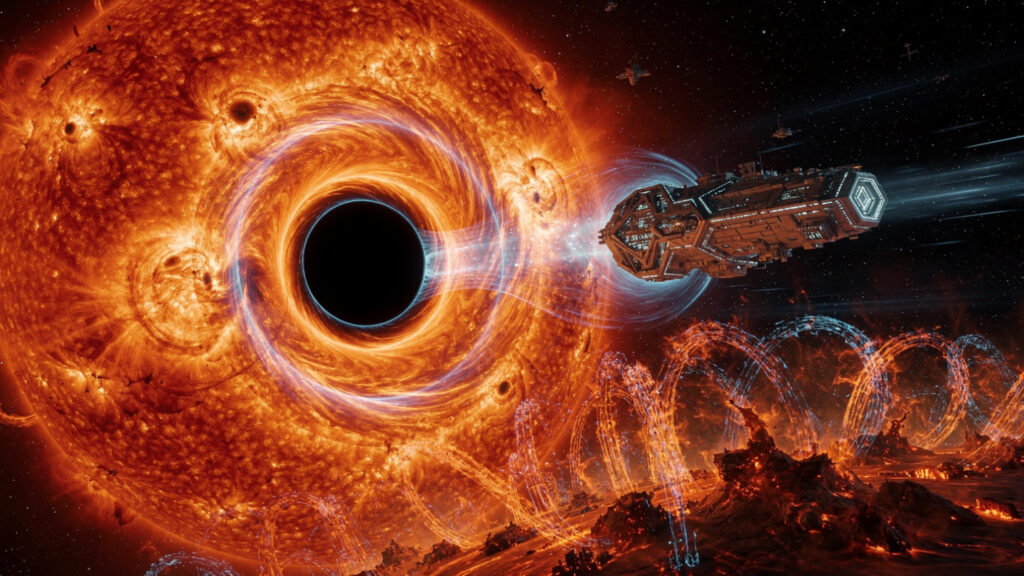
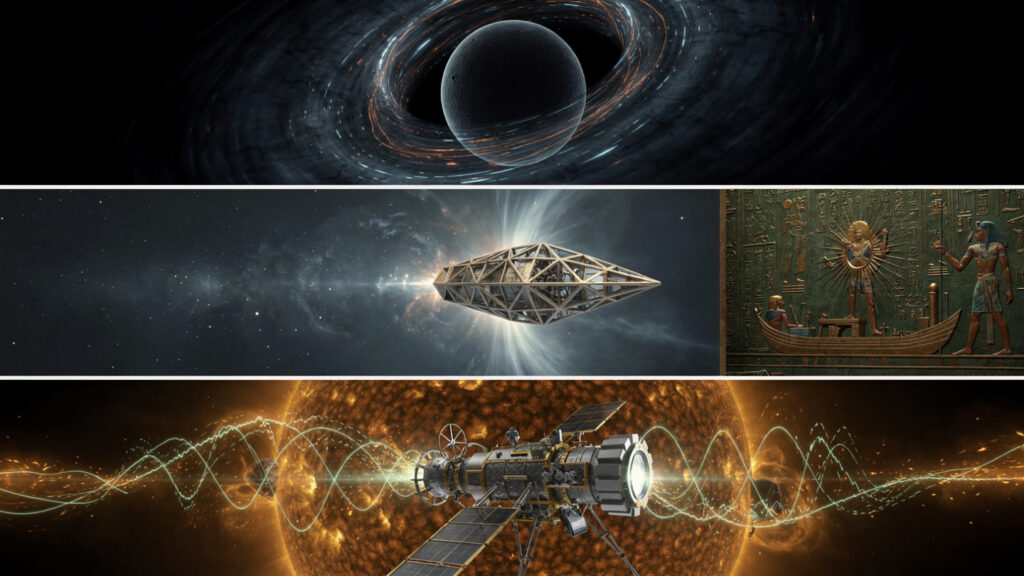
Sunspots, in Haramein’s model, are windows into this black hole core: regions where the magnetic field configuration allows material to be drawn toward the core rather than being supported by the outward pressure of the fusion reactions. Under magnetic field conditions, the sunspot region becomes a wormhole: a connection through spacetime to another location in the universe, allowing transit in both directions.
The wormhole physics underlying this claim is not fringe science. It is an application of general relativity that has been formally explored since Einstein and Rosen published the theoretical framework for what became known as Einstein-Rosen bridges in 1935. The conditions required to stabilize a wormhole against collapse are still debated in the theoretical physics literature, with exotic matter with negative energy density being the most commonly proposed requirement. Whether sunspots meet these conditions is not established. That the theoretical framework for stellar wormholes exists in accepted physics is established.
Haramein’s claim, that advanced civilizations use stellar black holes and wormholes as transit points for interstellar and intergalactic travel, is a logical extension of his framework that cannot be evaluated independently of the framework’s validity. If the framework is correct, the transit claim follows directly. If the framework is incorrect, the transit claim is unsupported.
The framework’s prediction for the proton charge radius has been experimentally confirmed. The prediction’s accuracy does not validate the entire framework, but it establishes that the framework is not internally inconsistent with physical measurement at the scales where it has been tested.
What the Ancient Traditions Were Describing
The Egyptian solar theology recorded in the pieces on this site’s Egypt cluster treated the Sun not as a passive luminous object but as an active cosmic mechanism through which divine entities traveled to and from the terrestrial world.
The solar barque, the vessel in which Ra traveled through the sky and through the underworld during the night, is not a poetic metaphor for the Sun’s daily path. It is a theological statement about the Sun as a vehicle, a craft capable of directed travel, operated by entities who used it as a means of transit between the terrestrial realm and the divine realm. The Pyramid Texts describe the pharaoh ascending through the Sun to reach the divine world and describe solar vessels carrying divine entities. The language is of transit through the solar body rather than simple proximity to it.
The Maya Long Count calendar’s most discussed endpoint, the alignment of the Earth, Sun, and the galactic center on December 21, 2012, reflects a tradition of understanding the Sun as a node in a larger cosmic network rather than an isolated stellar object. The galactic center alignment is a recorded astronomical fact: due to the precession of the equinoxes, the winter solstice Sun was aligned with the galactic equator in this period, an alignment that occurs approximately once every 26,000 years. The Maya calendar encoded this alignment as a significant transition point in cosmic time.
The understanding that the Sun occupies a cosmologically significant position in the galactic structure, and that this position has implications for the relationship between the solar system and the broader galactic organization, is present in multiple independent ancient traditions. The Vedic tradition’s description of the Sun as a gateway between worlds. The Egyptian tradition’s solar barque and the divine entities who use it. The Maya tradition’s encoding of galactic alignment. The Greek tradition’s Apollo as the solar deity who moves between the divine and human realms.

These traditions are not evidence that the Sun is a stargate in the technical sense that Haramein’s physics describes. They are evidence that multiple independent ancient civilizations developed a conceptual framework for the Sun as a transit point for entities moving between different realms of existence, and maintained that framework over long periods as a central element of their cosmological understanding.
Whether the framework reflects genuine ancient observation of anomalous solar phenomena, transmission from a source with knowledge of solar physics, or a universal archetypal pattern in human cosmological thinking, its convergence with the anomalous SOHO imagery and the Haramein framework is a correspondence that the monkeyandelf standard treats as worth examining rather than dismissing.
The Rocca Pia Precedent
The Rocca Pia contact case in Italy is one of the most extensively recorded long-term contact cases in the European research record. Beginning in 1956 and continuing for approximately thirty years, a group of Italian citizens in the region of Abruzzo reported sustained contact with entities who identified themselves as belonging to an underground civilization that had been present on Earth for thousands of years. The case appears in the work of researcher Roberto Pinotti and in the account collected by Stefano Breccia in Mass Contacts, published in 2009.
The entities described their underground bases in dimensions: 300 by 300 kilometers in extent, 150 kilometers in height, large enough that meteorological phenomena including precipitation occurred within the enclosed space.
Scott Waring cited the Rocca Pia case in his development of the hollow sun theory, using the scale of the described underground bases as a reference point for the kind of engineering that a sufficiently advanced civilization could achieve. The connection between a reported underground base and a hypothesis about the Sun’s interior is logically thin. But the Rocca Pia case itself, whatever the interpretation applied to it, is a recorded long-term contact case with multiple witnesses, physical evidence including photographs and material samples, and a research record that predates the internet and cannot be attributed to social media confabulation.
The entities in the Rocca Pia contact described themselves as having continuous access to underground locations on Earth, as having technological capabilities significantly beyond the current human level, and as having knowledge of solar physics and cosmic structure. Whether these descriptions are accurate, embellished, or fabricated is not established. They are documented testimony from a named case with named witnesses and named researchers.
The Convergence
Three separate lines of evidence point toward the same general conclusion about the Sun’s possible function as a transit point for intelligent entities.
The SOHO and SDO imagery contains objects that do not correspond to known solar phenomena and have not been formally analyzed with the rigor required to definitively attribute them to instrumental artifacts.
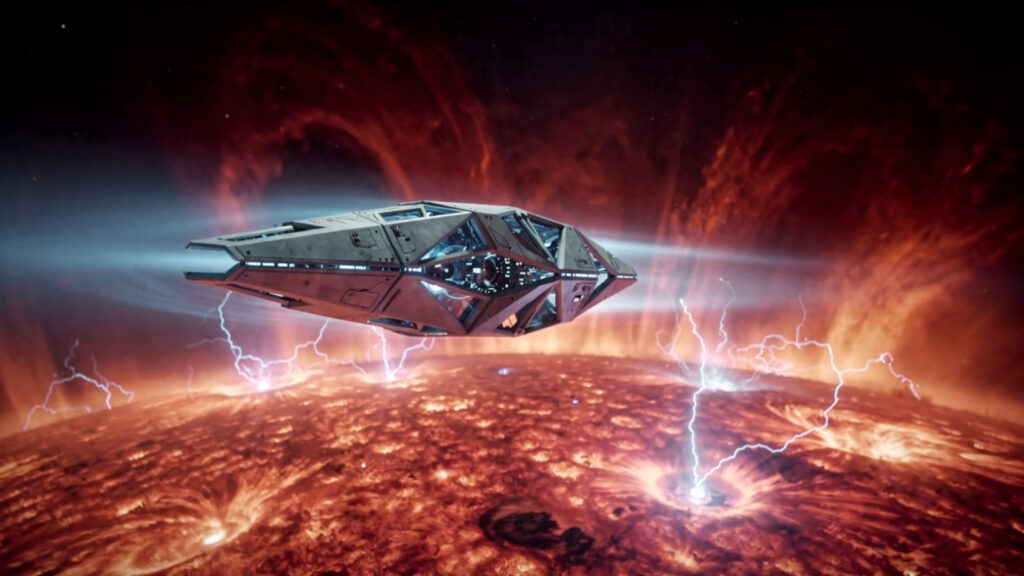
Haramein’s published physics provides a theoretical mechanism, sunspot wormholes driven by the solar black hole core, that accommodates both the transit pattern objects and the coronal heating anomaly documented by the Parker Probe.
The ancient traditions of multiple independent civilizations describe the Sun as a transit point for divine or non-human entities, maintaining this framework as a central cosmological element across thousands of years without apparent cross-cultural contamination.
None of these three lines of evidence is individually conclusive. The imagery anomalies have not been formally analyzed. Haramein’s framework extends significantly beyond its experimentally validated components. The ancient traditions may reflect archetypal cosmological thinking rather than literal historical observation.
Their convergence is the data point. Three independent approaches from different methods and different periods arriving at the same conceptual framework for the Sun’s function is not the kind of convergence that the null hypothesis, independent error or fantasy in all three cases, explains without requiring an additional element.
The Parker Probe is orbiting through the solar corona taking measurements that no previous instrument reached. The SOHO and SDO archive contains decades of imagery that has not been systematically analyzed for non-cometary anomalies using the statistical methods available to current researchers. Haramein’s framework is published and peer-reviewed at its foundational level.
The formal investigation that would resolve the question of whether the anomalous solar imagery represents known phenomena misidentified or something requiring a new category has not been conducted. The institutions that hold the imagery data have the capability to conduct it. Whether they have the institutional interest to publish the results of such an investigation is a separate question whose answer would itself be informative.
The Sun has been watched continuously for thirty years. What has been seen in that time that does not fit the standard model of solar physics has not been systematically published.